Key Takeaways
- Photo intake forms eliminate wasted truck rolls. Customers describe the job and upload photos. You assess scope remotely before committing a tech.
- Vision AI identifies materials, condition, complexity, and flags edge cases. Preliminary quote ranges generate in hours, not days.
- Technicians arrive prepared. Right parts, right tools, right expectation. Fewer surprises on site mean fewer callbacks and faster close.
- Close rates jump when customers get quotes in hours instead of waiting days for a callback.
Every Truck Roll Starts with Blindness
You get a call. "I need my kitchen backsplash done." You send a tech. The tech arrives to find tile removal is more complex than expected. Original quote doesn't cover the work. Call back to the office. Customer gets a revised estimate three days later. Job is already gone.
This is the home service quoting penalty. You roll the truck to assess. Assessment takes time. Scope surprises happen on site. Every wasted trip costs you fuel, time, and revenue.
Process beats ego. The process that prevents wasted rolls is assessment before dispatch.
The Pre-Visit Assessment Pattern
I learned this principle on a nuclear submarine. Every casualty drill starts the same way: damage assessment before any repair team moves. You don't send people blind. You evaluate the damage first. You report what you found. Then you act.
Home service quoting follows the same logic. The customer has a problem. Before you send a tech to fix it, assess what you are actually fixing. Assessment beats guessing.
The ATLAS Model for Growth puts assessment first in any scaling initiative. Assess the current state. Target the desired state. Lay out the process. Act. Score the results. Assessment is the first step. Without it, you optimize the wrong things.
AI pre-visit assessment uses the same discipline. The customer describes the job. The customer uploads photos. Vision AI analyzes what it sees. You get a preliminary scope and quote range before the truck leaves the yard.
How Vision AI Reads Pre-Visit Photos
The system works like this.
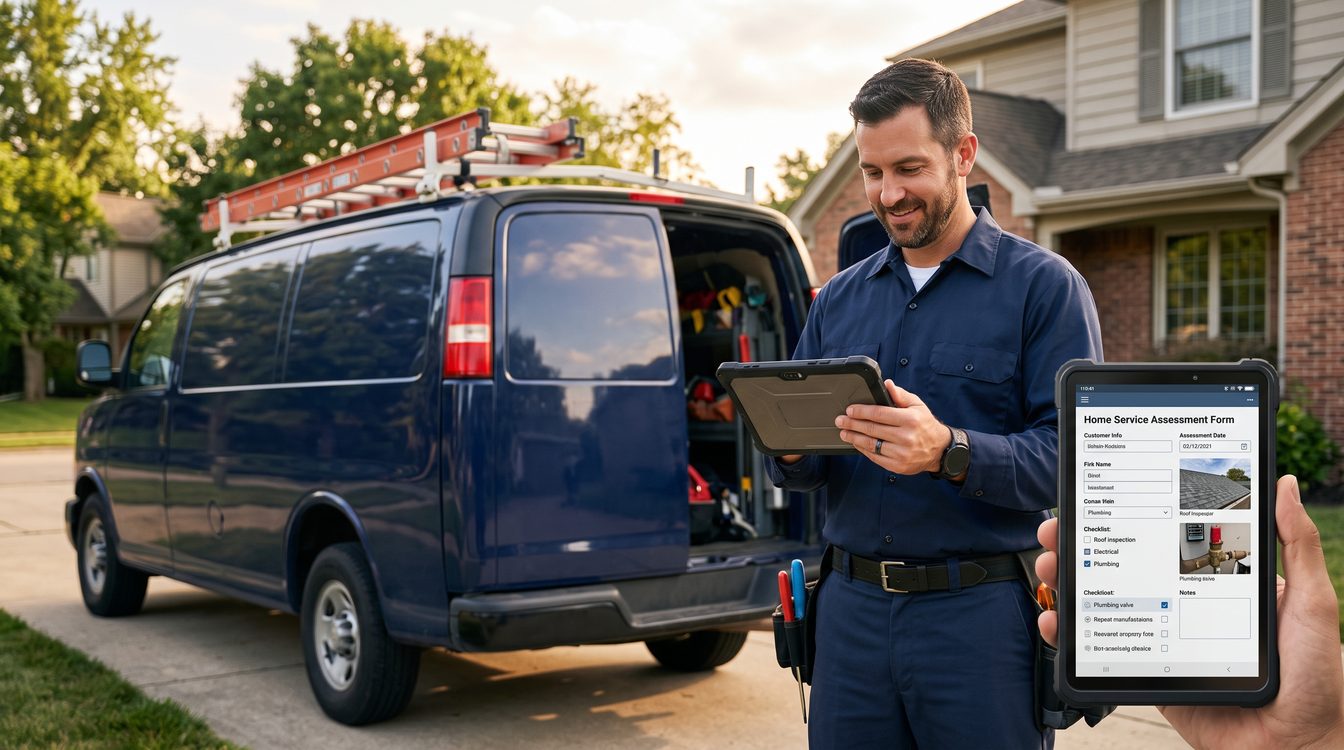
Step one: photo intake form. Embed a Typeform or GHL form on your website. Customer describes their job in plain language. Customer uploads 3 to 5 photos from different angles. No special gear required. Phone camera is enough.
Step two: vision AI processes the images. GPT-4V or Claude reads the photos. The AI identifies materials, condition, and complexity. It flags damage you cannot see in the photo. It estimates scope from visual context clues. It assigns a confidence score to each finding.
Step three: preliminary quote generation. The AI maps its findings onto your price book. It generates a quote range, not a fixed price. This range gives the customer realistic expectations and tells them you know the trade.
Step four: edge case flagging. If the AI is uncertain about structural issues, hidden damage, or complexity, it flags those items. Your senior tech reviews the flagged items and decides if a site visit is needed before quoting.
Step five: customer communication. The customer gets a preliminary quote in hours. The quote includes a list of what you assessed and what you still need to verify on site. The customer feels heard. The customer sees you are thorough.
Step six: technician dispatch. Your tech arrives with a printed scope document. The tech has already ordered the right parts. The tech knows what to expect and what to look for. Fewer surprises. Fewer callbacks.
The ROI: 60 Percent Faster Quoting, 25 Percent Fewer Wasted Rolls
The numbers compound fast. QuoteIQ reports 40,000 contractors now preview job sites before dispatch. QuoteIQ's street-view feature lets estimators spot access issues, material conditions, and obstacles before sending a crew. Wasted drive-outs drop by a quarter.
Quoting speed improves because you eliminate the back-and-forth. Customer uploads photos. AI generates a draft scope. Senior tech reviews the draft and approves it. Formal quote goes out same day. No waiting for a tech callback. No days of administrative lag.
Close rates jump because speed kills. SnapScope AI reports that contractors who send quotes the same day close 15 percent more jobs than contractors who quote after a site visit. Speed wins. The first contractor to send a quote usually gets the job.
Ticket value stays high. The preliminary quote range sets customer expectation before you arrive. When the final quote lands on site or the next morning, the number does not shock. Customer approval happens faster because they already know the range.
Implementation: Tech Stack and Integration
You don't need a custom platform. Build this from existing tools.
Photo Intake: Typeform or GHL form. Both let you collect photos and structured data. Both integrate with Zapier. Cost: free to $99 per month.
Vision AI: Inoscope or SnapScope have photo-to-estimate built in. Or call GPT-4V directly via API. Cost: $50 to $300 per month depending on volume.
CRM Integration: Zapier connects your intake form to your CRM. When a customer submits photos, a new lead record is created. Quote data flows into the job record. Scheduling syncs with your dispatch calendar. Cost: $25 to $100 per month.
Document Generation: HubSpot, Jobber, or Fast Estimate Maker can automatically generate branded quote PDFs and email them to customers. Cost: built into existing CRM subscription.
Total monthly cost: $150 to $400. ROI on that cost appears in month one when you stop wasting truck rolls.
Internal links: If you run a fleet, pair this with AI route optimization to ensure the fewer truck rolls you do dispatch go to your most efficient techs. Smart quoting upstream feeds smart dispatch downstream. To further reduce on-site surprises, combine pre-visit assessment with AI parts forecasting so your techs arrive with every component they need.
Why Edge-Case Flagging Prevents Surprises
The system doesn't pretend the AI has X-ray vision. It flags what it cannot determine. "Photos show water staining. Source is not visible. Recommend plumbing inspection before final quote." This honesty is the system's strength.
Your senior tech reviews these flags. The tech decides: site visit required, or can we quote with contingency language? This decision moves fast because the tech is reviewing a pre-screened list, not starting from zero.
Sleepless Tradesman reports that flagging potential issues visible in photos stops customers from disputing extras discovered on site. Transparency builds trust. Trust builds faster closes.
Integrating with Existing Field Service Workflows
This pattern doesn't replace your current CRM. It feeds it. Customer submits inquiry with photos. Intake form triggers a Zapier workflow. Workflow creates a lead in your CRM. Vision AI generates a preliminary scope and attaches it to the lead record. Senior estimator reviews and approves. Quote goes to customer. Tech gets notified with pre-visit scope document. Tech confirms appointment and begins parts ordering.
Tools like FieldFrame let your field team generate estimates on site from voice notes and photos. This compounds the speed advantage. Initial estimate comes from customer-submitted photos. Tech arrives prepared. If conditions differ, tech updates the estimate on the spot and sends a revision.
Every system component is replaceable. Swap Typeform for a Gravity Forms plugin on your website. Swap SnapScope for GPT-4V direct API calls. Your CRM can be Jobber, HubSpot, or Pipedrive. The pattern works because it moves the assessment upstream.
Real Implementation: Before and After
Before AI pre-visit assessment: Customer calls Monday. You schedule a tech for Thursday. Tech visits Thursday. Tech calls the office Friday with findings. Estimator builds quote Friday afternoon. Quote goes to customer Monday of the following week. Customer hired someone else Tuesday.
After AI pre-visit assessment: Customer requests quote via web form Monday morning. Customer uploads photos Monday morning. Vision AI processes photos and flags issues by Monday 2 p.m. Senior tech reviews flagged items and approves preliminary quote by Monday 4 p.m. Customer receives quote Monday evening. Customer approves Tuesday. Tech is dispatched Wednesday with scope document and pre-ordered parts. Job closes Wednesday or Thursday of the same week.
Speed kills. Process beats ego. The second timeline closes jobs the first timeline loses.
Frequently Asked Questions
Can the AI assess structural issues from photos alone?
No. Vision AI can spot indicators of structural concern (cracking, settling, movement) but cannot confirm diagnosis. This is where edge-case flagging helps. The AI flags suspect areas. Your senior tech decides if a site visit is needed before final quote. This pre-screening saves unnecessary trips while protecting you from under-pricing structural work.
What if the customer's photos are low quality or incomplete?
The AI works with what it gets. If photos are blurry or angles don't show the full scope, the AI flags this and recommends additional photos or a site visit. The system degrades gracefully. Incomplete information triggers investigation instead of a wrong quote.
How do you handle pricing variations by region or material cost fluctuations?
Your price book should include regional adjustments and material cost bands. The AI applies your price book logic, not national averages. If you source materials regionally, update your price book quarterly. Every quote then reflects current regional pricing. You control the margin, not the system.
What is the implementation timeline?
Four weeks. Week one: select and configure your intake form and vision AI platform. Week two: integrate with your CRM via Zapier. Week three: train your senior techs on edge-case review and workflow. Week four: soft launch with select customer segments and refine. You can be live in a month.
Process Beats Ego in Quoting
The companies winning in home service right now are the ones optimizing process upstream. Pre-visit assessment is an upstream optimization. It moves decision-making earlier. It eliminates wasted motion. It compresses the sales cycle.
AI pre-visit assessment systems are not perfect. They flag what they cannot determine. They ask for human review on edge cases. This is the opposite of magic. It is systematic. Systematic beats heroic. Repeatable beats inspired.
If your quoting process today depends on sending a tech first and asking questions later, you are absorbing the cost of bad assessment. That cost shows up as wasted truck rolls, delayed quotes, lost jobs, and customer frustration.
Flip the pattern. Assess first. Then dispatch. The truck roll becomes confirmation, not discovery. The tech arrives with a plan. The job closes faster. The customer never waits for a callback. Once the work is complete and invoiced, complete the cycle with AI invoice reconciliation to close out jobs in half the usual time.
Your next growth move is assessment before action. Build it. Measure it. Optimize it. Scale it. That is how the AI pre-visit assessment system cuts quoting time by 60 percent.
Jeff Barnes, MBA has no personal position in any company, fund, or platform named in this article. DEMG has no current commercial relationship with any party mentioned. DEMG provides marketing systems and education for owner-operators, not investment advice. Past performance does not guarantee future results.