Key Takeaways
- SmallBiz.ai launches with 275+ pre-built workflows designed for service businesses under $5M revenue.
- Voice-to-report automation saves 20 staff hours per month for plumbers, technicians, and service teams.
- Job-to-invoice automation eliminates the manual step between completion and payment—15 hours saved monthly.
- 80% of small businesses claim AI adoption, but fewer than 5% use it for actual workflow automation.
- You do not need another platform. You need workflows that work inside the systems you already own.
The Gap Nobody Talks About
When I started my commercial garbage collection brokerage, every quote was a phone call, every invoice was manual, and every follow-up lived in my head. The business collapsed under its own weight because I was the system.
Twenty companies later, the lesson is permanent: If the workflow lives in the founder's memory, the business is not sellable. It is barely a business.
This is the conversation we're not having about AI adoption. Eighty percent of small businesses say they use AI. But eighty percent also report that fewer than one in five of them consider it core to operations. Why the gap?
Eighty percent use ChatGPT. Five percent use AI to automate actual workflows. The difference is the difference between a tool and a system. Tools are toys. Systems sell businesses.
The Five Workflows That Actually Matter
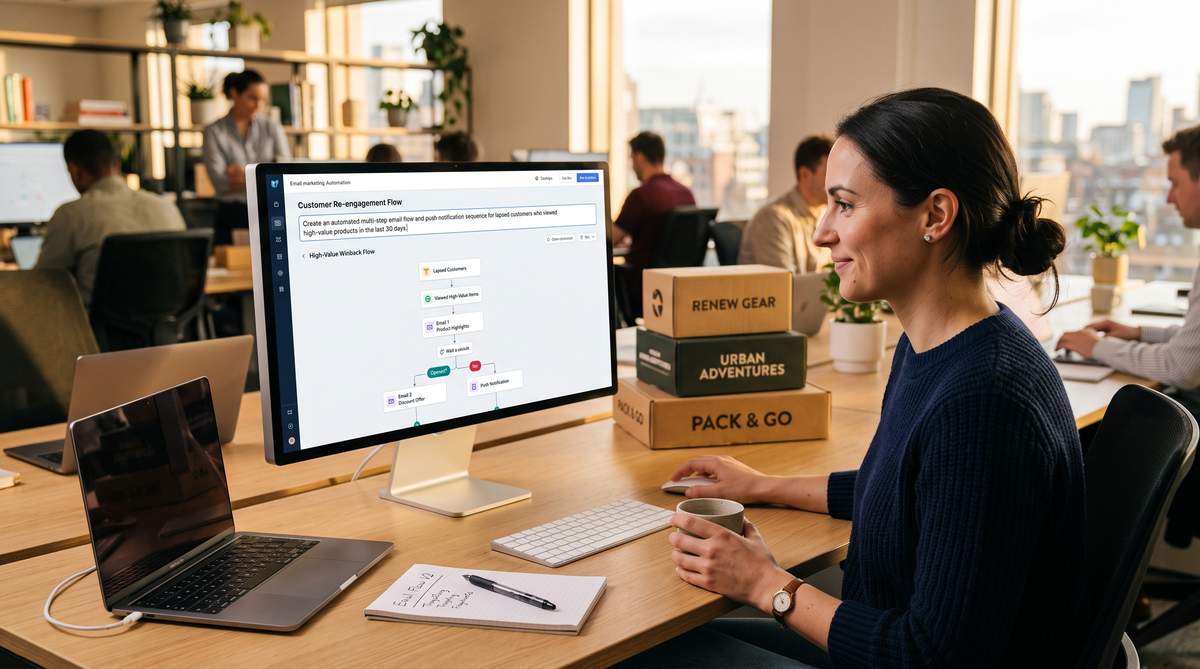
SmallBiz.ai's launch with 275+ workflows is not about having options. It is about having the right five. Service businesses under $5M operate on patterns. The same patterns repeat. The same handoffs fail. The same customers wait.
Here are the five that change the math:
- Voice Notes to Job Reports (20 hours per month saved)
- Jobs to Invoices (15 hours per month saved)
- Lead Response to Quote (estimated 8-12 hours per month)
- Quote Follow-up and Acceptance Tracking (estimated 6-10 hours per month)
- Invoice to Payment Reminder Loop (estimated 4-8 hours per month)
Add them together. You reclaim 50-65 hours per month. For a team of four, that is one person's full week of labor. Every single month. Without hiring. Without new software. Without changing what you already use.
The math is not theory. SmallBiz.ai documented it across target verticals: plumbers, family clinics, solo attorneys, HVAC contractors, dental practices, property management, and auto repair shops.
The Voice-to-Report System
This is the workflow that broke the automation ceiling for service businesses. A technician finishes a job. She speaks a 90-second voice note into her phone. The note becomes a structured report. The report routes to your existing system—CRM, project management, accounting, wherever.
No typing. No form-filling. No manual data entry. The handoff happens automatically.
Plumbers and HVAC technicians save 20 staff hours per month per person this way. A two-person crew becomes a three-person operation without hiring anyone. Clinicians and dentists use the same workflow to convert patient notes into structured records that feed directly into medical systems.
The key: This is not "AI magic." The system knows your business type (plumber, dentist, clinic). It knows your output format (quote template, job report, patient note). It converts voice to structure inside that known pattern. The accuracy compounds.
This is workflow automation. Not AI browsing. Not chat interfaces. Not large language models writing prose. One job in. One structured output. Every time.
The Job-to-Invoice Pipeline
Here is the problem nobody solves: The moment a job is marked "complete," something needs to happen. An invoice needs to generate. A payment link needs to attach. A reminder needs to schedule. A bookkeeper needs notification.
In most service businesses, that moment triggers a person. That person opens a system. That person fills fields. That person sends an email. That person forgets sometimes. That person moves to another company.
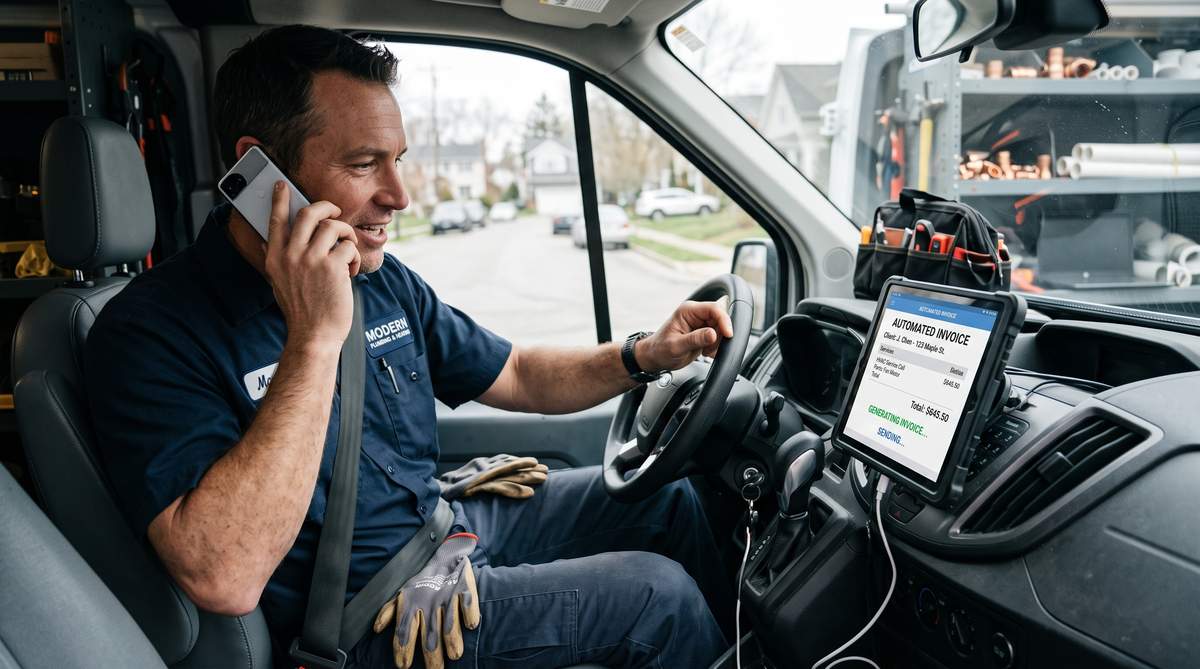
SmallBiz.ai's job-to-invoice workflow eliminates the person. The moment a job closes, an invoice generates from the job data (already captured). A unique payment link attaches. An email sends. A follow-up reminder queues for 48 hours later.
The data is already there. Your system already knows what work was done, who did it, and what it cost. The workflow just connects the dots that should have been connected all along.
The result: 15 hours per month of admin work vanishes. Your cash flow improves because payment moves from "someone gets around to invoicing" to "payment link exists before the customer closes their door."
For a service business carrying invoices overdue 30+ days (60% of the market does), this is not optimization. This is survival. Nearly half of small business owners report that payment-processing delays create cash-flow gaps. The gap is not the customer's fault. It is the system's fault.
Why 80% AI Adoption and 5% Real Automation
The adoption number is misleading. Most small business owners use AI the way most people use a car: to get from A to B. They use it for one task. They do not rebuild their operational infrastructure around it.
ChatGPT is useful for writing an email, drafting a proposal, brainstorming a tagline. That is not automation. That is assistance. Automation requires connection between systems. Automation requires happening without human decision points. Automation requires reliability.
When SmallBiz.ai says "fewer than 10% of AI-using workers at small businesses use it to automate workflows with minimal human involvement," they are naming the actual ceiling. Most AI usage is supplemental. It helps a person work faster. Workflow automation removes the person from the routine entirely.
The 275+ workflows in SmallBiz.ai's stack are built to cross that ceiling. Each one is pre-built for a specific business type and routine task. Each one connects to systems you already own. Each one runs without a person standing watch.
What to Build vs What to Rent
This is the decision that stops most service businesses from automating: Do we build custom workflows, or do we license templates?
The wrong answer is "custom is better because it fits our unique business." No service business is unique in the ways that matter for automation. You quote. You invoice. You follow up. You get paid. Every plumber does this. Every dentist does this. Every HVAC contractor does this.
The right answer is: Rent the templates. Customize only what is genuinely different. Use the 90 days you save to build competitive advantage in sales, service quality, and retention. not in reinventing invoicing for the hundredth time.
SmallBiz.ai's pricing reflects this philosophy:
- Automation Consult: $49 for one hour working session (fee credited toward implementation).
- AI Business Blueprint: $299 for a written 90-day roadmap with your top 10 opportunities ranked.
- Automation Advisor: $29 per month for ongoing guidance.
Start with the blueprint. Identify which five workflows move the needle for your business. Implement one per month. Measure what changes. Scale what works. This is not buying another SaaS subscription. This is renting a playbook and adapting it to your specific operation.
The reason this works: The workflows are pre-built for 500+ business types and 67,000+ tools. You are not starting from zero. You are not building from scratch. You are customizing what already exists.
The Integration Ceiling
One in three small business owners cite lack of integration between systems as their blocker. They are using five or six different tools. None of them talk to each other. Data lives in silos. Handoffs are manual.
This is where most AI adoption stalls. ChatGPT cannot integrate your systems. A workflow automation platform can. if it knows your systems and is built to connect them.
SmallBiz.ai's knowledge base includes 67,000+ tools. It includes 120+ cost-optimization decision engines and 2,800+ role-specific guides. This is not chatbot assistance. This is decision intelligence. The system knows which tool does what, how to extract data from it, how to route data into it, and what it will cost.
You do not need fewer tools. You need your tools to act as a system instead of a collection of separate silos.
Build the System, Not the Tools
The doctrine is clear: Systems beat slogans. Your business is only as automatable as your system is clear. If the workflow lives in your head, you are a one-person business wearing a business suit. If the workflow is documented in systems, you have something that survives your absence. Something that scales. Something that is worth buying.
This is why the voice-to-report workflow matters. This is why job-to-invoice automation matters. These are not features. They are system-builders. Each one codifies something that has been living in your brain or in one person's daily routine. Each one makes the business less dependent on any single person.
SmallBiz.ai's 275-workflow stack is built on this exact principle: Automate the routine so humans can handle the exceptions. Automate the handoff so the work flows between systems instead of between inboxes.
That philosophy is free. Take it. The 275 workflows are licensed. But the principle is yours to steal. Audit your bottlenecks. Find the routines that repeat. Build the systems to handle them. Then watch what unfolds.
How to Start: The 90-Day Path
You do not need to understand 275 workflows. You need to understand five. the five that open the most time in your operation.
This is exactly what the 90-day bottleneck audit is designed to surface. Run it. Map your bottlenecks. Rank by time cost.
Start with voice-to-report. Most service teams lose 20+ hours per month to note-taking and transcription. Once you reclaim that time, you can see what the next bottleneck is. Then you move to job-to-invoice. Then payment reminders.
The methodology matters more than the platform. But when the platform is built specifically for service businesses with the 275 workflows already mapped to your industry, implementation moves from "research what to build" to "customize what exists."
For more on automating what you do inside existing systems, read How to Write SOPs That Actually Get Followed and Invoice Reconciliation Automation: 12 Hours to Zero Manual Reconciliation.
FAQ
Do I need to switch platforms to use these workflows?
No. SmallBiz.ai is designed to work inside your existing stack. It extracts data from your systems, changes it, and routes it to where it needs to go. all without replacing what you already own.
How long does implementation take?
Most workflows integrate within 2-6 weeks depending on your stack complexity and the breadth of customization. Voice-to-report and job-to-invoice are typically fastest because the data structure is simpler.
What if my business type is not in the 500+ Automation Centers?
The platform is designed with a "reuse before purchase" philosophy. Most service-business workflows transfer across industries. A dentist's job-to-invoice system works for an electrician. A plumber's voice-to-report works for an HVAC contractor. Start with the closest match and customize from there.
What is the ROI on implementing voice-to-report alone?
At $50 per hour fully loaded labor cost, reclaiming 20 hours per month = $12,000 per year per person. For a two-person crew, that is $24,000 in recovered capacity annually. The implementation cost is $299 (blueprint) plus minimal setup time.
Jeff Barnes has no personal position in any company, fund, or platform named in this article. Digital Evolution Marketing Group has no current commercial relationship with any party mentioned. DEMG provides marketing systems and education for owner-operators, not investment advice. Past performance does not guarantee future results. All investments involve risk, including loss of principal.