Your Brand Now Has a Reputation Inside ChatGPT You Are Not Tracking
Cision, the media intelligence platform used by PR and communications teams for decades, acquired Trajaan this month to track how brands are mentioned inside ChatGPT, Google AI Overviews, and Perplexity, according to reporting on the deal. Trajaan built its technology specifically to answer a question that did not exist five years ago: is your brand mentioned inside a generative AI answer, and is that mention helping or hurting you.
If you run a $500K-$5M business, you have almost certainly never checked this. You check your Google ranking. You might check your Yelp reviews. You have not asked ChatGPT what it thinks of your company, and if you did, you would have no idea whether the answer it gave you today will still be the answer it gives tomorrow.
The Contrarian Angle: Most of This Category Is Noise, But the Underlying Shift Is Real
Every acquisition in martech gets dressed up as a seismic event. Most are not. A big PR platform buying a smaller AI-monitoring startup is, on its face, a routine consolidation. What makes this one worth your attention is not the deal itself. It is the category it validates.
Generative Engine Optimization, GEO for short, is becoming a real discipline with real measurement behind it, not a buzzword. Researchers from Princeton, IIT Delhi, and independent collaborators presented a peer-reviewed framework at KDD 2024 showing that specific content techniques, adding statistics, citing credible sources, and using direct quotations, can lift a page's visibility inside generative engine answers by up to 40% on their benchmark, with a smaller but still meaningful lift of roughly 22% when tested live on Perplexity. That is not marketing copy. That is a controlled academic study, and it is the foundation the entire GEO industry, Trajaan included, is now building products on top of. A separate industry breakdown of the same research corroborates the mechanism: SEO Strategy's analysis of the AI citation gap found that most brands are optimizing the wrong layer entirely, polishing on-page content while ignoring the earned-media signals that determine whether AI consults their site in the first place.
Here is the part most owner-operators get wrong: you do not need a GEO agency retainer to benefit from this. You need to understand three things: what a generative engine currently says about your business, where that information is coming from, and whether it is accurate. That is due diligence, not a subscription. The instinct to outsource the checking itself, rather than just the fixing, is where most small businesses waste money on this category before they have even confirmed there is a problem.
What the Data Actually Shows
A study by Ahrefs of 75,000 brands found that brand mentions correlate with AI Overview visibility at 0.664, compared to just 0.218 for traditional backlinks, meaning being talked about now predicts AI visibility roughly three times more strongly than being linked to. Brands in the top 25% for web mentions earn up to 10 times more AI mentions than the next quartile down. Separately, Muck Rack's analysis of more than one million links cited by AI models found that 82% of AI citations trace back to earned media rather than a brand's own website, with non-paid sources accounting for 94% of citations overall.
| Signal | Correlation or Share | Source | |---|---|---| | Brand mentions (unlinked or linked) | 0.664 correlation | Ahrefs, 75,000-brand study | | Traditional backlinks | 0.218 correlation | Ahrefs, 75,000-brand study | | Earned media share of AI citations | 82% | Muck Rack, 1M+ link analysis | | Non-paid source share of AI citations | 94% | Muck Rack, 1M+ link analysis | | Top-quartile web mentions vs. next quartile | 10x more AI mentions | Ahrefs, 75,000-brand study |
The practical translation: getting quoted in a trade publication, a local news story, or an industry roundup now does more for your AI visibility than a backlink from a link-building service ever did. That flips a decade of SEO conventional wisdom on its head, and most small business owners have not caught up to it yet. Roughly 26% of brands measured in the Ahrefs study had zero mentions at all inside AI Overview results, meaning more than one in four brands is simply invisible in a channel a growing share of customers now use first.
The Mechanism: Why This Requires Different Monitoring Than Traditional SEO
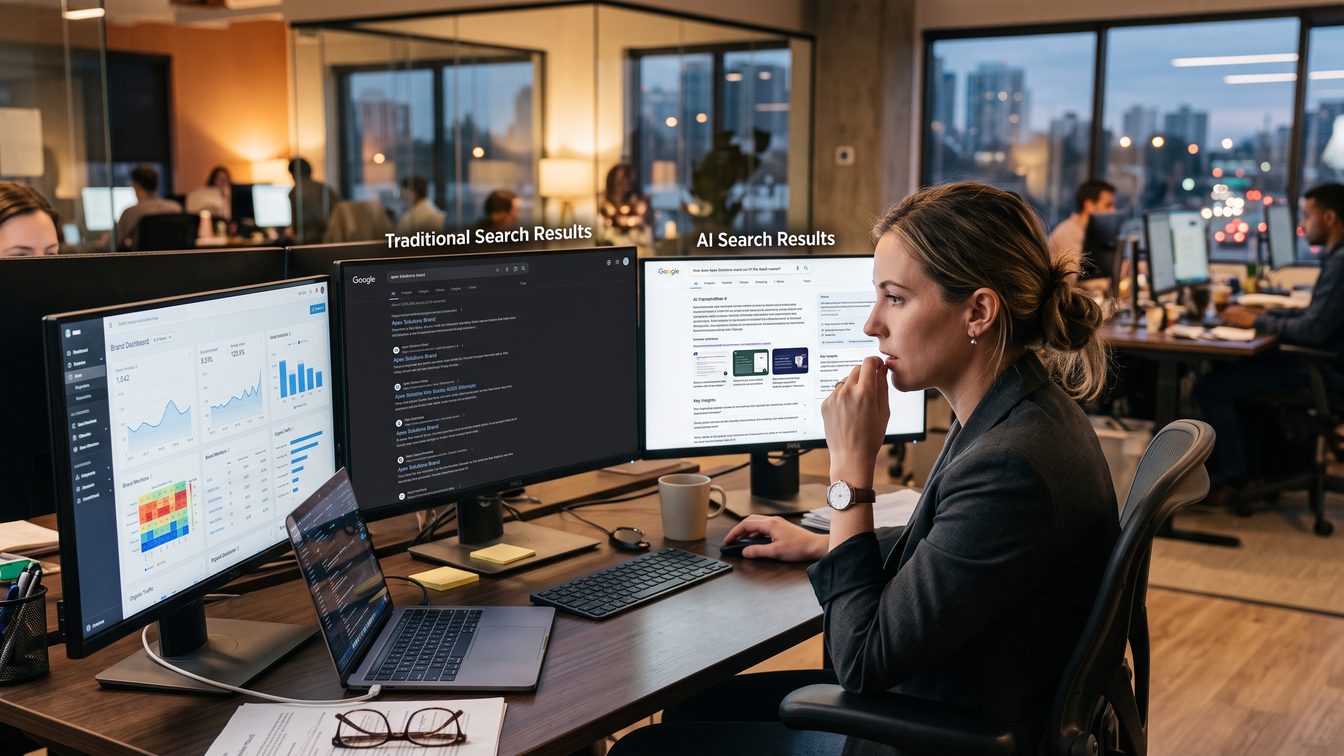
Traditional search results are indexed and archived. You can check your Google ranking today and get roughly the same answer tomorrow unless something material changes. Generative AI answers do not work that way. The same question asked of ChatGPT at 9 a.m. and again at 3 p.m. can return a different answer, shaped by model updates, prompt phrasing, and retrieval behavior that hour. There is no permanent index to crawl and no URL to bookmark.
This is exactly the gap Trajaan built its technology to close: mention detection across AI outputs, sentiment and framing analysis, and source attribution that identifies which underlying articles or press releases a model is actually pulling from when it talks about your brand. Cision folding that capability into its existing platform signals that enterprise PR teams are already treating this as a required line item, not an experiment.
Muck Rack's Generative Pulse product, the tool built on this same research, prices this kind of monitoring squarely at the enterprise PR budget level. For an owner-operator, you do not need enterprise tooling to start. You need a habit. Ask ChatGPT, Perplexity, and Google's AI Overview the questions a prospective customer would actually ask: "best [your category] in [your city]" or "is [your company name] any good." Do this monthly. Screenshot what comes back. That is a manual version of what Trajaan automates, and it costs nothing but ten minutes.
I call this a 90-Day Bottleneck Audit applied to reputation instead of operations. The same discipline of checking a specific process on a fixed schedule, rather than reacting only when something goes visibly wrong, works whether the bottleneck lives in your production line or in an AI model's understanding of who you are.
Case Study: What I'd Check First for a $2M Business
I ran this exercise recently with a regional consulting firm doing just under $2M in revenue. The owner had never once asked an AI tool what it said about his company. When we did, ChatGPT correctly named the firm as a regional option but attributed a case study to them that actually belonged to a competitor with a similar name. Small mistake. Real consequence if a prospect had brought it up on a sales call and the owner had no idea what they were referencing.
We did not hire a GEO agency to fix this. We identified the source: a poorly disambiguated business directory listing that both companies shared. We corrected the listing, published one clarifying piece of owned content with the firm's actual case studies clearly attributed, and rechecked a month later. The misattribution was gone. Total cost: an afternoon, not a retainer.
That is the AIN lesson applied to a new channel. In my work helping raise more than a billion dollars in capital formation through the American Investors Network, the recurring failure point was never a lack of opportunity. It was unverified information compounding quietly until it became expensive to unwind. A wrong AI Overview answer about your business is the retail version of the same problem: small, invisible, and only costly once you notice it too late. The businesses that got hurt worst in capital formation were never the ones who lacked deals. They were the ones who lacked a habit of checking their own facts before someone else did it for them, unfavorably.
The Honest Risk
This could blow up in the opposite direction from what most owners expect. The risk is not that you ignore GEO and get punished immediately. The risk is that a whole industry of GEO consultants sells owner-operators expensive monthly retainers to "optimize for ChatGPT" using tactics with thin evidence behind them, while the free version, checking manually and fixing your own source data, would have solved 90% of the actual problem.
Before paying anyone for GEO services, verify what they are actually monitoring, how often the data refreshes, and whether they can show you a specific inaccurate AI mention they identified and corrected for a client. If they cannot produce a concrete example, you are paying for a trend, not a service. There is also a second, more subtle risk worth naming: chasing AI visibility can pull attention away from the channels that still generate most of your revenue today. Treat this as an addition to your marketing system, not a replacement for what is already working.
The KDD 2024 researchers themselves noted that the effectiveness of any given optimization tactic depends heavily on the query domain, and a live-engine test showed real-world gains well below the headline lab number. Anyone selling you a guaranteed ranking inside ChatGPT is skipping past a nuance the original researchers were careful to include.
Your Next Step This Week
Ask ChatGPT, Perplexity, and Google's AI Overview the exact questions your best customers would ask before hiring you. Write down what each one says. If anything is wrong, outdated, or attributed to a competitor, trace it back to its likely source, usually a directory listing, an old press mention, or a Wikipedia-adjacent page, and correct it at the source. Repeat this check monthly. You do not need Trajaan-level infrastructure to start protecting a reputation you did not know you had.
Doctrine Connection: Due Diligence Is Non-Negotiable
Due diligence is non-negotiable, and that principle did not stop applying just because the venue moved from a spreadsheet to a chat window. You would never sign a partnership agreement without reading it. You should not let a generative AI model represent your business to prospective customers without at least once checking what it actually says. The check costs ten minutes. The unexamined risk costs a deal you never even knew you lost.
FAQ
Q: What is Generative Engine Optimization, or GEO? GEO is the practice of structuring content and brand presence so that generative AI tools like ChatGPT, Google AI Overviews, and Perplexity are more likely to mention and accurately represent your brand when answering a relevant question. The term originated from a 2024 academic study at KDD showing content changes could lift visibility inside AI answers.
Q: Do I need to hire a GEO agency to protect my brand? Not necessarily. A monthly manual check of what major AI tools say about your business, followed by correcting inaccurate source information, covers most of the risk for a small business. Paid monitoring tools like the one Cision acquired make sense at scale, but are not required to start.
Q: Why do backlinks matter less for AI visibility than they used to for SEO? Research from Ahrefs found brand mentions correlate with AI visibility roughly three times more strongly than backlinks, because generative models learn about entities from how consistently and credibly they are discussed across the web, not primarily from link graphs.
Q: How often should I check what AI tools say about my business? Monthly is a reasonable minimum for most small businesses. Generative answers can shift with model updates, so a quarterly check is too infrequent to catch a problem before it compounds.
Q: Is a bad AI Overview mention something I can actually fix? Often, yes. Most inaccurate AI mentions trace back to a specific outdated or conflicting source, a directory listing, an old article, or a misattributed case study. Correcting that source and publishing clear, accurate owned content is usually enough to resolve it over time.
Jeff Barnes is the founder of Digital Evolution Marketing Group (demg.ai). This article is for informational purposes only and does not constitute business or investment advice. The frameworks, tools, and strategies discussed reflect the author's operational experience and may not apply to every business context.