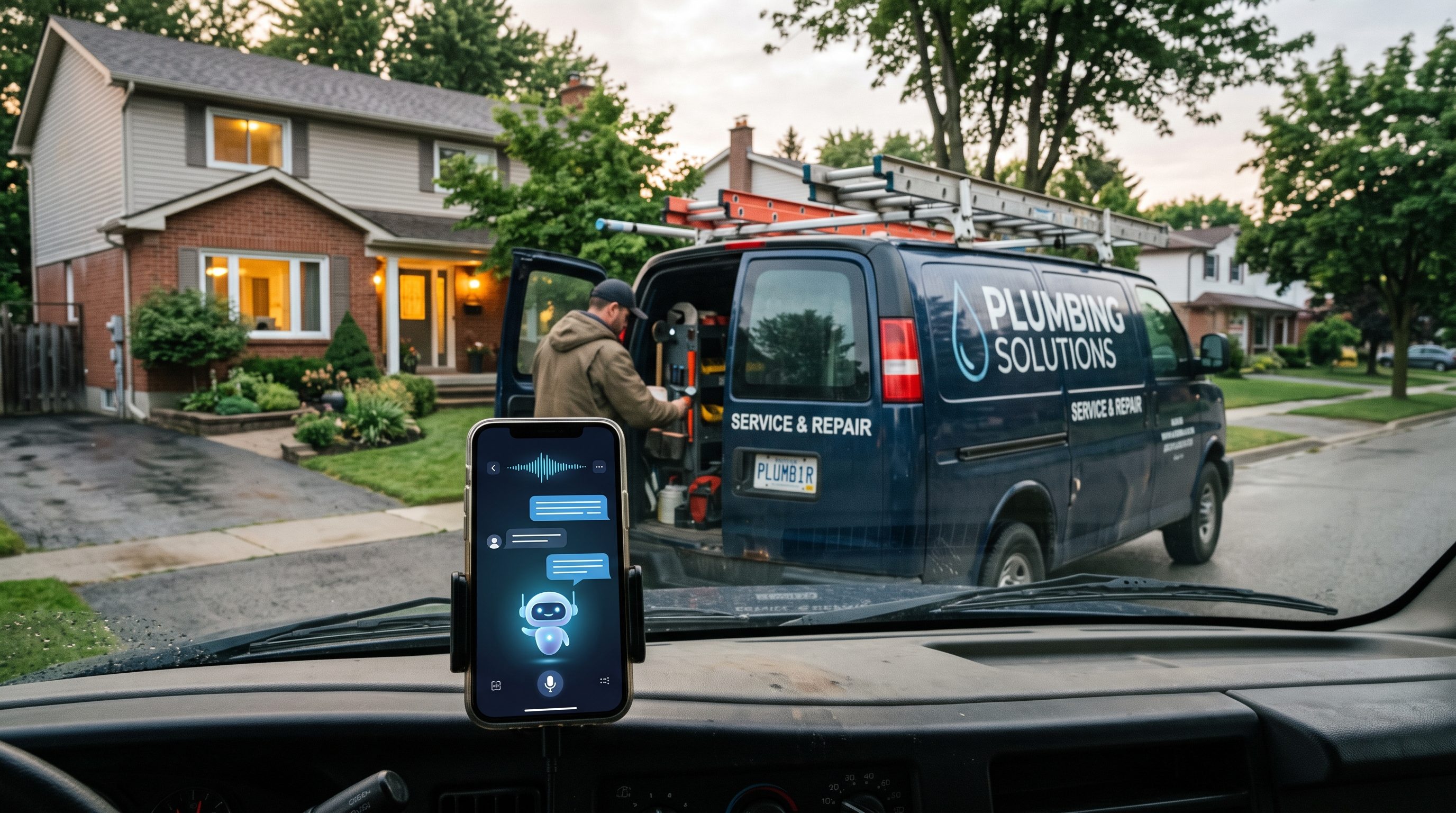
The Setup
Beers bought Gardner Plumbing in January 2026. According to ServiceTitan 2026 State of the Trades survey, It was his friend's business during COVID. The operation was solid, but it was running hot—50 to 55 jobs every single day with just a couple of office staff holding down the phones.
That's the math that kills growing service businesses. You scale the technical work. You hire more techs. Jobs increase 40-50% year over year. But your office staff? Still the same two people. Still drowning in calls. Phone rings constantly. Home warranty companies send 20 jobs a day. Each one calls multiple departments about the same job. Five calls in ten minutes. One call per task, repeated. Your best people are trapped answering phones instead of managing ops.
This is what I call the "heroics trap." Every growing service owner hits it. You solve it with systems or you burn out your office team. There is no third option.
The Problem: Phone Volume Exceeds Capacity
Home warranty companies operate differently than retail customers. One job gets handed off across departments. Billing calls. Authorization calls. Dispatch calls. Callbacks. Sometimes the same caller hits you five times in ten minutes about one repair. Gardner Plumbing's office staff were fielding 100+ inbound calls per day:most routine. Appointment requests. Job status checks. Basic questions that repeated every two hours.
The techs could not scale further. The phones were the bottleneck. Standard hiring for two more office staff would cost $60K-80K annually, burn through management time, and still not solve the core problem:most of these calls do not require human judgment.
Beers faced a choice: hire more office staff and accept turnover, or find a system that answers most calls before they hit a human. He chose the system.
The Solution: AI Virtual Agent "Penny Pipes"
Gardner Plumbing upgraded to ServiceTitan Max Package:a unified platform covering leads, booking, dispatch, and invoicing. Within that system, they deployed an AI virtual agent named Penny Pipes. The agent answers inbound calls, identifies the caller, matches them to jobs, and resolves simple requests without escalation.
Penny Pipes does the basics: appointment status, job confirmation, call transfers to the right department. When a warranty company calls the fifth time about the same repair, Penny Pipes recognizes the job, delivers the status, and logs the call. When a customer wants to confirm a technician arrival window, Penny Pipes pulls the dispatch data and gives an answer in real time.
Not every call gets handled entirely by the agent. High-complexity requests or customers who explicitly ask for a human still route to office staff. But the agent fields the volume:capturing the metadata, reducing operator demand, and compressing the decision tree down to only the calls that actually need a human brain.
The Results: 85 Percent Call Load Reduction
After Penny Pipes deployment, manual call handling dropped to 10-15% of inbound volume. That is an 85 percent reduction in the call load that hits human operators. Gardner Plumbing still answers every call:but most calls now terminate with the AI. Office staff spend their time on escalations, complex requests, and management tasks instead of answering "What time is my tech arriving?" for the hundredth time that day.
Twenty home warranty calls per day that used to fragment across five departments and tie up office bandwidth:now Penny Pipes fields the volume, logs it, confirms the job status, and only escalates when the request is outside her scope. The five-in-ten-minutes problem evaporates.
Beers' quote says it plainly: "I feel smarter every day that we picked ServiceTitan. We picked the right horse." That is not enthusiasm speaking. That is operational relief. His office staff can breathe. His phones are not the constraint anymore. The system handles the routine so humans can handle the exceptions.
ATLAS Model: Systems Over Heroics
Gardner Plumbing's solution maps directly to the ATLAS Model for Growth:a framework that separates sustainable scaling from burnout.
A – Automation: Penny Pipes automates the incoming call routine. No human touches the metadata capture, status lookup, or appointment confirmation. The system does it.
T – Tools: ServiceTitan Max Package integrates leads, booking, dispatch, and invoicing in one platform. One data store means Penny Pipes has complete context. She knows which jobs are assigned, which are completed, which are pending. No data islands.
L – use: Two office staff now manage the volume of a four-person team. Beers created use by outsourcing the volume-handling work to a system instead of buying more headcount.
A – Adaptation: The system learns which call types route to which departments. Over time, Penny Pipes gets smarter about matching callers to the right person or closure path.
S – Scale: As jobs increase 40-50% year over year, office staffing stays flat. The system absorbs the volume increase. This is how you grow without adding headcount proportionally to revenue.
Most growing service owners try to scale with heroics:hiring faster, working longer hours, accepting chaos. Beers chose the ATLAS path: system first, then humans operate the exceptions. That is the difference between companies that scale and companies that plateau.
What This Means for Your Operation
Penny Pipes works because Gardner Plumbing operates at scale. Fifty to fifty-five jobs per day is high volume. Twenty warranty calls per day with multiple incoming contacts about the same job creates a clear routine that automation can target. If your operation runs 5-10 jobs per day, you might not have the call volume to justify AI deployment. But if you are operating in the 30-plus range and seeing growth, your phones are probably your constraint just like Beers' were.
The math is simple. Count your inbound calls for one week. Track which ones reach humans and which could be handled by a system that knows your job data. If more than 50 percent of those calls are routine status checks, appointment confirmations, or callback requests, you have a Penny Pipes candidate.
Integration matters. Penny Pipes only works because it sits inside ServiceTitan:a platform that owns your job data, customer records, dispatch status, and billing history. A standalone chatbot cannot do this work. The AI needs the system. The system needs the AI. That integration is what creates the 85 percent reduction. Bolt-on solutions do not achieve those numbers.
The Operator's Doctrine: Systems Beat Slogans
Gardner Plumbing did not run a marketing campaign about being "innovative" or "cutting-edge." Beers did not post about "embracing AI" or "the future of service." He solved a concrete problem:phones ringing too much:with a system that worked. The result speaks.
In the Navy, we built systems that had to work under pressure. We tested them. We documented them. We trained people on them. We did not celebrate complexity. We celebrated reliability. Penny Pipes is that doctrine applied to plumbing. You build a system. You verify it reduces load. You let humans handle what humans are actually needed for. Everything else is process.
That is the operator's approach. Systems beat slogans. Measurement beats assertion. Gardner Plumbing did not guess at the results. They measured the call volume before and after. Eighty-five percent reduction is not a claim. It is the math.
FAQ
Q: Do customers mind talking to an AI agent?
A: No. Customers care about getting an answer to their question. Penny Pipes gives answers fast:usually faster than a human can look up the information. If the customer needs a human, they ask and get routed. Most do not ask. Most just want their job status.
Q: What happens if Penny Pipes gets the answer wrong?
A: The call gets routed to a human, who corrects it. High-stakes calls:payment disputes, warranty claims, technical questions:go straight to a human. Penny Pipes handles the calls where an incorrect answer is a minor inconvenience, not a problem. The system learns from corrections and improves over time.
Q: How much did this cost?
A: Beers upgraded to ServiceTitan Max Package, which includes the AI agent. The cost depends on company size and call volume. For a 50-job-a-day operation, the investment pays for itself in 3-6 months by preventing the need to hire additional office staff.
Q: Can we use this if we do not use ServiceTitan?
A: Not with Penny Pipes, which is built into the ServiceTitan ecosystem. Other service platforms offer AI agents, but they work best when the system owns your core data. If you use a different platform, ask your provider if they offer similar integration.
Q: What about the next hire? Do we still need office staff?
A: Yes. Office staff evolve:from call answering to customer relationship management, billing oversight, scheduling optimization, and strategic tasks. Automation does not eliminate the role. It changes what the role covers. Beers' office team now runs operations instead of fielding phones.
Key Takeaways
- Gardner Plumbing reduced inbound call handling from 85% to 15% of operator time by deploying an integrated AI virtual agent.
- The system only works when the AI sits inside a platform that owns your job data, dispatch status, and customer records.
- At 50+ jobs per day, the call volume justifies AI deployment. At 5-10 jobs per day, you probably handle it fine with existing staff.
- Systems beat slogans. Measure call volume before and after. If you are not cutting human workload by 50% or more, the system is not working.
- Office staff do not disappear:they shift from transaction handling to operational management and customer relationship work.
Disclosure
demg.ai works with ServiceTitan and other operational platforms. We are not endorsed by ServiceTitan, and Gardner Plumbing was not compensated for this case study. The data presented comes directly from the published ServiceTitan success story at servicetitan.com/blog/success-story-gardner-plumbing-ai-automation.
Sources and Further Reading
- ServiceTitan 2026 State of the Trades survey
- Housecall Pro trade-specific AI packages
- Trade Automation Pros
Jeff Barnes is the founder of demg.ai. This article reflects operator analysis, not investment advice. All claims are sourced. Your results depend on your execution.