
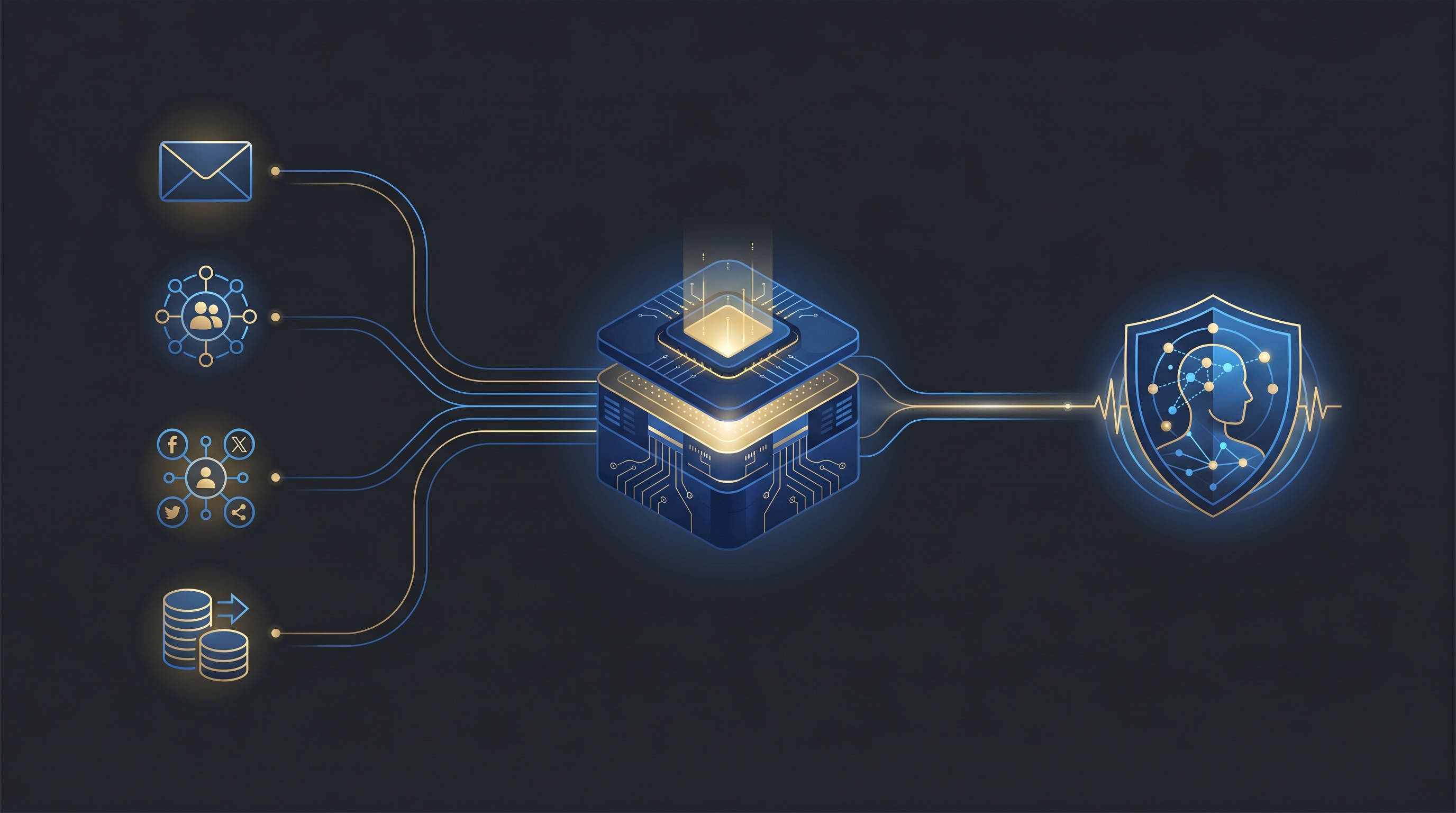
The Data Paradox
Salesforce reports that organizations with unified customer data are 60% more likely to deploy AI agents and 42% more likely to respond to customer inquiries within five minutes. Yet 87% of brands run generic campaigns from data silos scattered across email platforms, CRMs, SMS tools, and spreadsheets. The gap isn't philosophical—it's structural. When your customer context lives in fragments, your AI agents inherit those same blindspots. Your personalization engine is as good as your worst data silo.
The irony: a unified data stack doesn't require a $10,000/month CDP contract. It requires a doctrine. Own the architecture. Don't rent it from a platform that can cut you off.
The Problem with Enterprise CDPs
Segment. mParticle. Tealium. They're class acts—300+ integrations, beautiful UIs, and customer success reps on speed dial. Segment's MTU-based pricing starts at $120/month and scales to $2,000–$3,000/month once your customer base grows. mParticle and Tealium? Enterprise quotes only, often $20,000–$80,000 annually.
For a 10-person agency or bootstrap founder managing 50,000 customer records? That's operational torture. You're paying enterprise tax on SMB revenue.
There's another problem: vendor lock-in. Your unified customer data lives in their infrastructure. They control your access. Your data is their asset, not yours. That's not a platform. That's a lease on your customer relationships.
The Sovereignty Stack
I spent 27 years building data infrastructure at AIN, started with a spreadsheet in 1997, evolved into a pgvector-embedded knowledge base, but the principle never changed: own your data. Don't rent it. Let me show you a stack that costs under $200/month and gives you full sovereignty.
Here's the architecture: a lightweight event collection layer, a data warehouse you control, a free or cheap reverse-ETL tool, and one analytics dashboard. That's your engine room.
Layer 1: Customer Data Collection ($97/month)
GoHighLevel (GHL) starts at $97/month and consolidates your CRM, email, SMS, funnels, and basic contact management. It captures inbound customer behavior, form submissions, email opens, SMS replies, appointment bookings. For SMBs, it's your first-touch data collection point.
If you're already in HubSpot or Pipedrive, you can skip GHL. The principle is: own a contact database that auto-tracks behavior. Your baseline.
Layer 2: Open-Source Event Streaming (Free)
RudderStack's free tier includes 250,000 events per month. That's a complete customer data infrastructure for bootstraps and early-stage teams. RudderStack is warehouse-native: it doesn't store your data. It streams events directly to your warehouse, Snowflake, BigQuery, Redshift, Databricks.
Why this matters: you pay for the warehouse compute, not the CDP vendor's margin on your data.
RudderStack's free tier includes 10 Reverse ETL connections (pulling data back out to your activation tools). You're not locked in. Your data flows where you decide.
Layer 3: Simple ETL & Warehouse ($20–$50/month)
Pick one:
- Airbyte Cloud: Free tier covers two sources; paid plans from ~$50/month. Drag-and-drop integrations from CRM, email, Shopify, or APIs into your warehouse.
- Apache Airflow (self-hosted on a $5/month DigitalOcean droplet): More technical but zero marginal cost per pipeline. Control everything.
- Zapier: Expensive ($20–$50+/month), but if you already live in it, the integration tax is lower.
Your job: move data from GHL → RudderStack → warehouse in one direction. Pull clean customer profiles back out via Reverse ETL into your activation tools.
Layer 4: Analytics Dashboard ($0–$30/month)
One tool to own your unified view:
- Metabase: Free, open-source. Deploy on your server, connect to your warehouse, build dashboards in minutes. No vendor.
- Google Looker Studio: Free. Connects to BigQuery natively. Good enough for SMBs.
- Superset: Free, Apache project. Self-hosted.
- Tableau Public: Free tier for basic dashboards; paid tiers from $60+/month.
You're not paying for a CDP dashboard. You're paying for warehouse compute and a visualization layer. Your data lives in your warehouse. Your analytics live on your server.
The Total Cost Calculation
| Component | Cost | Notes | |-----------|------|-------| | GoHighLevel (CRM/collection) | $97 | Or your existing CRM if you use HubSpot/Pipedrive | | RudderStack (free tier) | $0 | 250K events/month; upgrade to $220/mo for 10M+ events | | Airbyte or ETL | $30 | Airbyte paid, or $5 for self-hosted Airflow | | Data warehouse (BigQuery) | $20–$40 | Depends on query volume; Snowflake similar | | Analytics (Metabase) | $0 | Self-hosted; zero marginal cost | | Total | $147–$167/month | Scales linearly with data volume, not user count |
Add a second layer if you need advanced segmentation: Inoyu or Meiro bring enterprise-grade CDP features (real-time audiences, consent management, AI-powered customer summaries) starting at comparable SMB pricing with full data sovereignty.
Why This Stack Beats Enterprise CDPs for Owner-Operators
1. Data Residency & Sovereignty
Your customer database lives in your warehouse, under your account. You own the encryption keys. You control backups. No third-party vendor can revoke access.Salesforce, Segment, HubSpot, they store your data in their infrastructure. You're a tenant. Our stack: you're the landlord.
2. Cost Scales with Revenue, Not Friction
Enterprise CDPs charge per user (MTU) or per profile. As your customer base grows, so does their margin. Our stack scales by data volume, warehouse compute, not platform seats. Ten million events cost you $40/month in BigQuery, not $3,000 in Segment fees.3. No Switching Costs
Your data is in your warehouse. You can swap Airbyte for Stitch, RudderStack for custom Lambdas, Metabase for Tableau, in weeks, not years. Your customer data isn't hostage to one vendor's API changes or pricing decisions.4. API-First Architecture
RudderStack, Airbyte, and your warehouse expose full APIs. You can plug in AI agents directly, Claude, ChatGPT, custom LLMs. Your customer context becomes a real-time system input, not a black-box dashboard.Three Real-World Comparisons
Scenario 1: Bootstrap SaaS (5,000 customer profiles)
- Enterprise CDP (Segment): $120/month minimum, often $300–$500 as you grow.
- Our stack: $147/month. Fixed cost until you hit 100M+ events.
Scenario 2: Marketing Agency (15 client accounts)
- You need client data isolation. HubSpot Enterprise: $1,200+/month per account.
- Our stack: GHL's Agency Unlimited plan ($297/month) handles 15 isolated locations. Add shared RudderStack + warehouse for $50. Total: ~$350/month for all 15 accounts.
Scenario 3: E-commerce Retailer (50,000 customer profiles, 10M events/month)
- Segment or Tealium: $3,000–$8,000/month.
- Our stack: RudderStack paid tier ($220/month for 10M events), BigQuery ($40–$60/month), Airbyte ($30/month), GHL if you use it for email ($97/month). Total: ~$390/month.
Doctrine: Systems Beat Slogans
A vendor's marketing says "unified customer data unlocks AI." That's sloganeering. The system that actually unlocks it: a clear separation of concerns. Event collection. Warehouse. Transformation. Activation. Each layer replaceable, each under your control.
Own your data infrastructure. Don't rent it.
Week-by-Week Implementation: 30 Days to Unified Data
Here is the exact timeline. No theory. No "it depends." Four weeks.
Week 1: Audit and Map. List every system that holds customer data. CRM. Email platform. Payment processor. Support desk. Social accounts. Analytics. Write the field names each system stores (email, phone, name, purchase history, engagement score). Identify which system is your source of truth for each field. Most operators discover 4-7 disconnected data sources. This is the damage assessment.
Week 2: Connect the Pipes. Set up your hub. If you run GHL, it becomes the central node. Connect your email platform, payment processor, and analytics via native integrations or Zapier/Make. If you chose RudderStack free tier, configure your event stream sources. The goal: every customer action flows to one place within 24 hours of occurring. Not real-time yet. Just connected.
Week 3: Build Your First Segment. Pick one high-value customer behavior (repeat purchaser, high-engagement subscriber, or abandoned cart within 48 hours). Build a active segment in your hub that updates automatically. Create one automated message flow triggered by that segment. Test it on a small cohort. Measure open rate, click rate, and conversion against your generic campaign baseline.
Week 4: Measure and Compound. Compare your segmented flow results against your old batch campaigns. Document the delta. If your segmented flow outperforms by 20%+ (it will), build two more segments. Start the compounding cycle. Each segment you add makes the next one smarter because the data gets cleaner with every interaction.
Total cost for this 30-day build: $97-$197/month for GHL, $0 for RudderStack free tier, $0 for Google Looker Studio dashboards. Under $200/month. The ROI shows up in Week 3.
FAQ
Q: Why not just use HubSpot's CDP?
HubSpot CDP is bundled into enterprise CRM tiers and requires a $1,200+/month minimum. If you're running a contact-light operation (agencies, coaches, consultants), that's expensive. If you need true customer data unification across multiple sources, Shopify, email, ads, custom APIs, HubSpot's CDP is decent but pricy. Our stack costs 1/4 the price and gives you full sovereignty.
Q: Do I need a data engineer to set this up?
No. RudderStack, Airbyte, and Metabase have no-code UIs. If you can set up Zapier, you can set this up. One caveat: SQL helps. When you want to join customer profiles with purchase data or create calculated attributes, you'll write simple SELECT statements in your warehouse. A junior analyst or a weekend of learning SQL gets you there.
Q: What if my data volume explodes?
Good problem. Your costs scale linearly: more events = more warehouse compute ($40/month → $80/month in BigQuery). You never hit a pricing cliff. Compare that to Segment: 10M events = $2,000–$3,000/month. Our stack: $220 + $80 + $30 = $330/month. That's a 10x arbitrage.
Q: Can I integrate with AI agents?
Yes. Your unified customer data lives in your warehouse as structured records. Expose it via an API, feed it into Claude's context window, or use it as a retrieval-augmented generation (RAG) source. RudderStack has native Model Context Protocol (MCP) support. Your data becomes a real-time input to AI reasoning, not a static report.
Disclosure
Jeff Barnes, MBA is the founder of demg.ai. This article reflects independent analysis. AI tools assisted with research. All conclusions are Jeff's own.
Citations & Resources
- Salesforce. (2025). "3 Reasons Why Unified Data Is More Important than the Latest LLM." Retrieved from https://www.salesforce.com/news/stories/video/reasons-for-unified-data/
- Volument. (2026). "RudderStack vs Segment: CDP Pricing, Features, and Open-Source Comparison." Retrieved from https://volument.com/blog/rudderstack-vs-segment-cdp-pricing-features-and-open-source/
- Coffee AI. (2026). "Best CDPs for Small and Midsize Businesses in 2026." Retrieved from https://www.coffee.ai/articles/best-customer-data-platforms-2026
- Meiro. (2026). "Customer Data Infrastructure for Regulated Environments." Retrieved from https://meiro.io/
- Kevin Leary. (2026). "Low-Cost Customer Data Platforms." Retrieved from https://www.kevinleary.net/blog/low-cost-customer-data-platforms/