The $48M Bet on the Corner Hardware Store
TL;DR: Rundoo just raised $30 million in Series B funding led by Battery Ventures, pushing its total to $48 million, to build an AI-native operating system for independent hardware, paint, and lawn-and-garden retailers. Its AI agent, Dooey, now runs inventory, pricing, and promotion decisions for 500+ stores that used to need a Home Depot-sized budget to compete. This is the moment the $500K-5M owner-operator gets the same weapon the big box has carried for a decade.
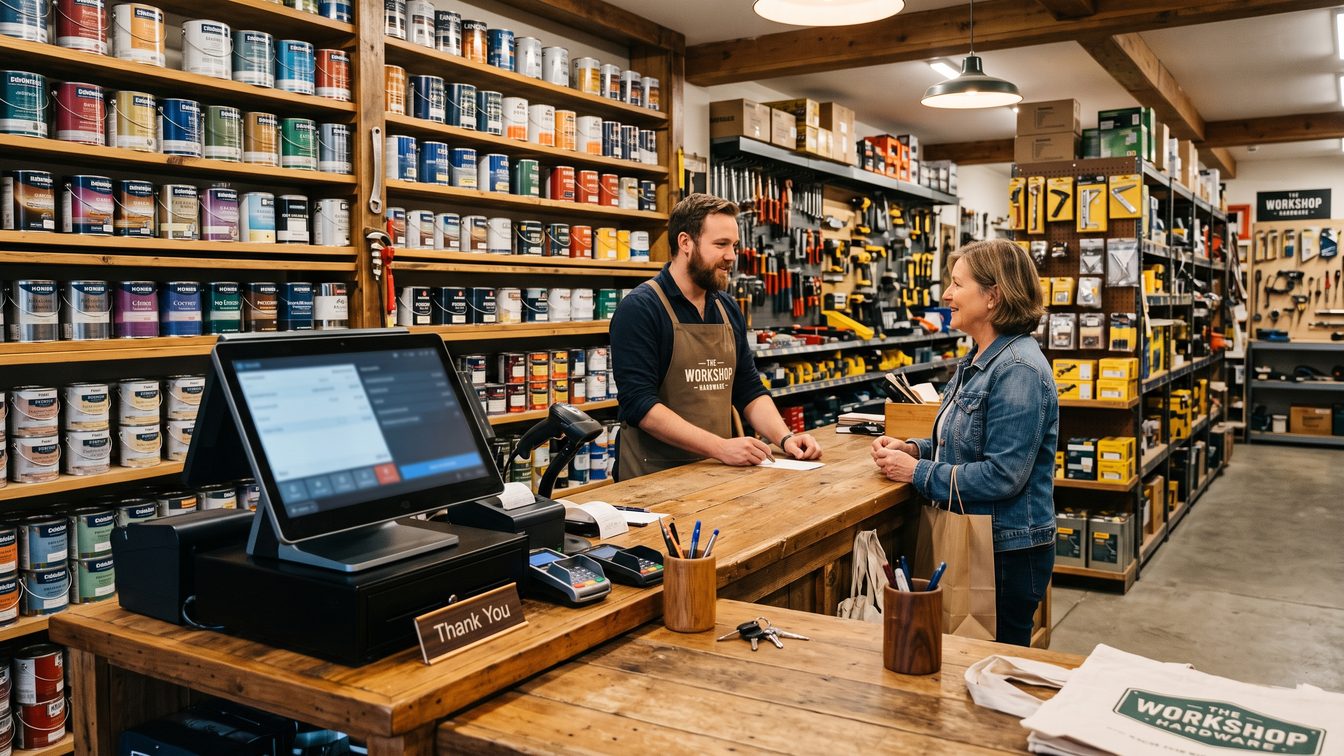
According to SiliconANGLE's coverage of the raise, Battery Ventures led the round with existing backers Bessemer Venture Partners and CRV participating. Rundoo now serves more than 500 independent supply stores across the U.S., Canada, and the Caribbean. Its AI agent Dooey handles point-of-sale, e-commerce, CRM, general ledger, and loyalty in one connected system. I have spent two decades helping owner-operators fight bigger, better-funded competitors, and this is the first time I have seen venture capital point directly at the guy running a paint store in a strip mall.
The Contrarian Angle: Fragmentation Is the Moat, Not the Weakness
Most people read a headline like this and think consolidation. Big platform, big investors, independents getting squeezed. That is backwards.
IBISWorld's industry analysis shows the U.S. hardware stores industry is highly fragmented, with no single company holding more than 5% market share. That fragmentation has always been the independent's problem: no shared infrastructure, no shared data, no shared bargaining power against suppliers or big-box pricing.
Rundoo does not fix fragmentation. It arms it. Each store keeps its ownership, its community relationships, its local judgment. What changes is the operating system underneath.
Battery Ventures partner Michael Brown put it plainly in that same SiliconANGLE piece. Independent supply stores are not behind the times, their software is. That is a bottleneck problem, not a talent problem.
You do not need Home Depot's balance sheet. You need Home Depot's decision-making speed.
Home Depot itself is not hiding its ambitions. In investor materials, the company pegs its total addressable market at $1.1 trillion and says it currently holds only around 15% share. It wants the rest.
That math should scare owner-operators. Instead, it should tell them exactly where the fight is happening: pricing precision, inventory timing, and Pro-customer retention. Those are the three levers Dooey pulls.
What the Data Actually Shows
| Metric | Independent Hardware Stores | Home Depot | |---|---|---| | Market share concentration | No player above 5% (fragmented) | ~15% of $1.1T TAM, largest single player | | Store count | 500+ on Rundoo alone | 2,350+ stores | | Core weapon | Local relationships, judgment | Scale, distribution, 16,000 delivery assets | | New AI layer | Dooey (Rundoo) | Internal analytics teams | | Funding for AI tooling | $48M total (Rundoo) | Built in-house at enterprise scale |
The Hardware Retailing trade publication account of the raise gives a concrete example. Berry's Hardware in Dumas, Arkansas, gets a nightly plain-language recap from Dooey covering top sellers, new customers, unusual returns, and any item that sold below the margin threshold the owner set. That is the exact kind of analysis a big chain pays a team of analysts to produce. Now it runs automatically, every night, for a single-location store in a town most people could not find on a map.
The Mechanism: How Dooey Actually Decides
Dooey is not a chatbot bolted onto a POS system. It sits at the center of Rundoo's stack, connected to inventory data, sales history, supplier feeds, and even weather forecasts. Per Pulse2's reporting, a garden center owner can ask Dooey to draft a purchase order ahead of the summer season, and it factors in historical sales, weather forecasts, and known landscaper bids in the area. That is a demand forecast that used to require a regional buyer at a chain retailer.
Dooey also recommends promotions: a 20% discount on garden hoses timed to the Fourth of July, based on the same data. This is the systems-beat-slogans doctrine in action. The store owner is not guessing what will sell or hoping a Facebook post moves inventory.
The system tells them, with a number attached, and the owner decides whether to pull the trigger. Verification beats optimism, every time, in retail margin math.
Rundoo also builds direct supplier integrations. It connects to Benjamin Moore's proprietary tint software so independent paint retailers can match colors reliably without a dedicated color specialist on staff. That is the kind of integration that used to require a chain's procurement muscle to negotiate.
The Case Study: Berry's Hardware
Berry's Hardware in Dumas, Arkansas is not a flagship location with a marketing budget. It is a single-store operator using Rundoo primarily as a nightly business analyst. Owner Brandon Berry gets a plain-language summary every evening: what sold, who bought it, what came back, and what sold below margin.
That last data point is the one that matters most for owner-operators. Margin leakage is invisible until someone tells you it happened, and by then the quarter is already gone. Dooey closes that visibility gap daily instead of quarterly.
This matters because most $500K-5M revenue retailers do not have a controller, let alone an analyst team. The founder is doing the analysis in their head, at night, exhausted, after closing the register. That is the founder dependency tax.
Every decision routes through one person's memory and gut feel. Automating the nightly recap does not replace the owner's judgment. It replaces the manual labor of assembling the facts the judgment depends on.
I learned this lesson the hard way long before AI existed. On the USS Jefferson City, I stood watch in the engine room as a nuclear power plant operator, and the entire discipline of a casualty drill was built on one idea: you do not wait for a crisis to figure out your numbers. You know your reactor's parameters cold, before anything goes wrong, because a submarine at depth does not give you time to improvise.
Retail margin works the same way. If you only find out a product sold below margin at quarter-end, you already lost the money. Dooey's nightly recap is a watchstanding procedure for a cash register. It just runs automatically now.
The Honest Caveat
This could blow up because Rundoo is still a venture-backed company chasing growth, and venture-backed companies eventually need an exit or an IPO that changes pricing and priorities. A $48 million total raise is real money, but it is not permanence. Independent retailers adopting Dooey are making a bet that Rundoo stays aligned with small operators instead of pivoting upmarket toward larger chains once its unit economics demand bigger accounts.
There is also a data dependency risk. Handing pricing and inventory decisions to an AI agent means the store's competitive edge now partly lives in a system it does not own or control. If Rundoo changes its algorithm, raises its pricing, or gets acquired by a company with different incentives, the store owner is exposed.
Due diligence is non-negotiable here. Know what data you are handing over, know the contract terms, and know your exit plan if the vendor relationship sours.
Finally, tariffs and macroeconomic pressure are real headwinds. Rundoo's own CEO Nick Hershey cited tariffs and oil shocks as forces squeezing independent retailers right now. AI tooling helps with decision speed. It does not fix a supply chain shock or a housing market slowdown.
The Actionable Next Step
If you run an independent hardware, paint, lawn-and-garden, or building-supply business in the $500K-5M range, the next 90 days matter. Run what I call the 90-Day Bottleneck Audit on your own operation before you evaluate any vendor. Track three numbers manually for two weeks: items that sold below your target margin, purchase orders you made from memory instead of data, and promotions you ran on a hunch. If those numbers are ugly, you have a system problem, not a marketing problem, and a platform like Rundoo becomes a serious conversation instead of a shiny-object distraction.
Do not adopt an AI operating system because a competitor did. Adopt it because you audited your bottleneck and the data told you where the leak is.
Doctrine Connection: Systems Beat Slogans
Every independent retailer has a slogan. "We know our customers." "Local service you can trust." Those slogans are true and they are also not a strategy against a company with a $1.1 trillion addressable market and 16,000 delivery assets.
What beats scale is not a better slogan. It is a better system: one that turns nightly chaos into a plain-language report, one that catches margin leakage before it compounds, one that times a promotion to actual demand instead of a gut feeling.
Rundoo did not give independent stores a better story. It gave them a system. That is the only thing that was ever going to work.
FAQ
Q: What exactly does Rundoo's Dooey AI agent do for a hardware store owner? Dooey functions as an always-on business analyst inside Rundoo's platform. It generates nightly recaps of sales, customers, returns, and margin performance, drafts purchase orders based on historical data and external factors like weather, and recommends promotions timed to seasonal demand. It operates across the connected POS, CRM, e-commerce, and general ledger data, so its recommendations reflect the whole business rather than one isolated system.
Q: Can a small independent store afford this kind of AI system, or is it priced for larger operations? Rundoo already serves 500+ independent stores, including single-location operators like Berry's Hardware in Dumas, Arkansas, which suggests pricing is built for exactly this segment. That said, every owner-operator should request specific pricing and contract terms before committing, since the funding round itself does not disclose per-store cost.
Q: Does using a platform like this mean giving up control over pricing and inventory decisions? No. Dooey makes recommendations. The store owner decides whether to accept a suggested promotion or purchase order quantity. The system removes the manual labor of gathering and analyzing data, not the owner's authority to make the final call.
Q: How is this different from just using a standard point-of-sale system with reporting? Most legacy POS systems report what happened. Dooey is built to recommend what to do next, using connected data across sales, inventory, supplier feeds, and external signals like weather. The distinction is between a dashboard and a decision engine.
Q: What is the biggest risk in adopting an AI-native platform from a growing startup? Vendor dependency and data control. A venture-backed company with $48 million raised still needs to scale and eventually deliver returns to investors, which can mean pricing changes, acquisition, or shifting product priorities. Read the contract terms on data ownership and portability before signing.
Jeff Barnes is the founder of Digital Evolution Marketing Group (demg.ai). This article is for informational purposes only and does not constitute business or investment advice. The frameworks, tools, and strategies discussed reflect the author's operational experience and may not apply to every business context.