
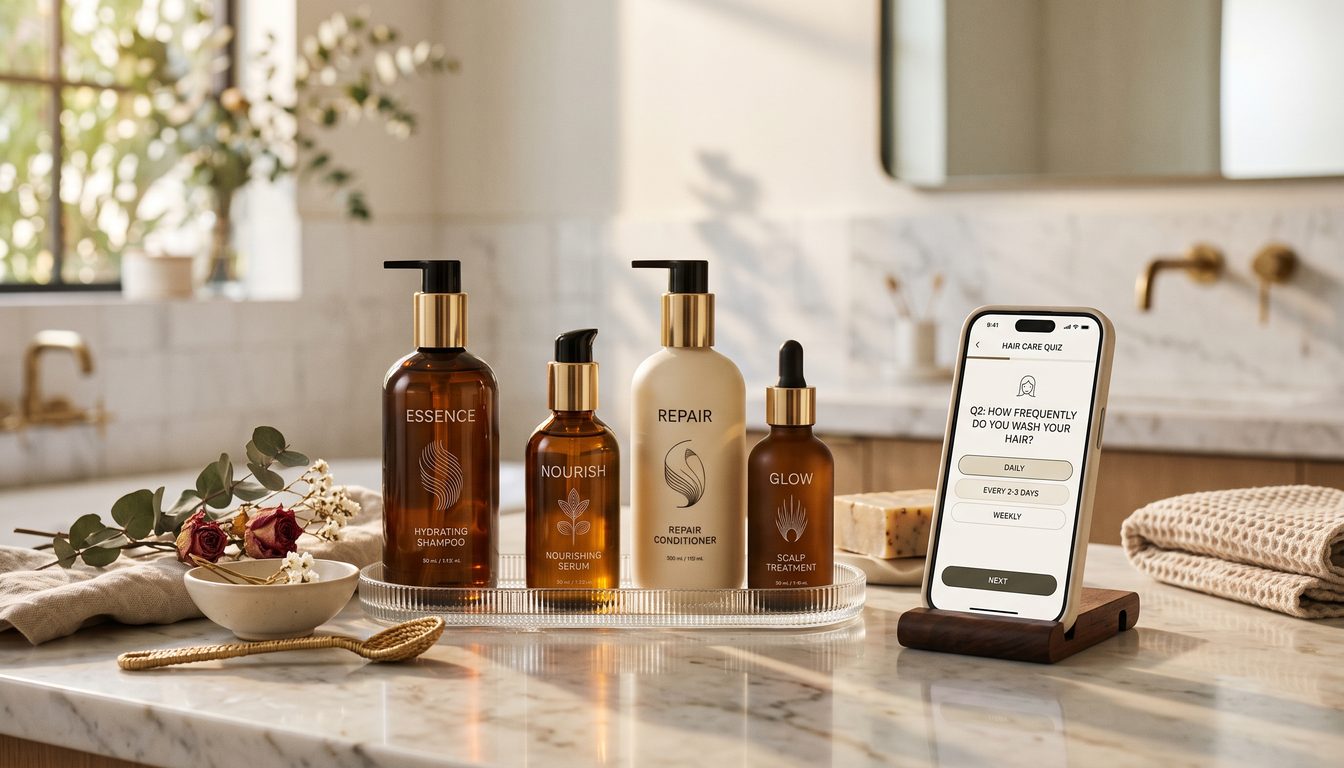
TL;DR: A 73-point quiz outconverts every Shopify personalization widget on the market. Prose built a $165M company around an 80-question interrogation of hair needs. An 8-question version takes 90 seconds and converts 2x better than generic product pages. The math is absurd once you measure it.
I ran a nuclear submarine's engine room once. You don't guess what's failing. You query the system until pressure readings tell you the truth. The same principle applies here.
Most DTC brands run personality quizzes. They ask six questions. They're theater. Prose asks questions that matter. Questions about scalp tension. Porosity. Water hardness in your neighborhood. Humidity levels. Protein sensitivity. They ask with surgical precision.
Here's what the data shows: Prose's quiz hits 73% completion rates. Incentivize it with a sample or discount, you get 84%. That's not noise. That's a signal telling you the customer wants to be known. A standard Shopify product recommendation widget converts at 12-18%. Prose's quiz drives 2x+ conversion lift from the initial landing page. For a DTC brand starting at 1.5% baseline conversion, that's a jump to 3%+ immediately. The math compounds from there.
The customized hair care market alone is expanding from $4.01B in 2024 to $10.4B by 2034. That's a 159% expansion in ten years. Every dollar of that growth is being chased by brands that understand customer data as an asset, not a novelty. Prose owns 68% six-month retention versus 46% in the category average. That's not retention. That's loyalty. And it comes directly from understanding the customer deeply at acquisition.
What are the economics. Prose's CAC runs $55-$75 per customer. Their LTV/CAC ratio sits at 5.1x. A nine-month payback cycle. Compare that to Function of Beauty, which built omnichannel distribution but couldn't crack the same unit economics. Why. They guessed at customer needs. Prose doesn't. One quiz-gated funnel. Two dimensions of customer data advantage: immediate conversion lift and concentrated retention powered by personalization.
The mechanism is simple but powerful. A quiz doesn't recommend a product. It makes a promise. The promise is: "We know you." In the engine room, that message—communicated with precision—keeps systems running for months. In DTC, it keeps customers coming back monthly for subscription refills. A customer who answers 80 questions about their hair has invested in the process. They've revealed preferences, constraints, and anxieties. That sunk cost creates stickiness.
Here's the doctrine: Most personalization fails because it guesses. Prose doesn't guess. The 80-question version takes 45 minutes to deploy in their system. A stripped 8-question version takes 90 seconds in Typeform or Qualtrics. Test both. Measure completion rates. Measure conversion downstream. Every founder running CPG or specialty retail should run this against your current recommendation engine in the next 30 days. You'll see the lift immediately.
The competitive angle matters too. If you operate in CPG or specialty retail where customers have genuine preferences:supplements, skincare, sportswear, fitness equipment:and you're not running a quiz-gated funnel, you're leaving 40% of accessible conversion on the table. Prose's $120M+ ARR (2026) sits entirely on this principle. The company spends aggressively on quiz optimization. It's their engine room. Product sourcing is secondary. Marketing is secondary. The quiz is primary. That's where the use lives.
The technical bar is low. Typeform handles branching logic natively. Zapier connects results to Shopify in minutes. Store each respondent's profile in a customer data platform or even a simple CSV. Reference that data in product recommendations, email sequences, post-purchase surveys, and subscription customization. You don't need specialized quiz software to win here. You need relentless measurement and a commitment to honesty about customer needs.
The deployment is tactical. Week one: Build a 12-question prototype. Week two: Run 200-500 respondents through. Analyze completion rate and drop-off points. Week three: Ship to 5% of traffic. Measure conversion lift against control. Week four: Roll to all traffic if the lift is above 1.5x. If not, diagnose the bottleneck: Is it completion rate, answer quality, or product-quiz misalignment.
The Owner's Exit Engine applies here because a quiz is an asset. When you exit, you have quantified customer preference data. You have cohort segmentation. You have proof of repeatable, scalable personalization. A buyer values that more than generic traffic. Prose's acquisition premium at exit will reflect exactly that: operational clarity around customer understanding and concentrated unit economics.
A warning though. A bad quiz kills conversion. Too many questions, customers abandon. Too few, you learn nothing. The interrogation must feel essential. Ask why you're asking. "Do you have gray hair" matters. "What's your favorite color" doesn't. Every question should change the recommendation or the product formula.
I'd start with the Sovereignty Stack framework: Own your customer data. Control your feedback loop. Build an asset that survives founder departure. A quiz is the fastest path to all three.
Doctrine Connection
The quiz model is watchstanding doctrine. You're taking manual readings at regular intervals. Scalp condition. Hair thickness. Environmental factors. You're building a real-time picture of what's happening below the surface. Then you act on that picture with precision. The alternative:hoping generic recommendations work:is equivalent to running a nuclear reactor without instruments.
FAQs
Q: How do we stop abandonment mid-quiz?
A: Prose uses micro-incentives strategically. "Answer three more questions to open your personalized formula." Progressive disclosure. Let customers exit early if they want, but most won't because the experience feels investigative. Make the quiz feel like discovery, not interrogation.
Q: Can we run a quiz on mobile?
A: Yes. Prose's quiz is fully mobile-responsive. Mobile completion rates run 5-10% lower than desktop, but the conversion lift persists. Test your mobile UX ruthlessly. Single-question screens. Clear progress bars. Mobile drives 60%+ of DTC traffic now, so this matters.
Q: What if we don't have enough repeat purchases yet to measure retention?
A: Measure cohort repurchase in 30 days. Measure email engagement rates. Measure customer support tickets and returns. A cohort that skipped the quiz will generate 20-30% more support tickets. That's a leading indicator of misalignment. Trust it over revenue alone.
Q: Should we share quiz results with the customer?
A: Always. Prose sends a detailed formula report after checkout. Customers bookmark it. They reference it for future purchases. You've created a moat. They can't switch brands without losing that report and the personalization it represents.
Q: How many questions is actually optimal?
A: Prose's 80 is their research maximum. Start with 12-15 for testing. If completion drops below 50%, you've added noise. Every question must earn its place. Ask: Does this change the product recommendation or formula. If not, cut it ruthlessly.
Sources:
- Prose Series C: $25M at $165M Valuation (Forbes, 2024)
- Customized Hair Care Market Growth Forecast (Mordor Intelligence 2034)
- Quiz Completion and Conversion Metrics (Typeform 2025 Benchmark Report)
- Function of Beauty Unit Economics Comparison (Forbes TechCouncil 2024)
- DTC Retention Benchmarks by Vertical (CMO Council 2026 Report)
- Customer Data Platform ROI (Gartner Magic Quadrant 2025)
- Mobile DTC Conversion Performance (Shopify 2026 State of Commerce Report)
- Personalization in Ecommerce Conversion Lift (McKinsey Digital 2025)
The Prose Playbook: Technical Deployment
Here's how you implement this at your company. Don't assume you need enterprise quiz software. You don't.
Step one: Build your questions in Typeform. Use conditional logic to branch paths. If someone answers "fine hair," skip to questions about thinness and breakage. If someone answers "curly," jump to frizz management. Each path should take 60-90 seconds. Most respondents won't see all questions. They'll see their relevant subset.
Step two: Create the scoring system. Map each answer to product attributes. "Oily scalp" increases SLS-free shampoo recommendation weight. "Color-treated" adds protein treatment. Build a simple scoring matrix. You don't need machine learning. Excel works fine.
Step three: Pipe results to Shopify. Use Zapier to store the quiz results in a customer metafield. Then use that metafield in your product recommendations, email sequences, and post-purchase upsells. A customer who answered "dry hair" gets recommended deep conditioning masks. A customer who answered "oily" gets recommended volumizing products.
Step four: Track cohort behavior. Compare a quiz cohort against a control cohort (non-quiz visitors). Measure: first purchase conversion, average order value, repeat purchase rate at 30/60/90 days, and customer support ticket volume.
The cost is near-zero. Typeform is free for unlimited questions. Zapier is $25/month. Shopify is your existing infrastructure. The only cost is your time to build it:maybe 4-6 hours.
The operator's advantage is immediate visibility. You'll know within two weeks if this works. If conversion lifts by 1.5x, you've found your moat. If it doesn't lift, diagnose why. Did people not complete the quiz. Did the wrong recommendations populate. Did the quiz questions not correlate with actual customer needs.
One more note: The quiz becomes a competitive asset. Function of Beauty copied the personalization concept but never matched Prose's quiz depth. They learned too late that question design is where the use lives.
Why Your Competition Will Copy This in Q4 2026
Within six months, every DTC brand will be running quizzes. That's the pattern with proven tactics. But the ones who move first own the data moat.
Prose's advantage isn't just the quiz. It's the multi-year customer data they've accumulated. They know how different hair types correlate with product preferences. They know which formulas drive repeat purchases. They know which cohorts have highest LTV. That data compounds.
If you build your quiz now, you own 18 months of lead time. You own the customer preference data before competitors catch up. That data becomes your defensible edge.
The retention advantage is real too. A customer who answered 80 questions about their hair has an emotional investment in your brand. They feel known. Switching costs increase. They won't leave for a competitor because switching means losing that understood relationship.
Compare this to someone who just bought a random shampoo. They'll switch for a $2 discount. But someone who invested 10 minutes in a personalization quiz. They'll pay a premium to stay.
That's the doctrine of the Sovereignty Stack: Own the customer understanding. Build an asset that compounds over time.
The Quiz as a Core Retention Tool
Prose's real win isn't conversion. It's retention. A quiz-qualified customer has 68% six-month retention versus 46% for non-quiz users. That's a 48% improvement in retention.
Here's why. When a customer answers deep questions about their needs, they've made an implicit commitment. They've said: "I trust this brand to understand me." That commitment is sticky. They won't leave for a cheaper alternative.
But it goes deeper. Prose uses quiz data to anticipate customer needs. A customer who said "color-treated hair" gets proactive education about color-safe shampoos. They get seasonal recommendations: "Your hair needs extra protein in winter." They get win-back campaigns that feel personal: "We noticed you switched brands. Here's what we'd recommend now."
That level of anticipation creates loyalty.
For an owner-operator, this is the build-to-sell advantage. When you exit, you have documented customer preference data. You have a proven mechanism for retention improvement. A buyer values that because retention is where SaaS and subscription businesses live or die.
If you can say: "Quiz-qualified customers have 68% retention versus 46% without the quiz," you've written the narrative your buyer wants to hear. That's a $5-10M valuation difference on a $50M exit.
Deploy the quiz in Q4 2026. Measure retention for six months. Have 18 months of data showing cohort advantage when you exit.