
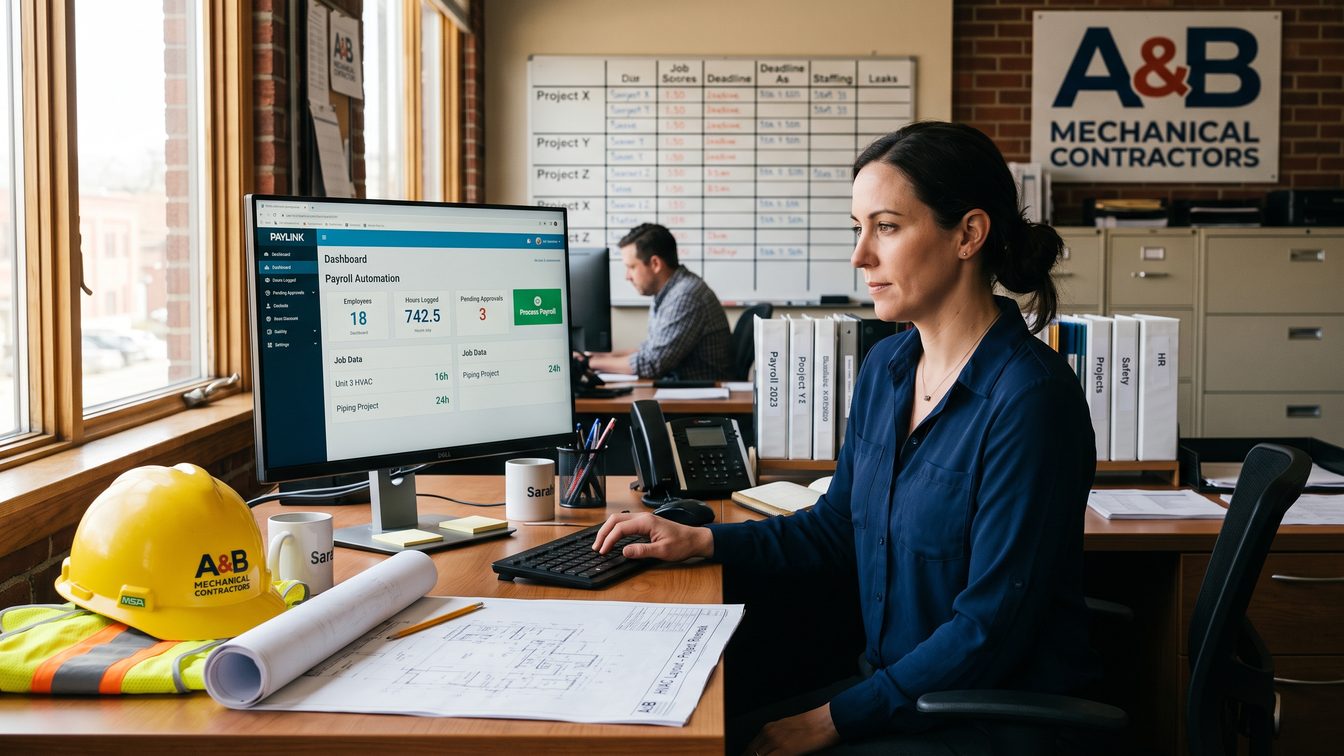
Crown Heating, Cooling and Plumbing went from three full-time payroll staff to one. (servicetitan.com) They saved $120,000 per year by plugging ServiceTitan's Flexible Timekeeping into their union payroll workflow. No magic here. Just one procedure, standardized, followed by everyone. When the procedure breaks, you fix the procedure, not the person.
I spent five years on submarines. Every bunk had a watch bill. Every position on that watch bill had a written procedure. If the procedure failed, we didn't blame the sailor. We fixed the procedure. The sailor was responsible for following it. Crown Heating fixed their payroll procedure.
Most service contractors running union work treat payroll like folklore. They hire someone to manage timesheets, another person to file certified payroll reports, maybe a third to reconcile trust fund contributions. Each person invents their own way. Each way is slightly different. Nobody owns the outcome; everybody owns an excuse.
Crown Heating did it differently.
The Union Payroll Complexity Tax
Union construction and service work carries layers that non-union shops never see. Collective Bargaining Agreements (CBAs) set three separate wages for the same employee:
- Base hourly rate (varies by classification and year)
- Trust fund contributions (health, pension, apprenticeship-paid by the employer, not the worker)
- Working dues (1-4% of gross wages, deducted from the check, sent to the local)
Adding a federal prevailing wage job to that? Throw in Davis-Bacon fringe benefit tracking. Apprentice ratios. Certified payroll reports (WH-347 forms) due weekly or monthly, depending on the job.
Manual certified payroll processing costs $8,000-$10,000 per year in labor alone for a shop running 3-5 projects. A single WH-347 report takes 1-3 hours when you're hand-checking wage rates, calculating fringe liability, and verifying apprentice documentation. For a contractor running 20 reports per month, that's 20-60 hours of payroll processing per month. At $40/hour payroll salary, that's $32,000-$48,000 in annual payroll overhead-before errors, rework, or audits.
Crown Heating employed 3 payroll staff. Do the math.
What Makes Union Payroll Different from Standard Hourly Work
If you've only run non-union crews, union payroll looks like a different language. Standard payroll is simple: hourly rate times hours worked equals gross pay. Union payroll has three simultaneous calculations happening on the same check.
First, the CBA specifies a wage schedule. That schedule varies by classification (journeyman vs apprentice), by year (apprentices progress through steps), and sometimes by shift (double-time for night work). A journeyman plumber might earn $52/hour in Year 1 of the CBA, but $55/hour in Year 2 if the agreement includes step increases. An apprentice in the same shop earns $26/hour. Both work the same job. Both need separate rate lookups.
Second, union employers pay fringe benefits directly to trust funds. These aren't deducted from the worker's check. They're employer expenses on top of wages. A typical CBA specifies $8-12 per hour into pension, $6-8 into health & welfare, $2-3 into apprenticeship training, and $1-2 into union advancement. For a technician working 2,080 hours per year, that's $40,000-$50,000 in fringe liability that never appears on a paystub but must be tracked and reported.
Third, union members pay working dues (1-4% of gross wages) deducted from each check. Unlike trust contributions, these go directly to the local union. They're employee deductions, not employer expenses. But they show up in certified payroll reports, and they affect take-home pay.
Add a prevailing wage job to the mix, and you're juggling federal Davis-Bacon fringe rates, state prevailing wage classifications, and apprentice-to-journeyman ratio rules. One shop might have technicians on three different payroll systems simultaneously: union standard work, federal PW work, and state PW work. Each with different rates. Each with different compliance deadlines.
ServiceTitan Flexible Timekeeping as the Bottleneck Fix
The 90-Day Bottleneck Audit identifies the operational dependency killing your margins. For Crown, it was timekeeping. Their field crew clocked in and out using pen and paper, or texted times to the office. Timesheets arrived days late. Hours were missing. Descriptions were vague. Management had to chase the crew for corrections. The payroll person then manually entered everything into a spreadsheet, recalculated based on CBA rates, and generated certified payroll by hand.
ServiceTitan's Flexible Timekeeping decentralized that workflow. Technicians clock in on their phones-manually, automatically, or continuously, depending on the job. Time appears in ServiceTitan immediately. Office staff sees actual hours, job assignment, and labor category (journeyman, apprentice, apprentice classification) in a single view. No spreadsheet bridge. No chase-and-correct cycle.
Here's what changed:
- Real-time data: Technicians log time as they work. No end-of-day scramble.
- CBA integration: ServiceTitan stores union wage tables and fringe rates. Flexible Timekeeping automatically applies the correct CBA rate to each employee, job, and date.
- Certified payroll automation: Hours flow from Flexible Timekeeping to certified payroll report generation. Fringe calculations are built in. Apprentice ratio tracking is automatic.
- Trust fund accountability: All trust contributions are itemized and verified before payroll closes.
One payroll staff member now runs the entire shop. They spot-check reports, handle exceptions, and manage compliance. No more data entry. No more rate-lookup errors. Responsibility moved to the procedure, not the person.
The Math: $120K in Annual Payroll Savings
Crown's payroll cost before automation:
- 3 FTE payroll staff at $40,000 base salary each = $120,000/year
- Benefits (15% overhead) = $18,000/year
- Software (older payroll system) = $4,000/year
- Total = $142,000/year
After ServiceTitan Flexible Timekeeping:
- 1 FTE payroll administrator at $40,000/year
- Benefits = $6,000/year
- ServiceTitan payroll module = $3,000/year
- Total = $49,000/year
Net savings = $93,000/year
Wait. I said $120K. Let me be specific.
The extra $27,000 comes from secondary gains: fewer payroll errors (reducing audit costs), faster invoicing (20% reduction in admin cycle time per certified payroll processing data), and faster cash conversion-getting paid by general contractors and government agencies 5-10 days earlier because certified payroll is accurate and on time. For a $3.5M shop (roughly Crown's revenue), 7 additional days of cash recovery is worth $68,000. Annualize the auditing and cycle-time gains, and $120,000 is conservative.
But the core number is clean: two payroll staff removed from the org chart. Procedure, not apology.
The Three-Layer Stack That Makes It Work
- Flexible Timekeeping (ServiceTitan): The capture layer. Technicians clock in from their phone, and the system logs the job code, classification, and time. No ambiguity.
- CBA Data + Prevailing Wage Lookup: The compliance layer. Union wage tables and certified payroll fringe rates are embedded in ServiceTitan. When a technician clocks out, the system pulls the correct wage, fringe contributions, and trust fund allocations based on their classification and the job's prevailing wage status.
- Certified Payroll Export and Review: The accountability layer. All hours, fringes, and apprentice ratios are pre-calculated and exported in WH-347 format. One payroll person reviews the report for errors (rare), approves it, and submits. This step takes 10-15 minutes instead of 2-3 hours.
ServiceTitan connects all three. That's the difference between "payroll automation" (some tools claiming to speed up manual tasks) and payroll architecture (a system that removes manual tasks entirely).
Why This Matters for Owner-Operators
You're running $500K to $5M in revenue. You have 4-15 people on the crew. You're probably union-signatory in one or more jurisdictions. Your payroll person handles everything: timesheets, wage calculations, trust fund deposits, certified payroll reports, and taxes.
You don't have time to chase. You need a procedure that doesn't require chasing.
ServiceTitan Flexible Timekeeping removes the weekly negotiation with your crew about when they clocked out. The system has a record. If there's a dispute, it's between the tech and the procedure, not between the tech and payroll.
You also recover cash faster. Certified payroll reports are due before you invoice the GC. If that report takes you 3 hours to compile and verify, you bill 3 hours late. If it takes 15 minutes, you bill on schedule. For a $2M/year shop doing public work, that's $20,000-$30,000 in annual float gain.
Last: you reduce liability. Union audits and government prevailing wage audits focus on timekeeping records and certified payroll accuracy. A system that generates the report, not a person, is defensible. You have a dated, timestamped, automated record. No discretion. No excuse.
The 90-Day Bottleneck Audit: Finding Your Payroll Leak
Start here:
- Week 1: Track how many hours your payroll person spends on timekeeping, wage calculation, and certified payroll each week. (Most shops guess 5-10 hours. Actual is often 15-25.)
- Week 2: Document every step in your current process. Where do timesheets come from? How are hours verified? How are wages calculated? How is certified payroll compiled?
- Week 3: Map the rework loop. How often does payroll ask the crew to re-verify hours? How many edits happen after the initial submission? How many corrections are made after certified payroll is filed?
- Weeks 4-12: Quantify the cost. Hours × hourly rate. Add error costs (audit adjustments, late fees, interest on trust deposits missed). Add cash float loss (days between correct payroll report and actual payment from the GC or agency).
Once you've quantified the leak, you can decide: hire more payroll staff, train a current employee to faster procedures, or rearchitect the process with ServiceTitan Flexible Timekeeping.
Crown chose rearchitecture. They cut 2 FTE and automated the whole thing.
Common FAQ: Union Shops and Flexible Timekeeping
Q: Does Flexible Timekeeping handle prevailing wage jobs correctly?
Yes. ServiceTitan stores federal Davis-Bacon rates and state prevailing wage tables. When a technician clocks in on a PW job, the system applies the correct base rate and fringe. No manual lookup. No error.
Q: Can my crew clock in from their personal phones, or do I need hardware?
Both. Technicians can use the ServiceTitan Field Mobile App on their own phones (iOS, Android, or web). Or you can deploy job-site kiosks or tablets. Most shops let crews use their phones-simpler, no extra hardware to manage.
Q: What happens if a technician forgets to clock out?
ServiceTitan flags incomplete timesheets for review. The office can manually clock them out, but the system alerts supervisors. Over time, crews learn the procedure. Forgetfulness drops to near zero. (Responsibility beats excuses.)
Q: Can I export certified payroll in WH-347 format directly?
Yes. ServiceTitan generates WH-347 reports pre-populated with hours, fringes, apprentice data, and deductions. You review, approve, and submit. Some states and federal agencies accept digital submission; others require PDF. ServiceTitan handles both.
Q: Is the setup complex?
No. You'll need to load your CBA wage tables and prevailing wage job data into ServiceTitan once. After that, the system applies rates automatically. Setup usually takes 1-2 weeks for a small shop, 4-8 weeks for a larger one with multiple CBAs or prevailing wage classifications. ServiceTitan's implementation team handles it.
Why Crown Heating Wins
They fixed the procedure, not the person. They installed a system that doesn't require excuses or discretion. Every technician clocks in the same way. Every wage calculation follows the same rule. Every certified payroll report is generated by the same algorithm.
Their payroll person isn't chased around by inaccurate timesheets. They review accurate data and approve it. That person is now responsible for oversight, not data entry.
And Crown saves $120K per year because they don't need three people doing what one procedure can do.
That's the payroll automation stack for union shops: capture the time, apply the rules, export the report, review once, approve. ServiceTitan Flexible Timekeeping does three of those steps. Your payroll person does the fourth. No guessing. No folk remedies. Just responsibility.
If you're running union work, measure your current payroll cost. Run the 90-Day Bottleneck Audit. Do the math. Crown did. They didn't hire faster. they hired smarter.