
The Shift That Renders Traditional SEO Reporting Incomplete
Answer Engine Optimization (AEO) is no longer theoretical. Your clients' prospects are asking ChatGPT, Gemini, and Perplexity instead of typing into Google. When a buyer asks "best consulting firm for digital transformation," the answer engine names three to five brands—or names none of yours. Traditional SEO tracks rankings. AEO tracks whether AI systems mention you at all. The gap between those two metrics is where your audit vulnerability lives.
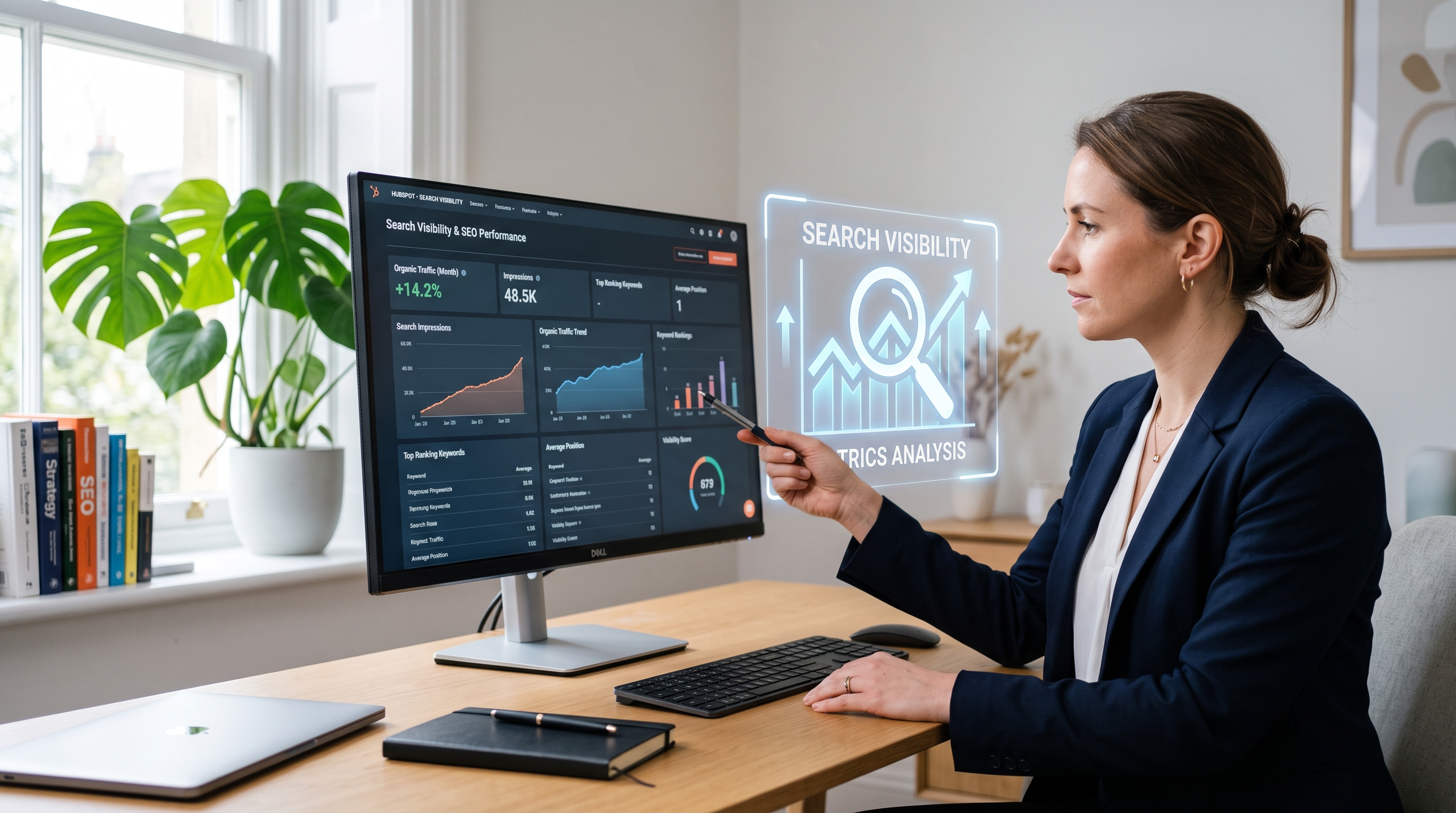
HubSpot's AEO dashboard is free for 28 days. In that window, consultants can establish a baseline of client AI visibility, identify where competitors appear and clients don't, and deliver a concrete action plan. The tool requires no technical setup beyond a brand name and website URL. What you get: brand visibility scores across three engines, prompt-by-prompt performance, citation source maps, and competitor positioning. More important: the data arrives structured and actionable.
The Navy Lesson on Instrument Reading
Early in my Navy career, I stood watch on a submarine. The engine room had dozens of gauges—pressure, temperature, bearing, fluid levels. Every reading was accurate. What mattered was knowing which reading to trust first when something shifted. We had a standing doctrine: "Trust but verify every instrument reading." Never isolate one gauge. Cross-check. Look for the pattern.
AEO dashboards produce dozens of metrics. Brand visibility. Sentiment. Share of voice. Competitor landscape. Citation analysis. Most consultants look at one number:visibility percentage:and miss the diagnosis. The real work is triangulating the readings: Which engines show your client? Which don't? Which sources shape the gaps? What does sentiment tell us that visibility misses? The procedure matters more than the headline number.
What the HubSpot AEO Dashboard Actually Measures
HubSpot AEO tracks four core dimensions across ChatGPT, Gemini, and Perplexity. First, Brand Visibility: the percentage of tracked prompts where your client's brand appears in AI answers. If you track 25 prompts and your client appears in five, that's 20% visibility:your baseline. Second, Prompt Coverage: which specific questions trigger mentions. Third, Competitor Landscape: Share of Voice (what percentage of total brand mentions belong to your client) and which competitors consistently outrank them. Fourth, Citation Analysis: which domains, pages, and content types answer engines cite when responding to category prompts.
The dashboard also surfaces sentiment:whether AI describes your client positively, negatively, or neutrally. This is where trust signals either compound or collapse. A client with 15% visibility but 85% positive sentiment occupies a different risk profile than one with 15% visibility and neutral or negative associations.
Setup takes 15 minutes. Enter your client's brand name, website, competitors (HubSpot auto-suggests them), and any products or services to track. HubSpot generates prompts from your company context, or you can add custom questions your clients' buyers actually ask. The system runs tracked prompts daily. Data begins accumulating immediately.
The 90-Day Bottleneck Audit Framework
Most AEO work stops at visibility reporting. Consultants show a dashboard and assume the client will act. That's how audits become shelf-ware. Instead, adopt the 90-Day Bottleneck Audit: a structured three-phase process that moves from diagnosis to execution priority to measurement.
Phase 1 (Days 1–30): Baseline and Gap Mapping. Run prompts across all three engines. Document where your client appears, where competitors dominate, and which prompts show zero visibility. This is data collection. Don't interpret yet. Just collect the signal.
Phase 2 (Days 31–60): Source Inventory and Content Gap Analysis. Examine the citations report. Which content types appear most (listicles, comparisons, reviews, YouTube)? Which channels (peer reviews, earned media, user-generated)? Which competitor domains consistently show up? Then ask: Does my client have equivalent coverage? If competitors own five listicles and my client has one blog post, that's the bottleneck.
Phase 3 (Days 61–90): Action Prioritization and Execution Roadmap. Rank fixes by impact and effort. Creating a listicle beats waiting for a YouTube strategy. Updating existing pages beats green-field writing. Claiming listings beats earned media campaigns. Assign ownership, set deadlines, measure.
This framework transforms an audit from a report into a operating system. It compartmentalizes work into achievable phases. It answers the question every founder-operator asks: "What do I do first?"
What the Dashboard Shows That Manual Auditing Doesn't
Without a tool, you'd manually prompt ChatGPT, Gemini, and Perplexity 25+ times, screenshot answers, read each mention, categorize sources by hand, and compare to competitor presence. That's 8–12 hours per client. You'd miss consistency patterns. You'd capture a snapshot, not a trend. You'd have no way to measure whether a content update actually moved the needle.
The HubSpot dashboard automates the legwork. It runs prompts daily. It aggregates responses. It calculates visibility percentage and trend over time. It maps competitor mentions. It categorizes citations by type and channel. It surfaces recommendations.
What matters: the dashboard shows you consistency patterns that manual work obscures. If your client's visibility jumps 10% one day and falls 5% the next, that's noise:or it's a signal that a new page ranked. The trend view lets you separate signal from volatility. You can tell a client, "Your visibility is stable at 20% across ChatGPT and Gemini, but Perplexity shows 8% and declining." That's diagnosis. That's actionable.
One constraint: the free trial includes 25 prompts daily. If your client needs 50 or 100, the paid plan ($50/month standalone; included in Marketing Hub Professional) adds capacity. For most consultants auditing SMB and mid-market clients, 25 is sufficient to establish baseline and gaps.
External Evidence: Where AI Citations Concentrate
Sourcebow's analysis of AEO citation patterns (July 2026) found that 35% of AI citations come from listicles:the single largest bucket. Multimedia (video) and blogs follow. Product pages and documentation trail far behind. This pattern matters because it tells a client where to focus content creation. If 35% of competitive citations come from listicles and your client has zero comparison guides, you've found the bottleneck.
Veza Digital's research (2026) shows that technical readiness:schema completeness, robots.txt rules for AI crawlers, llms.txt files, and E-E-A-T signals:directly correlates with AI citation volume. Pages with First Contentful Paint under 0.4 seconds average 6.7 AI citations versus 2.1 for slower pages. The audit reveals whether your client's site is even technically visible to AI crawlers, let alone citation-worthy.
BeCited's 2026 audit framework emphasizes that AI visibility differs by engine. A brand dominant in Perplexity can be invisible in ChatGPT. The HubSpot dashboard separates results by engine, so you can tell a client: "You're strong in ChatGPT but weak in Gemini. Here's why, and here's the fix." That's specificity that a blended visibility score cannot provide.
When HubSpot AEO Works Best (and When It Doesn't)
The dashboard excels for consultants auditing clients in competitive categories where AI answer visibility matters: SaaS, professional services, agencies, e-commerce, healthcare, fintech. If your client sells something that buyers research via AI, this tool delivers value.
It's less useful for highly specialized or niche products where buying happens offline, by referral, or without AI research. It also requires consistent prompts:tracking "best email tool" without refining to "best email tool for e-commerce" or "best email platform for nonprofits" dilutes the signal. You need to bake buyer personas and intent into your prompt selection, not rely on HubSpot's auto-generated list.
One more thing: the tool measures visibility and citations, not traffic or conversions. You can see that your client appears in 30% of AI answers, but the dashboard doesn't show whether that visibility converts to leads. You'll need to track that separately by monitoring UTM parameters from ChatGPT, Perplexity, and Gemini referral traffic. The audit tells you the starting position. Your analytics tell you the outcome.
FAQ
Q: Do I need a HubSpot account to use the AEO dashboard?
Yes. The AEO tool lives inside HubSpot, accessible via Marketing > AEO. If you don't have a HubSpot account, you can create one free. The 28-day trial is available immediately. If your client uses HubSpot, even better:the CRM data enriches prompt suggestions and recommendations.
Q: How long before I see meaningful trends?
Week 1 gives you a baseline. Week 2–3 shows whether the numbers are stable or volatile. A true trend takes 4–6 weeks. Don't react to day-to-day swings. Look at weekly aggregates over 30+ days. That's when signal emerges.
Q: What if my client's competitors aren't in the dashboard when I set it up?
Edit the competitor list manually. Click Settings on the Dashboard tab, select "Edit Competitors," and add up to five direct competitors. HubSpot's auto-suggestions are a starting point, not final. Your domain knowledge matters more.
Q: Can I export the data for client presentations?
Yes. The Dashboard, Prompts, and Citations tabs all support filtering and export to spreadsheet. Build your own slides or charts. The raw data is yours. (Note: HubSpot doesn't have a one-click "export to PDF" for the full dashboard:you'll compile manually or screenshot tabs.)
Q: What's the difference between AEO and traditional SEO audits?
SEO audits measure ranking position in Google organic results and track keyword volume, backlinks, and on-page optimization. AEO audits measure whether your brand is mentioned at all in AI-generated answers:a fundamentally different question. Both matter, but they're not interchangeable. A client can rank #1 for a keyword in Google and still be absent from ChatGPT responses for the same question.
Doctrine Connection
Due diligence is non-negotiable. In capital and operations, we say: verify every assumption. HubSpot AEO enforces that discipline in the AI visibility space. It lets you run the procedure, not guess. Every prompt produces evidence. Every claim about visibility or competitors has a receipt. The cost is minimal:$50/month or free for 28 days. The work is straightforward. The alternative is deploying content strategy without knowing whether your client shows up in the systems buyers use.
Disclaimer
*HubSpot AEO is a tool for measuring AI visibility, not a guarantee of traffic, leads, or revenue. This audit framework is a starting point:not a substitute for your expertise in your client's business, market, and buying process. Results vary by industry, competitive intensity, and implementation discipline. Verify findings with your own judgment. The dashboard shows you the landscape; you decide the strategy.*