
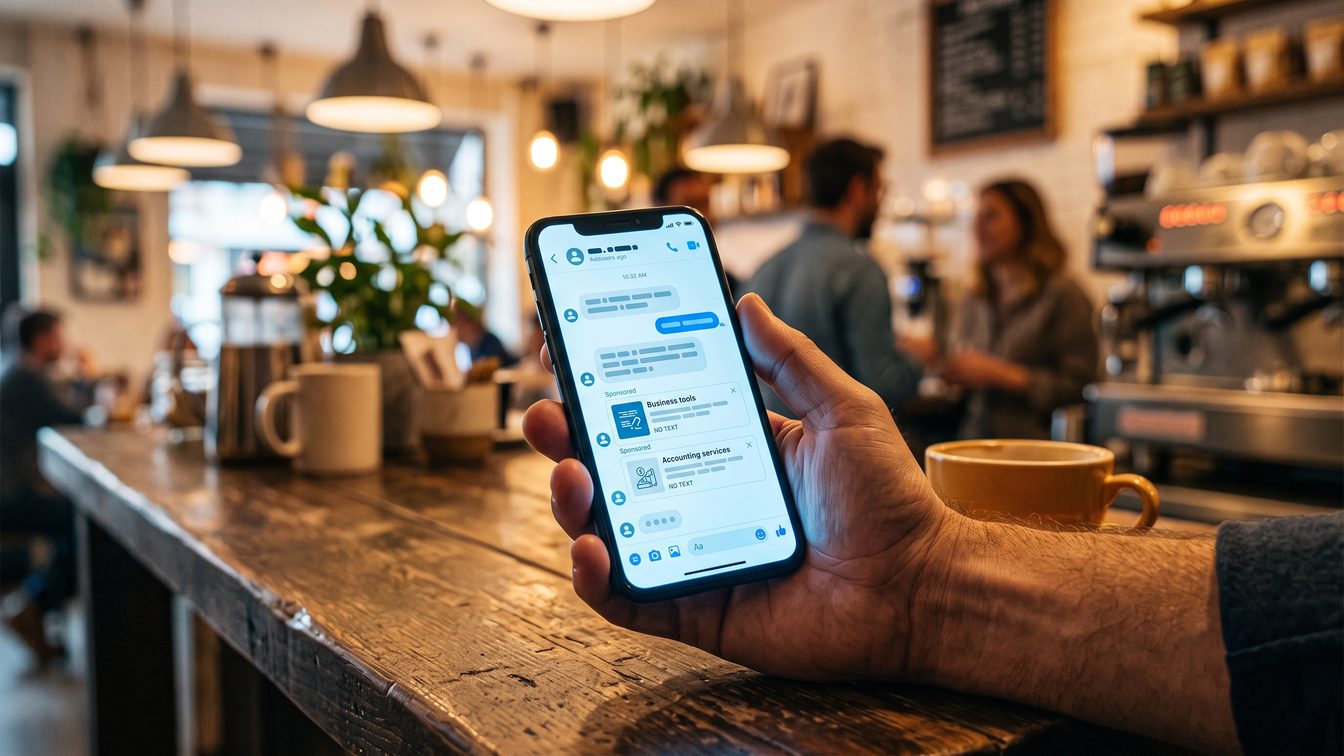
ChatGPT Ads oCPC (conversion-optimized CPC) went into open beta this month, and OpenAI's own developer documentation says the quiet part out loud: "oCPC optimizes delivery toward your selected conversion event, but billing is still based on valid clicks. You are buying better-selected clicks, not conversions." Read that twice before you set a budget.
Most of the coverage this week is buzzing about multi-product carousels. Ignore that noise if you run a service business. Carousels are built for catalog retailers with product feeds, full stop. If you close $5K-$50K service contracts, the feature that matters to you is oCPC on a standard conversion event, and the setup sequence has traps that will lock you into a bad campaign for good.
Here is the watch bill: what to set up, in what order, and where the permanent mistakes live.
The Core Mechanic: You Pay Per Click, Not Per Result
Get this straight before anything else. oCPC does not bill you when a lead converts. It bills you per valid click, same as standard CPC. What oCPC changes is which clicks OpenAI shows your ad to first: it biases delivery toward users statistically more likely to complete the conversion event you nominate. Your cost per conversion is a calculated number, spend divided by conversions, not a number you set going in.
This distinction changes how you should think about budget. You are not buying appointments. You are buying a smarter draw from the same pool of clicks, at the same per-click billing model you already know from search ads. If your landing page cannot convert a well-targeted click into a lead, oCPC will not save you. It will just find you better clicks faster and still bill you for every one of them.
Three Decisions That Lock Forever at Campaign Creation
According to a detailed oCPC guide from ContextHints, three settings lock the moment you create the campaign: the objective, the conversion event, and the campaign type itself. You cannot convert an existing CPM or CPC campaign into an oCPC campaign after the fact. Get any of the three wrong and your only remedy is building a new campaign from scratch, losing whatever learning data the locked-in campaign had accumulated.
This is a casualty drill, not a settings menu. Treat the creation screen the way you would treat arming a system you cannot safely disarm. Slow down. Confirm every field before you submit.
Step-by-Step: The Setup Sequence for Service Businesses
Step 1: Pick your conversion event before you open the campaign builder. OpenAI supports exactly 13 standard conversion events for oCPC eligibility: order_created, lead_created, appointment_scheduled, subscription_created, trial_started, plan_enrollment, checkout_started, items_added, contents_viewed, page_viewed, and a handful of others. Custom conversion events are not eligible for oCPC optimization, according to Search Engine Land's coverage of the rollout. For a service business, that means the decision is almost always between lead_created and appointment_scheduled. If your funnel ends at a form fill, pick lead_created. If it ends at a booked call, pick appointment_scheduled. Do not pick both and do not pick a custom event out of brand preference.
Step 2: Instrument tracking through Conversions API, not just the pixel. The pixel alone is fragile: browser privacy settings and ad blockers degrade its signal. Server-side Conversions API tracking is more reliable because it reports the event from your server, not the user's browser. Set up both if you can, but do not launch an oCPC campaign on pixel-only tracking if you have any other option.
Step 3: Confirm Automatic Advanced Matching is configured deliberately, not by default. Automatic Advanced Matching (AAM) became the default for all new pixels immediately, and auto-enabled for existing pixels on August 17 unless the advertiser opted out. AAM improves match rates by sending hashed customer data alongside the standard event. Know that it is on. Decide whether your data-handling policy is comfortable with it before launch, not after.
Step 4: Set your Bid Cap to your real customer acquisition cost ceiling, not a guess. Bid Cap is the maximum CPC you will pay. The actual price is determined by auction and typically comes in lower. At the API level this parameter is called max_bid_micros. Calculate your acceptable cost-per-lead from your existing close rate and deal value, then set the cap below that number with room for the auction to work.
Step 5: Fund a full 7-day budget cycle, not a daily test. Daily budgets became 7-day averages as of July 27, 2026: your actual daily spend can run up to 2x your set daily budget, and your maximum 7-day spend caps at 7x the daily budget. Do not panic if day two comes in heavy. Judge the campaign on the 7-day window OpenAI is actually managing it against.
Step 6: Give it 2-3 weeks before you touch anything. oCPC needs conversion volume to learn which clicks convert. Under-fund it or start optimizing on day four and you starve the system of the data it needs to do the one thing you are paying it to do.
Why This Channel Matters Right Now
Here is the part that should change your urgency, not just your setup checklist. Buyers are asking ChatGPT for vendor recommendations mid-decision, in the exact moment they would otherwise be searching Google. ChatGPT Ads remain in beta with a gradual, geography-limited rollout, now expanded to the UK, Mexico, Brazil, Japan, and South Korea as of this month. Most service-business agencies have not touched this channel yet. That is not a permanent advantage. It is a window.
I spent six years in the Navy standing watch on nuclear reactor systems before I ever wrote a marketing plan. The lesson that transferred directly: the advantage goes to the watch team that acts on the intelligence report before the report becomes common knowledge. By the time this channel is crowded, the cost-per-click curve will have moved against late arrivals the same way paid search did a decade ago. Early movers set the auction floor. Late movers pay it.
For a service business closing 30-60 day sales cycles on $5K-$50K contracts, showing up as a clicked, tracked ad inside a buyer's ChatGPT conversation can compress 7-10 days out of that cycle just by intercepting the decision earlier than a cold search ad would. That is not a guess. It is the same mechanism that made proposal-speed compression valuable for agencies: shrink the window between intent and contact, and your whole pipeline gets more efficient.
The Integrations Worth Setting Up
OpenAI added measurement integrations with Triple Whale, Sonar AI, and Hightouch this month, feeding conversion data back into the platform to sharpen oCPC's targeting over time. If you already run one of these in your stack, connect it before launch. If you do not, do not buy a new tool just for this. Conversions API alone is sufficient to get a service business campaign running correctly.
Reading the Weekly Report Like a Watchstander
Once your campaign clears the 2-3 week learning window, you will get a weekly report showing spend, clicks, average CPC, and conversions. Do not read these numbers in isolation. Read them together, the way you would read a set of reactor plant gauges: no single needle tells you the state of the plant, but the pattern across all of them does.
If clicks are climbing and average CPC is falling while conversions hold flat, your oCPC targeting is working correctly and getting more efficient over time. If clicks are climbing but conversions are flat and average CPC is also climbing, something in your targeting or your landing page has broken, and you need to check both before you touch the Bid Cap. If conversions are climbing faster than spend, you are underpricing your own campaign relative to what the market would bear, and you can likely raise the Bid Cap slightly to capture more volume without hurting your cost-per-conversion.
Check this report every week without exception for the first two months. After that, a biweekly check is sufficient once the campaign has stabilized. The mistake is checking daily out of anxiety during the learning window, seeing normal early-stage noise, and making a change that resets the learning period before it ever had a chance to finish.
Two More Mistakes That Cost Real Money
The first is launching on the pixel alone because it installs faster than Conversions API. It works, until a browser update or an ad blocker quietly cuts your signal and your cost-per-conversion numbers stop making sense for reasons that have nothing to do with your campaign. Fix your tracking infrastructure before you fund the campaign, not after the data starts looking strange.
The second is treating the Bid Cap as a target instead of a ceiling. Owners set it at their ideal cost-per-lead and wonder why delivery is thin. The cap needs room above your target for the auction to actually compete on your behalf. Set it too tight and you throttle your own campaign before it ever gets a fair shot at your market.
Doctrine Connection
Due diligence is non-negotiable. Three settings lock permanently the moment you click create. That is not a minor UI quirk. That is a live-fire decision with no safety on the back end. The operator who opens the campaign builder and starts clicking through defaults will end up with a locked-in objective built around the wrong conversion event, discover it three weeks later when the numbers do not add up, and have no path to fix it except starting over.
The operator who reads the documentation, decides on lead_created or appointment_scheduled before opening the tool, confirms tracking is live through Conversions API, and sets a Bid Cap grounded in real acquisition cost math walks in with a plan a casualty drill would survive. Verify the settings before you commit. There is no undo button on this one.
Q: Should service businesses bother with product carousels at all?
No. Multi-product carousels only work with product-feed campaigns built for e-commerce and retail catalogs. If you are not selling a catalog of discrete SKUs, this feature does not apply to your account regardless of how it is marketed in the rollout coverage. Set it aside and focus on standard oCPC campaigns.
Q: What happens if I pick the wrong conversion event by mistake?
You rebuild the campaign from scratch. The objective, conversion event, and campaign type all lock at creation, and OpenAI provides no conversion path from a standard CPM/CPC campaign to oCPC or between different oCPC conversion events. Budget an extra day before launch specifically to confirm this choice with whoever owns your funnel data.
Q: How much budget do I need before oCPC's optimization actually kicks in?
There is no single published minimum, but the practical answer is enough spend to generate a meaningful sample of conversions inside a 7-day budget window, typically several dozen conversion events at minimum. Under-funding the test is the most common early mistake. Give it 2-3 weeks of real spend before judging performance one way or the other.
Q: Is oCPC worth it if my landing page conversion rate is weak?
No. oCPC improves which clicks you receive. It does nothing to fix what happens after the click lands. Fix your landing page conversion rate first with a clean, single-purpose page tied to the one event you are optimizing toward, then layer oCPC on top. Otherwise you are just paying more per click to feed a leaky funnel.