
When I qualified as a submarine officer, every watch station had a laminated procedure binder. (freightwaves.com) The procedures didn't change based on rank or experience. A senior chief and a fresh-qualified ensign followed the same process. The system ran the same either way. Predictability beats improvisation.
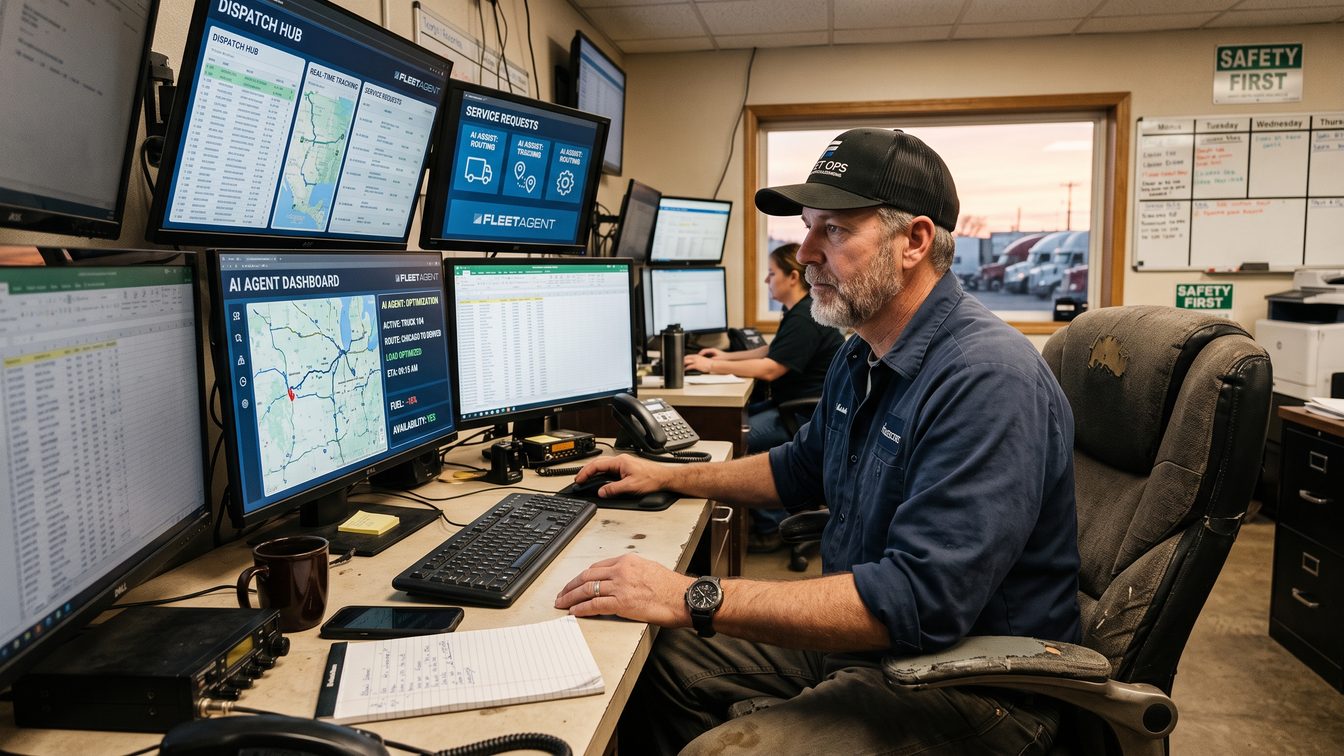
This is what Alvys Foundry just brought to freight. Owner-operators and small carriers now have access to an agentic AI platform built into the transportation management system they already run. Twenty-plus pre-built agent templates. The ability to build custom agents. A governance layer called Agent Shield that logs every action and routes high-impact decisions for human approval. An intelligent model picker that selects the cheapest capable language model for each task. One platform. One login. One source of truth.
Alvys announced Foundry on August 11, 2026. The company raised $77 million total (including a $40 million Series B in September 2025) and moves over $9 billion in freight annually. But the launch matters less for Alvys than for what it signals about how AI agents are reaching the people who need them most: owner-operators running $500K to $5M in annual revenue, managing operations alone or with a skeleton crew.
The bottleneck owner-operators face isn't complicated. It's volume. Check calls. Invoice prep. Settlement reconciliation. Track-and-trace exceptions. Load assignments. Driver compliance checks. Every day an owner-operator loses hours to tasks that don't move freight. These tasks run on spreadsheets, email threads, and manual handoffs. They don't scale without adding people. Alvys Foundry automates them inside the system where loads and processes already live. Operators hold the keys. They decide which workflows run, what guardrails govern them, and who approves what. They don't have to call a vendor for permission.
Nick Darman, Alvys CEO and a former trucking company owner, said this clearly in the launch announcement: "Over the past year, we've watched how our customers were actually adopting AI; where it helped, where it stalled, and where the hype left operators with more tools and more logins instead of more capacity." This is the core insight. AI vendors had flooded the market with chatbots, workflow tools, and "intelligent automation" that required integration work, compliance review, security sign-offs, and ongoing vendor management. The operator-owner ends up with more overhead, not less. More systems to maintain. More passwords. More vendor relationships to manage.
"I lived the other version of this as a trucking company owner," Darman continued. "Vendors got me started, then charged for every customization, every report, every integration. They held the keys, and leaving was a struggle. We are building Alvys Foundry so our customers hold the keys instead. The user should hold the power, not the vendor." This is freedom. Not comfort. Not the comfort of outsourcing your automation to a vendor who extracts fees for every change. Freedom to own your process, modify it without permission, and switch it off without struggle.
The Upwork Research Institute reported in Q1 2026 that 62% of SMB leaders are very confident in handing high-stakes tasks to AI agents, but only one in three see AI agents as mission-critical to strategy. Conviction outruns proof. The gap isn't hype. It's friction. The SMBs piloting AI agents still operate on conviction while waiting for productivity gains that require integration work, data cleanup, and change management. When AI lives where the work already happens, conviction becomes proof. The productivity gains arrive when the operator doesn't have to maintain separate systems, retrain staff, or negotiate every change with a vendor.
Foundry's governance layer, Agent Shield, is important here. It logs agent activity, keeps actions traceable, and routes high-impact decisions for human approval. This is not permission theater. This is operationalization of policy. You define which tools each agent can touch, which data scopes apply, and which decisions require human sign-off. The system enforces it at runtime, and the audit trail proves it happened. Carlos M. Llanes Jr., CEO of Spartan Carrier Group and an early Foundry customer, said: "Foundry is not AI for show. It is AI with a job description. For Spartan, Alvys Foundry feels like having our own R&D team embedded inside the operation without having to build one ourselves. It helps remove the manual friction from freight so our people can stay focused on judgment, service, and elite execution." That's the pattern working.
Alvys opened its platform to owner-operators and small carriers as part of this launch. Before, the TMS was built for larger fleets with dedicated operations staff. The platform now scales from owner-operators with a single truck to enterprise carriers. This is democratization, but the word obscures what actually happened. Alvys didn't strip down a product for the SMB tier. It opened a platform. It made the building blocks available. It trained operators to assemble agents on their own, while keeping pre-built templates available for teams without engineering resources. This is different from every major software company's approach to SMBs: scaling down, simplifying, reducing features. Alvys handed operators the power to scale up without waiting for vendor permission.
The trend extends beyond freight. Upwork's 2026 data shows that across every use case and business function surveyed, SMB leaders piloting AI agents outnumber those not considering it at all. Hermify, a guide to AI agents for small business owners, identified the actual bottleneck: "Most small businesses are an owner, maybe a co-founder, maybe one or two part-time helpers. The bottleneck is not 'we need 20 specialized agents talking to our CRM.' The bottleneck is the supplier email that has been sitting unanswered for three days, the invoice that should have gone out on Tuesday, the customer who asked a question on Friday and is still waiting, and the quarterly numbers nobody has totalled since March." This is every service business. Accountancy firms. Law practices. Staffing agencies. Contractor networks. HVAC shops. The pattern is identical: founder-led, resource-constrained, manual processes burning time.
Intelligent model selection is a detail worth attention. Alvys Foundry includes a model picker that selects the cheapest capable large language model for each task. This is cost-aware scaling. A check-call automation task doesn't need GPT-4; a smaller model handles it faster and cheaper. An invoice-prep workflow might need more capability. The system routes each task to the right model, reducing compute costs as usage grows. Most AI platforms hide this from users. Hide the decision. Hide the cost. Foundry surfaces it. Operators see what's running where and why. They can adjust thresholds. They can switch models. This is transparency as a feature. This is treating the operator as competent.
Foundry was first shown at Alvys' June 17 Customer Advisory Board meeting. The first customer cohort filled immediately. The second cohort's waitlist is open. Alvys has built 120-plus integrations and maintains native EDI connections to hundreds of shippers. The platform sits on SOC 2 security. Foundry builds on existing AI capabilities already running throughout the TMS: Insights (an AI chat and report builder), Intel (real-time weather and load alerts), and AI-assisted load creation. The company maintains enterprise agreements with leading model providers so customer data isn't used to train public models. These details matter because they show how Foundry wasn't bolted on. It was built in. The platform knows about loads, margins, lane history, driver compliance, shipper rules, and appointment windows because it lives where that data already exists.
The lesson for other service businesses is direct. You don't need a separate AI platform. You don't need another vendor. You don't need custom integration or compliance theater. You need AI that works inside the system where your people already operate. You need procedures that don't change based on who runs them. You need governance that's enforced, not documented. You need models that are cost-aware. You need to hold the keys.
This applies across every service vertical. Accounting firms running QuickBooks or Xero need agents inside those systems to prep tax docs and reconcile client accounts. Law practices need agents inside their case management systems to draft motions and calendar critical deadlines. Staffing agencies need agents inside their ATS to screen candidates and schedule interviews. The pattern is the same in every case: the work happens in systems that already exist. The operators who run those systems shouldn't have to leave them to access AI tools.
Alvys opened their foundry to owner-operators because Nick Darman lived that world. He understood vendor lock-in. He understood the cost of customization. He understood that a small operation can't afford to wait three months for a vendor engineer to add a feature. He understood that procedures are power. The same procedures, executed the same way, by anybody, produce the same result. This is freedom. Not the freedom to experiment endlessly. The freedom to own your process, modify it when you need to, and switch it off when you don't.
The submarine taught me that procedures are power. Same procedure, same result. The operator who runs the procedure doesn't matter. The procedure guarantees the outcome. This is what Alvys Foundry does for freight and logistics operations. And this is what every service business should demand from the AI tools they adopt next. Not comfort. Not convenience. Not the comfort of outsourcing your thinking to a vendor. Freedom to own your process. Freedom to modify it. Freedom to move when the vendor stops serving you.
Sources
FAQ
What is Alvys Foundry?
Alvys Foundry is an agentic AI platform built directly into Alvys TMS. It lets freight teams deploy pre-built or custom AI agents inside the transportation management system they already run. Operators choose from 20-plus pre-built templates, build custom agents with Alvys engineers, or assemble their own agents using platform building blocks.
Who can use it?
Foundry is available to all Alvys customers, from owner-operators with a single truck to enterprise carriers. Alvys also opened its TMS platform to fleets of all sizes in August 2026, expanding beyond the larger carriers it traditionally served.
How does Agent Shield work?
Agent Shield is a governance layer that logs every agent action, keeps actions traceable, and routes high-impact decisions for human approval. Operators define which tools each agent can use, which data scopes apply, and which decisions require human sign-off. The system enforces these rules at runtime and maintains an immutable audit trail.
What kind of work does Foundry automate?
Early use cases include check-call automation, invoice and settlement prep, track-and-trace exception handling, and load assignment. Foundry targets the manual work that still ties up freight teams. Operators can define custom workflows based on their own SOPs and rules.
How does the intelligent model picker work?
Alvys Foundry includes an intelligent model picker that automatically selects the cheapest capable language model for each task. This optimizes compute costs as usage grows. A check-call automation task might use a smaller, faster model, while invoice prep might need more capability. The system routes each task to the right model.