
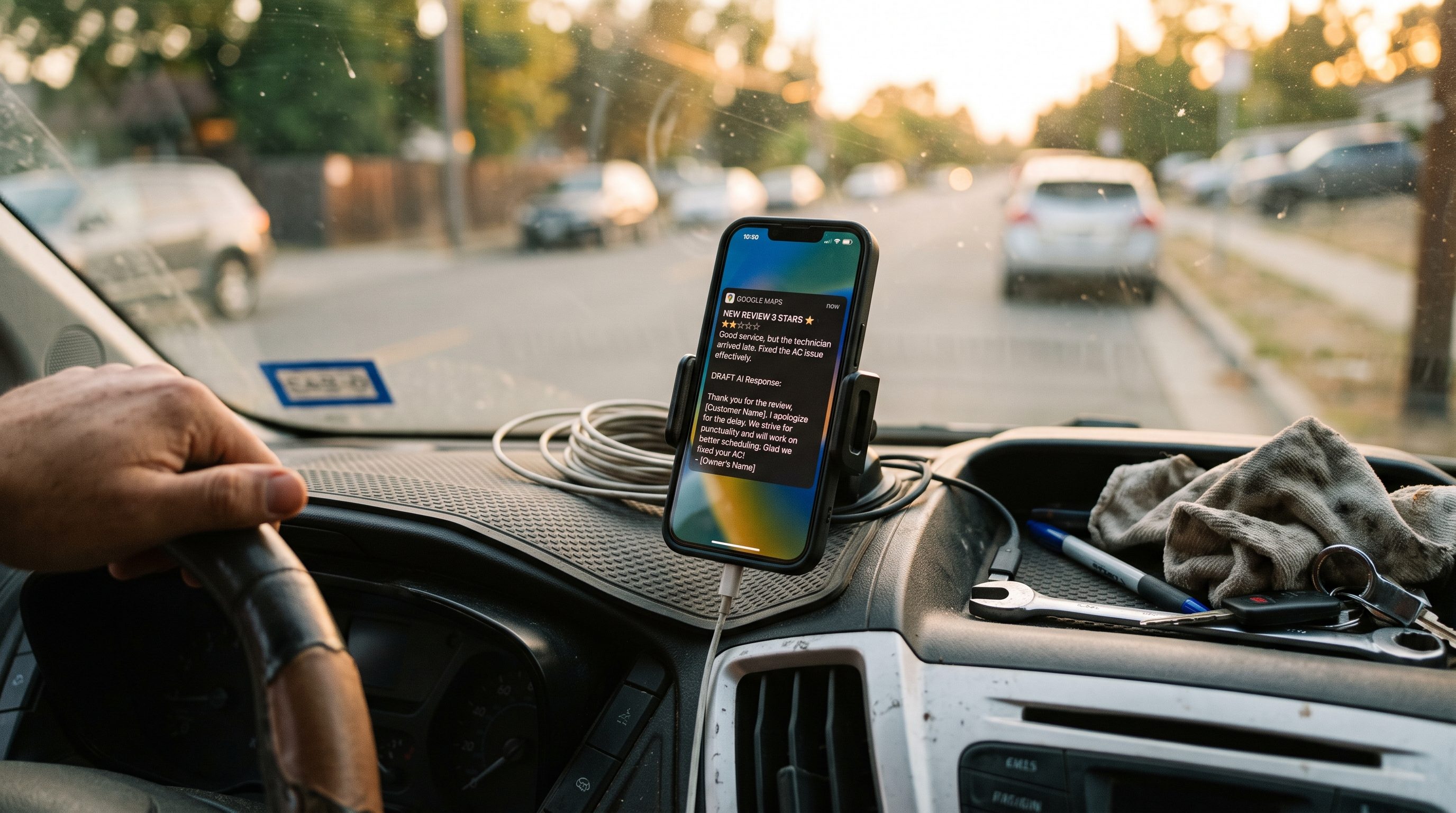
The 3-star review is the most valuable review your business will ever receive, and most owner-operators treat it like garbage. Here is the direct answer: a 3-star review is a customer who liked you enough to not leave one star, but was disappointed enough to leave a signal. That customer is still reachable. Respond within 4 hours with an AI-assisted review response system, and you convert a lukewarm review into a rebooking. Wait 4 days, and that customer has already hired your competitor. According to BrightLocal's 2025 Local Consumer Review Survey, 87% of consumers read online reviews for local businesses.
Most owner-operators obsess over 1-star reviews. They panic, they call a lawyer, they draft a defensive essay nobody reads. Meanwhile the 3-star reviews pile up, unanswered, quietly bleeding lifetime value out of the business. That is backwards. The 1-star reviewer is often gone for good. You're not going to win back someone who hated you enough to warn the internet. The 3-star reviewer is still on the fence. They are exactly the customer FOCUS Strategy tells you to find: the one where your unique response, delivered faster than anyone in your market, becomes your position. Nobody else in your trade area answers a 3-star review in under 4 hours. That gap is your terrain.
Why the 3-Star Review Is Your Highest-use Asset
Think about what a 3-star rating actually communicates. The customer didn't ghost you. They didn't threaten a chargeback. They took the time to write something, which means they still care about the outcome. Harvard Business School research from Michael Luca found that each additional star on Yelp correlates with a 5 to 9 percent revenue lift for independent restaurants, and the mechanism runs straight through consumer trust in aggregate rating. A 3-star review sitting there unanswered doesn't just cost you that one customer. It drags your average down and it signals to the next 50 people reading your profile that you don't fight for your customers.
BrightLocal's Local Consumer Review Survey found that 89 percent of consumers expect a business to respond to negative and neutral reviews, not just the five-star praise. That's not a nice-to-have. That's the baseline expectation. And a separate BrightLocal study on Local Pack click-through found that businesses with 3-star ratings earned 44 percent of clicks in search results, compared to 69 percent for 5-star listings. Every 3-star customer you don't win back is a review that keeps taxing your click-through rate for as long as it sits there.
Here's the number that should change how you run your business: a personalized review response can bring back 51 percent of customers who had a negative experience, according to Sitejabber's research on review behavior. Half. You are one thoughtful, fast response away from converting a coin flip into a loyal, repeat customer. Most owner-operators leave that coin sitting on the table because they're too busy running jobs to write a paragraph.
The 5-Minute Rule, Borrowed From the Navy
I spent years around casualty response drills. The rule was always the same: what you do in the first 5 minutes determines the outcome. Not the first hour. Not the shift report. The first 5 minutes. Flood, fire, man overboard, the crew that acts in the opening minutes contains the damage. The crew that waits for someone else to make the call loses the compartment, and sometimes loses the ship.
A 3-star review is a casualty drill for your business. The clock starts the second the review posts, not when you happen to check your phone. Every 3-star review is a damage control drill. Handle it in 4 hours, you save the account. Handle it in 4 days, you lose the lifetime value, and you probably lose the next five referrals that customer would have sent you too.
This is where the research backs up the instinct. A 2025 study published in the International Journal of Business Studies tracked 100 businesses over six months and measured brand perception recovery against response speed. Responses delivered within 24 hours recovered 42 percent of lost brand perception. Responses delivered after 7 or more days recovered only 18 percent. The study's regression model found response speed alone explained more of the variance in rating recovery than any other factor measured, including resolution quality. Speed isn't a nice add-on to a good response. Speed is most of the response.
The same study found something owner-operators need to hear: defensive responses, the kind where you argue with the customer or explain why it was actually their fault, decreased subsequent ratings by 28 percent. Don't return fire. Take the hit, own it, and move to recovery. That's the whole doctrine: responsibility beats excuses. Every single time.
What an AI Review Response System Actually Does
An AI review response system isn't a chatbot that argues with angry customers. It's a triage and drafting engine that removes the two things that kill response speed: noticing the review exists, and staring at a blank reply box trying to sound human at 9pm after a 10-hour day.
The category has matured fast. NiceJob's AI Review Replies feature lets you set tone, length, and rules, including a rule that routes anything below a certain star threshold to a human instead of auto-publishing. Birdeye's Review Response Agent goes further, reading sentiment and intent from the review text, pulling in custom tokens like the technician's name or the service performed, and offering human-in-the-loop approval before anything posts publicly. Podium leans into the same workflow inside its broader messaging platform, tying review response into the same inbox where you're already texting customers about scheduling.
None of these tools should be left fully on autopilot for 3-star and below. Set the rule this way instead: reviews at 4 stars and above can auto-publish an AI-drafted thank-you within minutes. Reviews at 3 stars and below get an AI-drafted response routed to a human for a 60-second review and edit before it posts. That's the system. The AI does the labor of noticing and drafting; you supply the 60 seconds of judgment and the phone call that actually saves the account.
Because the real save doesn't happen in the public review reply. It happens in the follow-up. The best operators use the AI-drafted response as step one of a two-step process: post a short, specific, non-defensive public reply, then follow with a direct call or text offering to make it right. A generic "we're sorry, please reach out" response is table stakes. A named manager calling within the hour and offering a fix is the account save. If you've already tightened your admin workflow with automation the way we walked through in how one HVAC company cut admin overhead 28 percent with 3 AI tools, plugging review triage into that same stack is a small lift with an outsized payoff.
Building the 4-Hour Response Protocol
You don't need enterprise software to run this. You need a protocol and the discipline to run it every single day, including weekends, because reviews don't wait for your office hours.
Step 1: Real-time alerts, not weekly digests. If you're checking your Google Business Profile once a week, you've already lost the window on anything that happened Monday. Set up instant notifications through your review platform of choice, or at minimum turn on Google's own review alerts. The clock starts at post time.
Step 2: Triage by star rating, not by fear. Most owners' instinct is to spend an hour agonizing over the 1-star review and ignore the 3-star. Flip it. The 1-star customer is often unreachable. Still respond, calmly, for the sake of everyone else reading it, but don't burn your morning there. Spend your energy on the 3-star and the softer 2-star reviews, where the customer relationship is still salvageable.
Step 3: AI drafts, human sends. Feed the review into your AI response tool. Read the draft. Cut anything that sounds corporate or defensive. Add one specific detail that proves a human read the actual complaint, not just the star count. This step should take under 3 minutes per review once you've got templates dialed in.
Step 4: Call within the 4-hour window. The public response is for the audience. The phone call is for the customer. "Hey, this is Jeff, I saw your review, I want to make this right" said out loud, same day, does more for lifetime value than any comment thread ever will.
Step 5: Close the loop publicly. If you fixed it, ask the customer if they'd consider updating the review, but never demand it and never offer anything in exchange for a rating change. That crosses into review manipulation territory that gets accounts suspended. A simple "thanks for giving us the chance to make it right" reply, posted after the resolution, does the reputational work on its own.
Run this protocol daily and you're not just managing reviews, you're building a moat. Competitors who let reviews sit for a week are training the market to expect mediocrity. You're training it to expect a same-day response from a business that actually cares whether the last job went well.
The Revenue Math Owner-Operators Skip
Do the arithmetic on your own numbers. If you're closing 200 jobs a month and even 5 percent generate a 3-star review, that's 10 reviews a month sitting in the danger zone. At a 51 percent recovery rate from a fast, personalized response, that's roughly 5 saved customers a month who would have otherwise churned. If your average customer lifetime value is $1,200, which is conservative for most trades, that's $6,000 a month in retained revenue you were leaving on the table because nobody owned the review inbox.
That number doesn't include the compounding effect on new customer acquisition. BrightLocal's 2025 survey confirms that consumers are reading how you respond to criticism as closely as they read the criticism itself. A visible pattern of fast, accountable responses to imperfect reviews builds more trust with a prospect than a wall of five-star reviews with zero owner engagement. Trust converts. That's the whole game, and it connects directly to the visibility work covered in the 30-day plan for winning in Google's AI Mode as a local service business. AI-generated search summaries increasingly surface review sentiment and owner responsiveness as a trust signal, not just star count.
Where This Fits Your Broader AEO Strategy
Review response speed isn't a side project. It's part of the same authority-and-trust infrastructure that determines whether AI answer engines cite your business at all. If you're running through an audit of your digital footprint, the review response system belongs on the same checklist as your schema markup and your service pages. See the full AEO migration checklist for service businesses for how these pieces connect. A business that responds to every review within 4 hours is demonstrating exactly the kind of active, accountable operation that both humans and AI models learn to trust over time.
FAQ
Q: Should I respond to 5-star reviews too, or just focus on the 3-star and below? Respond to everything, but don't spend equal time on it. A short AI-drafted thank-you on a 5-star review takes 15 seconds and keeps your response rate high, which BrightLocal ties to both consumer trust and local search ranking signals. Your judgment and time budget belong on the 3-star reviews where a real relationship can still be saved.
Q: Is it safe to let AI auto-publish review responses without a human checking first? For 4 and 5-star reviews, yes, most platforms including NiceJob and Birdeye support that as a standard rule. For anything 3 stars or below, keep a human in the loop. The stakes are higher, the wording matters more, and a defensive or tone-deaf AI response can do more damage than no response at all. Research shows defensive replies cut subsequent ratings by 28 percent.
Q: What if the 3-star review is unfair or factually wrong? Respond calmly and factually in public, correct the record briefly without arguing, and move the real conversation to a phone call or direct message. Never call a customer a liar in a public review reply. Even readers who side with you will remember that you got defensive, not that you were right.
Q: How much does an AI review response tool cost for a small operation? Pricing runs from roughly $75 a month for NiceJob's Reviews plan up to $299 to $399 a month or more for full platforms like Birdeye or Podium once you add AI response tiers. For most owner-operators under $5M in revenue, start with the lower tier that covers review monitoring and AI drafting. You don't need the full omnichannel messaging suite to run the 4-hour protocol.
Q: What's the single biggest mistake owner-operators make with review responses? Treating the 1-star review as the emergency and the 3-star review as background noise. Flip that. The 1-star customer is frequently gone regardless of what you say. The 3-star customer is still deciding whether to give you another shot. Put your fastest response and your best judgment where the outcome is still winnable.