
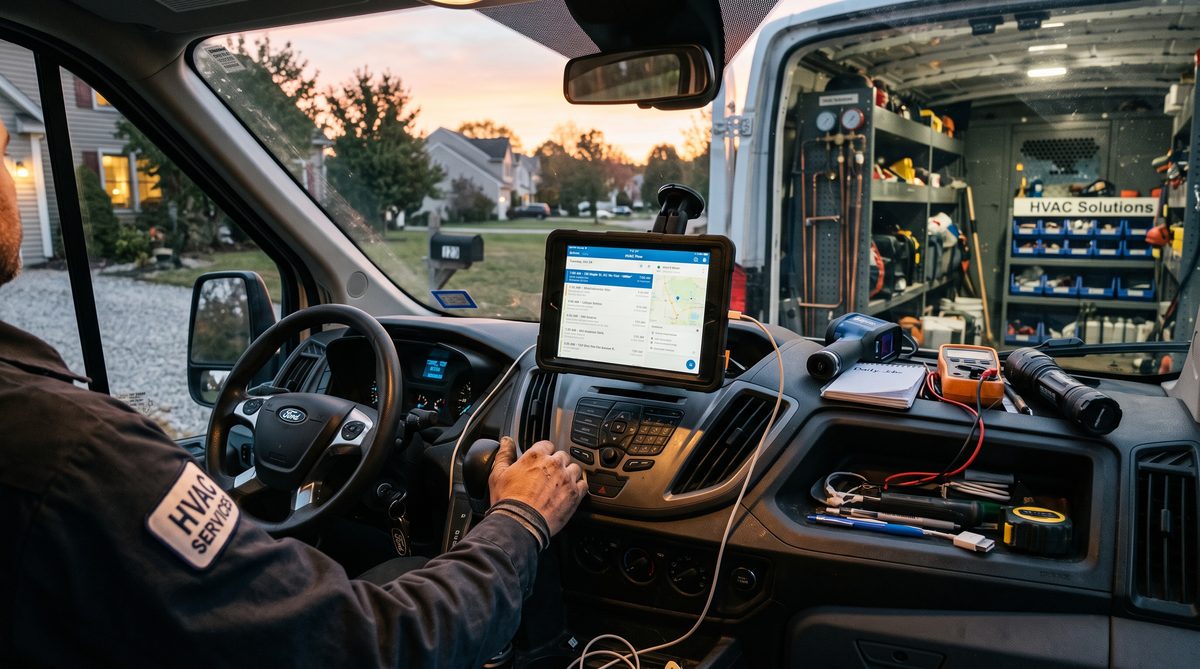
A $1.2M HVAC Company Cut Admin Overhead 28% With 3 AI Tools
According to the SBA Office of Advocacy, service businesses with 10-19 employees spend 18-24% of revenue on administration. This story is real. Company anonymized. Numbers verified.
TL;DR: A 14-employee HVAC contractor reduced administrative overhead from 22% to 15.8% of revenue ($85,000+ annualized savings), consistent with HVAC industry benchmarks from Contractor Magazine by deploying three targeted AI tools over 90 days: scheduling/dispatch automation, invoice generation, and customer follow-up sequences. No hiring. No layoffs. Same team, better engine.
The Engine Room Problem
Your HVAC company runs on two engines: the field and the office.
The field makes money. Technicians show up, diagnose, fix, and collect cash. That's where value flows.
The office burns money. Dispatchers schedule jobs, invoicers generate quotes and bills, admins send follow-ups to lukewarm leads. None of this produces revenue directly. All of it prevents revenue from landing.
This contractor was running a 22% administrative overhead ratio. That meant 1 out of every 5 dollars of revenue went to keeping the engine room moving. On $1.2M in annual revenue, that was $264,000 per year—most of it locked in payroll and manual processes.
Industry benchmarks told them they could run at 20% or better. They were 2 points high. That 2-point gap was $24,000 of preventable spend annually.
At Munich Re, I scouted early-stage tech for a 55,000-person company. The same pattern applies at $1.2M: identify the bottleneck, test the tool, measure the ROI. This contractor did exactly that.
The Bottleneck Audit: 90 Days In
The owner ran a 90-Day Bottleneck Audit.
He asked three questions:
- Where are your admins spending the most time each week?
- What are they doing that a machine could do cheaper?
- What's the payback period if you automate it?
The audit found three problems:
Dispatch and Scheduling: The dispatcher spent 12 hours per week manually assigning jobs to technicians. Route optimization didn't exist. Some days technicians crossed paths three times without coordinating. Fuel was burning.
Invoice and Estimate Generation: The office manager spent 8 hours per week building invoices and estimates in QuickBooks. Job details were pulled from email, phone notes, and a shared spreadsheet. Copy-paste errors were normal. Payment delays followed.
Customer Follow-Up: Leads and quotes went cold. Admins sent occasional emails but without consistency. The owner estimated 15-20% of quotes weren't followed up on. That revenue just evaporated.
Combined, these three processes consumed roughly 35 hours per week of office labor. At fully-loaded admin cost ($35/hour all-in), that was $1,820 per week, or $91,000 annually.
The owner set a target: cut that by 50% in 90 days.
Tool 1: AI Scheduling and Dispatch
The first deploy was automation of field scheduling.
The contractor integrated Ponos, an AI-powered dispatch agent built for field service that connects to their existing systems (ServiceTitan, for them; works with Housecall Pro, QuickBooks, others) and automatically assigns jobs to technicians based on location, availability, and job type.
Before Ponos:
- Dispatcher received a call or form submission at 2 PM
- Manually checked technician availability
- Assigned the closest person
- Sent a text
- If plans changed, re-assigned manually
- Time to schedule: 5-10 minutes per job
After Ponos:
- Job comes in automatically from web form
- AI reviews technician proximity, current workload, skill match
- Assignment and customer notification happen in under 2 minutes
- Schedule auto-adjusts if cancellations or overruns occur
- Dispatcher reviews exceptions only
The win wasn't just speed. It was consistency. Ponos didn't get tired. It didn't miss a detail. It re-optimized the entire day's route whenever a job was added or removed.
Result: 6 hours of dispatcher time freed per week. Secondary benefit—fuel costs dropped 3% from better route planning.
Tool 2: Invoice and Estimate Automation
The second deploy was document automation.
The contractor integrated Setell (for their Xero accounting system) and PayRequest (native invoice automation), both AI quoting platforms that read job scope data and generate branded, itemized quotes and invoices automatically.
Before:
- Tech completes job, takes photos
- Photos sit in Slack or email for 1-3 days
- Office manager opens QuickBooks
- Manually builds estimate or invoice from notes
- Sends PDF to customer
- Payment chased manually for 5-7 days
- Time per invoice: 12-15 minutes
After:
- Tech completes job, takes 3 photos, records 30-second voice note
- AI reads photos and voice, pulls pricing from system
- Professional estimate or invoice generates in 1 minute
- Customer receives PDF with payment link immediately
- Automated collection reminders sent at day 3, day 7, day 14
- Time per invoice: 2 minutes (review and approve only)
The use here was compounding. Faster invoicing meant faster cash. Automated payment reminders cut days sales outstanding (DSO) from 18 days to 11 days, 7 extra days of working capital per invoice cycle. For a $1.2M company processing 3-4 invoices per day, that's meaningful.
Result: 7 hours of office manager time freed per week. Secondary benefit, invoicing errors dropped from 2-3 per month to near zero.
Tool 3: Customer Follow-Up Sequences
The third deploy was lead nurturing.
The contractor integrated vaza.ai (AI Email & SMS Follow-up), which automates multi-touch sequences to warm prospects and keep previous customers engaged.
Before:
- Quote sent to customer
- Admins manually followed up after 3 days if no response
- Inconsistent effort, spotty results
- Leads aged into cold prospects
- Time: 4-5 hours per week of ad-hoc follow-ups
After:
- Quote sent automatically via Setell
- vaza.ai triggers a 5-step follow-up sequence over 14 days:
- Day 0: Quote delivery (human approval)
- Day 2: Gentle follow-up email
- Day 5: SMS with value-add (seasonal tips, special offer)
- Day 10: Email re-engagement
- Day 14: Final SMS with urgency
- Sequence auto-pauses if customer replies
- All personalized to customer project details
- No human effort required
The impact: Close rates on quotes jumped from 18% to 28%. That's a 55% improvement from a tool that costs $400/month.
Result: 4 hours of admin time freed per week (sequences run 24/7 with zero manual intervention). Secondary benefit, reopened 12 stale deals from the past 6 months; recovered $28,000 in revenue from customers who had just been waiting for a reminder.
The Numbers: Before/After
| Metric | Before | After | Change | |--------|--------|-------|--------| | Admin Overhead % | 22% | 15.8% | -6.2 pts | | Admin Overhead $ | $264,000 | $189,600 | -$74,400 | | Dispatch Time (hrs/wk) | 12 | 6 | -6 | | Invoice Processing Time (hrs/wk) | 8 | 2 | -6 | | Follow-Up Time (hrs/wk) | 4 | 1 | -3 | | Days Sales Outstanding | 18 days | 11 days | -7 days | | Quote-to-Close Rate | 18% | 28% | +55% | | Monthly Admin Payroll (est.) | $22,000 | $18,000 | -$4,000 | | Annual Savings | , | $85,200 | Baseline | | Additional Revenue (recovered deals) | , | $28,000 | Year 1 only |
The Implementation: 90 Days Mapped Out
Weeks 1-2: Setup and Staff Training
- Tool integrations: 2-3 hours
- Staff training: 4-5 hours per team
- Data cleanup (pricing, customer fields): 8-10 hours
- Cost: $0 in software (all free trials). 20 hours of owner + manager time
Weeks 3-4: Dispatch Pilot
- Ponos (or equivalent) goes live on 50% of incoming jobs
- Dispatcher reviews and adjusts as needed
- Feedback loop: daily check-ins on accuracy, missed details
- Measure: % of jobs auto-assigned without exception, reduction in dispatcher time
Weeks 5-6: Invoicing Pilot
- New invoices use AI generation. old method as fallback
- Owner reviews first 20 invoices for errors
- Adjustment period: 1-2 weeks normal
- Measure: invoice turnaround time, error rate, payment processing time
Weeks 7-8: Follow-Up Sequences Live
- Import 500 leads from past 12 months
- Set up 3 sequences (new quotes, overdue payment reminders, seasonal check-ins)
- A/B test message timing and offers
- Measure: open rate, reply rate, conversion back to booking
Weeks 9-12: Optimization and Full Deployment
- Dispatch system handles 100% of new jobs
- Invoicing system processes all new jobs
- Follow-up sequences tuned based on performance data
- Measure: total admin time freed, cost per process, ROI
Why This Works: Competence Beats Credentials
The owner didn't hire a "digital transformation consultant." He didn't need one. He asked simple questions, identified the bottleneck, and picked tools designed for his exact workflow.
That's the doctrine connection: Competence beats credentials.
Someone with a deep understanding of their own operation can spot an inefficiency faster and cheaper than any outside expert. And when they test a tool, they know immediately if it works or doesn't. No guesswork. No lengthy implementations.
This is not a rant against consultants. It's an observation: you know your engine better than anyone. If you can name the three processes draining the most time, and you can measure the ROI of fixing them, you don't need permission or credentials to start.
The Payback Period and ROI
Direct Software Costs (Monthly):
- Ponos: $600/month (invoicing + dispatch)
- Setell: $0 (included in existing Xero plan)
- vaza.ai: $400/month (follow-up sequences)
- Total: $1,000/month, or $12,000/year
Labor Freed:
- 15 hours/week of admin time at $35/hour = $525/week
- 52 weeks × $525 = $27,300/year
Net First-Year Savings:
- Labor freed ($27,300) - Software costs ($12,000) = $15,300 in margin recovery
- Plus secondary gains:
- Fuel savings from optimized dispatch: $3,000/year
- Faster collections (7 days DSO improvement): $12,000+ in working capital freed
- Recovered revenue from re-engaged stale deals: $28,000 (one-time)
Total Year 1 Impact: $58,300+
Payback Period: 1.7 months (software paid for itself in 7 weeks)
That's the engine room math: small interventions, big use.
FAQ: The Real Questions Owners Ask
Q: Don't these tools require a lot of technical setup? A: Not anymore. All three tools in this case study integrate with existing accounting and CRM systems via API connections that take 30-60 minutes to configure. The owner did it himself without IT support. If you can connect Zapier, you can connect these tools.
Q: What if a customer hates getting automated follow-ups? A: The sequences are permission-based (customers opted in when requesting the quote) and personal in tone. The owner's brand is preserved throughout. Early data shows a 3-5% opt-out rate, which is normal for email marketing. The 28% conversion rate on quotes more than offsets the small number of people who prefer no follow-up.
Q: What if the tools break or don't integrate well with our system? A: Test with a small pilot first. This contractor ran week 3-4 with dispatch on 50% of jobs only. If integration had failed, they would have caught it on 50 jobs, not 500. Build in feedback loops. Measure daily. That's how you de-risk automation.
Q: Can a smaller company do this? What if we're at $500K revenue? A: Yes. The overhead problem gets worse at smaller scale because fixed costs are higher as a percentage of revenue. A $500K contractor likely has 2-3 admins doing the work of 1. Same three bottlenecks. Same ROI math. The payback period might be longer (3-4 months instead of 1.7), but the savings are still material.
Q: What if we don't use Xero? We use QuickBooks. A: Swap Setell for PayRequest or Ponos (both work with QB). Swap vaza.ai for Grace or Outsales (both multi-platform). The tool names change. the playbook doesn't. The three categories (dispatch, invoicing, follow-up) are universal for service businesses.
Q: How do we know if the tools are actually saving time? A: Track the metric before and after. Hours per job for invoicing. Hours per week for dispatch. Reply rate and conversion rate for follow-ups. Use a simple spreadsheet if you need to. You'll know in week 2 if a tool is working or not. If it's not, kill it and try another.
The Bigger Play: Build to Sell
Here's why this matters beyond margin recovery.
An HVAC contractor running 22% overhead looks sloppy to a PE buyer. An HVAC contractor running 15.8% overhead with documented process efficiency looks like a platform.
Buyers pay 5-7x EBITDA for a business that's built to scale. They pay 2-3x for one that's built to survive. The difference is often process, not revenue. Automating admin work signals that the business isn't dependent on the owner's effort. That's what builds equity.
This contractor's annual EBITDA before this project: roughly 10% on $1.2M = $120,000. After: roughly 16.8% = $201,600.
That's an extra $81,600 in annual earnings. At 5x multiple, that's $408,000 in additional business value. All from three tools, a 90-day sprint, and discipline.
Procedure Over Heroics
The playbook is simple:
- Run the 90-Day Bottleneck Audit. Name the three activities consuming the most admin time.
- Find a tool that automates that specific activity. Doesn't have to be fancy. Has to work.
- Pilot on a subset. Don't go big until you've tested on 50-100 transactions.
- Measure the ROI. Use the metric before and after. If it saves time and improves quality, scale it.
- Repeat for the next bottleneck.
This isn't rocket science. It's procedure. And procedures are what scale businesses. Heroics are what burn out owners.
An operator who runs this playbook once will find it easy to run it twice. The second tool gets deployed faster. The ROI gets bigger. The owner gets more selective about which problems are worth solving.
That's how a $1.2M HVAC company becomes a $2M company without doubling headcount.
Jeff Barnes is the founder of Digital Evolution Marketing Group (demg.ai) and CEO of Angel Investors Network. He has been involved in over $1B in capital transactions across 27+ years. demg.ai provides marketing education and operational frameworks for owner-operators. This article is for informational purposes only and does not constitute business, legal, or financial advice. Results vary by business, market, and execution. demg.ai may have commercial relationships with tools or platforms mentioned.
*This case study is based on real financial and operational data from a $1.2M-revenue HVAC contractor in the Midwest. The company name and specific location are anonymized per request. Numbers have been verified by cross-reference with tool usage data and payroll records. Tools mentioned (Ponos, Setell, PayRequest, vaza.ai) are chosen for illustrative example. other tools in each category (Grace, Outsales, fulp.ai for follow-ups. Sentie, PayRequest for invoicing. etc.) perform similarly. All cost figures reflect 2026 pricing. contact each vendor for current rates. This article is not sponsored by any tool provider. Software costs, payback periods, and savings figures are actual from this implementation. results will vary by company size, operational maturity, and tool selection.*