
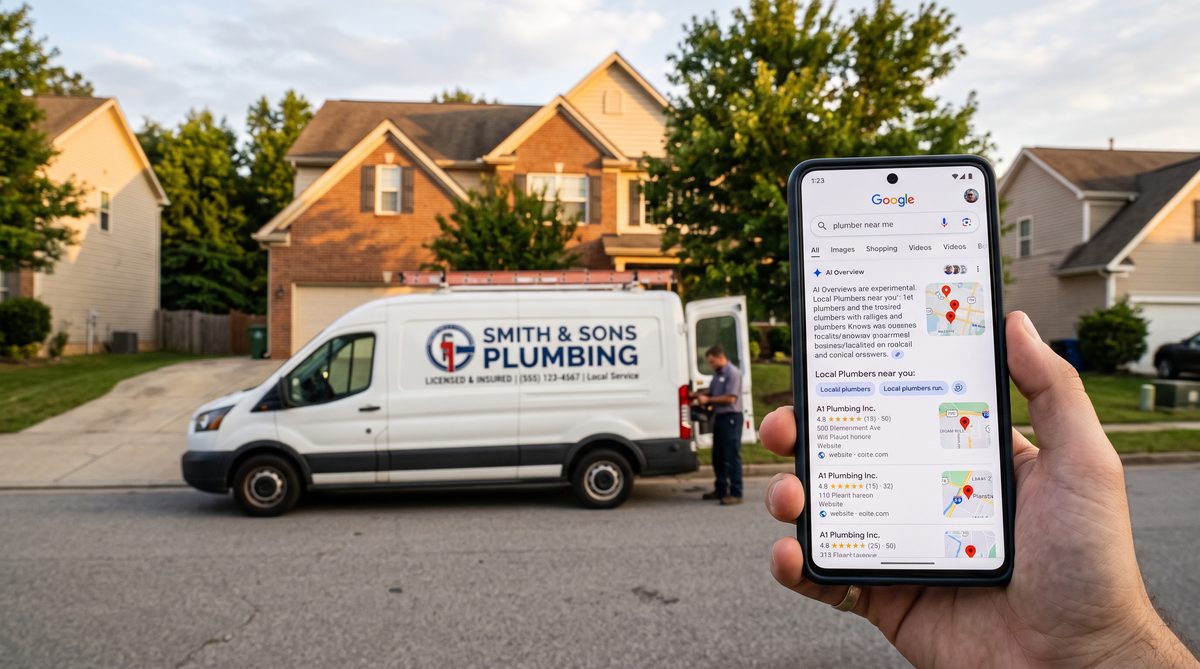
Google AI Mode is rewriting how local customers find plumbers, HVAC contractors, electricians, and dentists, and most owner-operators have not touched their Google Business Profile in over a year. Ahrefs found that AI Overviews now correlate with a 58% lower average click-through rate for the top-ranking page, up from a 34.5% drop measured in April 2025. AI Mode has crossed 1 billion monthly users as of Google I/O 2026, and it now decides who gets recommended before a searcher ever sees your website. If 40-60% of your leads come from "near me" search, the channel is not disappearing. It is being intermediated by an AI that has to know you exist, trust your data, and choose to say your name.
I want to be direct about what changed, because most of the local SEO content published this year buries the lede. AI Overviews are the summary box that sits above the ten blue links. AI Mode is the deeper conversational experience Google unified with those Overviews at I/O 2026, and it works through what Google calls query fan-out: it breaks one question into eight to twelve sub-questions, runs them all simultaneously, and synthesizes a single cited answer. A homeowner does not type "plumber near me" into AI Mode. They type "why is my water heater making a banging noise and should I call someone tonight," and the AI decides which local business earns the citation.
The number that should scare you
Here is the math. BrightLocal's home services SERP study found that when a local pack is present, organic position #1 click-through rate drops from 39.8% to 23.7%, a 40.5% reduction, purely from the local pack sitting above it. Now stack an AI Overview or AI Mode citation on top of that pack. You are competing for clicks that get siphoned off twice before a searcher ever scrolls to your listing.
The upside: 76% of people who perform a "near me" search visit a business within 24 hours, and near-me query volume has grown 900% in two years. The demand has not dropped. The discovery layer has moved. BrightLocal's Local SEO statistics report confirms 46% of all Google searches carry local intent, and Google Business Profile signals now account for roughly 36% of local pack ranking weight. Whoever controls your GBP data controls whether the AI recommends you or your competitor down the street.
I have seen this pattern before, and it never resolves in favor of the operator who waits.
The Navy drill, applied to your business
On the boat, we ran casualty drills every week. Not because casualties happened every week. Because when they did, the procedure had to be automatic. Nobody stood in the engine room reading a manual while the reactor plant was in trouble. You drilled until the response was muscle memory, so when the real casualty hit, you did not think, you executed.
Google AI Mode is the casualty. It is already here, already routing your customers, already deciding who gets cited when someone asks "who fixes furnaces near me" at 11pm in February. Your 30-day plan is the drill. You do not run it because you are certain disaster strikes on day 31. You run it because the day AI Mode reroutes 60% of your local visibility to a competitor with better structured data, you need a system already built, not a scramble.
This is the same discipline behind demg.ai's FOCUS Strategy framework: pick the bottleneck that is actually constraining growth, build the system around it, and stop treating marketing as a series of unrelated fire drills.
Week 1: Audit your current visibility (Days 1-7)
You cannot fix what you have not measured. Week 1 is diagnostic, not corrective.
Day 1-2: Run the AI citation test. Open an incognito browser. Search your top five service queries the way a customer would phrase them conversationally, not as keywords. Not "HVAC repair Phoenix" but "my AC stopped cooling and it's 105 degrees, who can come today." Do this in Google AI Mode directly at google.com/ai. Screenshot every result. Note whether your business is cited, whether a competitor is cited instead, and whether the AI recommends calling, visiting a site, or booking directly.
Day 3: Audit your Google Business Profile field by field. Log into business.google.com. Check primary category accuracy, secondary categories, services list completeness, service area radius, hours (including holiday hours), and photo count. Searchlab's 2026 GBP data shows GBP signals account for 36% of local pack ranking, and businesses within 3 miles of the searcher are 68% more likely to appear in the pack. If your service area or categories are stale, this is your first fix.
Day 4: Pull your Google Search Console data. Compare click-through rate for your top 10 local queries against 12 months prior. If you are not tracking clicks separately from impressions, set this up now. A dropping CTR with stable or rising impressions is the AI Overview tax in action, not a ranking problem.
Day 5: Check for structured data. View source on your homepage. Search for `application/ld+json`. If you find nothing, you have zero LocalBusiness schema, which means the AI extractor is guessing at your name, address, phone, and hours from unstructured HTML. Run whatever you find through Google's Rich Results Test at search.google.com/test/rich-results.
Day 6-7: Document the gap. Build a simple table: query, current citation status, competitor cited instead, and root cause (missing schema, thin GBP, no FAQ content, weak reviews). This becomes your Week 2 punch list.
Week 2: Optimize for AI extraction (Days 8-14)
This week is technical implementation. It is not glamorous. It is the compartment-sealing work that keeps the whole boat afloat later.
Day 8-9: Ship LocalBusiness schema. Use the most specific subtype available. `Plumber`, `Electrician`, `HVACBusiness`, `Dentist`, not the generic `LocalBusiness`. Include name (exact match to GBP), full PostalAddress, telephone in E.164 format, `openingHoursSpecification` as a structured array, geo coordinates, and `areaServed`. RevioReputation's audit data shows sites with valid LocalBusiness schema are cited in AI Overviews at roughly 1.3-1.5x the rate of sites without it, and layered schema (3-4 complementary types) doubles citation frequency again.
Day 10-11: Build a real FAQ page and mark it up. This is the single highest-impact move in the entire plan. One schema audit found FAQPage schema puts pages in AI Overviews at approximately 2.8x the rate of pages without it, and a separate study measured a 67% lift in AI citation odds when FAQ schema is paired with LocalBusiness schema. Write 8-10 questions your customers actually ask before calling: "How much does a water heater replacement cost in [your city]," "Do you offer same-day emergency service," "What's included in an HVAC tune-up." Answer each in 40-80 words, specific numbers, no hedging language. "Costs vary" gets skipped by the extractor. "$1,800 to $3,200 depending on tank size, with most jobs completed same-day" gets cited.
Day 12: Add Service schema per offering. If you offer drain cleaning, water heater repair, and pipe replacement as a plumber, each gets its own Service block with `areaServed`. This lets the AI answer "does this plumber do X" without inference.
Day 13: Reconcile every data point across platforms. Your schema, your GBP, your website footer, and your Yelp listing must show identical NAP (name, address, phone) and matching star ratings. Structured data audits flag mismatched aggregateRating as a trust-eroding signal that causes AI systems to discount your entity confidence entirely.
Day 14: Validate everything. Run every page through Rich Results Test and the Schema.org Validator at validator.schema.org. Fix every warning, not just every error.
Week 3: Build direct channels (Days 15-21)
An AI-mediated discovery channel is a rented channel. You do not own the algorithm, the citation logic, or the next model update. Week 3 builds the owned asset underneath it.
Day 15-16: Stand up a review-generation system. Reviews feed both the local pack and the AI's trust signal. Set up an automated post-service text or email requesting a Google review, sent within two hours of job completion while satisfaction is highest. Tools like Podium, NiceJob, or GoHighLevel automate this. Target a minimum 20 new reviews per month across your top locations.
Day 17-18: Launch a first-party lead capture asset. Build a simple landing page independent of your Google visibility, with a phone number and a booking form, and drive existing customers there via email and SMS. This is your list. When the AI changes its citation logic again, and it will, your list does not evaporate with it. This is the same logic behind the Sovereignty Stack: you build assets you control underneath channels you do not.
Day 19-20: Set up Google Business Profile messaging and booking. Enable direct messaging and, if applicable, the booking link inside GBP. AI Mode's agentic booking features, expanded at I/O 2026 for categories including home repair, route bookings straight through the profile. If yours is not configured, the AI cannot complete the action even when it wants to recommend you.
Day 21: Audit your Local Service Ads eligibility. LSAs capture 10-15% of home services SERP clicks on their own, and up to 25.3% of clicks combined with traditional PPC when present. Unlike traditional ads, you pay per lead. If you are licensed and insured, this is a paid channel that sits above both the AI Overview and the organic results, and it is worth testing in Week 3 while your organic and AI signals mature.
Week 4: Measure and adjust (Days 22-30)
Day 22-24: Re-run the Day 1-2 citation test. Same queries, same phrasing, incognito browser. Compare citation status against your Week 1 baseline. You are looking for movement, not perfection. Going from zero citations to two or three out of ten test queries in 30 days is a real result.
Day 25-26: Pull fresh Search Console and GBP Insights data. Check calls, direction requests, and website clicks separately in GBP Insights, not just website analytics. Category-level data shows 60-65% of local search conversions never touch a website at all for emergency service categories, with phone calls converting to booked appointments at 40-60% versus 2-8% for website visitors. If you are only measuring site traffic, you are blind to most of your actual pipeline.
Day 27-28: Interview your last 10 booked customers. Ask directly: "How did you find us?" This qualitative data catches what analytics miss, especially AI-mediated discovery where the referring source often shows as direct or unknown in standard tracking.
Day 29-30: Set the recurring cadence. This is not a one-time project. Schedule a quarterly schema audit, a monthly GBP review, and a standing review-generation check. Assign an owner. If it is you, block the calendar time now, because it will not happen otherwise.
The doctrine connection
Due diligence is non-negotiable. Every owner-operator I talk to wants the AI Overview problem solved with a plugin or a one-time fix. There is not one. The businesses that hold their local visibility through this transition are the ones auditing their data quarterly, matching their schema to their GBP to the decimal point, and treating "near me" as an engineering problem, not a marketing afterthought. This is the same audit discipline I walk owners through in the 90-Day Bottleneck Audit: find the constraint, verify it with data, fix the actual thing. The businesses that lose 40-60% of their lead flow are the ones who assumed Google would keep sending traffic the old way because it always had.
FAQ
Q: Will Google AI Mode replace the local pack entirely? Not based on current rollout data. AI Mode and AI Overviews sit above or alongside the local pack rather than replacing it. The local pack still appears for 93% of local-intent queries as of 2026, but AI-generated answers increasingly sit above both the pack and organic results, capturing attention and clicks before either is seen.
Q: How long does it take to see AI citation improvement after fixing schema? Expect 2-6 weeks for initial movement, based on typical Google re-crawl and re-indexing cycles for structured data changes. Full stabilization after major GBP or schema changes commonly takes 60-90 days. The 30-day plan gets your foundation in place. Gains often keep compounding past day 30.
Q: Do I need a developer to add schema markup? Not necessarily. WordPress with Yoast or RankMath, and most modern website builders, offer schema plugins that handle LocalBusiness and FAQPage markup without custom code. Multi-location businesses or non-standard builders should budget for a developer, given the 1.3-2.8x citation lift documented across the schema studies above.
Q: What if I don't have the technical time to run this whole plan myself? Delegate the technical weeks (2 and 3) to a contractor or agency and keep the diagnostic and measurement weeks (1 and 4) yourself. You need to see the before-and-after data with your own eyes to know whether the spend was worth it. Outsourcing the audit entirely is how owners end up paying for work they cannot verify.
Q: Is Local Service Ads spend worth it if I'm already investing in organic and AI optimization? Often yes, at least as a test. LSAs pay per lead, not per click, which changes the risk profile versus traditional PPC. Google grew local pack ad inventory 733% between November 2025 and January 2026 by industry tracking. Treat LSAs as a complementary channel, not a replacement for organic work.
*Jeff Barnes, MBA has no personal position in any company, fund, or platform named in this article. demg.ai has no current commercial relationship with any party mentioned. demg.ai provides marketing systems and education services, not investment advice. Past performance does not guarantee future results. All business decisions involve risk, including loss of capital.*