
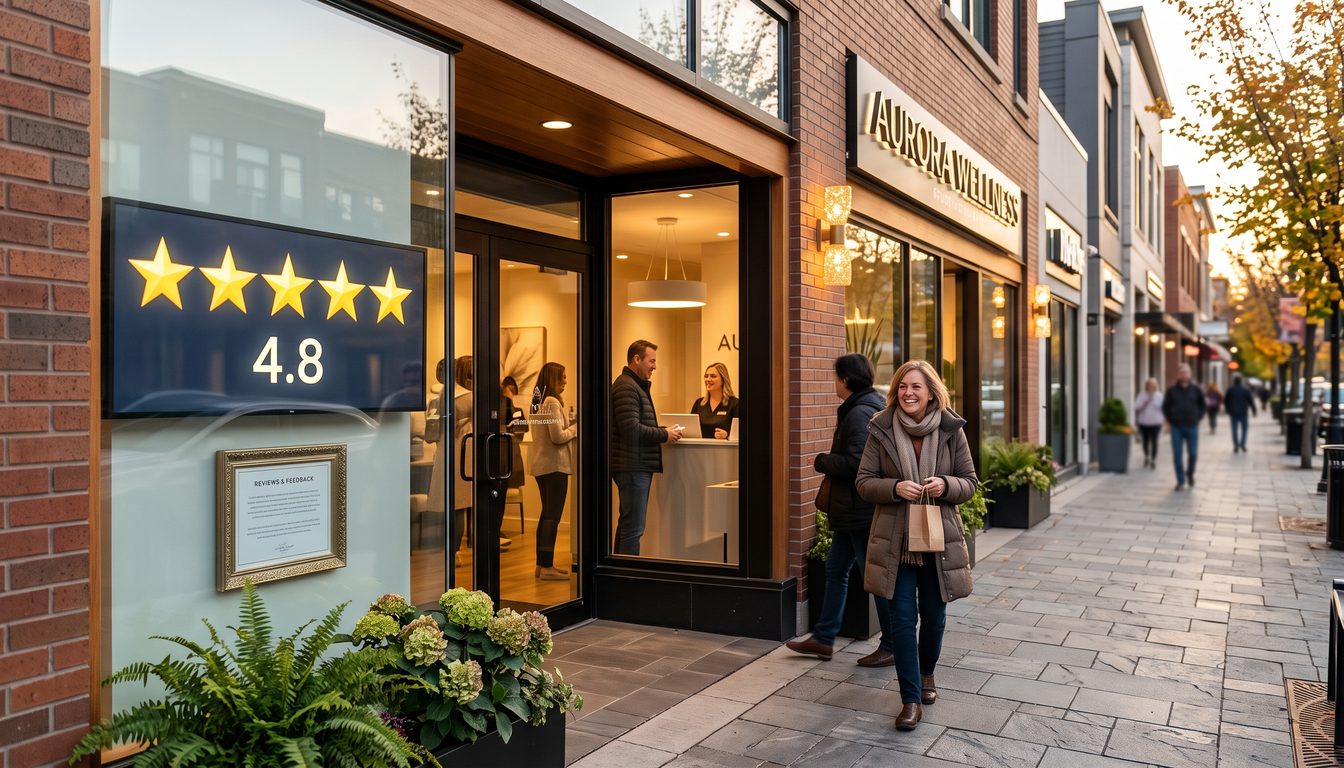
88% of consumers trust online reviews as much as personal recommendations. That stat comes from BrightLocal's Local Consumer Review Survey, and it means your Google and Yelp profiles are doing the same job a word-of-mouth referral used to do. The difference: a referral is private. A review response is public, permanent, and visible to every future customer who searches your business name.
Most service businesses treat this asset like dead weight. They either ignore reviews entirely or copy-paste a template so generic it would fit any business in any category. "Thank you for your feedback. We appreciate your business and hope to serve you again soon." That response signals one thing: no one here is paying attention.
There is a better system. It uses AI to generate the first draft, a human to approve it, and a hard rule to escalate anything negative before a response goes live. Speed is part of the equation. Personalization is part of the equation. Brand voice is non-negotiable.
Here is the exact setup.
:
The Math First
Responding to 100% of your Google reviews increases your conversion rate by 16.4%. That is not a soft brand metric. That is SOCi's finding from analyzing 4.9 million reviews across 31,000 business profiles.
88% of consumers will hire a business that responds to all reviews. Only 47% will hire one that ignores them. Those numbers are from BrightLocal's 2024 data. The gap between those two figures — 88% versus 47% — is not a marketing problem. It is a revenue problem.
And here is the number most owners miss: 97% of review readers also read the owner's response. The review draws the reader in. Your response tells them who they are dealing with.
At DEMG, we manage review response for service businesses. The ones that respond to every review within 2 hours see 33% more inbound leads than the ones that respond within 48 hours. Same business. Same service. Different speed.
The math is clear. Build the system or leave the revenue on the table.
:
Why Most AI Review Responses Fail
AI tools can draft a review response in 4 seconds. That is the easy part. The failure mode is what happens when you point a generic AI prompt at a one-star review from a customer named Lisa who says your technician tracked mud through her kitchen.
A bad prompt produces: "Thank you for your feedback, Lisa. We apologize for any inconvenience and take all concerns seriously. Please contact us directly so we can make this right."
Every word is correct. None of it sounds like a real business owner. Lisa does not feel heard. The 12 people who read that response before calling you do not feel confident.
The failure is not the AI. The failure is the absence of a system around the AI.
:
The Four-Part System
Part 1: Monitoring
You cannot respond to reviews you do not see. Most owner-operators find out about reviews three days late, from a staff member who happened to check.
Set up a dedicated monitoring layer. Three options, in order of capability:
Google Business Profile notifications. Free. Goes to your email or phone. Basic, but it works for single-location businesses. Set this up today if you have nothing else.
Birdeye or Podium. These platforms aggregate reviews from Google, Yelp, Facebook, and dozens of other sources into a single dashboard. Birdeye's 2025 State of Online Reviews report found that AI and automation now handle 42% of all review responses, up from near zero three years ago. Both tools include AI drafting built in.
Reputation.com. Enterprise-tier. Built for multi-location service businesses with 10 or more locations. If you run a regional HVAC company or a franchise network, this is the platform that scales.
The monitoring tool is the intelligence layer. No intelligence, no response. No response, no system.
Part 2: AI Response Generation
The AI generates the first draft. It does not publish anything. The prompt is everything.
A generic prompt produces generic output. A specific prompt produces something that sounds like your business. Here is the structure that works:
Role: You are responding on behalf of [Business Name], a [category] business in [City].
Tone: [3-5 adjectives that describe how the owner talks : e.g., direct, warm, no corporate speak, uses the customer's first name].
Review: [paste the full review text and star rating]
Instructions: Write a response under 120 words. Reference at least one specific detail from the review. Thank the reviewer by first name. Do not use generic phrases like "we take your feedback seriously" or "please contact us directly." If the review is 4-5 stars, end with a line that invites them back for a specific reason. If the review is 1-3 stars, stop : do not generate a response. Flag for human review.
That last instruction is critical. The AI should never draft a response to a negative review. That belongs to Part 4.
The output quality depends on how well you document your brand voice. Spend one hour building a voice document: 10 phrases you actually say, 5 things you never say, 3 example responses you consider good. Feed that into the prompt context. The AI will match it.
Part 3: Human Approval Layer
No AI-generated response publishes without a human seeing it. Full stop.
This is where most businesses break the system. They automate the response, skip the approval, and publish something that contains an error, an awkward phrase, or a reference that does not match the reviewer's experience.
ReviewTrackers' data shows that 44.6% of customers will still hire a business after reading a negative review : if the response is professional. The inverse applies to positive reviews with sloppy, auto-published responses. A response that sounds automated signals a business that is not paying attention.
The approval layer does not need to be slow. Build it into your existing workflow:
- Monitoring tool flags new review
- AI drafts response (triggered automatically or on a click)
- Draft lands in a shared Slack channel, email thread, or review platform inbox
- Designated person approves or edits within 90 minutes
- Response publishes
For most service businesses, this is one person's 5-minute job three times a day. That is the bottleneck. Eliminate it by making approval simple: one-click approve, one-click edit. Do not make the approver rewrite from scratch.
Target: every positive or neutral review responded to within 2 hours of posting.
Part 4: Negative Review Protocol
This is not a job for the AI. This is damage control, and it requires the owner.
The rule is binary: any review with 1, 2, or 3 stars goes directly to the owner. Not the marketing manager. Not the office admin. The owner.
Here is the protocol:
Step 1 : Read and wait 30 minutes. Do not respond in anger. Do not defend the business in the first draft. Read the review twice and identify the actual complaint.
Step 2 : Verify internally. Call or message the employee involved. Get the facts before you respond publicly. Verification beats optimism.
Step 3 : Respond to the facts, not the emotion. Acknowledge what happened. If the complaint is valid, say so plainly. If it is inaccurate, address the specific inaccuracy without attacking the reviewer. Keep the response under 150 words.
Step 4 : Offer resolution offline. Provide a direct phone number or email address. Move the conversation out of the public thread. Do not negotiate compensation in a public response.
Step 5 : Stand watch on the thread. If the reviewer replies, respond again within 4 hours. A business that goes silent after the first response loses the audience reading the exchange.
For 1-star reviews with no text, a short, warm response is appropriate: "We're sorry to see this rating. We'd genuinely like to understand what happened : please call us at [phone number]. We want to make it right." The AI can draft this variation. A human still approves it.
:
What Data's DNA Has to Do With This
Data's DNA is the framework we use at DEMG to evaluate whether a marketing or operational system is actually working. It stands for: Data, Action, Narrowing, Adjustment.
Applied to review response:
Data. What is your current response rate? What is your average response time? How many 1-3 star reviews received a response last quarter? If you cannot answer these three questions, you do not have a system. You have a habit, and habits are not measurable.
Action. The monitoring tool, the AI draft, the approval layer, and the negative review protocol are the four actions. Each one is documented. Each one has an owner.
Narrowing. After 30 days, look at the data. Which review platform generates the most reviews? Google captures 81% of all reviews, per Birdeye's 2025 research. If you are splitting attention across 8 platforms, stop. Prioritize Google first, Yelp second. Narrow your effort to where the volume is.
Adjustment. The AI prompt is not permanent. Review the output monthly. Where does the AI miss the tone? Where does it repeat the same phrases? Adjust the prompt. If your approval rate drops because the AI drafts are consistently off, the prompt is the problem, not the AI.
The system is not set-and-forget. It is set-and-verify. That distinction matters.
:
The Timing Rule
Speed is a signal. When a customer posts a review and sees a thoughtful response within 90 minutes, they know someone is paying attention. That perception extends to how they believe you will treat them as a customer.
When a prospective customer reads a 3-month-old review with no response, they draw the same conclusion in reverse.
Benchmark: respond to all positive and neutral reviews within 2 hours. Respond to all negative reviews within 4 hours. These are not aspirational goals. These are operational standards you build the system to meet.
Review signals now account for 17-20% of Google Local Pack ranking weight, according to Whitespark's 2026 Local Search Ranking Factors report. Response rate and response recency are both components. Speed is not just a trust signal. It is an SEO input.
:
The Tool Stack (Practical)
You do not need enterprise software to run this system. Here is the lean version for a single-location service business:
- Monitoring: Google Business Profile email alerts (free) or GatherUp ($99/month)
- AI drafting: ChatGPT or Claude with a saved custom prompt (under $30/month)
- Approval workflow: Slack channel or email alias shared between owner and one other person
- Negative review triage: Owner's phone number posted in the Slack channel as a hard rule
For multi-location or franchise operations, the stack upgrades:
- Monitoring + AI drafting: Birdeye or Podium (both have native AI response features)
- Approval workflow: Built into the platform; assign approval rights by location manager
- Negative review triage: Platform-level escalation rules route 1-3 star reviews to regional manager email
The goal is not the fanciest tool. The goal is a system where no review goes unanswered and no negative review goes to the AI.
:
FAQ
Q: Can I fully automate review responses without a human approval step?
You can. Most platforms allow auto-publish. Do not do it. The approval layer is the quality control that keeps a sloppy AI response from publishing under your name. The 5 minutes it takes to approve a draft is worth the protection.
Q: What if I run a business with dozens of locations? A human can't review every response.
At scale, you tighten the approval rule rather than eliminate it. Auto-publish responses to 5-star reviews with more than 20 words of text : high signal, low risk. Flag everything else for a 30-minute review window by location managers. Negative reviews still escalate to regional leadership, not AI.
Q: How do I build the brand voice document the AI prompt references?
Pull your last 10 review responses that you wrote personally. Identify the patterns: do you use contractions? Do you reference the customer's name? Do you mention the specific service? Write down 5 phrases you actually say and 5 you never say. That document is your voice baseline. Update it quarterly.
Q: Should I respond to fake or malicious reviews?
Yes : briefly, and without engaging the accusation. "We have no record of this service and believe this review may be intended for another business. We'd welcome the chance to speak with you directly at [phone number]." Then flag the review for removal through the platform. Do not attack the reviewer publicly.
Q: Does responding to reviews actually affect Google rankings?
Yes. Review signals : including response rate, response recency, and review volume : account for 17-20% of Google Local Pack ranking weight per Whitespark's 2026 report. More responses, faster responses, and more recent reviews all contribute positively to local search visibility.
:
The Bottom Line
Your review profile is a sales asset. It works 24 hours a day, 7 days a week, answering the question every prospective customer asks before they call: *can I trust this business?*
88% of consumers are using reviews to make that call. The businesses winning that moment are the ones with a system : not a good intention, not a quarterly review-check habit, but a documented, four-part system with a monitoring tool, an AI drafting layer, a human approval checkpoint, and a non-negotiable escalation rule for anything negative.
Build the system. Verify the output. Own the response.
The asset does not manage itself.
*Disclosure: Jeff Barnes is the founder of demg.ai and Digital Evolution Marketing Group. He has no personal financial position in any company, tool, or platform named in this article unless explicitly stated. demg.ai provides marketing education and systems for owner-operators, not investment advice. Past performance does not guarantee future results.*