
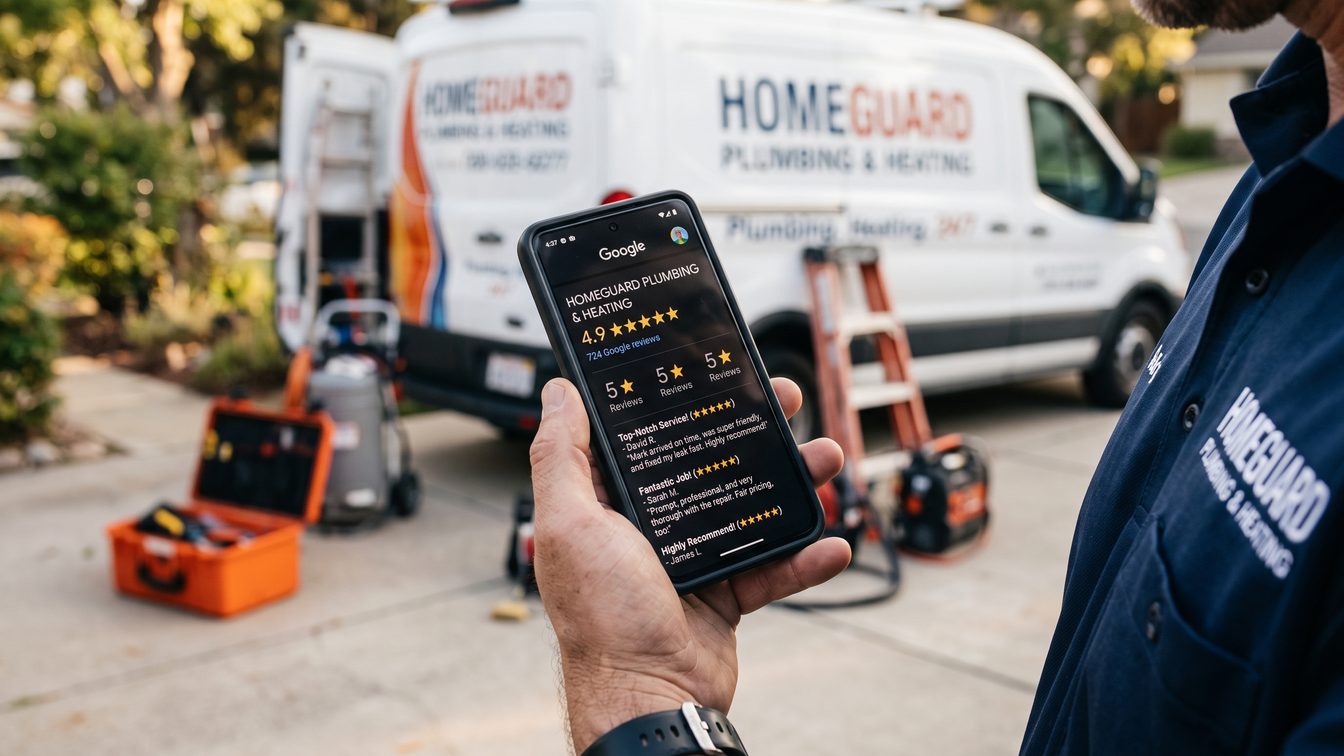
Home service operators with 50 or more Google reviews book jobs at 2.7 times the rate of businesses with fewer than 10. Most operators know reviews matter. Almost none of them have a system to collect them. The owner is in the field all day running calls, managing crews, putting out fires. Asking every customer for a review manually is a pipe dream. AI reputation management tools automate the ask, draft the response, and feed the local SEO engine that puts you in the map pack. The math is simple and the payback is fast.
The Revenue Math on Reviews
Harvard Business School professor Michael Luca published research on Yelp showing that a one-star increase in rating drives a 5 to 9 percent increase in revenue for independent local businesses. Not chains. Independents. That is your category.
The effect compounds when you layer in volume. Businesses with 25 or more fresh reviews in the past 90 days generate 108 percent more revenue than the average business in their category. That stat comes from a Womply study of 200,000 small businesses. Review velocity matters as much as star rating because Google treats it as a signal of active, trustworthy operation.
And 82 percent of U.S. adults read online reviews before making a purchase decision. For home services, where you are literally inviting a stranger into your house, that number is probably higher. The customer is Googling you while you are driving to the job site.
I watched a $4M HVAC company lose a major commercial contract because the decision-maker Googled them and found a 3.2-star rating buried under three unanswered complaints. The company's work was excellent. Their reputation management was nonexistent. That gap cost them a six-figure deal.
Why Manual Review Collection Fails
The failure mode is not lack of effort. It is lack of system. Most home service operators try one of two things. They print "Please review us on Google!" cards. Or they tell their technicians to ask customers verbally after the job.
Both methods produce single-digit response rates. The window for collecting a review is narrow. The customer is happiest within two hours of a completed job. After that, the urgency fades, life gets in the way, and the review never happens. Manual methods miss that window consistently because the operator is already on the next call.
Automated review requests sent within two hours of job completion achieve 34 to 48 percent response rates compared to 6 to 9 percent for manual or delayed requests. That is a five-to-one multiplier just from timing and automation.
The AI Review Engine: How It Works
The system has three components that run without you once configured.
Component 1: Automated Ask. Your field service software (ServiceTitan, Jobber, HouseCall Pro, or whatever you run) triggers a text message to the customer within two hours of job completion. The message is short: a thank-you and a direct link to your Google review page. No friction. One tap to write the review.
Component 2: AI Response Drafting. Every review that comes in, positive or negative, gets a drafted response within minutes. You approve or customize with one tap from your phone. The AI handles the tone, the personalization, and the brand voice. You just confirm it sounds like you.
This matters because 88 percent of consumers say they would use a business that responds to all its reviews, compared to 47 percent for businesses that ignore them. Responding to 25 percent or more of reviews correlates with 35 percent higher revenue.
Component 3: Negative Review Triage. AI flags any review below three stars for immediate attention. You get a push notification, a suggested response, and a prompt to follow up with the customer directly. The goal is damage control within hours, not days. Most competitors take a week to notice a bad review. That week costs you every potential customer who Googled you during that window.
The Local SEO Connection
Google reviews are a direct ranking factor in the "prominence" component of local search. Search Engine Land's research shows that moving from a 3-star to a 5-star rating can increase click-through rate by up to 25 percent in local results. Review velocity, the rate at which new reviews arrive, is itself a signal that Google uses to assess whether a business is actively serving customers.
Your Google Business Profile is the front door of your online presence for local service businesses. More fresh reviews, faster response times, and consistent engagement all feed the algorithm that decides whether you show up in the map pack or get buried on page two.
Tool Comparison for Owner-Operators
Here are the four tools worth evaluating, sorted by the operator profile they fit best.
NiceJob ($75/month): Pure play review automation. Connects to your CRM or field software, sends automated review requests, and reports on review velocity. Best for operators who just need the automated ask dialed in and nothing else. Users report two to four times more reviews within 60 days.
GoHighLevel ($97/month): Bundled with CRM, pipeline management, and AI-powered responses. Best for operators who want one platform for reviews, lead tracking, and follow-up. The review request automation is one feature inside a broader system. If you already run GHL for your CRM, the review engine is built in.
Birdeye ($299/month): Monitors 200-plus review sites, multi-location dashboards, and competitive benchmarking. Best for operators running three or more locations who need centralized visibility. Overkill for a single-location shop.
Podium ($399/month): Text-first communication platform with AI lead capture. Best for operators with high inbound inquiry volume who want to manage reviews, leads, and customer messaging in one text interface.
For most single-location home service operators doing $500K to $2M, NiceJob or GoHighLevel is the right starting point. The tool costs $75 to $97 a month. The revenue impact of moving from 10 reviews to 50 reviews and from a 3.8-star to a 4.6-star rating is measured in hundreds of thousands of dollars annually.
Implementation: The Four-Week Build
Week 1: Claim and fully optimize your Google Business Profile. Connect your field service software to your chosen review tool. Set the automated review request to fire two hours after job completion.
Week 2: Configure AI response drafting. Set approval workflow so you review each response before it posts. Train the AI on your brand voice with five to ten example responses.
Week 3: Turn on negative review triage alerts. Set up your escalation workflow: flag below three stars, draft response, prompt direct customer follow-up.
Week 4: Expand to secondary platforms: Yelp, Facebook, Nextdoor. Monitor weekly in a 20-minute review of your dashboard. Track star rating, review count, and response rate.
After the four-week build, your weekly time investment is 20 minutes reviewing the dashboard and approving AI-drafted responses. Everything else runs automatically.
The Exit Angle
A home service business with a 4.7-star rating and 200-plus reviews is a different acquisition target than one with a 3.5-star rating and 30 reviews. The review profile is a visible, verifiable proxy for customer satisfaction and operational quality. Acquirers check it during diligence the same way they check your financials.
An automated review engine that runs without the founder is operator-independent infrastructure. It compounds value month over month without adding headcount or founder hours. That is the whole point.
Doctrine Connection: Systems beat slogans. A review engine that runs without you is an asset on the balance sheet, not a task on your to-do list.
FAQ
Q: How quickly will I see results from automated review requests? Most operators see a two-to-four-times increase in review volume within 60 days. The star rating improvement depends on your starting point and service quality, but businesses that respond to all reviews and maintain fresh review velocity typically see measurable improvements within 90 days.
Q: Should I respond to every single review, including positive ones? Yes. Responding to all reviews, not just negative ones, correlates with 35 percent higher revenue. A short, genuine thank-you on a five-star review takes 30 seconds and signals to both Google and future customers that you are engaged and attentive.
Q: What do I do about fake negative reviews from competitors? About 14 percent of reviews in home services are identified as fake or suspicious. Flag them through Google's review policy violation process. Do not engage publicly with an accusation. Respond professionally and let Google's moderation process handle removal.
Q: Is GoHighLevel better than a dedicated review tool like NiceJob? If you already run GoHighLevel for your CRM, use its built-in review automation and save the $75 a month. If you just need review collection and nothing else, NiceJob is simpler and purpose-built for that one job.
Q: How does review management affect my Google Maps ranking? Directly. Google's local algorithm uses review signals including volume, velocity, star rating, and response rate as part of its "prominence" ranking factor. More and fresher reviews with consistent owner responses improve your visibility in the map pack.