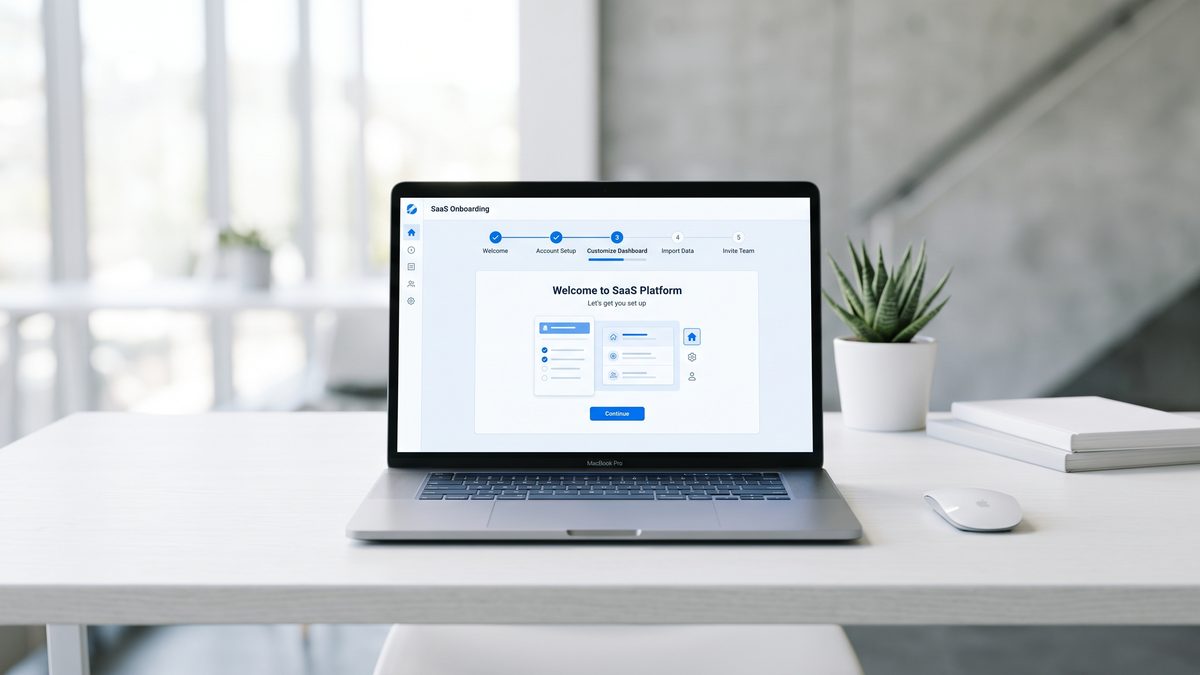
Customers who reach first value within 14 days retain at 82 percent by month 12. Those who take 30 or more days retain at 42 percent, per SaaS Mag's 2026 retention benchmark. That is a 40-point swing on one variable: speed. AI onboarding agents now compress time-to-value from 30 days to three by reading user intent at signup, auto-configuring the product, and routing stuck users before they disappear. For B2B SaaS founders building to sell, this is where the multiple is won or lost.
Key Takeaways
- 60 to 70 percent of annual SaaS churn happens in the first 90 days. Fix onboarding before anything else on your roadmap.
- AI-native onboarding delivers a 3.2x median activation lift over tour-based flows, verified in A/B-controlled studies across roughly 1,400 product organizations.
- Each 1 percent increase in activation rate correlates with roughly 2 percent lower churn. A 10-point activation improvement means 20 percent churn reduction. That math compounds on your balance sheet.
- A four-phase system built on the ATLAS Model for Growth moves TTV from weeks to minutes without changing a line of product code.
The Retention Battleground Has Moved
Retention is not won at renewal. It is won in session one. Most founders do not know this yet, and that gap shows up directly on their churn curve.
Data from ChartMogul, ProfitWell, and SaaS Capital, synthesized in SaaS Mag's 2026 analysis, puts 60 to 70 percent of all annual SaaS churn inside the first 90 days. The single largest bucket is the first 30 days, where 40 to 60 percent of new users walk away without ever feeling the product work. They signed up for a promise. The product did not deliver it fast enough.
The 2026 Perspective AI benchmark, drawn from 1,400 product organizations, found that AI-native onboarding delivers a 3.2x median activation lift over tour-based onboarding, and 4.8x at the top quartile. Same value event. Same activation window. A/B-tested within the same product. The receipts are clean.
This is not a product problem. It is a system problem. Systems can be rebuilt in weeks, not quarters.
Why Generic Tours Have Failed
Generic product tours carry a 15 percent median completion rate. They do not predict conversion. Every 2026 cohort analysis confirms this. A tour is a brochure. Nobody builds a business on a brochure.
The core failure of tour-based onboarding is assumption: the product assumes the user knows what they need, where to go, and why each step matters. Most new users do not. They arrived with one job in mind. The tour sends them on seventeen others.
Slack, Notion, and Canva solved this before AI matured. The Venue Cloud PLG playbook analysis documents the pattern. Slack defaults to value through pre-built channels and a conversational guide. Notion routes users through a jobs-based questionnaire at signup, then drops them into a curated template matched to their stated intent. Canva fills a canvas before the user touches a single control.
None of these products run a 17-step tour. All three hit signup-to-activation conversion of 35 to 60 percent, with median time-to-first-value under 10 minutes for single-player use cases. Show value before you explain the product. That is the doctrine that beat the tour.
The ATLAS Model for Growth Applied to Onboarding
ATLAS is an operator-level framework for building growth systems that do not require founder involvement to run. Applied to onboarding, it has five steps. The first four compress TTV. The fifth compounds the gain.
Activate. Define one observable activation event that predicts month-3 retention, not a five-step checklist. For B2B SaaS, the Perspective AI benchmark points to workspace creation plus a second seat invited as the canonical signal in the segment. Find the equivalent for your product and instrument it in the first two weeks. If you have not done this yet, review our guide on defining SaaS activation events before selecting any onboarding tool.
Track. Capture intent at signup with one open-text question: what are you trying to do? The user's own words become the routing signal for everything downstream. Most onboarding systems skip this step and guess at intent from company size or job title. That is a casualty drill nobody runs until accounts start churning at month three.
Layer. Branch the first-run experience based on stated intent. Build three to five variant flows per product, each aligned to a distinct job-to-be-done. A/B-test copy, template ordering, and defaults against manual configuration. This segmentation step alone drives a 15 to 30 percent activation lift in the Perspective AI data, before any AI layer is added.
Automate. Add a conversational intake layer using an LLM. The user types intent in plain language, the product auto-populates settings, drafts the first artifact, and confirms the configuration before the user leaves session one. Gartner projects that 40 percent of enterprise applications will embed task-specific AI agents by end of 2026. The window for differentiation is open now.
Scale. Monitor conversational signals for confusion and off-path behavior. Route genuinely stuck users to an in-app AI copilot first. Escalate to a customer success manager only when the AI detects real blockage. This keeps CSM hours reserved for accounts with compounding revenue potential, not users who needed better defaults from the start.
What I Learned Onboarding Angel Investors
I founded Angel Investors Network in 1997. Every new member went through a one-hour intake call with me personally, one questionnaire on paper, one phone line. It worked at 12 members. It broke at 120.
The bottleneck was not the quality of the conversation. It was the founder dependency tax: every member's first experience ran through me. No system, no doctrine, no operator-independent path to feeling part of the network. I was the engine room and the captain at the same time.
We rebuilt the intake process as a structured sequence: right resources, right introductions, right context delivered in the right order. Time-to-first-value, the moment a member made a meaningful capital introduction, dropped from six weeks to under ten days. Retention climbed. Build a system that delivers the promise before the member has time to doubt it.
SaaS founders are running the same operation I ran in 1997. They are the bottleneck in their own onboarding. AI removes that bottleneck without reducing the quality of the first experience. Use it.
The Tool Stack at Each Phase
Phases one and two, weeks one through six, call for fast deployment and behavioral branching. Chameleon's 2026 guide to in-app onboarding tools breaks down the leading options. Appcues deploys in hours at $249 per month for 2,500 monthly active users with no dedicated engineer required. Userpilot matches that price and adds native analytics including autocapture funnels, cohorts, and session replays for teams ready to consolidate their data stack.
Chameleon enters at $279 per month with the deepest CSS customization in the category and embedded AI agents that answer in-product questions without routing users to a support ticket. Phase three, weeks seven through twelve, is where AI configuration enters. Command AI, acquired by Amplitude in October 2024, combines co-browsing, natural-language product search, and behavioral Nudge Autopilot that triggers on what users do rather than what they said at signup.
The payback period on this stack closes fast. Each 1 percent activation improvement equals roughly 2 percent churn reduction. On $1 million ARR, a 10-point activation improvement cuts annualized churn by $20,000 to $40,000 against a $3,000 annual tool cost. For a broader look at AI tooling choices at this ARR stage, the analysis at AI tools for B2B SaaS founders covers the adjacent category.
Measuring What Moves the Multiple
Owner-operators building to sell need three cohort views running from day one. Week-one metrics: activation rate by day seven and fourteen, median time-to-first-value in minutes, session-one completion rate. Week-four metrics: activation rate by acquisition source and funnel drop-off by step. Month-three metrics: retention curves by onboarding speed bucket, churn rate by time-to-value group, and NRR impact of any experiments run in the prior weeks.
A vertical SaaS company at Series B ran this exact split on a live cohort. Same product, same pricing, same support team, one variable: speed to first value. Cohort A hit activation within 14 days and retained at 82 percent at month 12. Cohort B took 30 or more days and retained at 42 percent.
A 40-point retention gap driven by one variable is a multiple-defining data point. Acquirers read retention curves before they read revenue projections. Vertical SaaS gained nine activation points year-over-year by replacing CSM kickoffs with conversational onboarding, the largest single-year move in the Perspective AI benchmark by category. This is what verified due diligence looks like from the sell side.
Onboarding speed and churn response are two sides of the same retention asset. The complementary moves on the churn side are covered at SaaS churn reduction for B2B founders.
Doctrine Connection: Legacy matters more than lifestyle. A founder who fixes onboarding this quarter builds a retention asset that compounds for years. The business becomes acquirable and the metrics tell a story that survives due diligence. Build the system now. The lifestyle can wait.
Frequently Asked Questions
What is time-to-value in B2B SaaS and why does it matter more than onboarding completion?
Time-to-value is the elapsed time between signup and the moment a user experiences the outcome they came for. Onboarding completion means they finished your checklist. Those are different events that predict different outcomes. The 2026 SaaS Mag benchmark shows 82 percent month-12 retention for users reaching first value within 14 days, versus 42 percent for those taking 30 or more days.
How does AI onboarding differ from a traditional product tour?
A traditional tour walks every user through the same steps in the same order regardless of their intent. An AI-native system captures intent at signup in the user's own words, branches the experience to their specific job-to-be-done, and pushes the activation event into session one before the user closes the tab. The Perspective AI 2026 benchmark found a 3.2x median activation lift for AI-native onboarding over tour-based systems, measured under A/B-controlled conditions across the same products and activation windows. Generic tours belong to the manual-configuration era.
Which AI onboarding tool is right for a sub-5M ARR SaaS company?
The right choice depends on your technical depth and analytics maturity. Appcues deploys in hours with no dedicated engineer, making it the fastest entry into phase one of the ATLAS framework. Userpilot adds native funnels and session replays for teams ready to consolidate analytics. Chameleon offers deeper customization and embedded AI agents, while Command AI is best for teams already running Amplitude.
What does a realistic payback period look like for AI onboarding investment?
Entry-tier tools run $249 to $300 per month, with phases one and two taking two to four weeks to implement. Each 1 percent activation improvement drives roughly 2 percent churn reduction. If activation moves 15 points and average contract value is $50,000 or more, the payback period closes in 60 to 90 days from churn reduction alone. Verify the math against your own cohort data before signing anything.
Jeff Barnes has no personal position in any company, tool, or platform named in this article. DEMG.ai has no current commercial relationship with any party mentioned. DEMG provides marketing systems and education, not investment advice. Past performance does not guarantee future results.