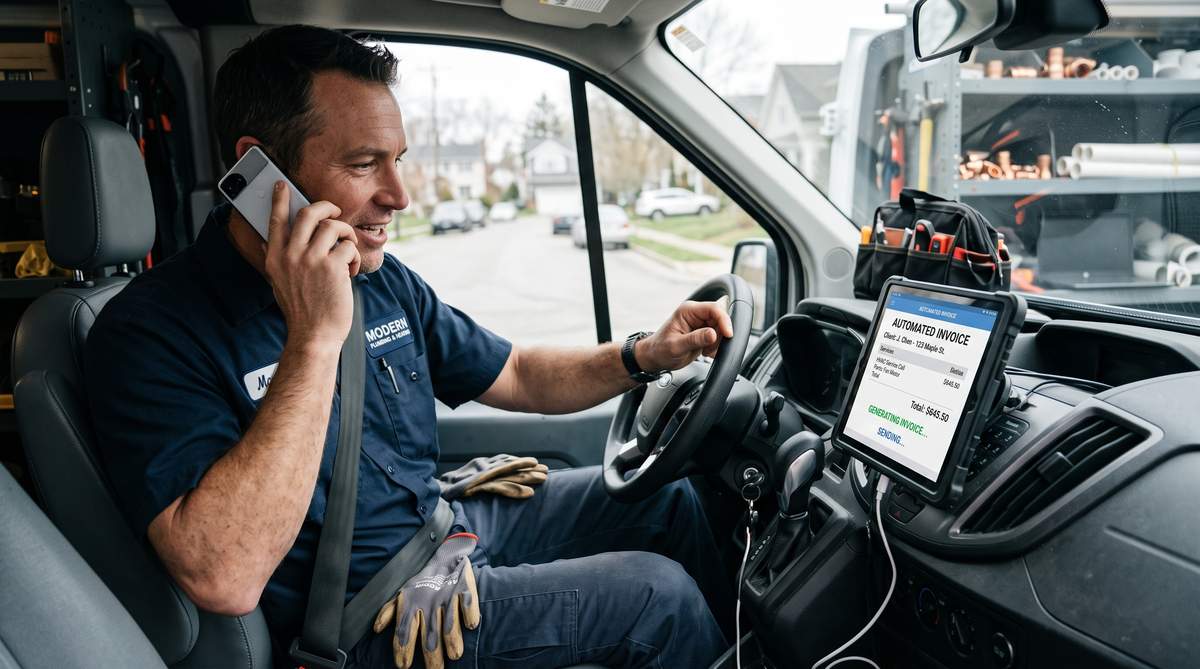
Wix Symphony made news in August 2026 by building AI agents that hold a daily "morning meeting," reviewing completed work, flagging what needs attention, and surfacing new opportunities. Owner-operators of service businesses in the $500K to $2M range do not need Symphony to get the same result. You can wire this yourself using Claude, your existing CRM or field service platform, and Slack or email delivery. The build takes 90 minutes and the return is over $9,000 per year in recovered operator time. Symphony by Wix
- A functional AI morning briefing covers five data points: jobs completed yesterday, today's schedule, outstanding invoices, new leads with no response, and parts or inventory alerts.
- The tool stack is three layers: an LLM (Claude), a field service API (Jobber, GoHighLevel, or ServiceTitan), and a delivery channel (Slack or email).
- The build is approximately 90 minutes: data source discovery, API connection, prompt and report template, and a scheduled send.
- 30 minutes saved per day equals 182 hours per year. At $50 per hour in operator cost, that is $9,125 recovered annually.
Why Manual Status-Checking Is Bleeding You Dry
Before the day starts, most owner-operators of HVAC, plumbing, cleaning, and landscaping businesses spend 20 to 40 minutes assembling status. You check your field service platform for yesterday's job completions. You pull up the invoice aging report. You scan the CRM for overnight leads.
That is not management. That is manual data assembly. It is the founder dependency tax at its most fundamental level.
According to a BizTech Magazine report citing Google data, there are 400 million SMBs worldwide and 36 million in the United States alone. The majority still run morning status checks manually. A Bluevine study from July 2026 found that AI is already saving nearly half of all SMBs more than 4 hours per week. The businesses not capturing that time are paying for it in owner hours that cannot compound on a balance sheet.
The fix is not a motivational habit. It is a system. A structured daily briefing pulls from your existing data, formats it with an LLM, and delivers it to you every morning before you open a single app.
What Goes Into the Daily Briefing
Five data points define a complete operational briefing for a service business.
Jobs completed yesterday. How many closed, and which technicians were on each one? Any flagged for callbacks or issues? This is your overnight receipt: it tells you exactly where yesterday ended and where accountability stands this morning. No receipt means no damage control. Today's schedule. What is on the dispatch board? Are there gaps or back-to-back jobs that could create a conflict for a single technician? Seeing conflicts before dispatch is worth more than solving them mid-day. Outstanding invoices. What is the total dollar amount of unpaid invoices? Which ones are past 30 days? This is the balance sheet health check you should run every morning. Aging invoices are silent cash flow problems. New leads not yet responded to. Any lead that came in overnight without a response is a revenue bleed. The briefing surfaces them before 8 AM so you can act before a competitor does. Parts and inventory alerts. If your platform tracks parts, pull a flag on anything below reorder threshold. A technician who shows up without the right part costs you the job and the review. Identify the shortage before dispatch, not during it.The Tool Stack
You need three components. You likely already have two of them.
Layer 1: Your field service platform or CRM. Jobber, ServiceTitan, and GoHighLevel all expose API access. Jobber's GraphQL API uses OAuth and supports webhooks for job status changes, schedule updates, and invoice events. GoHighLevel has a native two-way sync with Jobber as of September 2025, syncing client data, job records, and contact fields in both directions. ServiceTitan connects via Zapier or direct API webhook.You do not need all three platforms. HVAC shops under $1M typically run Jobber. Shops above $1M with heavy dispatch often run ServiceTitan. Pick one and start there.
Layer 2: An LLM. Claude is the right choice here. Give it a structured data pull and a prompt template. It formats the output into a clean daily briefing, flags anomalies, notes schedule gaps, and highlights any lead older than four hours with no response. Write the prompt once and it runs every day. Layer 3: Delivery. Send the briefing to a dedicated Slack channel or directly to your inbox. Inferensys documents a Jobber-to-Slack AI integration that posts a daily dispatch summary each morning, covering scheduled jobs, technician availability, and parts inventory. That architecture is replicable for any field service shop using Jobber, GoHighLevel, or ServiceTitan.The 90-Minute Build
Here is the procedure. Four steps. Follow the manual.
Step 1: Data source discovery (15 minutes). Log into your field service platform. Identify which API endpoints expose jobs, invoices, leads, and inventory. Jobber's GraphQL API covers all four in one connection. ServiceTitan exposes them through its Jobs, Invoices, and CRM endpoints after you request API credentials from their developer portal. Step 2: API connection (30 minutes). Set up OAuth credentials. Use Make or n8n to pull the previous day's data on a scheduled trigger set for 5:30 AM. For a single system feeding a morning report, 30 minutes is achievable. Two-system setups run closer to 90 minutes based on documented build times. Step 3: Prompt and report template (30 minutes). Write a system prompt that tells Claude what data format it will receive and how to structure the output. Include instructions to flag invoices over 30 days, surface unresponded leads, and note schedule gaps. Test it with one real data pull. Refine until the output reads exactly like a briefing you would write yourself. Step 4: Schedule and deliver (15 minutes). Set the automation to run at 5:30 AM. Post the output to your Slack ops channel or route it to your inbox. You arrive at the office and the briefing is already there. Stand watch at the command level, not the engine room.The ROI Math
Let me show the receipts.
You spend 30 minutes per day on manual status-checking. That is conservative for any service shop doing $500K to $2M in revenue. Thirty minutes times 365 days equals 182 hours per year. At $50 per hour in operator cost, that is $9,125 per year. Run the math yourself and it holds every time.
Build this system once, in 90 minutes, and you recover that annually with no recurring build cost. This is a one-time operator investment with an indefinite annual return. Consider what you do with those 30 freed minutes each morning. Time applied to sales calls or technician coaching compounds differently than time spent pulling reports you already own.
A Small Business Expo survey of 145 SMB owners found that nearly 9 in 10 report saving at least some time per week from AI tools. Almost 30 percent save six hours or more weekly. The morning briefing is one piece of a larger stack. Start here because the payback period is day one.
What the Submarine Taught Me About Status Transfers
I served on the USS Jefferson City, a Los Angeles-class nuclear submarine. Every watch section started the same way. The outgoing watch officer handed the incoming watch officer a written status brief: reactor plant readings, navigation situation, equipment out of service, and standing orders from the commanding officer. That handoff took ten minutes and ran every six hours, every day, regardless of conditions.
Nobody waited to feel like doing it. The procedure ran the ship. I carried that lesson into every business I have built since, from my time at Hartford Steam Boiler coaching operators on process discipline, to building Angel Investors Network systems that had to run without me in the room.
That is what this briefing is. It is the watchstanding handoff for your service business. You do not miss a flagged invoice, an unanswered lead, or the day's first crisis. This is the Owner-Operator Frame: every morning, the system hands you the ship.
A morning briefing is not a productivity habit. It does not require motivation, a good night's sleep, or the right mindset. It is a system. It runs at 5:30 AM whether you feel like it or not.
That is the difference between a business that depends on the founder's energy and one that runs on doctrine. The 90-Day Bottleneck Audit at demg.ai identifies exactly where manual status-checking and information gaps are costing owner-operators hours they cannot recover. This briefing is one of the first fixes we put in place.
Frequently Asked Questions
Do I Need a Developer to Build This?
No. Tools like Make and n8n support no-code and low-code automation flows. You connect your field service platform via API key or OAuth, set a scheduled trigger, and route the output through Claude. Most owner-operators with moderate technical comfort complete the setup in 90 minutes. The demg.ai systems team can handle it in a single session if needed.
Which Field Service Platform Is Easiest to Connect?
Jobber is the easiest starting point. Its GraphQL API exposes jobs, invoices, schedules, and client data cleanly via OAuth authentication. ServiceTitan requires API credentials from their support team, which can take 24 to 72 hours to activate. For HVAC or plumbing shops deciding between platforms, Contractor ToolStack's GoHighLevel versus ServiceTitan breakdown covers cost and capability tradeoffs in detail.
What If My Leads Come From Multiple Channels?
Include every source in the prompt template. If leads arrive via web form, phone log, or Google Business Profile, pull each feed and include a summary in the briefing section labeled "New Leads Not Responded To." GoHighLevel aggregates multi-channel leads natively into one CRM view. For Jobber-only shops, any lead captured outside Jobber requires a secondary webhook or Zapier step to consolidate before it hits the report.
How Do I Keep the Briefing Accurate Over Time?
Audit it weekly for the first month. Compare the briefing output against what you see directly in your platform. If numbers diverge, trace the API pull. Field service platforms update their API schemas occasionally, so build a simple version check into your automation to catch when endpoint parameters change.
Can the Morning Briefing Replace My Team Meeting?
No, and it should not try to. The morning briefing is a daily status transfer: what happened and what is on the board right now. Your team meeting handles strategy: what are we changing and why. Research compiled by Stealthagents shows that automated daily capacity summaries shift meetings from status reporting to problem-solving, cutting meeting time by up to 30 percent.
Jeff Barnes has no personal position in any company, fund, or platform named in this article. demg.ai provides marketing education and systems consulting, not investment advice.