
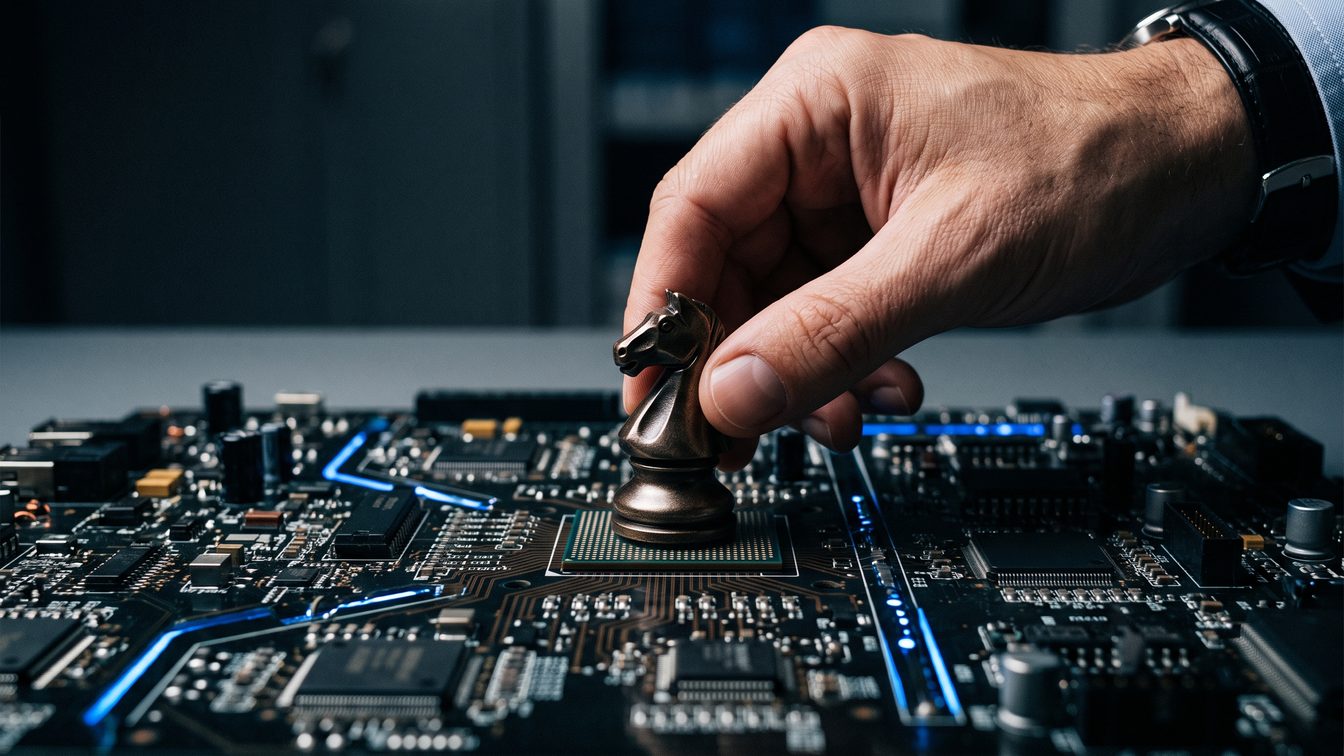
Your AI agent is not an employee. Stop treating it like one. This distinction separates winners from losers faster than anything else in the current AI adoption curve.
The confusion runs deep. Leaders see AI agents performing tasks. They assign them to org charts. They expect judgment calls. They reward "creativity" in prompts. They manage them like junior team members. All mistakes. Fatal ones.
Here's the difference: An employee is accountable for outcomes within ambiguity. An agent executes a defined procedure with precision. An employee grows from feedback and intuition. An agent improves from data and system redesign. One requires judgment. One requires procedures.
On the submarine, we didn't ask the reactor control system to think creatively about coolant flow. We didn't tell it to "use your best judgment" on containment pressure. The manual had one job: describe the procedure. The system had one job: follow it. Deviation meant casualties. We knew our lives depended on the distinction between operator latitude and system compliance. Your business margins depend on it too.
The real money is in workflows, not prompts. Most owner-operators waste effort in the wrong place. They obsess over getting the wording right—"be more concise," "add more detail," "sound more professional." That's prompt engineering. That's busy work. That's founder dependency tax compounding daily.
What actually moves the needle is the structure around the agent. Input validation. Trigger conditions. Output gates. Feedback loops. Data handoff. Rollback procedures. These are systems. Prompts are just the tip of the spear.
Harvard Business Review published large-scale research showing that organizations placing AI agents on org charts "as employees" with autonomy and creative latitude saw measurable failures. The framing itself broke outcomes. Teams treating agents as systems—with defined scope, clear procedures, and measurement gates. Shipped faster and ran cheaper.
The same pattern shows up in small business research. Over 80% of AI implementations fail to deliver meaningful impact, according to Dr. Dave Heath's analysis of owner-managed firms. The failure isn't the AI. It's integration. Data readiness. Change management. Owner-operators especially struggle because they skip the unglamorous work. They tinker with prompts. They don't build infrastructure. They add AI friction instead of removing existing friction.
This is where most businesses fall into the casualty drill trap. A casualty drill is a damage-control procedure on submarines. Specific, rehearsed, repeatable. It's not creative. It's not a suggestion. It works because the operator doesn't make decisions during execution. The procedure is the decision. Apply that framework to your AI stack and watch what changes.
TechTarget's recent analysis nailed it: "Prompts alone reach a practical limit. Execution loops move enterprise AI beyond prompt engineering." The gap between sophistication and reliability is huge. Any operator-independent AI implementation. One that works regardless of who's running it. Must have execution loops built in. Trigger, execute, verify, recover. That's the pattern.
The founder dependency tax is real and it compounds. If your AI results depend on careful prompt wording, your business depends on you standing at the helm continuously. That's not a system. That's you becoming the bottleneck. Systems beat slogans. Procedures beat intuition. When the CEO's plane is delayed and the AI isn't working, your competitive advantage evaporates.
CellCog's framework cuts through the noise: An agent completes a task. An AI employee owns a recurring outcome with queue management, state tracking, and accountability loops. Most owner-operators are trying to build the second thing with the first tool. Then they wonder why results vary.
The receipts tell the story. Businesses that treat AI as a system. Defined input, bounded output, clear procedure. See consistent results across team members. Results repeat. Risk drops. ROI compounds. Businesses that treat AI as a creative worker see exactly what you'd expect: inconsistent quality, constant tuning, knowledge hoarding, and the founder permanently soldered to the execution.
The distinction matters most when things break. In submarines, when a system failed, we had damage-control procedures. We didn't call the reactor and ask it to "be more resilient." We executed the procedure. The system recovered because the procedure accounted for failure modes in advance. Same principle: Your AI system needs failure recovery built into the architecture. Not into the prompt. Into the loops.
Owner-operators often skip this because they're moving fast. Speed feels like efficiency until a single prompt change breaks three downstream workflows. Then it feels like thrashing. Then they blame the tool instead of the architecture. The Knowing-Doing Gap in AI adoption research nailed this: familiarity with ChatGPT doesn't translate to business results because knowing how to write prompts is not the same as knowing how to build systems.
Competence beats credentials. A founder who understands systems. Inputs, procedures, feedback, gates. Will outbuild one with flashy prompt tricks. Not eventually. Right now. The operator who specifies clear boundaries for the agent outperforms the operator trying to negotiate with it. The team that builds procedures outpaces teams that iterate on wording.
The playbook is straightforward. Define the exact input the agent receives. Specify the exact output you need. Document failure modes in advance. Build recovery loops into the system. Test with different operators. If results change based on who's running it, it's not a system yet. Keep redesigning until it is. The moment results become operator-independent, you have infrastructure. You have compounding advantage.
Losers will keep managing AI like employees. They'll hire consultants to "optimize prompts." They'll retrain staff on "better phrasing." They'll stay dependent on the founder. They'll blame the technology. They'll eventually give up and go back to manual work.
Winners will treat AI like engines in the engine room. Procedures. Specs. Maintenance schedules. Failure recovery. Operator-independent design. No judgment calls. No creativity expected. Just reliable output, repeated at scale, without the founder's fingerprints on every decision.
Your choice is clear. Build a system or become the system. Treat your AI agent as a tool with defined scope and you'll scale. Treat it as an employee and you'll cap out exactly where you stand today. Dependent, manual, fragile.
The doctrine says: Competence beats credentials. In AI adoption, systems beat slogans. Operators who recognize this distinction will see their competitors' results flatten while their own compound. The ones who don't will spend the next 18 months in damage control.
Frequently Asked Questions
Q: What is the difference between treating AI as an employee versus as a system?
An employee makes judgment calls. A system follows procedures. When you treat an AI agent like a junior hire, you prompt it conversationally and hope it figures out what you want. When you treat it like a system, you give it defined inputs, expected outputs, and failure-recovery protocols. The system approach produces repeatable results. The employee approach produces expensive randomness.
Q: How do I know if my AI implementation is failing because of the tool or because of my approach?
Check the feedback loop. If you keep re-prompting the same tool hoping for a different result, the problem is approach. If the tool cannot execute a specific technical function you need, the problem is the tool. Most owner-operators I work with are stuck in the re-prompting loop. They need procedures, not patience.
Q: What does an operator-independent AI marketing system actually look like?
It looks like a documented workflow with four components. First, trigger events that start the process automatically. Second, defined steps that execute without human judgment. Third, quality gates that catch failures before they reach the customer. Fourth, escalation paths that route genuine exceptions to a human. The founder touches the system during quarterly reviews, not daily operations.
Q: Can a small business with no technical team build AI systems instead of just using AI tools?
Yes. The distinction is architecture, not coding. You map your process on paper first. Then you connect tools that handle each step. GHL, Zapier, Make, or native API integrations handle the wiring. The technical skill is in the process design, not the software engineering. A $500K service business can build this in 90 days.
Q: How does the Owner-Operator Frame change how I think about AI investment?
It shifts the question from 'what can AI do for me today' to 'what would a buyer pay for this system in 36 months.' Every AI tool decision runs through a valuation filter. Does this reduce founder dependency? Does it create a repeatable process? Does it show up on a balance sheet as an asset? If the answer is no to all three, the tool is a toy, not an investment.
Q: What is the first step to converting my AI tools from employee-mode to system-mode?
Map every AI touchpoint in your business on a single sheet of paper. For each one, write down the trigger (what starts it), the input (what data it receives), the expected output (what good looks like), and the failure path (what happens when it breaks). If you cannot define all four for a given touchpoint, that AI tool is running in employee-mode. You are hoping it figures things out. The 90-Day Bottleneck Audit does this systematically. Most operators find that 60-70% of their AI usage has no defined failure path at all.