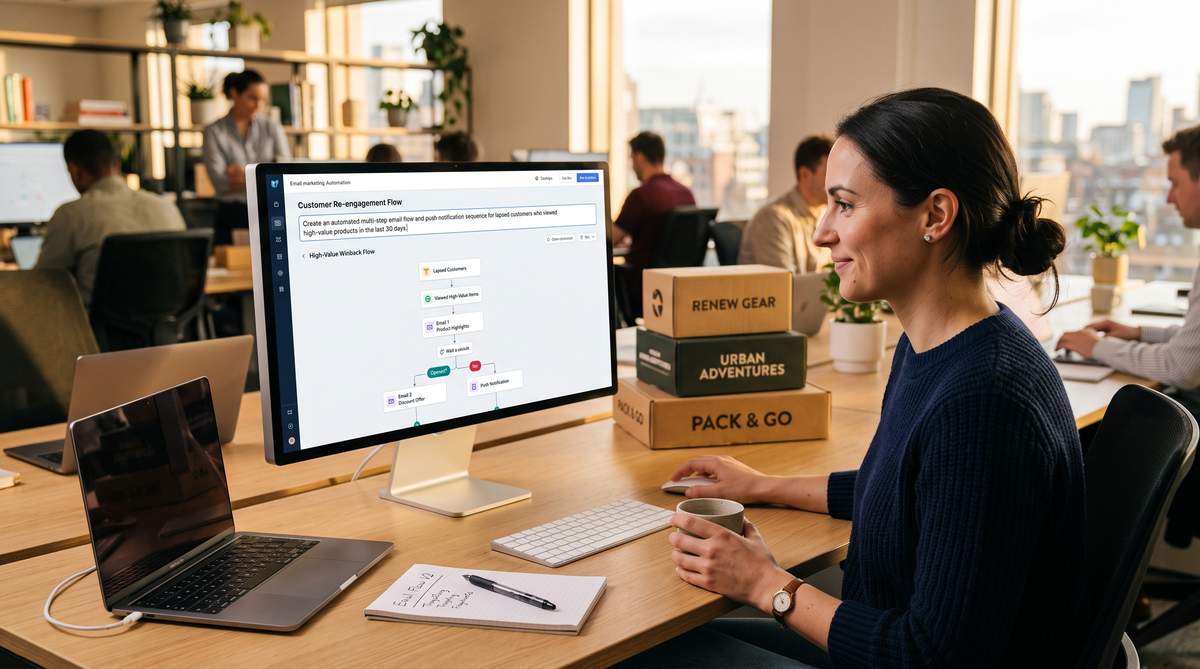
Four autonomous AI marketing platforms launched in six weeks. August 22 through September 9, 2026. The pattern is unmistakable. Small-business owners are abandoning fragmented software stacks. They're trading control for convenience. This audit examines the true cost, according to Osmoti marketing automation for small businesses.
The playbook moves to someone else's server. The customer data lives there too. Export your account. Unclear. Run your workflows elsewhere. Not a default option. This is the sovereignty problem. It's not unique to AI marketing. But autonomous agents make it acute.
The Setup
These aren't integrations. These aren't tools you plug into your stack. These are replacements.
Osmoti (Atlanta, launched Sep 9) runs marketing after the click. Paste a URL, get pages, campaigns, social calendars, review responses, follow-up sequences. One engine replaces the typical agency plus software fragmentation. The value prop is simple. Fragmentation is expensive. Osmoti consolidates it.
MarketOwl AI (Dover, Aug 24) takes a goal and budget, then runs weekly sprints across 8,000+ marketing platforms. It includes a marketplace where practicing marketers sell playbooks. The logic is clear. Real operators have battle-tested workflows. Publish them. Let others license them. Twelve beta customers saw 15% positive reply rates on Reddit. That's not spectacular. But it's auditable.
Tenably AI (Carmichael, Sep 2) is an agentic teammate that understands natural language. "Increase lunch traffic this week" becomes a plan, executed across content generation, social posting, CRM, email, SMS, lead prospecting, and analytics. The interface is the product. You don't configure. You describe.
Sunbots Marketing (Ahmedabad, Aug 22) runs a five-step weekly cycle. Check performance, write content, distribute, capture leads, report results. One subscription replaces six separate tools. The founder targets a specific segment: owners who never wanted to be marketers. That's honest positioning.
Why does this matter. Because the owner never becomes the operator. The machine does. And when the machine operates your business, who owns the output.
The Ownership Question
I spent fifteen years on submarines. Every system had a single operator. The operator owned the result. Not the equipment manufacturer. Not the Navy. The operator ran the boat. When something went wrong, we traced it to operator decision and equipment state. Both visible. Both auditable.
Autonomous AI marketing flips this dynamic. You specify intent. The system specifies execution. The result lives on the vendor's infrastructure. Can you see how the decision was made. MarketOwl publishes a marketplace of playbooks. That's more than the others offer. But seeing the playbook and owning it are different. Can you download every campaign created. Every message sent. Every customer interaction recorded. The answer for all four: not by default.
Osmoti's value prop is speed and replacement. You stop managing tools. You start managing a contract. That's a genuine productivity win. But the moment you want to leave, the data gravity becomes real. MarketOwl's marketplace creates lock-in through intellectual property, not infrastructure alone. Tenably's natural-language interface is elegant until you need to extract what it learned about your customers. Sunbots' five-step cycle is mechanical and repeatable. Which means fragile if the vendor changes the terms.
The Sovereignty Stack: Four Audit Dimensions
The Sovereignty Stack measures what you truly own when you use a platform. Four questions drive the audit.
Ownership: Who holds title to the content created. The workflows designed. The customer data collected.
Portability: Can you export everything and run it on a competitor's platform in 30 days.
Transparency: Can you see the decision tree. The prompts. The ranking algorithm. The selection logic.
Dependency: What breaks when the vendor goes down. What's replaceable. What's not.
Audit Results
| Platform | Ownership | Portability | Transparency | Dependency | |----------|-----------|-------------|--------------|-----------| | Osmoti | Vendor holds content | No export API | Black box automation | Total: no workaround | | MarketOwl AI | You own campaigns, playbooks licensed | Partial: campaigns maybe, playbooks no | Playbook marketplace visible, execution opaque | High: platform-specific sprints | | Tenably AI | Ambiguous (ToS required check) | Unclear API | Natural language visible, internal decisions hidden | Moderate: some standalone execution | | Sunbots Marketing | Unclear | No clear export | Five-step cycle visible, AI reasoning hidden | High: cycle dependent on platform |
Verdict: All four trade sovereignty for convenience. The trade is worth making for some businesses. But enter with eyes open.
The Capital Problem
Capitalism creates value. But only if you own what you create. If I run a campaign and the results live on Osmoti's server, did I create value. My business did. The capital I deployed did. But the record of that creation, the proof of concept, the asset itself. It stays behind the vendor's wall.
This is the classic SaaS lock-in mechanism. And it's not wrong. Some businesses can't afford to build marketing infrastructure. They shouldn't have to. Renting is rational. But renting your autonomy is different from renting software.
The distinction matters. Can you own the output while renting the input.
Osmoti makes this impossible. All four platforms make it difficult. None offer a straightforward "export everything, own it, leave clean" path. They're not designed that way. The business model depends on friction at the exit.
That's not a moral judgment. It's a structural fact. It shapes your decision.
The Dependency Problem: One Anecdote
I watched a biotech founder lose six months to a CRM migration. Not a bad CRM. Just a switch from one decent system to another. The data was portable. The configuration wasn't. The decision logic lived in the CRM. The business logic lived in his head. When the new system couldn't replicate the old workflow, he had to rebuild it. Six months. That was a $2M mistake in opportunity cost.
Autonomous AI compounds this risk. The decision logic now lives in the AI's weights and prompts, not in documented procedures. If Tenably AI makes a decision about lead scoring, where's the decision tree. If you need to migrate, how do you port the learned behavior. You don't. You start over.
That's not a flaw in Tenably. That's a flaw in the structure. Agentic systems create opacity by design. The agent learns. You observe results. But the reasoning behind decisions. That's proprietary. The audit trail of how the machine arrived at "spend $5K on Reddit ads." That's locked away.
For large enterprises, this is unacceptable. For small businesses, the tradeoff might be worth it. But the cost is real. You're buying speed at the price of auditability.
When Autonomy Isn't Free
Osmoti claims it replaces fragmented agency plus software. That's accurate. The cost savings are real. But what you lose is the ability to swap parts. If Osmoti's email underperforms, you can't route email to Klaviyo while keeping campaigns on Osmoti. The system was designed as a monolith, not a stack. This is the core tradeoff. Unified automation beats modular flexibility in the early stages. As you scale, you'll want flexibility back. By then, you're locked in.
MarketOwl's playbook marketplace is clever. Other marketers' workflows become assets you can deploy. But you're licensing their IP, not owning it. If a playbook stops working due to algorithm change or platform policy shift, you lose it. The playbook didn't travel with you. This is especially problematic for playbooks targeting short-lived tactics. Reddit marketing evolves fast. A playbook optimized for 2024 Reddit is worthless in 2026.
Tenably's natural-language interface is the furthest from traditional marketing operations. You're not configuring. You're describing. That's simpler. It's also less controllable. The AI interprets "increase lunch traffic" as it sees fit. Your guardrails are softer. If it decides to slash prices, that's a business decision the AI made. You didn't. Can you audit that. Only if Tenably shows you the reasoning. They haven't committed to that.
Sunbots' five-step cycle is the most deterministic of the four. But deterministic automation is brittle. If week five reporting breaks, the whole cycle stalls. The vendor's SLA matters more than your backup plan. Sunbots offers weekly cycles. If you need daily optimization, you're constrained by their cadence.
All four platforms have this in common. The decision to automate is also a decision to centralize. Centralization creates efficiency. It also creates single points of failure.
Further Reading
FAQ
Q: Is using these platforms wrong.
No. For early-stage companies and solopreneurs, the productivity gain is real. You get professional-grade campaigns without hiring a marketer or an agency. The question isn't whether to use them. It's whether you understand the tradeoff. Own it consciously. Don't pretend the data is yours if it lives on their server. Don't expect to port your campaigns if you didn't design the export mechanism upfront. Some founders will max out these tools for two years, build the business, and sell it. That's a legitimate strategy. The buyer inherits the vendor relationship. If you're the buyer, price that friction into your offer.
Q: Which platform is best for leaving later.
MarketOwl, marginally. The playbook marketplace is visible IP. You can document what you've deployed. You know which playbooks drove which results. The others are optimized for staying. Switching them out costs more than switching out a software tool. Osmoti especially. If the entire funnel runs on Osmoti, migrating means rebuilding the entire funnel. That's not impossible. But it's expensive enough that most businesses won't do it until forced.
Q: Should companies demand export guarantees.
Yes. Before signing, require four things. (1) Raw data export in 30 days, no fees. (2) Workflow documentation in portable format. (3) Campaign performance history as structured data, not screenshots. (4) Customer interaction logs as JSON or CSV. If the vendor won't commit to this in writing, you know the contract is designed to be sticky. That's not inherently wrong. But it changes the price. A platform with high exit friction is worth 30% less than one without it.
Q: What's the alternative.
Build it yourself with in-house expertise. Hire an agency for capital and management. Or use a best-of-breed stack where each tool is swappable. This is slower and more expensive upfront. But you own the playbook. You own the data. You own the decision tree. The cost of that ownership is real. So is the cost of losing it. The right choice depends on your growth stage and your ability to reinvest in infrastructure later.
Doctrine: Ownership Creates Optionality
The best marketing operations are owned by the operator, not rented from the platform. Autonomous AI promises to eliminate the need for operations expertise. In some cases, it delivers. But it replaces one dependency with another. You go from managing software to managing a vendor relationship.
That's not inherently worse. Many businesses benefit. But it changes your strategic flexibility. Your ability to adjust. Your ability to move fast. Your ability to own the outcome. All of it now depends on a third party's roadmap and uptime. When you own your playbook, you can test variations, debug failures, optimize for your specific customer base. When the platform owns it, you submit requests. You wait for priorities to shift. You accept whatever optimization the vendor chose.
Here's the doctrine: Capitalism creates value. Ownership amplifies it. When you own the playbook, the data, and the customer relationship, you have options. You can sell the business. You can migrate. You can license your workflows to competitors. You can hire an operator and hand over the keys. You own the asset. You decide its fate.
When the platform owns these things, the value remains on their server. You rent it. Your competitors rent from them too. The platform captured the advantage. You captured the convenience.
The four platforms audited here are well-built. They solve a real problem. The audit scorecard shows they all make the same tradeoff. Convenience over control. Speed over optionality. If that's the right bet for your business, deploy them. But do it with clear eyes about what you're trading away.
The playbook should be yours to own. If you choose otherwise, own that decision too.
Jeff Barnes, MBA has no personal position in any company, fund, or platform named in this article. Digital Evolution Marketing Group has no current commercial relationship with any party mentioned. DEMG provides marketing systems and education for owner-operators, not investment advice. Past performance does not guarantee future results. All business decisions involve risk.