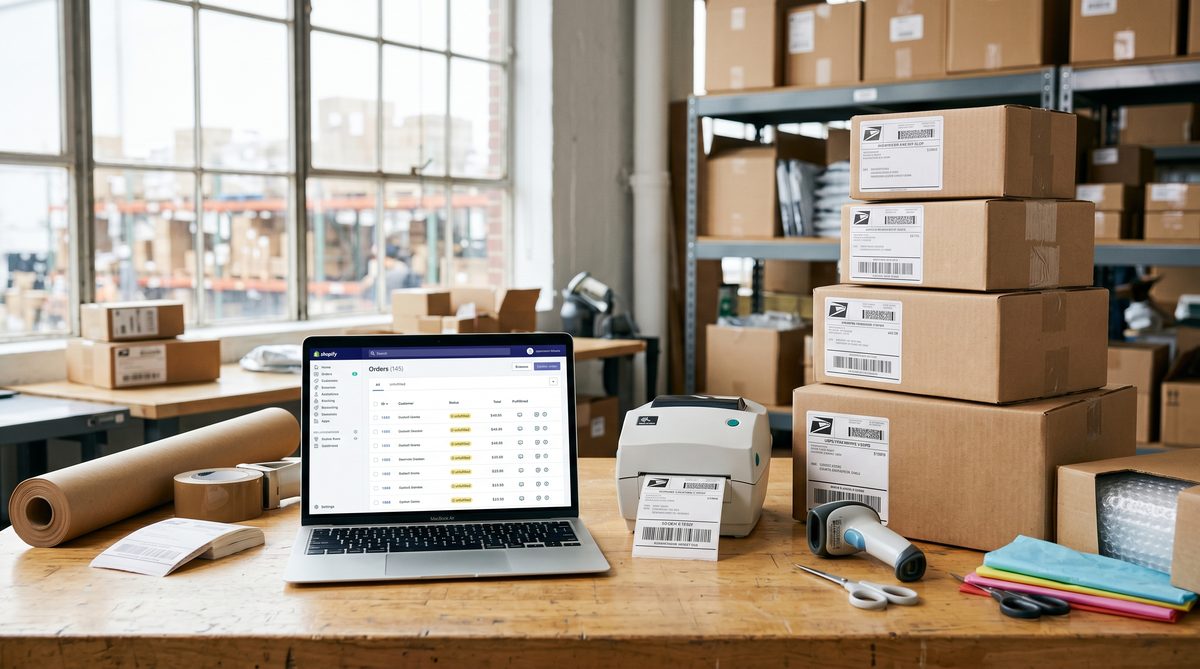
The 150-Feature Trap: Why Most Shopify Updates Fail Small Operators
Shopify dropped 150+ features in Winter '26. The marketing headline screams "RenAIssance"—AI this, AI that, agentic storefronts, SimGym simulations, Tinker apps for creators. None of it matters if your store is bleeding cash on abandoned carts or losing orders to payment friction. Most operators see the feature dump, feel the pressure to "stay current," and waste 20 hours evaluating tools that don't move the needle.
This tactical audit applies the 90-Day Bottleneck framework to filter signal from noise. Five updates deserve your attention. The rest are infrastructure debt disguised as innovation.
The Framework: 90-Day Bottleneck Audit
Before evaluating any new feature, ask: *Does this remove a specific constraint that blocks revenue in the next 90 days?* Not in theory. In practice.
Bottleneck categories that matter for $500K–$5M operators:
- Conversion friction – Cart abandonment, checkout drop-off, payment method friction.
- Discovery time tax – How many manual hours weekly do you burn merchandising, tags, descriptions?
- Decision paralysis – Information gaps preventing you from choosing between optimization paths.
- Traffic quality – Are you selling to real customers or wasting ad spend on poor-fit traffic?
- Operational bottleneck – Repetitive tasks that don't scale without breaking your margin.
Map each feature against these five. If it doesn't solve one within 90 days, defer it.
The Five Edges That Matter
1. Sidekick's Theme Control: Remove the Designer Tax
The bottleneck it solves: Design iteration cycle time.
Historically, store customization required either a developer ($150–250/hr) or hours in Shopify's theme editor (if you can code). Small operators chose neither—they lived with default layouts, weak merchandising, slow conversions.
Sidekick now understands natural language instructions like "make the Add to Cart button larger," "round the corners on product cards," or "move the reviews section above the fold." It translates these instructions into working theme modifications without code.
ROI math: If you've been delaying three design iterations because of cost friction, Sidekick eliminates that barrier. A merchant running $3M annual revenue paying 15% ad spend on cold traffic (assume 2% conversion, 1M annual visitors) gains an extra $60K–$90K from lifting conversion 0.5–1% through improved design clarity. At zero designer cost. Payback period: two weeks.
What to act on: Audit your top 10 product pages. Identify three design friction points (unclear CTA, slow buy signal, poor mobile layout). Prompt Sidekick once per friction point. Measure cart rate and conversion before/after. If you see +0.3% conversion lift, roll it across the catalog.
2. Shopify Magic for Meta Titles & Descriptions: Reclaim 40 Hours/Month
The bottleneck it solves: Manual SEO metadata creation.
Most operators do one of two things: write 500 product meta descriptions at 3 minutes each (25 hours), or skip it entirely and leave conversion upside on the table. Google's algorithm rewards pages with distinct, keyword-rich meta descriptions with 15–25% higher click-through rates from organic search.
Magic now auto-generates meta titles and meta descriptions following SEO best practices (character limits, keyword inclusion, CTR patterns) based on your product data. Accuracy isn't perfect—you'll still review 5–10% of outputs—but you compress 40 hours down to 4.
ROI math: If you're running $500K revenue and organic traffic drives 20% of it, a 3% lift in organic CTR (realistic with proper meta descriptions) adds $30K annually. Cost: 4 hours of review time. 12.5:1 return ratio. This is bottleneck demolition.
What to act on: Export your 500 products without SEO meta descriptions (Shopify admin reports > Products > Keyword tagging). Run Magic batch across them. Spot-check 20 outputs. If 18+ are usable, approve the batch and redirect freed time to traffic generation.
3. Sidekick Pulse: Stop Flying Blind on Merchant Performance
The bottleneck it solves: Decision paralysis from incomplete data.
Owner-operators lack the advanced analytics of Shopify Plus. You log in, check Orders and Revenue cards, and ask: *Am I trending up or down relative to reality?* No baseline. No anomaly detection. No answer.
Sidekick Pulse compares your real-time performance (conversion rate, AOV, traffic) against global Shopify benchmarks. It alerts you proactively when metrics drift outside normal ranges. Instead of you running reports weekly, Pulse flags problems and recommends levers to pull.
ROI math: Pulse prevents the $500–$2K revenue leak from undetected churn. Example: Your conversion rate drops 0.4% (hard to spot in small cohorts, easy to miss). For a $1M annual revenue store at 2% conversion, that's $20K in lost orders monthly. Pulse catches it on day three instead of day 30. One alert saves $13K. Cost: zero (it's free). Decision velocity improves by 5x.
What to act on: Enable Pulse. Set aside 15 minutes daily to review alerts. When an alert fires, ask one question: *Which of the three controllable levers (traffic quality, conversion rate, AOV) is the root cause?* Act on the answer within 24 hours. Track whether Pulse-flagged interventions moved the needle in the following week.
4. Rollouts + A/B Testing: Kill the Launch Guessing Game
The bottleneck it solves: Launch confidence and post-launch visibility.
Most operators launch new site designs or checkout flows all-or-nothing. 50% of the time, the change tanks conversion by 0.5–1%. They panic, revert, and lose two weeks of iteration time. The other 50% of the time, they don't notice a 0.3% lift because they have no baseline to compare against.
Rollouts lets you stage design or flow changes and deploy them to a percentage of traffic. You can run multiple rollouts simultaneously (de facto A/B tests) with real visitor data before committing.
ROI math: Most owner-operators should run four optimization cycles per year. If Rollouts prevent one bad 0.5% conversion drop per year, you save $25K for a $1M store. If Rollouts accelerate decision-making from two weeks to three days per cycle, that's 12 extra days of optimized traffic annually—conservatively +$15K. Bottleneck removal: ~$40K per year.
What to act on: Identify your highest-impact element: checkout flow, homepage hero, product page layout. Build two versions. Deploy Version A to 70% of traffic, Version B to 30%. Run for two weeks. Measure conversion and AOV. Roll the winner out to 100%. Repeat quarterly.
5. Agentic Storefronts (ChatGPT, Copilot, Perplexity): Capture Conversation-First Commerce
The bottleneck it solves: Discoverability in the new search paradigm.
By 2026, 35–45% of commerce discovery happens through conversational AI. Users ask ChatGPT, "Show me a waterproof wireless speaker under $100." If your store appears in the result, you capture high-intent traffic outside of paid channels. If it doesn't, you're invisible.
Agentic Storefronts automatically index your catalog for discovery in ChatGPT, Microsoft Copilot, and Perplexity AI. Your products appear directly in conversational responses—not ads, organic product listings.
ROI math: Conservative assumption: 5% of your organic traffic shifts to conversational discovery within 12 months (some traffic is net new, some cannibalizes existing channels). For a $2M revenue store, 5% of 100K annual visitors = 5K incremental visitors. At 1.5% conversion, that's 75 orders, ~$15K revenue. Cost: zero (platform feature). First-year payoff: $15K+ with zero friction.
What to act on: Ensure your product data is complete: titles, descriptions, pricing, tags. Shopify auto-submits to Agentic Storefronts; you don't need to do anything. Begin tracking "referrer=chatgpt" and "referrer=copilot" in your analytics in 90 days. Measure conversion and AOV. If traffic quality is above 1.2% conversion rate, double down on product data completeness.
What to Skip (And Why)
SimGym (AI Store Simulation): Seductive. Useless for $500K–$5M operators. It simulates user behavior based on aggregate data—not your audience. Save your review time.
Tinker App (Creator Tools): For Shopify's Instagram influencer ecosystem. Unless you're selling branded merchandise (hoodies, prints), ignore it.
Shopify Functions (Replaces Scripts): Critical infrastructure for developers. Not your lever. Let your dev team handle the migration in June.
2,048-Variant Products: Real use case: clothing (size + color combinations). If you sell 12 SKUs, this solves nothing. Adds data bloat, breaks search, creates decision paralysis for customers.
The 90-Day Playbook: What to Do Monday Morning
Week 1:
- Enable Sidekick Pulse. Set daily review cadence (10 minutes).
- Audit five highest-traffic product pages. Identify two design friction points per page. Test Sidekick theme edits on one page.
Week 2–3:
- Export products without meta descriptions. Run Magic batch. Review 20 samples. Approve or iterate. Deploy approved batch.
Week 4:
- Design Rollout test. Build Version A (control) and Version B (hypothesis: larger CTA button, removed reviews section, or simplified copy). Deploy to 70/30 split.
Day 90:
- Measure Rollout winner. Roll out to 100%. Identify next element to test.
- Check Pulse data for anomalies. Review organic referrer breakdown (organic direct, organic chatgpt, organic copilot). If copilot traffic exists, validate product data completeness.
Systems Beat Slogans
Jeff Barnes built AIN in 1997, watching platforms evolve and die. Netscape was cutting-edge. Yahoo was agentic search. Myspace was the social platform. Shopify was a boring ecommerce cart until merchants realized boring wins. The operators who survived didn't adopt every feature—they adopted the ones that removed specific, quantified constraints.
Winter '26 is noise and signal mixed 30:1. These five features hit on signal. The other 145 are infrastructure debt masquerading as opportunity. Your job isn't to be current—it's to move revenue.
Systems beat slogans. Five bottleneck removals beat 150 feature announcements. Get to work.
FAQ
Q: I'm running $750K revenue. Am I the target audience for this audit? A: Yes. These five features target $500K–$5M operators directly. If you're generating $2M+ and have paid marketing, weight Agentic Storefronts and Pulse higher. If you're $500K with zero paid traffic, weight Magic metadata and Sidekick theme control higher.
Q: What if I test Sidekick theme edits and see zero conversion lift? A: You have a design clarity problem, not a design execution problem. Drop Sidekick and hire a designer ($5K–15K) for one comprehensive audit. The friction isn't activation—it's diagnosis.
Q: Isn't Shopify Magic text generation going to look generic? A: Partially. Magic learns your product data and applies SEO patterns correctly 80% of the time. The remaining 20% need human review. This is why you batch review—find the errors, provide feedback, and let the system improve. It's not magic; it's leverage.
Q: How do I measure Pulse's value if I'm already monitoring my dashboards? A: You're not—that's the insight. Track the time you spend reviewing dashboards weekly. Pulse reduces that time 40–50% while increasing decision quality. Measure time saved + decisions triggered by Pulse alerts. If Pulse surfaces one actionable insight monthly that you would have missed otherwise, it's paying for itself.
Q: Should I build for Agentic Storefronts or wait until ChatGPT commerce is more mature? A: No wait. Agentic Storefronts are free. Shopify auto-indexes your catalog. The only action is ensuring your product data (titles, descriptions, tags) is complete and accurate. That's good practice regardless. By the time 20% of your traffic flows through these channels (12–18 months), you'll already be indexed.