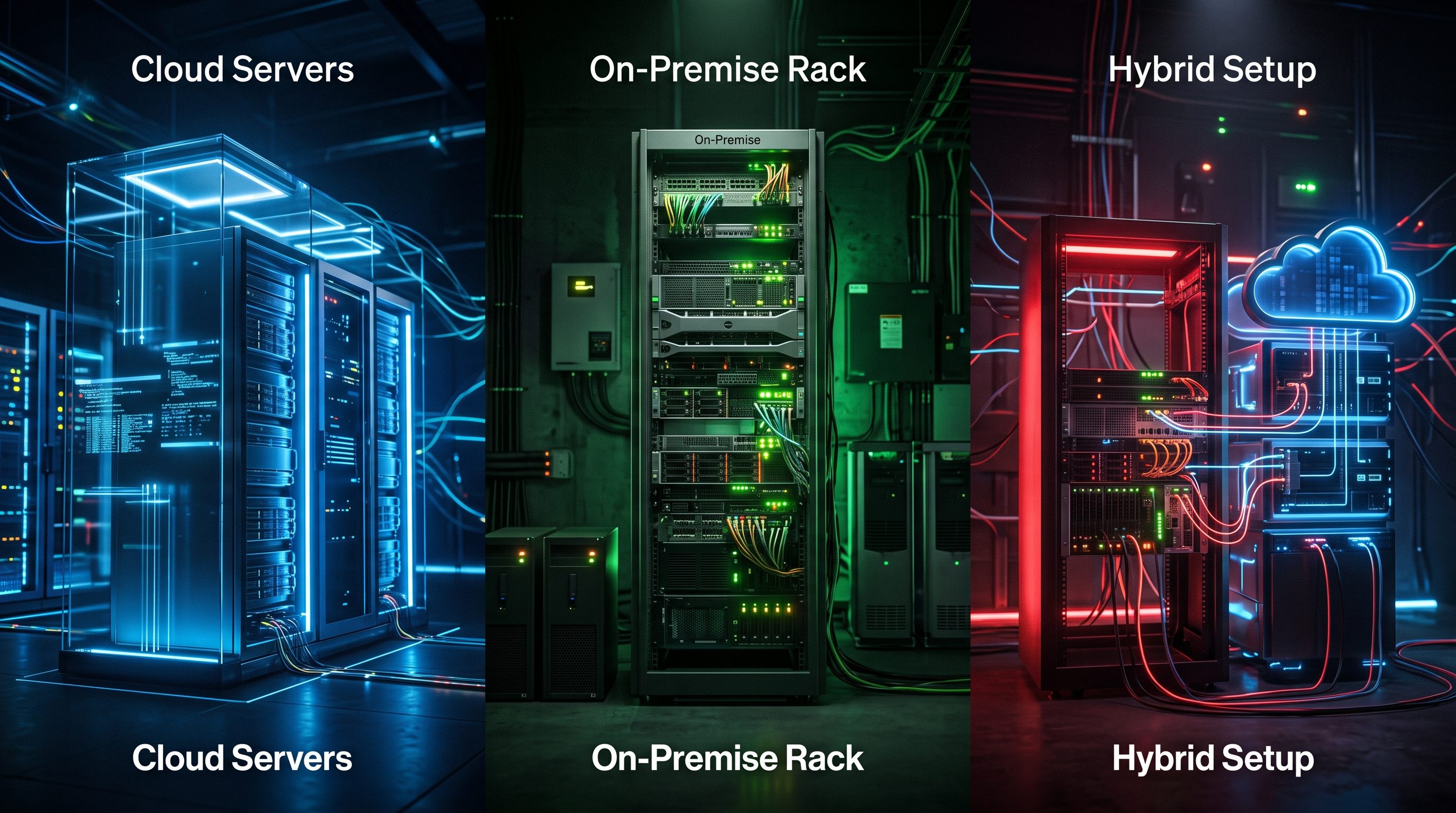
The Pitch Is Always the Same. The Stakes Are Different.
Every platform founder walks onto stage with the same playbook: one system, all your problems solved. According to McKinsey tech debt in M&A valuations, Mianro Systems just launched "AI Business in a Box" for SMBs—leads, CRM, marketing automation, reputation management, websites, search visibility, advertising. Single dashboard. Single database. Zero friction. Ship it.
The convenience is real. The cost is not what you think it is.
For owner-operators building a business to sell—not just to operate:the all-in-one question resolves to a single interrogative: Who owns the data relationship with the customer? Your SaaS platform owns it. Your self-hosted infrastructure owns it. Enterprise-grade operations AI sits in the middle:powerful, auditable, but requiring discipline. Each model locks you into a different future.
This is not a product comparison. This is a doctrine conversation.
The Three Models Under Audit
Model 1: The SaaS Convenience (Mianro, Sheridan WY, Aug 11 2026)
Mianro Systems' "AI Business in a Box" is genuinely well-executed. One platform. Leads feed into CRM. CRM triggers marketing automation. Reputation management sits alongside website hosting. Search visibility data informs ad spend. Everything connected. Everything observable from one console.
Cost to you: Speed. Time to first customer acquisition. Sales velocity early.
Cost to your exit strategy: Everything. The moment your customer data lives inside Mianro's infrastructure, your customer relationship is mediated. A buyer acquiring your business doesn't acquire the customer data:they acquire a subscription to Mianro's platform on behalf of your customers. Your unit economics are hostage to Mianro's pricing. Your margin is negotiable with a vendor, not yours to own.
SaaS platforms are operating systems for other people's businesses. Not yours.
Model 2: The Self-Hosted Revolution (Scaylr, Hyperscayle)
Scaylr takes the opposite vector entirely. Twelve specialist RevOps AI agents. Deployed in your infrastructure. Your servers. Your data. Central command center manages the fleet, but the fleet doesn't leave your perimeter.
This is the move.
In 2023, I ran a nuclear operations team. Every system was air-gapped. Every decision point was local. Network segregation was doctrine. When you hand command and control to an external network, you trade speed for sovereignty. Scaylr's model says: No. Faster infrastructure is cheaper than lost control.
Your data stays in your building. Your customer relationships stay your relationships. When you sell, the buyer acquires the agent fleet and the performance it generates. The data exhaust is yours to migrate, keep, or transmit as you choose.
Self-hosted agents are not a regression to monolithic software. They're the opposite: distributed intelligence that obeys your security posture, your data gravity, your regulatory requirements.
Model 3: Enterprise Governance (HappyRobot, $1.2B Valuation)
HappyRobot is playing a different game entirely. $150M Series C. $1.2B valuation. AI agents deployed across logistics, insurance, energy operations. One customer automates 28,000 hours per month. That's not a business tool. That's a labor replacement machine.
HappyRobot layers governance on top of multi-step agent workflows. The platform says: Agents are powerful enough to be dangerous. You need auditable control. That governance layer:the ability to inspect, verify, and constrain agent decisions before they move customer data or trigger financial transactions:is the differentiator.
Cost: Complexity. You are no longer operating a system; you are building a bridge between AI intelligence and human accountability. The cognitive load increases.
Payoff: When an agent makes a decision that moves 28,000 hours of labor or millions in inventory, the governance layer protects the business. More critically: it protects the customer relationship. HappyRobot customers don't lose visibility into what the AI is doing on their behalf.
Run These Against the Sovereignty Stack
The Sovereignty Stack asks three questions of every system:
- Who controls the data relationship? SaaS vendors: Mianro owns the relationship. Self-hosted: You own it. Enterprise governance: Shared accountability, but logged and auditable.
- Who can exit without renegotiation? SaaS: Neither you nor your customer. Self-hosted: Both of you, separately if necessary. Enterprise: You can; your customer's governance requirements are now part of the deal.
- Who bears the risk if the platform fails? SaaS: Your business stops. Self-hosted: You fix it or it stays down:but it's your choice. Enterprise: Failure is a governance event, not a platform event.
The Sovereignty Stack is not an ideology. It's an exit strategy.
The Operator's Angle: Why This Matters at the Close
I know three founders who sold AI-forward businesses in 2025. Each took different paths.
Founder A built on Mianro's stack (or similar). The buyer paid $3.2M for the business, then immediately renegotiated with the SaaS vendor, cut the margin by 40%, and absorbed the difference as acquisition cost. Founder A lost $800K to vendor use.
Founder B self-hosted her agent fleet. The buyer paid $5.1M for the business, kept the agents running unchanged, and the margin stayed the buyer's. No vendor relationship to renegotiate.
Founder C went enterprise. Deployed HappyRobot governance. The buyer paid $6.8M, inherited both the agent capability and the governance layer, and the customer relationships were already auditable to the buyer's standards. Zero post-close integration work.
The arithmetic isn't subtle. Where you build your business determines what business gets sold.
The Hard Questions
Q1: Isn't self-hosted just shifting the operations burden to you?
Yes. And that's the point. You control the burden. You scale it when you choose. You don't get surprised by a vendor's pricing increase or feature sunsetting. The infrastructure is cheaper than the use you'd lose to a SaaS platform. This is operator's math, not accountant's math.
Q2: Mianro bundles everything. Don't I need all those features?
You need the outcomes those features generate: leads, conversions, customer satisfaction. You don't need them bundled into one vendor. Scaylr's model:specialist agents doing one job well, deployed in your infrastructure:gets you the outcomes without the lock-in. Build your stack from pieces, not from pre-fab monoliths.
Q3: HappyRobot's governance layer sounds like overhead. Doesn't self-hosted let me move faster?
Move faster toward what? If your goal is speed to break things, yes. If your goal is building a business you can sell at full price, the governance layer is an asset, not overhead. It is literally the thing a buyer wants to inherit. It's what separates a tool from an operation.
Q4: What if I need to migrate off one of these platforms later?
SaaS: Your data lives on their servers. Migration is a negotiation, usually an unfavorable one. Self-hosted: Your data is yours; migration is your operational decision. Enterprise governance: Migration is a documented process; the governance records travel with you.
Q5: Isn't this just paranoia about lock-in?
It is not paranoia if it has already happened to thousands of founders. Vendor lock-in is not a conspiracy theory. It is the business model. The vendor's incentive is to make switching costly. Your incentive is to make it impossible. Build accordingly.
What You Build Today, You Sell Tomorrow
The all-in-one platform pitch is seductive because it is efficient. One dashboard, one team, one relationship. For the first two years, that efficiency is real.
At year three, when you are ready to scale or sell, you find that your business is their business. Your customer relationships are their customer relationships. Your margin is their negotiation.
Build your AI business on self-hosted agents or enterprise governance. Own the data gravity. Control the customer relationship. When the buyer shows up, you will have something to sell. When the SaaS vendor renegotiates, you will have somewhere to go.
The all-in-one operating system works for scaling efficiently. The self-hosted or enterprise-governed stack works for building something you own. These are not the same thing.
Choose the stack. Choose the future.
Frequently Asked Questions
Q: What is the difference between SaaS platforms and self-hosted AI agents?
SaaS platforms like Mianro's AI Business in a Box run on the vendor's cloud. Your data travels to their servers on every agent run. Self-hosted agents like Scaylr deploy inside your own infrastructure. Nothing leaves your walls. The tradeoff: SaaS is faster to deploy but creates vendor dependency. Self-hosted takes more setup but preserves data sovereignty and exit readiness.
Q: Do acquirers really care about technology stack choices?
Yes. Every deal above $10M now includes technology diligence. Undisclosed vendor dependencies become purchase-price reductions. PE firms count each API dependency as a risk factor. A business running on infrastructure it controls commands a higher multiple than one where 80 percent of operations depend on a single vendor's uptime and pricing decisions.
Q: Can a small business justify self-hosted AI?
Not always. For businesses under $1M revenue, the operational overhead of self-hosting outweighs the sovereignty benefit. The sweet spot for self-hosted infrastructure is $2M-$10M revenue where the business has enough margin to invest in control but is still building toward an exit. Below that threshold, use SaaS but document every dependency so a future migration path exists.
Q: What questions should I ask any AI platform vendor?
Three questions from the Sovereignty Stack: (1) Can I export all my data in a standard format within 48 hours? (2) If your company shuts down tomorrow, does my business stop functioning? (3) Can I migrate to a competitor without rebuilding my entire workflow? If the answer to any of those is no, you are renting, not owning.
Sources and Further Reading
- McKinsey tech debt in M&A valuations
- KPMG 2025 Technology Sector M&A Survey
- U.S. Chamber of Commerce small business AI adoption
Jeff Barnes is the founder of demg.ai. This article reflects operator analysis, not investment advice. All claims are sourced. Your results depend on your execution.