
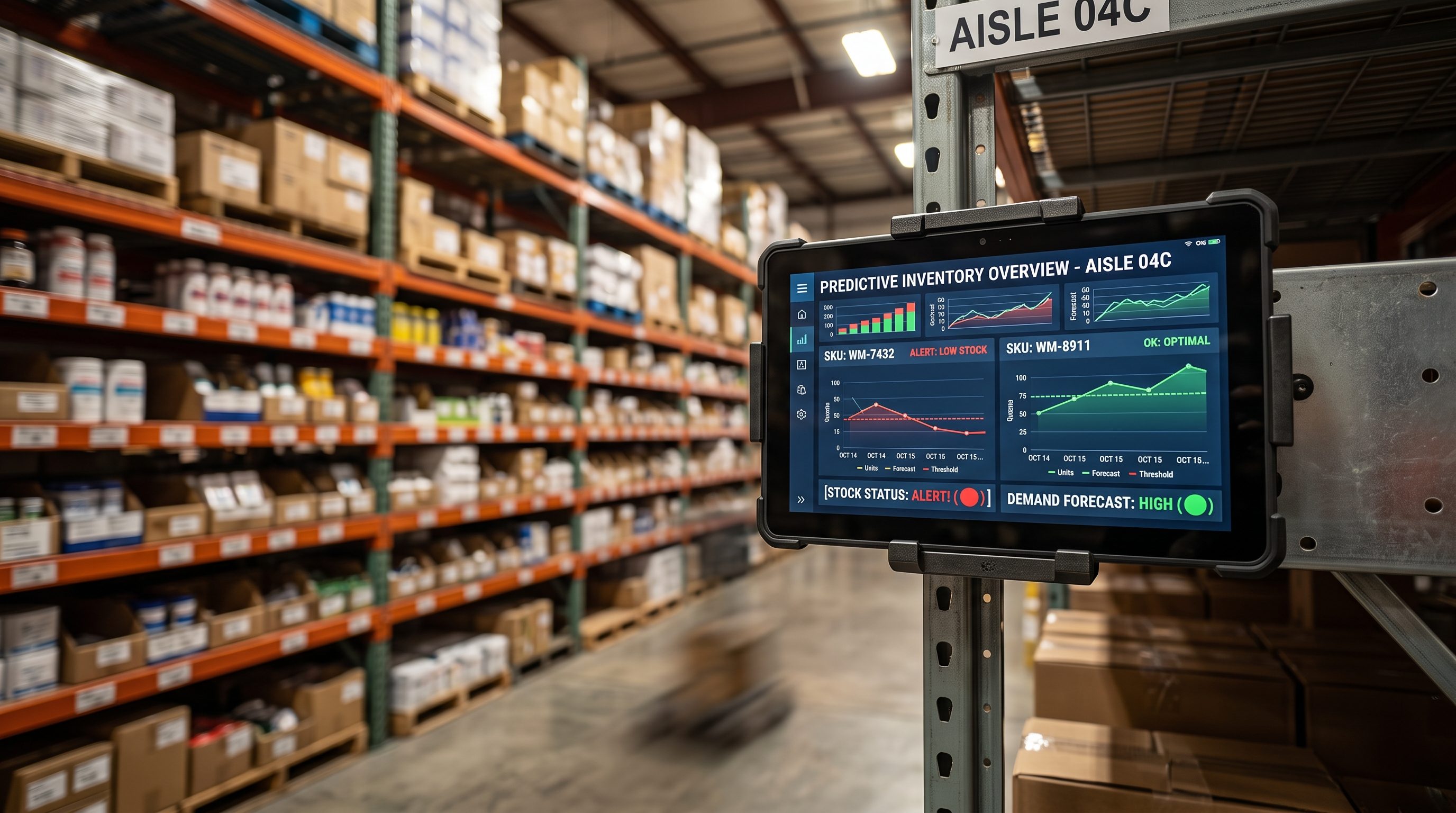
Stockouts cost the average ecommerce operator up to 23% of monthly revenue once you add lost sales to customer churn and wasted ad spend, a figure that sits inside the 20-30% Lost Sales Ratio range documented by Alexander Jarvis's ecommerce research. AI-driven predictive inventory systems flip the odds: forecasting platforms built on sales-velocity and lead-time modeling now catch roughly 87% of stockouts 14 or more days before the shelf actually goes empty, per the 15-30 day warning windows reported in Helium 10's forecasting benchmarks. That gap between "found out from a customer complaint" and "found out three weeks early" is the entire game.
The math is brutal. One stockout during a paid campaign burns the ad spend AND the revenue. You paid to put a customer in front of a product. The product wasn't there. You still paid for the click. Twice the loss, once the mistake.
Most owner-operators find out about a stockout the way a ship's captain finds out about a hull breach: when water is already on the deck. A customer emails. A support ticket piles up. Someone finally checks the dashboard. By then the SKU has been dark for four, six, ten days. Orlio's stockout cost analysis puts the average ecommerce stockout duration at 35 days once it happens, and 53% of Shopify catalogs experience at least one stockout event a year. That is not a rounding error. That is a hole in the hull nobody noticed until the compartment flooded.
Why Reactive Inventory Management Fails Owner-Operators
Spreadsheet-based reordering runs on a lagging indicator: current stock level. By the time a spreadsheet formula flags "low stock," the sales velocity that caused the drop may have already changed. A TikTok mention. A competitor's stockout sending traffic your way. A seasonal spike nobody modeled. The spreadsheet doesn't know any of it happened until the count hits zero.
Manual forecasting methods land at 60-75% accuracy on demand prediction, per Helium 10's comparison data. That means one in four forecasts misses badly enough to cause either a stockout or a cash-eating overstock. On a $2M-revenue brand, a 25% miss rate on core SKUs is not a rounding error. It's the difference between a profitable quarter and a cash crunch that forces a fire-sale discount to move dead inventory.
The deeper problem: reactive systems have no early-warning function. They tell you what already happened. They cannot tell you what's about to happen. An owner-operator checking inventory once a week, once a day even, is still fighting the last war. The stockout already has orders in motion by the time anyone notices.
How AI Predictive Alerts Actually Work
AI inventory forecasting tools, the category that includes Inventory Planner, Flieber, Cogsy, and Prediko, ingest historical sales data, lead times, seasonality, and, in the more advanced platforms, external signals like ad spend and promotional calendars. They don't just track current stock. They project forward.
The mechanism is straightforward once you see it:
- Sales velocity modeling. The system tracks not just units sold, but the rate of change in units sold. A SKU selling 10 units a day last week and 18 a day this week gets flagged even if the stock count still looks healthy on paper.
- Lead time integration. The alert accounts for how long your supplier takes to deliver, not just how many units sit in the warehouse. A 45-day lead time and a 20-day runway is a five-alarm fire, even when the stock count still shows "in stock."
- Reorder point calculation. Instead of a static threshold set once and forgotten, the reorder point recalculates daily based on current velocity and lead time drift.
- Confidence-weighted forecasting. More mature platforms run ensemble models, statistical time-series plus machine learning, and flag SKUs where forecast confidence is dropping. That's often the earliest sign of a demand shift.
The accuracy gap between this and spreadsheet forecasting is not subtle. xByte Analytics reports predictive demand forecasting achieving 85-95% accuracy versus 60-70% for traditional methods, alongside a 60-80% reduction in stockouts and 95%+ fill rates. A national retail case study documented by Norvik took forecast accuracy from 61% to 94% after deploying ensemble machine learning models, eliminating $4 million in annual stockout losses. Different scale, same principle: better forecasting means fewer surprises.
Cogsy, Flieber, and Prediko each approach the alerting layer differently. Some push reorder recommendations straight to Slack; some auto-draft purchase orders for approval. The underlying discipline is identical. The system watches velocity and lead time continuously, not on a weekly review cycle, and it screams before the shelf goes empty, not after.
The Submarine Principle: Drill Before the Casualty
Submarine crews run casualty drills constantly. Flooding drills. Fire drills. Loss-of-power drills. They run them when nothing is wrong, on a boat that is, at that exact moment, perfectly fine. The point is that when the real casualty happens, at depth, at night, with half the crew half-asleep, the response is not a decision. It's muscle memory.
Nobody waits for actual flooding to figure out the flooding procedure. That is how boats sink.
Predictive inventory alerts are the drill. The stockout is the casualty. Most ecom operators run their business the way an untrained crew runs a boat: waiting for the casualty to happen before they learn the compartment even had a valve. An AI forecasting system runs the drill every day, on every SKU, whether anything is wrong or not. It surfaces the SKU with a widening velocity-to-lead-time gap 20 days before it becomes a support ticket. That's not a nice-to-have. That's the difference between a crew that responds on instinct and a crew still hunting for the flashlight while the compartment fills.
Set the drill up once. Let the system run it every day. Stop waiting for the casualty to teach you where the weak point was.
Applying the 90-Day Bottleneck Audit to Inventory
This is exactly the kind of operational dependency the 90-Day Bottleneck Audit is built to expose. The audit's core discipline is identifying operational dependencies, the single points of failure that, if they break, take a chunk of revenue down with them. Inventory is one of the most common blind spots because it looks fine right up until the moment it doesn't.
Here's how to run the audit against your inventory function over the next 90 days.
Days 1-30: Map the dependency. Pull every SKU that drove revenue in the trailing 90 days. Rank by contribution margin, not just units sold. For your top 20% of SKUs, the ones carrying 80% of your margin, document current lead time, current safety stock, and how many stockout events happened in the last 12 months. This is your exposure map. If you don't know your reorder point on your top SKU, you've found your first bottleneck.
Days 31-60: Instrument the alert. Deploy a forecasting layer, whether that's a dedicated platform like Inventory Planner or Flieber, or a lighter-weight setup through Cogsy or Prediko, on your top-tier SKUs first. Don't try to instrument all 400 SKUs on day one. Cover the 20% doing the damage if they go dark. Set alert thresholds at 14-21 days of runway, not the day stock hits zero.
Days 61-90: Stress-test the response. An alert nobody acts on is worse than no alert. It creates false confidence. Assign a named owner for every stockout alert, someone who reorders, expedites, or reallocates ad spend within 24 hours of the flag. Run one live drill: manually flag a SKU as "at risk" and time how long it takes your team to act. If it's longer than two days, the alert system isn't the bottleneck anymore. Your response process is.
The 90-Day audit doesn't end with the dashboard. It ends when a system, not a person's memory, catches the problem, and a defined process, not a scramble, resolves it.
What to Measure Alongside Stockout Rate
A predictive alert system is only as good as the numbers feeding it and the numbers you use to judge it. If you're already tracking a weekly unit economics dashboard, fold stockout-adjacent metrics into that same weekly cadence rather than treating inventory as a separate report nobody checks:
- Days of supply on top-20% SKUs. Target 45-60 days for AI-optimized operators versus 75-90 for manual planning, per Helium 10's benchmark data.
- Forecast accuracy (MAPE). If your platform can't beat your gut-feel baseline by at least 15%, the data feeding the model is the problem, not the model itself.
- Stockout-to-alert lead time. How many days of warning did the system actually give you before the SKU went dark? This is the metric that proves the drill is working.
- Revenue at risk. Sum the contribution margin of every SKU currently flagged inside its lead-time window. Put this number on the same dashboard as CAC and gross margin. A stockout is a margin event, not just an operations event.
Where Predictive Inventory Connects to the Rest of the Stack
Inventory alerts don't operate in isolation. A stockout on a hero SKU wrecks more than that SKU's revenue line. If that product anchors an AI-powered bundling strategy, the bundle breaks the moment the anchor item goes dark, and average order value drops with it. Coordinate bundling logic with inventory alerts so bundles auto-suspend, rather than sell a bundle you can't fulfill.
The same logic applies to retention. A customer who abandons a cart because a size or color is unavailable isn't a candidate for your standard win-back sequence. They're a candidate for a restock notification instead. Sending a discount code to someone who couldn't buy the product in the first place solves the wrong problem. Route stockout-driven cart abandons into a separate flow: notify on restock, don't discount into a void.
The Owner-Operator's Next Move
You do not need an enterprise data science team to run this. Inventory Planner, Flieber, Cogsy, and Prediko all serve the $500K-$5M revenue band specifically, with setup measured in days, not quarters. Pick one, connect it to your top 20% of SKUs, and set the alert threshold at 14-21 days out. That's the drill. Run it before the casualty, not after the customer email arrives.
FAQ
Q: How much revenue do stockouts actually cost a small ecom operator? A: Estimates converge in a wide but consistent band. Alexander Jarvis's Lost Sales Ratio research puts the industry average at 20-30% of potential revenue lost to stockouts, and Eightx's 2026 benchmark analysis shows a typical $20M brand at industry-average stockout rates leaking $1.1-1.2M annually, before marketing effects are even factored in. The exact number depends on your product margin, ad spend intensity, and how concentrated your revenue is in a handful of hero SKUs.
Q: How far in advance can AI actually predict a stockout? A: Helium 10's forecasting data shows AI systems flagging at-risk SKUs 15-30 days before the stock hits zero, based on sales velocity and lead time modeling. xByte Analytics documents similar seven-day and longer risk windows across retail deployments. The exact lead time depends on your supplier's replenishment speed and how volatile the SKU's demand pattern is.
Q: Do I need a full ERP system to get predictive inventory alerts, or can a smaller tool handle it? A: You don't need an ERP. Platforms like Inventory Planner, Cogsy, Prediko, and Flieber were built for the $500K-$5M Shopify and multichannel brand range, connecting directly to your store and marketplaces without a six-month implementation. Start with your highest-margin SKUs and expand from there.
Q: What's the single biggest reason predictive alerts fail to prevent a stockout even after installation? A: No owner behind the alert. A flag that sits in an inbox unread for five days is functionally the same as no flag at all. Assign a named person to act on every stockout alert within 24 hours, and treat that response time as a KPI, not an afterthought.
Q: Should I set predictive alerts on every SKU or just my best sellers? A: Start with the SKUs carrying your top 80% of contribution margin, usually 15-25% of your catalog. Instrumenting your entire catalog on day one spreads attention too thin and buries the alerts that matter under noise from slow-moving tail SKUs.