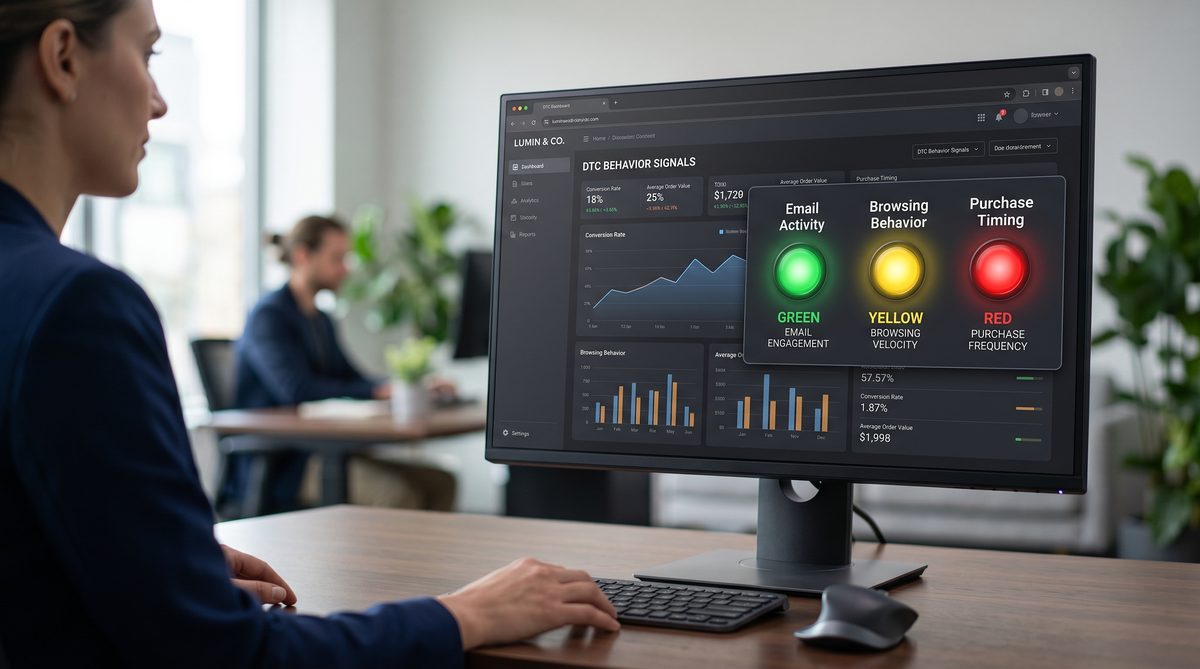
Alex and Ani achieved an 18% AOV increase using Rebuy Engine's AI-powered recommendations, with 37% of total sales influenced by the system, according to a Rebuy case study. Show Me Your Mumu grew AOV nearly 20% in six months with Nosto's AI, per Nosto. Both are vendor-reported numbers. The directional signal is reliable: AI-driven bundling lifts AOV without discounting. Here is how to implement it at the $1M-$5M operator level.
Why Bundling Beats Discounting
Discounting is a margin tax. Every 10% discount on a $50 product costs $5 in gross margin per unit. Scale that to 10,000 orders per month and you have burned $50,000 in margin to move the same volume.
Bundling adds value instead of subtracting margin. A customer who buys a $50 product plus a $25 complementary item at full price generates $75 in revenue with zero margin erosion. The customer perceives value because the bundle solves a complete problem. The operator preserves margin because no price was cut.
Research published on SSRN analyzing approximately 250,000 Amazon product interconnections found that visible co-purchase relationships amplify demand between complementary products by up to 3x. "Frequently bought together" is not a feature. It is a revenue multiplier.
The Three Bundling Architectures
1. Algorithmic Bundles (Automated, Data-Driven)
Tools like Rebuy, Nosto, or Shopify's native recommendations analyze purchase history, browsing behavior, and cart contents to suggest bundles in real time. No manual curation required.
Best for: Catalogs with 200+ SKUs where manual bundling is impractical. The algorithm finds patterns human merchandisers miss.
Implementation: Install the recommendation engine. Feed it 90 days of order history. Set the widget placement on product pages, cart pages, and post-purchase confirmation. Let the algorithm iterate.
Expected lift: 15-25% AOV increase over 90 days as the algorithm trains on your specific customer behavior.
2. Curated Bundles (Expert-Selected, Fixed)
The operator selects bundles based on domain expertise. A skincare brand bundles cleanser, toner, and moisturizer as a "Complete Routine" at a slight savings versus buying separately.
Best for: Brands with strong category expertise and a clear "complete solution" narrative. The bundle tells a story.
Implementation: Identify your top 10 products by revenue. For each, select 2-3 complementary products that complete a use case. Price the bundle at 5-10% below the sum of individual prices. This is not discounting. This is anchoring.
3. AI-Assisted Responsive Bundles (Personalized Per Customer)
The next tier uses AI to personalize which bundle each customer sees based on their individual behavior profile. A returning customer who bought running shoes sees a bundle with performance socks and insoles. A first-time visitor sees the entry-level bundle.
Best for: Operators with 5,000+ monthly visitors and a recommendation engine that supports behavioral segmentation.
Implementation: Connect your recommendation engine to your customer data platform. Build segments based on purchase history, browsing behavior, and lifecycle stage. Assign bundle strategies to each segment.
The 90-Day Implementation Timeline
Days 1-7: Audit your catalog.
Pull your top 50 products by revenue. For each, list the natural complements. "What else would a customer need to get full value from this product?" That question generates your bundle candidates.
Days 8-21: Build 10 curated bundles.
Start with manual bundles while your AI trains. Select 10 product combinations based on your catalog audit. Set pricing at 5-10% below individual purchase. Create bundle-specific product pages with "Complete Solution" messaging.
Days 22-30: Install the recommendation engine.
Choose based on your platform: Rebuy for Shopify Plus, Nosto for multi-platform, Klevu for search-driven commerce. Feed 90+ days of order data. Configure widget placements on product pages, cart, and post-purchase.
Days 31-60: Train and measure.
The algorithm needs 30 days of live data to optimize. Track three metrics weekly: bundle attach rate (percentage of orders that include a bundle), AOV delta (current vs. pre-bundle baseline), and margin impact (verify bundles are not cannibalizing full-price individual sales).
Days 61-90: Iterate and expand.
Kill bundles with attach rates below 5%. Double down on bundles with attach rates above 15%. Test new combinations based on the algorithm's co-purchase data. Layer in AI-personalized bundles for returning customers.
The Math for a $2M Ecom Operation
| Metric | Before Bundling | After 90 Days | |--------|----------------|---------------| | Monthly orders | 3,000 | 3,000 (held constant) | | AOV | $55 | $68 (23% lift) | | Monthly revenue | $165,000 | $204,000 | | Annual revenue delta | — | +$468,000 | | Recommendation engine cost | — | $300-500/month | | Net annual ROI | — | ~100x |
These numbers assume a 23% AOV lift, which is conservative relative to the 18-20% lifts Alex and Ani and Show Me Your Mumu reported using more limited implementations.
The Doctrine Connection
Systems beat slogans. "Increase your AOV" is a slogan. A documented bundling system with algorithmic recommendations, curated combinations, weekly measurement, and quarterly iteration is a system. The system compounds. The slogan does not.
Frequently Asked Questions
Q: Does product bundling hurt individual product margins?
Only if you discount the bundle below cost. A well-structured bundle prices at 5-10% below the sum of individual items, preserving margin on each component while increasing total order value. The net effect is higher revenue per transaction with marginally lower per-unit margin, a trade-off that favors the operator at scale.
Q: Which recommendation engine works best for Shopify stores under $5M revenue?
Rebuy Engine is the strongest option for Shopify and Shopify Plus stores with 200+ SKUs. It offers AI-powered smart cart, post-purchase upsells, and deep Shopify integration. Pricing starts at $99/month, which is accessible for operators in the $1M-$5M range.
Q: How do I measure whether bundling is cannibalizing individual product sales?
Track individual product unit sales alongside bundle attach rates. If individual unit sales decline while bundle rates rise, the bundle is cannibalizing rather than complementing. The fix is typically adjusting the bundle discount downward or changing the product combination to include items customers would not have purchased individually.
Q: Should I bundle slow-moving inventory with bestsellers?
Strategically, yes, but with limits. Bundling a slow mover with a bestseller can clear inventory without discounting. The risk is associating your bestseller with a product customers did not want. Test small. If the bundle's attach rate exceeds the slow mover's standalone conversion rate, the combination works.