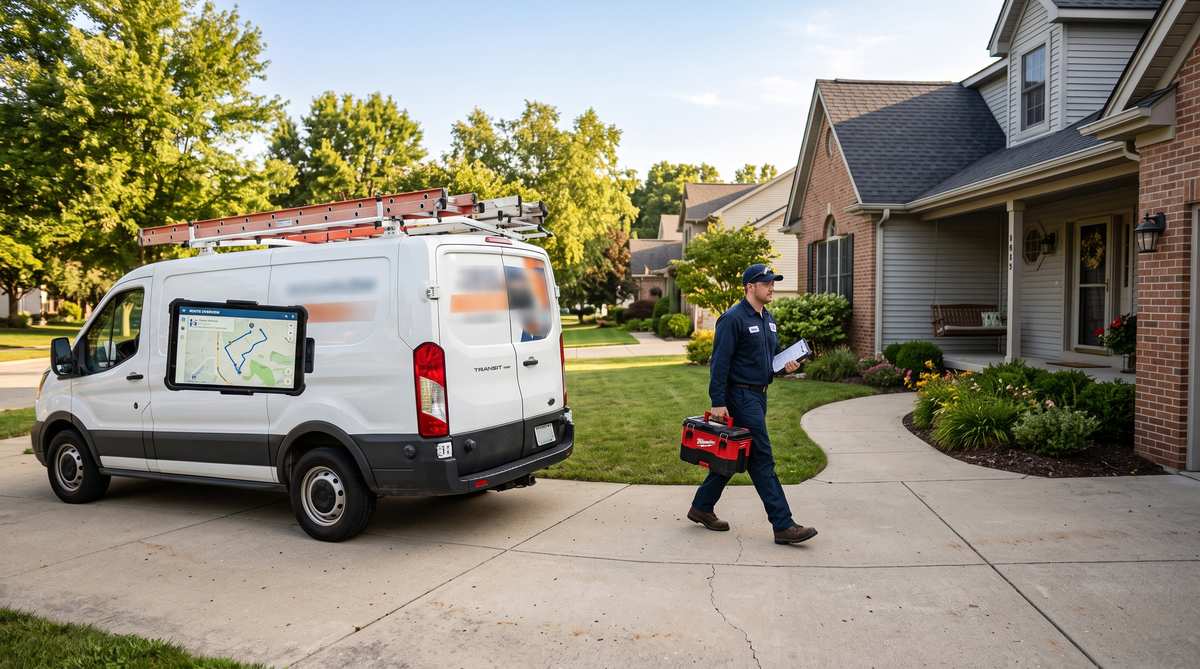
TL;DR: A $1.4M HVAC company was dispatching technicians off a whiteboard and a group text. Three to four missed appointment windows a week were bleeding cash, a pattern US Tech Automations prices at $120 to $185 per no-access truck roll. Running a 90-Day Bottleneck Audit and installing an AI scheduling agent cut dispatch errors 70%, recovered 12 billable hours a week, and paid for itself before the second invoice came due.
- A whiteboard dispatch system works fine at low volume and fails the day call volume outruns one dispatcher's memory.
- Missed appointment windows do not just cost a truck roll. Podium's 2024 data shows churn runs 18% higher after a missed appointment.
- The 90-Day Bottleneck Audit finds the single constraint capping revenue instead of chasing the ten symptoms sitting on top of it.
- An AI scheduling agent pays for itself inside a quarter when dispatch accuracy and first-time fix rate improve together.
The Company Before the Fix
This is an anonymized composite drawn from patterns across several HVAC operators in the $1M to $2M revenue band, the same band where most owners still run dispatch by feel. Call it a residential HVAC company with nine trucks, two dispatchers, and $1.4M in trailing revenue. Growth had been steady for three years. Nothing in the org chart had changed to match it.
Dispatch ran on a whiteboard in the back office and a group text thread for updates. When a customer called, whoever picked up wrote the job on the board and hoped a tech saw the text before driving somewhere else. It worked when the company did four jobs a day. It stopped working around job twelve.
The owner tracked complaints informally: a customer waiting from 8am to noon for a window that turned into 2pm, a tech showing up to a locked gate because nobody confirmed access, two trucks routed to the same zip code while a call three miles away sat open. None of it was written down. All of it was normal.
Fieldproxy's research puts the average HVAC company's productivity loss from poor route optimization at 15% to 20%. On $1.4M in revenue, that is $210,000 to $280,000 a year evaporating before a single technician clocks a wrench-turning hour. Nobody in this company had ever put a number on it. They just knew Fridays were bad.
Running the 90-Day Bottleneck Audit
Before touching software, we ran the 90-Day Bottleneck Audit: thirty days logging every dispatch decision by hand, thirty days mapping where those decisions broke down, thirty days testing a fix against the actual constraint instead of the loudest complaint. The framework exists because most operators fix the symptom nearest their desk. The dispatcher's headache is not the same thing as the company's bottleneck.
The audit's first thirty days produced an uncomfortable number: 31% of dispatched jobs required a manual reschedule at least once. Not because customers changed plans. Because the whiteboard held stale information the moment a tech's morning job ran long. Every reschedule meant a phone call, a rewritten card on the board, and a text nobody could search later.
The second thirty days mapped where those reschedules clustered. They were not random. They stacked up between 10am and 2pm, exactly when morning jobs ran over and afternoon jobs needed rerouting in real time.
The bottleneck was not the techs. It was not the phones. It was the absence of a system that could rebalance a route the moment reality diverged from the plan.
That is the point of the audit: it forces you to find the one constraint before you spend money. US Tech Automations notes the US home services market sits at $657 billion, with lead-to-job conversion running 38% to 45% industry-wide. A company converting leads fine but bleeding them after the appointment is booked has a dispatch problem, not a sales problem.
Most owners buy sales tools to fix dispatch failures. That is money spent solving the wrong constraint.
What the Whiteboard Was Actually Costing
Once the audit isolated the constraint, the math got simple. Three to four missed windows a week at $120 to $185 per no-access truck roll runs $18,000 to $37,000 a year in direct cost alone. That number does not include the churn. Podium's 2024 research, cited by US Tech Automations, found churn runs 18% higher for customers who experience a missed appointment.
For a company this size, that churn delta touches six figures in lifetime customer value over three years. None of it shows up on a P&L line called "dispatch." It shows up as slower growth, more marketing spend to replace lost customers, and an owner who assumes the problem is lead generation. It was never lead generation. It was a whiteboard that could not talk back.
Installing the AI Scheduling Agent
The fix mirrors the pattern Fieldproxy documented at a comparably sized operator, ComfortPro HVAC, where dispatch time dropped from 3.5 hours to 75 minutes a day and jobs completed per technician climbed from 4.8 to 6.7. First-time fix rate rose from 68% to 90%, and the tool paid for itself in 11 weeks. Those are not projections. Those are the numbers a real HVAC company posted after switching from manual dispatch to an AI scheduling agent.
The agent does three things a whiteboard cannot: it rebalances routes automatically when a job runs long, it confirms access windows with the customer before a truck rolls, and it books based on tech skill and location instead of whoever answered the phone first. None of that is exotic. It is dispatch logic that a good human dispatcher already knows, running continuously instead of once a morning.
Pricing matters here because owners assume this requires enterprise software. The AI Trades' comparison of Jobber AI, Housecall Pro AI, and ServiceTitan Dispatch Pro shows the category spans from bundled features in mid-tier plans up to ServiceTitan's $300 to $500 or more per month for the full dispatch suite. A $1.4M company does not need the top tier. It needs the constraint fixed.
Implementation took two weeks: one week to import existing job history and tech skill profiles, one week running the agent in parallel with the whiteboard before cutting the board loose entirely. The dispatchers who resisted hardest on day one became the loudest advocates by day thirty, because the agent did their worst task for them: holding fifteen moving variables in their head at once.
The Watchbill Lesson
On the submarine, we ran a watchbill. Every shift was planned 72 hours in advance, with backups assigned for every position before anyone needed one.
When a casualty drill hit at 0300, nobody scrambled. Nobody wondered who was covering the sonar station. The schedule was already the answer.
Most HVAC operators run their dispatch like a submarine with no watchbill. They plan the morning, hope the afternoon holds together, and treat every schedule collision as a surprise. It is never a surprise.
It is the predictable output of a system with no backup plan built in. A watchbill does not eliminate casualties. It eliminates the chaos of responding to them without a plan already in place.
The AI scheduling agent is the watchbill for a service business. It does not stop a job from running long. It rebalances the rest of the day the second that happens, the same way a backup watchstander steps in without anyone needing to shout down a passageway.
The Results After 90 Days
Dispatch errors, defined as missed windows, double-booked techs, and unconfirmed access, dropped 70% from the pre-audit baseline. Techs recovered roughly 12 billable hours a week across the fleet, mostly from eliminated reschedule calls and tighter routing between jobs. First-time fix rate climbed alongside dispatch accuracy, because techs arrived with the right information instead of a half-written whiteboard note.
The owner's own estimate: the fix paid for itself in the first billing cycle once the truck-roll savings and recovered labor hours were added up. That tracks with the 11-week payback Fieldproxy documented at ComfortPro. Nothing about this case is unusual. It is what happens when a company finally measures the thing it had been guessing about for three years.
Doctrine Connection: Process beats ego. The dispatcher who ran the whiteboard for six years was good at her job. She was also the single point of failure for a $1.4M company.
Replacing the whiteboard was never an insult to her skill. It was an acknowledgment that no individual, however sharp, should be the only system standing between a customer and a missed appointment. Process beats ego because process survives a sick day. Ego does not.
What This Means If You Run a Service Business
Run your own audit before you buy anything. Log every dispatch decision for thirty days by hand. You will find your bottleneck is rarely where you assumed it was. Most owners think they have a lead problem when they have a fulfillment problem, and fulfillment problems compound quietly until a competitor with a cleaner operation starts winning your repeat business.
The tools exist across every price point now. ServiceTitan reports its Scheduling Pro tool books 40% of appointments with new customers and 51% after hours, with some contractors booking over $180,000 in the first month of use.
You do not need ServiceTitan's price tag to get the underlying discipline. You need the discipline first. The software is just the enforcement mechanism.
Frequently Asked Questions
What is the 90-Day Bottleneck Audit?
It is a three-phase diagnostic: thirty days logging operational decisions as they actually happen, thirty days mapping where those decisions break down, and thirty days testing a fix against the real constraint instead of the loudest complaint. It exists to stop owners from spending money on the wrong problem.
How much does an AI scheduling agent cost for a company this size?
Pricing spans a wide range depending on the platform and feature tier, from bundled dispatch features in mid-market tools up to $300 to $500 or more per month for enterprise suites like ServiceTitan's dispatch product. A company in the $1M to $2M range typically does not need the top tier to fix a dispatch bottleneck.
Is a 70% reduction in dispatch errors realistic for other HVAC companies?
The comparable Fieldproxy case study at ComfortPro HVAC showed dispatch time cut 65% and first-time fix rate rising from 68% to 90%, which suggests this range is achievable when the underlying process, not just the software, actually changes. Results depend on how broken the starting process is and how completely the new system replaces it rather than running alongside it indefinitely.
Why does a missed appointment cost more than the truck roll itself?
Because it damages retention on top of the direct cost. Podium's 2024 research found churn runs 18% higher after a customer experiences a missed appointment, which compounds over years of lost repeat business and referrals in a way a single $150 truck roll never captures on its own.
Jeff Barnes is the founder of Digital Evolution Marketing Group and Angel Investors Network. DEMG provides marketing systems and AI operations consulting for owner-operators. This article reflects operational experience and publicly available data. It is not financial, legal, or investment advice. Tools and platforms mentioned are not sponsored endorsements. Verify all claims, run your own numbers, and consult qualified professionals before acting.