
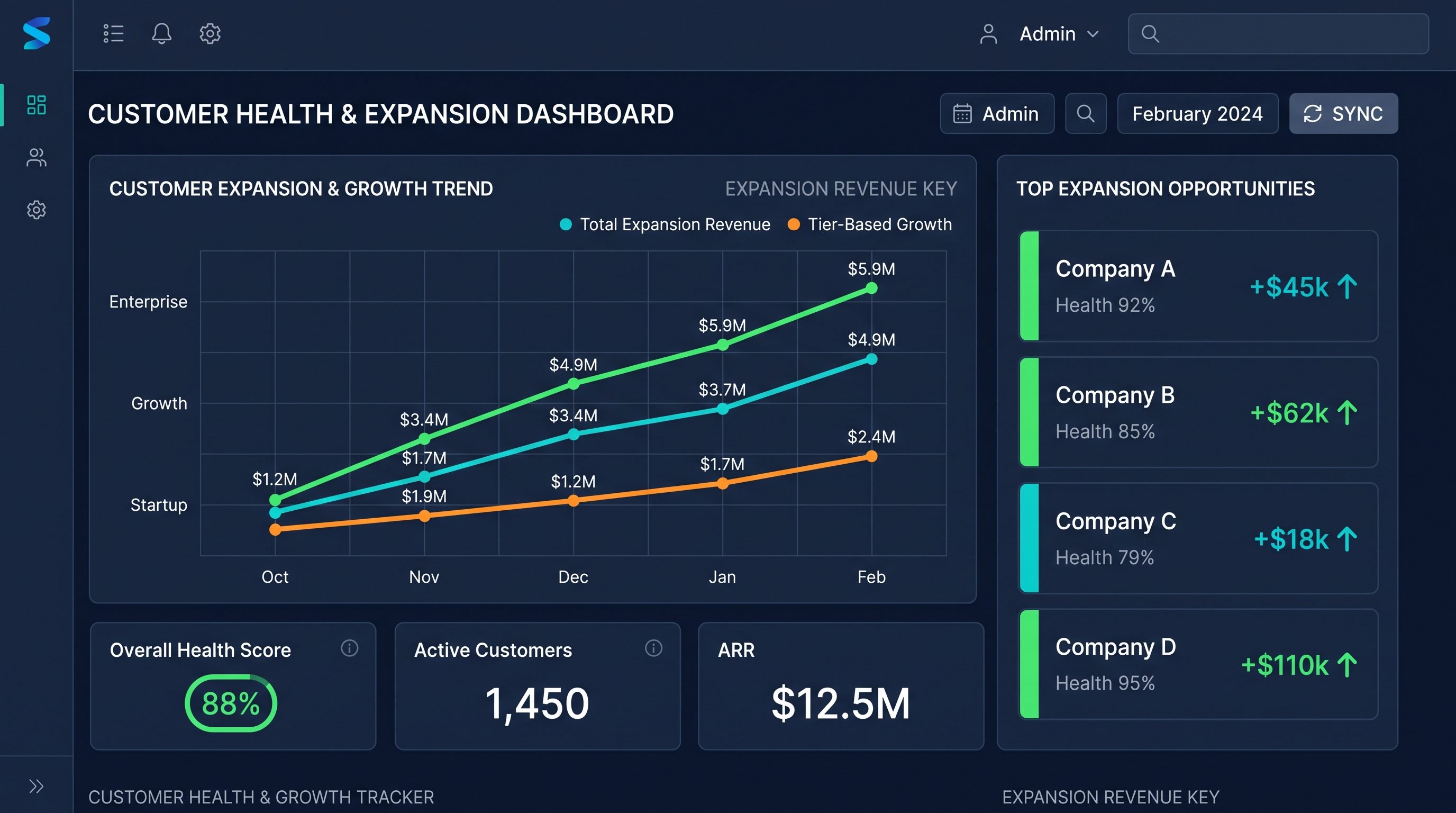
SaaS companies with net revenue retention above 120% command 5x-12x revenue multiples at exit. Companies below 100% get discounted to 3x-4x, and the ones bleeding customers get zero bids at all. That is not opinion. Software Equity Group's own SaaS Index puts the greater-than-120% NRR cohort at a median 9.3x to 11.7x EV/TTM revenue depending on the quarter, against 3.1x to 4.1x for the sub-100% group (Software Equity Group). The gap is not a rounding error. It is the difference between an acquirable business and a business nobody wants. And here is the part most owners miss: AI usage signals predict which accounts will expand 30 to 60 days before the upgrade request ever lands in your inbox. You can see the compounding coming. You can also see the leak coming. Most owners watch neither.
Expansion revenue is the compounding engine. Churn is the leak. AI finds both, and it finds them before your customer success team notices anything on a call.
Why NRR Is the Metric Buyers Actually Underwrite
New logos are expensive. Expansion is cheap. That is the entire argument, and it's why acquirers price NRR before they price growth rate. A company generating 20% growth from expanding existing accounts and one generating 20% growth from a bloated sales team burning cash look identical on a revenue line. They are not identical to a buyer running diligence. One scales capital-efficiently. The other scales a payroll problem.
The data backs this up hard. m3ter's 2026 analysis found a 10-point NRR increase can lift valuation by 20% to 30%, sometimes tens of millions of dollars on an otherwise identical ARR base (m3ter). Fairview's private-market research quantifies it at the deal level: a $7M ARR business at 105% NRR might close at 5x ARR. Move NRR to 115% while holding everything else constant, and the same business commands 6x to 6.5x, an extra $7M to $10.5M in exit value, purely from retention (Fairview). That's not a rounding error. That's a second exit.
We have covered how to build the underlying health infrastructure that makes this possible in Customer Health Score Dashboard in 48 Hours and the valuation mechanics in Net Revenue Retention 120%: The 5x-12x Multiple. This article is about the operating layer between the two: how AI reads usage data to tell you which accounts are about to expand, and which ones are about to walk.
The Signals Arrive Before the Ask
Customers do not wake up one morning and decide to upgrade. They build toward it for weeks. They add three teammates. They bump against an API ceiling. They click into a feature gated behind the next tier and try it anyway. Every one of those actions is a data point, and AI models trained on usage patterns turn scattered data points into a readiness score before a human ever picks up the phone.
The research here is specific and repeatable across companies. Athenic tracked expansion behavior across 19 B2B SaaS companies over 18 months and found something owners should tattoo on their forearm: customers who hit usage limits but had not yet complained converted to an upgrade at 73%. Customers who complained first converted at 34%. Same product, same offer, half the conversion. The only variable was timing (Athenic). One VP of Sales quoted in that research put it plainly: reactive upselling converted at 41%, proactive triggering at 74%, and expansion revenue went from 23% of company growth to 67% after the switch.
The signal hierarchy is not a mystery. It's consistent across every vendor and every research shop that has studied it:
- Capacity signals. Seat utilization above 80%, API calls approaching throttle, storage nearing contracted limits. Datadog's own CFO disclosed on an earnings call that 80% host utilization sustained for 20 days predicts 73% conversion to a contract uplift within 60 days (Pulse RevOps).
- Adoption signals. A customer on a starter plan starts behaving like a power user: using advanced features, running deep sessions, touching capabilities normally reserved for higher tiers. Notion's own data, shared at SaaStr, showed accounts that activate a second workspace within 90 days expand at 3.2x the rate of single-workspace accounts.
- Growth signals. Headcount growth, new funding, hiring for roles your product supports. A funding round is not customer success trivia. It's a budget signal, and AI models that pull firmographic data alongside product usage catch it before your CSM does.
This is exactly the terrain AI-powered platforms were built to patrol. Pendo Predict, built on the Forwrd.ai acquisition, applies machine learning models to usage and CRM data to flag expansion-ready accounts based on feature usage momentum, not guesswork ("Usage data is the truest and most reliable signal of customer health," said Pendo CEO Todd Olson) (Pendo). Gainsight's Staircase AI goes a layer deeper, parsing 90 days of emails, meetings, and support tickets to surface implicit expansion signals most teams never see, scoring each with ARR potential and readiness before a CSM opens the account (Gainsight). Whatever stack you run, the principle is the same. Usage data is a forward indicator. Treat it like one.
Building the Expansion Score
You do not need a data science team to run this. You need three inputs and a weighting system.
Input one: usage ceiling. Track seat utilization, API consumption, and storage against contracted limits. Anything crossing 80% sustained for two to three weeks is a live signal, not noise.
Input two: behavioral graduation. Watch for starter-plan accounts adopting features associated with higher tiers. This is the clearest tell that a customer has outgrown their own contract and doesn't know it yet.
Input three: firmographic movement. Hiring, funding, new departments touching your product. These are budget signals hiding in plain sight on LinkedIn and in your CRM's enrichment layer.
Weight usage ceiling heaviest. It's the strongest predictor across every study cited above. Then behavioral graduation, then firmographic movement. Score every account weekly. Route anything above threshold to a named owner with a deadline to act, because a hot signal that sits in a dashboard for three weeks is a cold signal by the time anyone touches it.
The mechanics matter less than the discipline. GrowthCues frames it well: your customers are telling you when they're outgrowing their plan constantly, "through their clicks, their usage patterns, and their team's behavior inside the product," not through a support ticket or a sales call (GrowthCues). If you wait for the ticket, you've already lost the proactive-conversion premium.
The Fundraise Parallel Jeff Keeps Coming Back To
I built the AIN principle around one observation from raising capital: the best raise is the one where investors come to you. Not because you chased them with a deck and a discount. Because your metrics told the story before you opened your mouth. Revenue trajectory, retention curve, unit economics, laid out clean enough that the term sheet writes itself.
Expansion revenue works on the same principle, and most owners get it backwards. They train reps to chase upgrades. Chasing signals desperation, and desperate asks get discounted. The better move is engineering your product and your data so the account comes to you already convinced. When a CSM reaches out and says "you're at 96% of your seat limit and you just closed a Series A," that's not a pitch. That's a mirror. The customer already knows it's true, because the AI surfaced it from their own behavior, not from a sales playbook.
This is the same discipline that makes a company acquirable. Buyers don't want to see a founder who can tell a growth story. They want a system that tells the story on its own, continuously, without a founder in the room. NRR dashboards that update in real time. Expansion pipelines that build themselves off usage triggers. That's a business that sells itself in due diligence the same way it sells itself to existing customers.
Why This Matters More If You're Building Toward a PE Sale
Private equity has shifted its entire playbook toward add-ons. Add-on acquisitions made up 75.9% of U.S. buyout deal count in Q2 2025, up from just 20% in 2000 (Capital Pad). McKinsey found add-ons composed 70% of total PE deal count in 2023, up from 57% in 2017, precisely because cheap debt and easy multiple expansion no longer do the work for sponsors (McKinsey). If you're a $500K-$5M revenue SaaS business, you are not the platform. You are the bolt-on. And bolt-ons get bought for one reason above all others: proof that revenue compounds without heroics.
A buyer evaluating your business as an add-on is not asking whether you can grow. They're asking whether growth survives the acquisition without you standing in the room. An AI-driven expansion engine, one that surfaces upgrade-ready accounts on its own and converts them at a documented rate, is exactly that proof. We wrote the full playbook on positioning your business this way in Position Your SaaS as a PE Bolt-On. Read it before your next board meeting, not after your first term sheet.
The Weekly Cadence That Makes This Real
Set this up and it runs on rails. Pull usage data into your analytics layer, whether that's Pendo, Amplitude, Mixpanel, or Gainsight. Score every account against the three-input model above. Route the top decile to a named rep, weekly, with a hard SLA of 48 hours, which is standard among the teams that actually convert on this (Pulse RevOps). Suppress accounts less than 60 days into a contract or mid-renewal negotiation. A premature pitch burns the signal for later. Track close rate by trigger type quarterly, and retrain your weighting when a signal stops predicting.
None of this requires a data science hire. It requires an owner who treats usage data as a forward-looking instrument instead of a quarterly report nobody reads. Expansion revenue is not a sales tactic. It's an operating system, and once it's running, it compounds whether or not you're in the room.
FAQ
Q: What net revenue retention rate should a small B2B SaaS company target? Segment matters. SMB-focused SaaS under $25K ACV sits at a median of roughly 97% NRR, mid-market lands near 108%, and enterprise clears 118% (Digital Applied). Whatever your segment, treat 120% as the line where valuation multiples start compounding rather than merely holding steady.
Q: How early can AI usage data actually predict an expansion opportunity? The strongest capacity signals, seat or API utilization above 80% sustained for two to three weeks, predict conversion within 60 days at rates above 70% in documented studies. Behavioral and firmographic signals extend that window further, sometimes 90 days out.
Q: Do I need Gainsight or Pendo to run this, or can I build it myself? You can start with spreadsheets and a weekly manual review if your account count is small. The principle, not the tool, is what matters: score usage ceiling, behavioral graduation, and firmographic movement, then route hot accounts to a named owner fast. Purpose-built platforms just automate what discipline can do manually at smaller scale.
Q: Does expansion revenue actually change what a buyer will pay for my company? Yes, measurably. A 10-point NRR improvement correlates with a 20% to 30% lift in valuation multiple, according to multiple independent analyses of SaaS M&A data (m3ter). On a $7M ARR business, that can mean millions in additional exit value without touching growth rate or headcount.
Q: What's the single biggest mistake owners make with expansion revenue? Waiting for the customer to ask. Proactive outreach on a usage signal converts roughly twice as often as reactive outreach after a complaint or a support ticket. The data is available weeks before the ask. Most owners just aren't looking at it.