
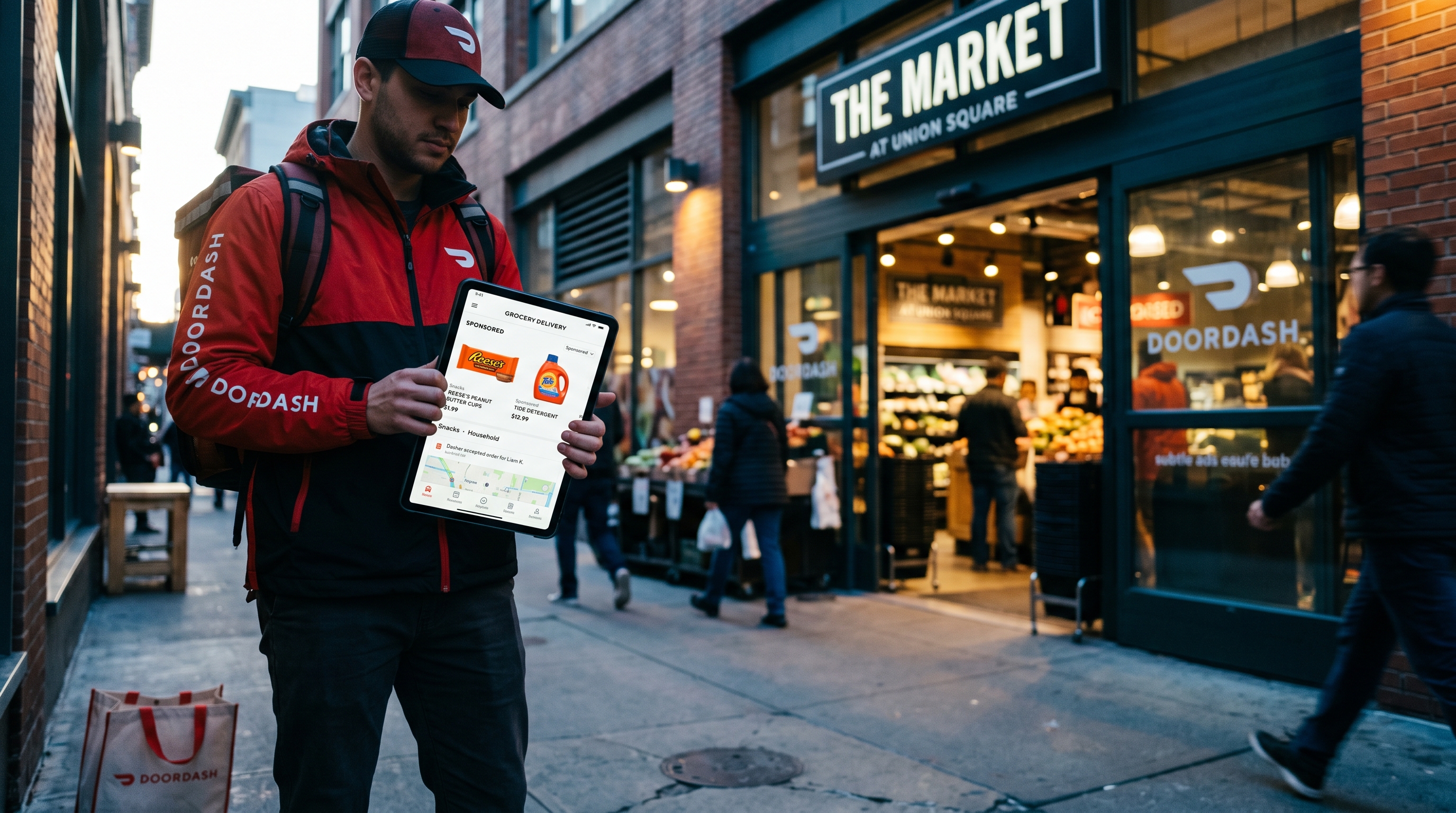
DoorDash's Move: The New Commerce Media Market
DoorDash Ads officially became a global commerce media platform on June 4, 2026, adding 400,000 advertisers to its network with expanded offsite reach through its Symbiosys subsidiary and AI-powered automation. The platform dominates 67% of the US food delivery market, generating over $1 billion in annual ad revenue. This move consolidates a trend that's now impossible to ignore—retail media networks are no longer experiments. They're the primary battleground for customer acquisition.
When a new exchange opens, the smart money studies the rules before placing bets. I watched this in capital markets during the rise of electronic trading systems. The operators who won weren't the ones who moved first—they were the ones who understood the infrastructure, cost structure, and competitive advantages before committing significant capital. DoorDash's launch is exactly that kind of inflection point for ecom operators.
The Three-Front Competition: Amazon, Walmart, Instacart,Now DoorDash
The US retail media market reached $60.32 billion in 2025 and will hit $71.09 billion in 2026, with Amazon Ads controlling 79.7% of market share. But the real story isn't Amazon's dominance,it's the fragmentation beneath it.
Walmart Connect grossed $4.4 billion in 2025, a 27% year-over-year increase. Instacart Ads surpassed $1 billion in trailing twelve-month ad revenue as of Q3 2025, reaching 95% of North American households. Each network owns distinct customer data and behavioral signals. Amazon sees purchase history. Walmart sees grocery baskets and foot traffic. Instacart sees real-time shopping behavior across 100,000+ store locations. DoorDash now sees food delivery patterns, delivery times, neighborhood demographics, and repeat ordering behavior,all compressed into a user base that skews younger and urban.
For ecom operators, this creates a forced diversification problem. No single network captures your entire addressable market. You must deploy capital across multiple platforms, each with different auction mechanics, creative requirements, and attribution models. This is the friction that most operators underestimate.
Data's DNA: Why First-Party Data Is the Moat
Off-site retail media grew 35% year-over-year while on-site grew only 18% in 2025, and the off-site share of total retail media will exceed 25% by the end of 2026. This shift reveals the actual game. Retail media networks aren't primarily about in-app advertising,they're about first-party data access and the ability to reach customers beyond their owned channels.
DoorDash's Symbiosys subsidiary now powers offsite commerce media for retailers globally, with media dollars through the platform nearly doubling since the 2025 acquisition. This is data compounding. DoorDash collects behavioral signals from deliveries, builds audience segments, and sells advertisers the ability to reach those segments across partner properties. Amazon, Walmart, and Instacart do the same,each using their proprietary first-party data to extend reach beyond their primary app.
For operators, the implication is brutal: you cannot win on reach alone. Your only defensible position is owning customer data outside these networks. Direct email subscribers, SMS lists, first-party website tracking, CRM databases,these assets become your negotiating use. Retail media networks will always have better targeting. Your moat must be direct relationships.
What Ecom Operators Should Do Right Now
1. Audit Your Current Media Spend
Map your ad budget across all retail media networks. What percentage flows to Amazon? Walmart? Instacart? Are you spending on DoorDash Ads at all? Most operators have blind spots,money flowing into platforms without clear ROI targets or attribution.
2. Test DoorDash's Platform Strategically
DoorDash's new AI-powered Smart Campaigns and Ghost Ads feature reduces measurement noise by 90%, according to their June 2026 announcement. If you sell complementary products to food delivery (kitchen tools, meal-prep containers, beverages), DoorDash's audience alignment is dangerous to ignore. Start with a $5,000 monthly test budget. Track ROAS to a defined customer segment. Don't scale until you understand unit economics.
3. Map Customer Overlap
Walmart's customer base skews different from DoorDash's. Amazon's is older. Instacart's is suburban and suburban families. Document which networks drive traffic to your owned channels. Which platforms deliver customers with the highest lifetime value? Build a simple spreadsheet: platform, cost per acquisition, repeat purchase rate, AOV, LTV. This is your allocation strategy.
4. Invest in Data Infrastructure
Retail media networks now offer clean room integrations,DoorDash added LiveRamp clean room capabilities in June 2026. These tools let you measure campaign impact without exposing customer data. Implement them. Build connectors between your CRM and each network. The operators winning in 2026 have smooth data pipelines to retail media platforms.
5. Shift Capital Deliberately
Amazon and Walmart will capture 89% of incremental retail media spending in 2026, leaving small slices for all other networks. But "small slices" still represent billions of dollars flowing into Instacart, DoorDash, Target, and Kroger. If you're running paid search or social ads at 1.5x ROI, shifting 20% of that budget to retail media at 2.0x ROI is a clean 200 basis-point gain. Calculate it. Then move capital deliberately, not reactively.
FAQ: Operator Questions on Retail Media
Q: Should I cut Google Shopping budget to fund retail media?
A: Not entirely. Google Shopping and retail media serve different funnel stages. Google captures demand that's already active. Retail media builds demand using first-party behavioral data. If you're profitable on Google at current spend levels, don't cannibalize it. Instead, reallocate underperforming spend (Facebook brand awareness, YouTube, display networks) into retail media pilots. The margin is cleaner.
Q: Is DoorDash's platform mature enough to allocate serious budget?
A: DoorDash has 400,000 advertisers and generates $1B+ in annual revenue. The platform is mature from a volume perspective. But audience overlap with your customer segment matters more than platform size. Test first. The platform's Ghost Ads feature for measurement noise reduction suggests they're investing heavily in attribution,a good sign for long-term viability.
Q: How do I compare ROI across platforms when attribution is broken?
A: Stop waiting for perfect attribution. Instead, implement incremental testing. Run a controlled test: withdraw budget from one platform for two weeks while holding all variables constant. Measure sales impact. This is your true ROAS for that channel. Repeat quarterly. It's not scalable to do this for every platform every week, but rotating through your top five networks provides data that third-party attribution tools cannot.
Q: What's my first move if I have no retail media spend today?
A: Allocate $2,000 to Amazon Ads (proven largest audience), $1,000 to Walmart Connect (second largest, typically better ROAS), and $500 to either Instacart or DoorDash depending on whether your customers skew suburban (Instacart) or urban/younger (DoorDash). Track ROAS weekly. After 30 days, double the winner; cut the underperformer. Iterate.
The Operator's Doctrine
Due diligence is non-negotiable. This isn't hype season anymore. Retail media networks control customer discovery across geographies and demographics. Your choice isn't whether to engage,it's which networks, when, and how much capital. The operators who win in 2026 won't be the ones who move fastest into DoorDash's platform. They'll be the ones who audited their current spend, understood their customer overlap, and allocated capital based on measurable unit economics.
DoorDash's move signals maturation, not disruption. Treat it accordingly.
Related Reading
- 2026 Retail Media Market Growth and Trends
- How to Build Retail Media Attribution Models
- Walmart Connect vs. Amazon Ads: ROI Comparison
Sources
- DoorDash Ads Becomes a Global Commerce Media Platform
- DASH Expands Global Commerce Media Platform With AI And Offsite Reach
- Retail Media Network (RMN): 2026 Guide | Coinis
- FAQ on Retail Media Networks: How Marketers Should Allocate Budgets in 2026
- Retail Media Growth, Statistics, and Trends for 2026 - Fugo.ai
- Future of Retail Media 2026: Marketplaces, RMNs & FMNs Decoded
*Jeff Barnes, MBA has no personal position in any company, tool, or platform named in this article. DEMG.ai has no current commercial relationship with any party mentioned. DEMG provides marketing education and systems, not investment advice. Past performance does not guarantee future results.*