
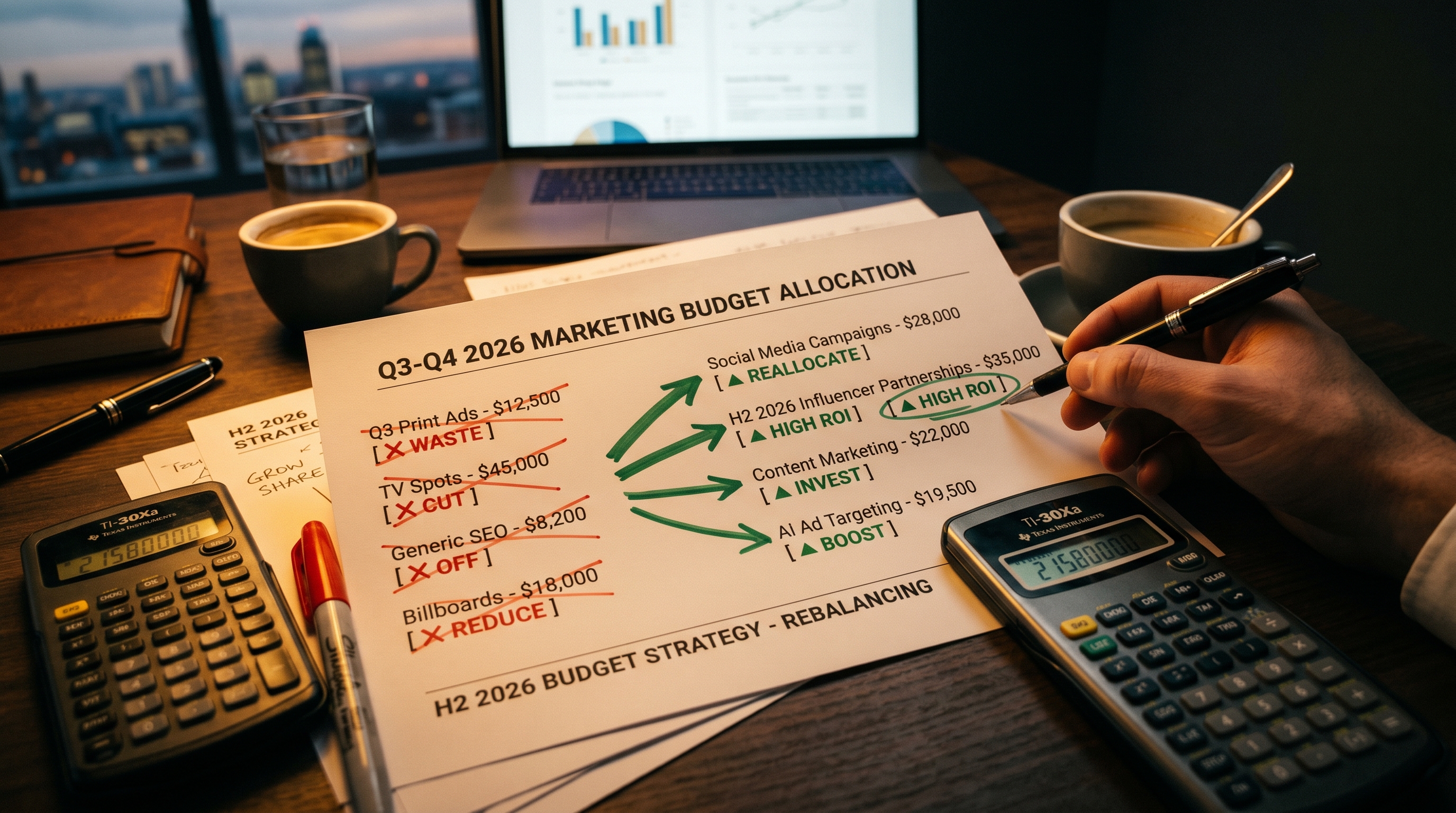
The Rebalance Starts Now
Marketing automation returns $5.44 per dollar spent—$8.71 for top-quartile operators. Most companies recoup automation investment in under 6 months. But that math only works if you're not bleeding cash into dead subscriptions and manual busywork. H2 2026 is your window to cut waste and redirect dollars into systems that compound.
After open-heart surgery two years ago, I audited every system in my life. Your H2 budget deserves the same scrutiny. This isn't cost-cutting for comfort. This is capital discipline—moving dollars from comfort to capability.
The Bleeding Points: Where to Cut
Redundant SaaS Subscriptions
The average company manages 305 SaaS applications. Enterprises waste 51% of purchased licenses. For a 50-person team spending $3,500 per employee annually on tools, that's $175,000 in spend. If half is dead weight, you just found $87,500 in cuts.
Action: Run a 90-Day Bottleneck Audit. List every subscription. Who actually uses it? What problem does it solve? Can a competing tool do 80% of the job? If yes,kill it.
Target: Cut 15-25% of your SaaS stack. Redirect the savings into one or two platforms that actually move the needle.
Manual Processes AI Can Automate
If someone on your team spends 10 hours a week on email list segmentation, CRM data cleanup, or content tagging, that's $2,000-$3,000 a month in labor cost. AI does it in hours for $50-$200 a month.
Example math: Data cleanup contractor costs $4,000/month. Automate with Claude API + simple Python script: $200/month. Payback period: 1 month. Savings over H2: $11,400.
Action: Identify three manual workflows that eat 5+ hours per person per week. Run a pilot automation. If it cuts 70% of that time, roll it out across the team.
Target: Redirect 15-20 hours of weekly labor toward strategy, testing, and creative work.
Underperforming Ad Channels
Not all ad spend is equal. Meta ads may pull 3:1 ROAS; TikTok ads might pull 1.2:1. Google Search is efficient but expensive. Most owner-operators run 4-6 channels simultaneously, spreading budget thin.
Example portfolio: $10,000/month across Google ($3,000), Meta ($3,500), LinkedIn ($2,000), TikTok ($1,500). If LinkedIn pulls 1.8:1 ROAS and TikTok pulls 2.1:1, reallocate. Move that $2,000 from LinkedIn to TikTok. Hypothetical new revenue: +$2,000 a month. Annualized impact: +$24,000.
Action: Pull 90-day performance data on every paid channel. Calculate true ROAS (revenue attributed / spend). Kill anything below your acceptable threshold. Consolidate winners.
Target: Cut 1-2 underperforming channels. Funnel savings into your two highest-ROAS channels.
The 90-Day Bottleneck Audit Framework
This is the operating system for your budget rebalance. Run it quarterly. Answer three questions for every dollar of spend:
- What problem does this solve? If you can't articulate it in one sentence, it doesn't solve a problem,it's comfort.
- What's the ROI? Revenue in / cost out. If you can't measure it, stop spending.
- What's the 90-day test? If you cut or doubled this spend, what would you learn? If the answer is "nothing," the spend isn't critical.
Application: List your top 20 marketing expenses. Run the three-question audit on each. This will surface 15-20% immediate cut targets and 3-4 reallocation opportunities.
Where to Double Down: The Capital Deploy
First-Party Data Infrastructure
Third-party cookies are dead. Owned email lists are gold. A 50,000-person email list is worth $200,000-$500,000 in customer value.
Investment: Email platform upgrade ($500-$2,000/month depending on volume), landing page builder, analytics integration. Total: $1,500-$3,000/month.
ROI: Email automation delivers $36 return for every $1 invested. Although automated emails are 1.8% of all sends, they generate 31% of email orders. If you mail 500,000 emails a month and earn $5 average order value, that 31% share = $775,000 annual revenue from automation alone.
Action: Audit your email data quality. Implement re-engagement campaigns. Build gated content offers. Segment by behavior and purchase history.
Target: Grow your email list 20-30% in H2. Achieve 25%+ open rates on automated sequences.
AI Content Systems
Manual content creation is expensive and slow. A content writer costs $4,000-$8,000/month for 8-12 publishable pieces per month. AI reduces that to human editing and fact-checking only.
Tool stack: Claude API ($50-$300/month depending on usage), Midjourney ($20/month), SEO research tool ($100/month), scheduling platform ($20/month). Total: $200-$500/month for a 3-4 piece/week production engine.
Cost per piece: $10-$30 versus $500-$700 for human-created.
Action: Build a content calendar for Q3-Q4. Assign 2-3 writers to oversee AI generation, fact-check, and adapt. Measure engagement and conversion on AI-authored pieces.
Target: Produce 3x more content for 40% of current spend.
Owned Media & Email/SMS Automation
Paid ads scale until they hit saturation. Owned channels scale indefinitely.
Investment: Email platform ($200-$500/month), SMS service ($50-$200/month), content calendar ($0 if internal), automation workflows ($0 if DIY, $2,000-$5,000 if agency-managed).
Example: 50,000-person email list at $0.50 customer acquisition cost = $25,000 lifetime value per 10,000 new subs. If SMS automation improves repeat purchase rate by 8%, that's $2,000 in incremental monthly revenue from a $50/month SMS platform. Payback: 1.5 weeks.
Action: Map your customer journey. Identify 4-6 trigger points (post-purchase, abandoned cart, low engagement, expiring subscription). Build automation sequences.
Target: Achieve 2-3% conversion on email campaigns, 10-12% on SMS. Reduce manual outreach by 50%.
FAQ: The Rebalance Questions
Q: How much should I cut from my overall marketing budget?
A: Not dollars,waste. If you're spending $50,000/month marketing, target 10-15% efficiency gain (tools + redundancy). That's $5,000-$7,500/month reallocated, not necessarily cut. Most owner-operators can find this without reducing total spend.
Q: When should I pull the trigger on these changes?
A: Now. H2 planning happens in June-July. By August, you've lost two months of compounding returns. If you wait until October, you've lost half the H2 window.
Q: What if my team resists cutting a favorite tool?
A: Run a 30-day pilot shutdown. Migrate workflows. Measure productivity. If nothing breaks and revenue doesn't drop, it was comfort. Cut it. If the business suffers, restore it and justify the expense through the audit framework.
Q: Should I cut ad spend or optimize it?
A: Both. Kill the lowest-ROAS channels (bottom 20%). Optimize the remaining 80% through testing, landing page work, and creative refinement. Dead ads drain capital; weak ads teach you something.
Q: How much budget should flow into first-party data infrastructure?
A: 8-12% of total marketing spend. If you spend $100,000/month marketing, allocate $8,000-$12,000/month to email, SMS, landing pages, and CRM integration. This is your defensive moat.
The Operator's Doctrine
Freedom beats comfort. Every tool you cut and every manual process you automate buys you back cognitive load. Every dollar moved from dead ads into owned channels buys you independence from platform changes and algorithm shifts. The rebalance isn't about saving money. It's about buying optionality. By H2 2027, you'll have the infrastructure, audience, and data to operate on your own terms,not on Meta's or Google's.
Related Reading
Sources
Marketing Automation ROI Statistics 2026 , Email automation ROI and top-quartile performance benchmarks.
SaaS Statistics 2026 , Application proliferation and license waste data.
Subscription Fatigue Statistics 2026 , Enterprise SaaS cancellation trends and waste metrics.
B2B Marketing Budget Benchmarks 2026 , Framework allocation and rebalancing cadence.
Marketing Budget Allocation Guide 2026 , 70-20-10 framework and quarterly rebalancing.
*Jeff Barnes, MBA has no personal position in any company, tool, or platform named in this article. DEMG.ai has no current commercial relationship with any party mentioned. DEMG provides marketing education and systems, not investment advice. Past performance does not guarantee future results.*