
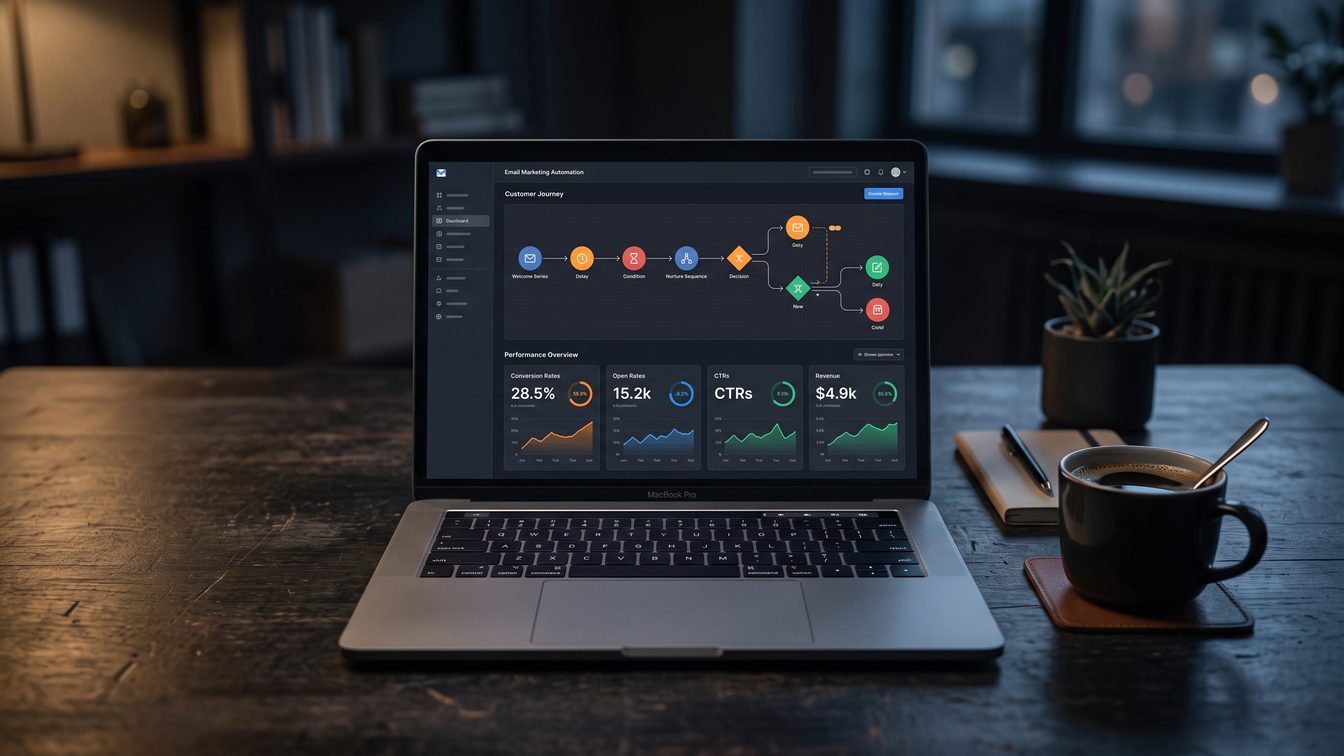
Email still returns $42 for every $1 spent, according to Litmus's 2025 State of Email report. No other channel comes close. But most ecom operators are leaving that return on the table because they're running campaigns, not flows.
Here's the split that matters. Automated flows make up just 2-8% of total email sends. Yet they drive 40-65% of email revenue. Per recipient, flows outperform one-off campaigns by 15-30x. That's not a rounding error. That's the difference between an email program that requires a person and one that runs itself.
If email is under 20% of your total revenue, you're under-flowed. Mature stores sit at 20-35% of total revenue from email. And the gap between those stores and the ones stuck at 8% isn't creative talent. It's structure. Nine flows, built once, running on autopilot.
Why Flows Beat Campaigns, Every Time
A campaign is a broadcast. You write it, you send it, everyone gets the same message regardless of where they are in the relationship. A flow is a system. It watches for a trigger, a cart abandonment, a first purchase, sixty days of silence, and responds automatically with the right message at the right moment.
That's the core distinction operators miss. Campaigns require you. Flows don't.
The revenue math backs this up hard. Welcome flows post 40-60% open rates and 6-12% conversion, numbers no campaign touches. A 3-email abandoned cart series recovers 60-70% more revenue than a single cart-reminder email. Browse abandonment flows, the ones almost nobody builds, hit 45-50% open rates because they're triggered by real intent, not a calendar date.
The replenishment flow is the sleeper. Javy Coffee and Kettle & Fire report 18-22% of their total email revenue comes from replenishment alone, and replenishment flows convert at 3x the rate of a standard promo blast. That's a consumable-product goldmine most stores never touch because nobody remembered to set the timer.
And this compounds. Email-engaged customers, the ones actually opening and clicking your flows, deliver 2.1-3.4x higher 12-month LTV than customers you only reach through paid acquisition. Flows don't just recover revenue. They build the asset.
The 9 Flows, In Order
Think of these as a pipeline. Each flow catches a customer at a different point in the lifecycle. Miss one and revenue leaks out through the gap.
1. Welcome Series (5 emails / 14 days) Triggered on signup or first email capture. Email 1 delivers the incentive and sets expectations. Emails 2-3 build brand story and social proof. Email 4 handles objections, shipping, guarantees, reviews. Email 5 closes with urgency on the original offer. This flow alone should be converting 6-12% of recipients, at 40-60% open rates. If it's not, the offer or the segment is wrong.
2. Abandoned Cart (3 emails / 72 hours) Triggered when a cart is built but checkout isn't started. Email 1 fires within an hour, simple reminder, no discount. Email 2 at 24 hours adds urgency or social proof. Email 3 at 48-72 hours introduces an incentive if needed. Three emails recover 60-70% more revenue than one. This is the highest-use flow in the entire stack per hour of build time.
3. Abandoned Checkout (2 emails / 48 hours) Different from cart abandonment. This triggers when someone enters payment or shipping info but doesn't finish. These buyers are closer to the finish line, so the message is shorter and more direct: finish your order, here's your saved information, here's support if something broke.
4. Browse Abandonment (2 emails / 48 hours) Triggered by product page views with no cart add. Lower intent than cart abandonment, so the tone is softer, more recommendation-based. Still posts 45-50% open rates because it's timely, not generic. Most operators skip this flow entirely. That's a mistake, since it catches the largest volume of site traffic.
5. Post-Purchase Nurture (4 emails / 30 days) Starts the day an order ships. Email 1 confirms and sets delivery expectations. Email 2 covers usage tips or care instructions. Email 3 cross-sells complementary products. Email 4 checks satisfaction and opens the door to support. This flow is where LTV gets built or lost in the first month.
6. Replenishment Reminder (2 emails / consumption-based) Triggered by estimated product-usage timing, not a fixed calendar date. If your average customer finishes a bag of coffee in 21 days, the first reminder fires at day 18, the second at day 25 if they haven't reordered. This is the flow behind that 18-22% of email revenue Javy Coffee and Kettle & Fire report. If you sell anything consumable, this flow is not optional.
7. Winback (4 emails / 60-180 days) Triggered by inactivity windows. Email 1 at 60 days, a simple "we miss you." Email 2 at 90 days, a bigger incentive. Email 3 at 120 days, social proof or new-product news. Email 4 at 150-180 days, last call before suppression. This flow protects your list health and recovers customers before they churn silently.
8. VIP / Loyalty (ongoing, top 20% LTV segment) Not trigger-based like the others. This is an ongoing segment treatment for your highest-LTV 20%. Early access to launches, exclusive discounts, surprise perks. This segment already drives disproportionate revenue. The flow's job is to keep them feeling recognized so they don't drift.
9. Review / UGC Request (2 emails / post-delivery) Triggered by estimated delivery date. Email 1 asks for a review 5-7 days after delivery. Email 2 follows up 10-14 days later if no response, sometimes with an incentive. This flow feeds the social proof your Welcome Series and product pages depend on. It's the flow that funds every other flow's credibility.
The Anecdote That Sold Me On Flows
I built a 9-flow email system for a $2M service business and it was doing $40K/month within 6 months without anyone touching it. Nobody logged into Klaviyo to hit send. Nobody wrote a weekly campaign. The flows just ran, catching every cart, every browse session, every lapsed customer, on a schedule the business owner never had to think about.
That's the entire point. A campaign calendar is a job. A flow stack is an asset. One needs a person forever. The other needs a person once, to build it.
Building It: Sequence and Priority
Don't build all nine at once. Sequence them by revenue impact per hour of setup.
Start with Abandoned Cart and Welcome Series. These two alone typically account for the majority of flow-driven revenue and take the least technical lift. Next, layer in Post-Purchase Nurture and Abandoned Checkout. Then Browse Abandonment and Review/UGC. Finish with Replenishment, Winback, and VIP, since these require more segmentation logic and consumption-cycle data.
Most platforms, Klaviyo especially, ship pre-built templates for all nine. The work isn't creative, it's configuration: setting the right delays, the right trigger conditions, the right segment exclusions so flows don't collide and spam the same customer twice in one day.
Check your flow-to-campaign revenue ratio monthly. If flows are under 30% of total email revenue, you have gaps in the stack. Find them and build the missing flow before you write another campaign.
The Owner's Exit Engine Angle
A buyer diligencing your business doesn't want to hear that email revenue depends on someone remembering to send a Tuesday newsletter. They want to see a documented, automated system that keeps producing whether you're in the building or not. Nine flows, running independent of any single person's calendar, is exactly the kind of infrastructure that raises a multiple. It's proof the revenue is systemic, not personality-driven.
This is the same logic behind the Owner's Exit Engine: documented systems are worth more than heroic effort. Flows are one of the cleanest examples, because the before-and-after is a dashboard anyone can read. A buyer can log into Klaviyo, look at flow revenue over trailing twelve months, and see the business keeps producing without the founder writing a single email that week. That's diligence-proof revenue, not a story you have to sell them on.
Metrics That Tell You The System Is Working
Don't just build the nine flows and walk away. Check four numbers monthly. First, flow revenue as a percentage of total email revenue, target 40-65%. Second, total email revenue as a percentage of total store revenue, target 20-35% once the stack matures. Third, open rate by flow, Welcome and Browse Abandonment should sit in the 40-50% range; if they're drifting below 30%, your list health or your subject lines need attention. Fourth, revenue per recipient by flow versus revenue per recipient by campaign. If that gap isn't 15x or better, a flow somewhere in the stack is underperforming its trigger logic, not its copy.
These four numbers turn email from a guessing game into a system you can audit in ten minutes a month. That's the whole idea. Build once, check the dashboard, fix only what's actually broken.
One Deliverability Note Before You Launch
Nine flows running simultaneously means a single customer could theoretically land in three sequences at once, a winback message next to a replenishment reminder next to a review request. That's a fast way to get marked as spam. Build suppression logic into every flow: exclude anyone who purchased in the last 48 hours from Abandoned Cart and Browse Abandonment, exclude anyone already in Winback from receiving a Welcome Series retrigger, exclude VIP segment members from generic Winback messaging since they get their own track. Five minutes of exclusion logic per flow prevents months of deliverability damage.
Doctrine Connection
Systems beat slogans. A clever subject line might lift one campaign's open rate for a week. A 9-flow system lifts every single email touchpoint, every day, for the life of the business, without a copywriter re-entering the picture. That's the difference between a marketing tactic and a marketing system. Build the system once. Let it compound.
For the mechanics of pairing this with your broader retention stack, see our post-purchase LTV system breakdown and the abandoned cart automation playbook for deeper build specs on the two highest-use flows in this stack.
FAQ
Q: Which flow should I build first if I only have time for one? Abandoned Cart. It has the highest revenue-per-build-hour ratio of the nine, and a 3-email version recovers 60-70% more than a single reminder. Most platforms have a template ready in under an hour.
Q: How much of my email revenue should come from flows versus campaigns? For a healthy program, flows should drive 40-65% of total email revenue despite being only 2-8% of sends. If campaigns are still your majority revenue source, you're under-built on flows.
Q: Do I need all 9 flows if I only sell one product with no repeat purchases? Skip Replenishment if there's genuinely no repeat-purchase pattern. Keep the other eight. Winback and VIP still matter for referral behavior and secondary purchases, and Review/UGC still funds your social proof.
Q: How long does it take to build all 9 flows from scratch? Most operators can build the first four (Welcome, Cart, Checkout, Post-Purchase) in a focused week. The full 9-flow stack, with proper segmentation and consumption-cycle data for Replenishment, typically takes 4-6 weeks of part-time build work.
Q: What's the biggest mistake operators make when building these flows? Treating flows like campaigns, stuffing every email with a discount. Discounts train customers to wait for one. Reserve discount pressure for the final email in Cart, Checkout, and Winback sequences only.
Sources
- Litmus, 2025 State of Email report
- eshoppick.com, ecommerce email flow performance data
- ecommerce-times.com, retention marketing benchmarks
- Klaviyo, email marketing benchmark reporting
- Kettle & Fire, replenishment flow case study
- Javy Coffee, email retention program
- DTC Newsletter, ecommerce flow benchmarks
*Disclosure: Jeff Barnes is the founder of Digital Evolution Marketing Group (demg.ai). DEMG has no current commercial relationship with any company, fund, or platform named in this article unless explicitly stated. This content is for educational purposes only and does not constitute business, legal, or financial advice.*