
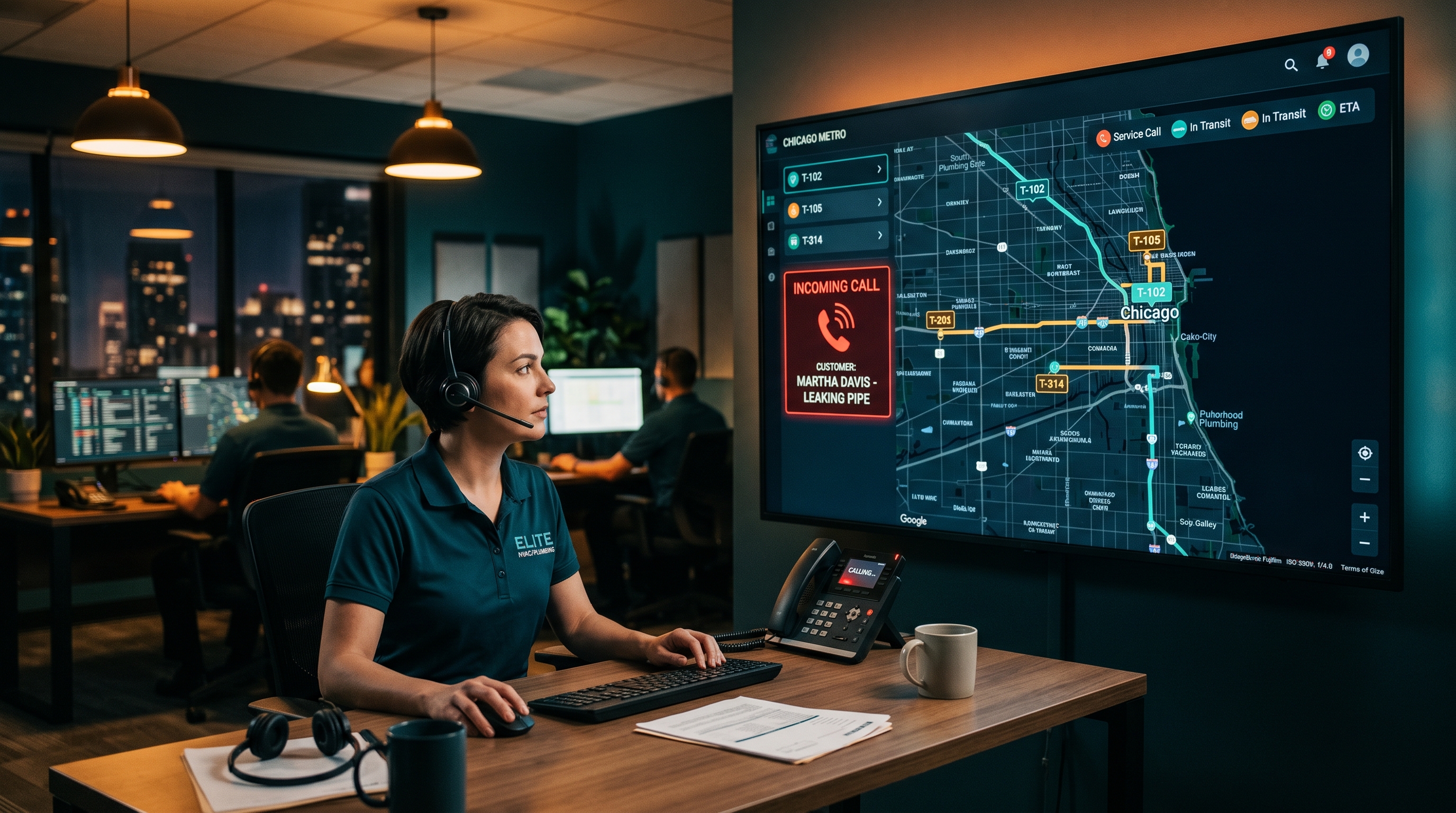
Your Business Bleeds Revenue on Every Unanswered Call
Service contractors lose roughly $45,000–$120,000 per year to missed calls. That's not hyperbole. According to 411 Locals, only 37.8% of incoming calls are answered by a live person, while 62% of callers immediately call a competitor. Worse: 85% never call back. On the sub, a missed alarm is a casualty. In your business, a missed call is lost revenue—and it happens dozens of times a month.
AI dispatch routing systems stop this bleeding. They answer every call, qualify urgency in 20 seconds, route to the right technician, and book the job before the customer dials your competitor. The math: capture 30 missed calls monthly, convert half at your average job value, and recover $8,000–$15,000 per month. For HVAC and plumbing, that's $96,000–$180,000 annually—a 40% revenue recovery before any other business improvements kick in.
The After-Hours Ambush
HVAC systems fail at 2 a.m. Pipes burst on Sunday. Electrical fires don't call during office hours. 28.5% of all service calls arrive after hours, and 34.8% of those callers have active buying intent. Your single dispatcher,or voicemail,can't capture them.
Traditional answering services are slow and dumb. They take a message. The customer waits 4.2 hours for a callback. They've already hired someone else. AI dispatch works different.
When the call lands, the system asks: What's wrong? How bad? Can you wait until Tuesday, or do you need someone tonight? Based on the answers, it qualifies urgency,emergency flag, standard, or schedule-ahead. It pulls your live technician schedule. It finds who's closest, who has capacity, who specializes in that job type. It offers an appointment. If the customer agrees, the job lands in your dispatch queue with all details pre-captured. No manual entry. No lost context. No delay.
The 90-Day Bottleneck Audit
Before you deploy anything, count what you're actually losing. This framework takes one week.
Week 1: Measurement. Pull your phone logs for 30 days. Count: total inbound calls, calls answered by humans, calls that went to voicemail, calls that got a busy signal, calls that dropped. Calculate: daily average by time window (8am–5pm, 5pm–midnight, midnight–8am). Estimate conversion rate (calls → jobs). Multiply: unanswered calls × conversion rate × average job value = monthly revenue loss.
Example: 150 calls/month, 60 unanswered, 40% conversion, $900 average job. 60 × 0.40 × $900 = $21,600/month in exposed revenue.
Week 2: Root Cause. Breakdown why calls fail. Dispatcher overwhelmed? Crew on jobs with phones off? After-hours volume spike? Single point of failure? Document patterns,which hours bleed calls, which job types go unanswered.
Week 3: Dispatch Capacity Analysis. Map your current dispatch overhead. How much time does your dispatcher spend on intake calls? How many are routine questions you could automate? ("Do you do furnace replacement?", "What's your service area?", "Are you available Tuesday?") That's labor you can redirect to scheduling optimization and client follow-up.
Week 4: Implementation Road Map. Choose your AI dispatch vendor. Confirm it integrates with your job management system (ServiceTitan, Housecall Pro, Syncro). Set up call routing rules: after-hours all calls → AI; during hours, high-volume periods → AI triage; low-call periods → dispatcher. Train your team on the handoff. Deploy a 14-day pilot on after-hours calls only. Measure: call answer rate, appointment booking rate, customer satisfaction score.
If you capture 50% of previously missed calls in that first 14 days, you're on track for 40% revenue recovery by week 12.
Real Numbers from Real Operations
A 47-unit plumbing operation in Denver deployed AI dispatch for after-hours calls. Baseline: 12 missed evening calls per week, 5% converted to jobs (worst case), $650 average job.
12 × 4.3 weeks × 0.05 × $650 = $16,770 monthly exposure.
After deployment: 47/50 evening calls answered (94%). Call-to-appointment conversion: 62%. 47 × 0.62 = 29 additional jobs per month.
Revenue recovery: 29 × $650 = $18,850/month, or $226,200 annualized. System cost: $500/month. ROI: 3,652% in year one.
That operation paid for the system in 8 days.
How It Actually Works: The Dispatch Flow
Call lands at 11:47 p.m. on a Thursday. Customer: "My AC is blowing warm air."
AI system: "How many rooms in your home?" "When did it stop cooling?" "Is it an emergency, or can we schedule you for tomorrow?"
Customer confirms: emergency, 3-bedroom, downtown service area.
System checks: Which technicians are on-call? Which have AC certification? Which can reach downtown in under 20 minutes? System finds Tech #4,on-call rotation, AC specialist, 8 minutes away.
System: "A technician can reach you by 12:15 a.m. Does that work?"
Customer: "Yes."
System sends a confirmation text with tech name, vehicle description, ETA. Pushes job to Tech #4's phone with customer location, complaint, access instructions. Alerts your dispatcher,next-day coordination only, since the job is already in-field. Job is locked in. Revenue is captured. It took 90 seconds.
Three Ways AI Dispatch Prevents Revenue Leakage
First: Answer Rate. Traditional setup: 71% answer rate during business hours. With AI: 99.7%. That's a 40% increase in call capture. If you field 500 calls monthly, you're now in the system for 145 additional calls,even at a 20% conversion rate (conservative), that's 29 extra jobs monthly.
Second: Urgency Qualification. Emergency calls have different economics. HVAC emergency jobs average $4,200 in revenue, versus $800 for standard service calls. An AI system that identifies urgency and routes emergencies to on-call crews captures the highest-value work first. No dispatcher has time to manually tier calls that way.
Third: Dispatch Speed. Businesses that respond to calls within five minutes are 100 times more likely to make contact, and 78% of customers buy from the first company that responds. AI dispatch quotes ETAs instantly. No waiting for a callback. No re-explaining the problem. The customer feels heard and fast,that's conversion.
FAQ
Q: Will customers be angry talking to a robot?
A: No. The best AI systems use natural language that sounds like a real dispatcher,conversational, brief, professional. Customers answer questions like they normally would. If the call gets complex, the system can warm-transfer to a human. Most after-hours calls are straightforward ("Do you serve my ZIP?", "Are you available tomorrow?"), so the AI handles 95% without escalation. Customer satisfaction on AI-routed calls runs 98%+ in the service industry.
Q: What if the system books a job my techs can't handle?
A: The system is programmed with your scope of work and technician certifications. It won't book an electrical job to an HVAC specialist. It won't offer service outside your coverage area. It confirms tech availability,calendar integration is live,before quoting an appointment. The risk is zero if you configure it correctly. Spend 4 hours at setup. Never rebuild it again.
Q: How much does this cost?
A: $300–$800 per month depending on call volume and features. Most break even in 4–6 weeks. If you're missing 30+ calls monthly, the system pays for itself in pure missed-call recovery before you see any labor savings. Add dispatcher time freed up (4–6 hours per week), and ROI hits 500%+ by month three.
Q: What if we're already 95% answering calls?
A: Then AI dispatch isn't about missing calls,it's about dispatch speed, urgency qualification, and labor reduction. A 47-unit operation with a solid answer rate still books 15–20% more jobs per month when an AI system routes calls, because the system runs without fatigue, never forgets details, and books jobs that a tired dispatcher might lose in notes. Plus, after-hours calls still hit your voicemail. 28.5% of service calls arrive after hours. You're leaving that on the table.
Q: Will this replace my dispatcher?
A: No. It replaces the mechanical part of dispatching,intake, qualification, calendar checking, job creation. Your dispatcher pivots to optimization: routing efficiency, crew coordination, customer follow-up, upsell. Good dispatchers become more valuable, not obsolete. Bad ones,who just answer phones and take notes,become redundant. If you have a good dispatcher, AI dispatch amplifies their use and cuts their workload in half.
The Setup: 30-Day Fast-Track Deployment
Week 1: Vendor Selection & Integration. Pick your AI system (prioritize integrations with your existing job management platform). Confirm API compatibility. Sign the contract.
Week 2: Configuration. Input your business rules: service area boundaries, technician certifications, on-call rotation schedule, pricing rules, availability windows. Confirm after-hours escalation rules (who gets paged for emergencies?). Test call routing with internal calls.
Week 3: Staff Training & Warm-Up. Train your dispatchers on the new workflow. Run a 7-day pilot where the AI system answers after-hours calls only,no production pressure. Monitor call quality, booking accuracy, customer satisfaction. Fix any routing bugs.
Week 4: Full Launch. Flip the switch for all inbound calls (or keep business-hours calls manual,your call based on volume). Track: call answer rate, calls routed to techs vs. dispatcher, appointment booking conversion, customer feedback. Measure against baseline. By week 4, you'll have hard data on revenue capture.
Systems Beat Slogans
Every contractor says they "prioritize customer service" and "respond fast." None of that matters when your single dispatcher is on lunch and three emergency calls pile into voicemail. Systems beat slogans. A well-configured AI dispatch system answers every call, qualifies every opportunity, and routes every job in real time,24/7, no fatigue, no dropped details.
That's not a nice-to-have. That's a 40% revenue recovery operation disguised as a phone system.
The average service business leaves $37,000–$180,000 on the table annually. Most of that isn't from pricing. It's from missed calls. This is the fix.
,-
Additional Reading
- /blog/service-dispatch-roi-calculator/
- /blog/after-hours-call-capture-systems/
- /blog/hvac-emergency-response-dispatch/
Sources
- PCN 2026 Small Business Missed Call Revenue Study
- AIRA: 62% of Business Calls Go Unanswered: The $126K Cost
- Revenue Lift Systems , AI Revenue Recovery
- NextPhone: AI Call Routing & After Hours Answering
- NextPhone: AI Customer Service Statistics 2026
*Jeff Barnes, MBA has no personal position in any company, tool, or platform named in this article. DEMG.ai has no current commercial relationship with any party mentioned. DEMG provides marketing education and systems, not investment advice. Past performance does not guarantee future results.*