
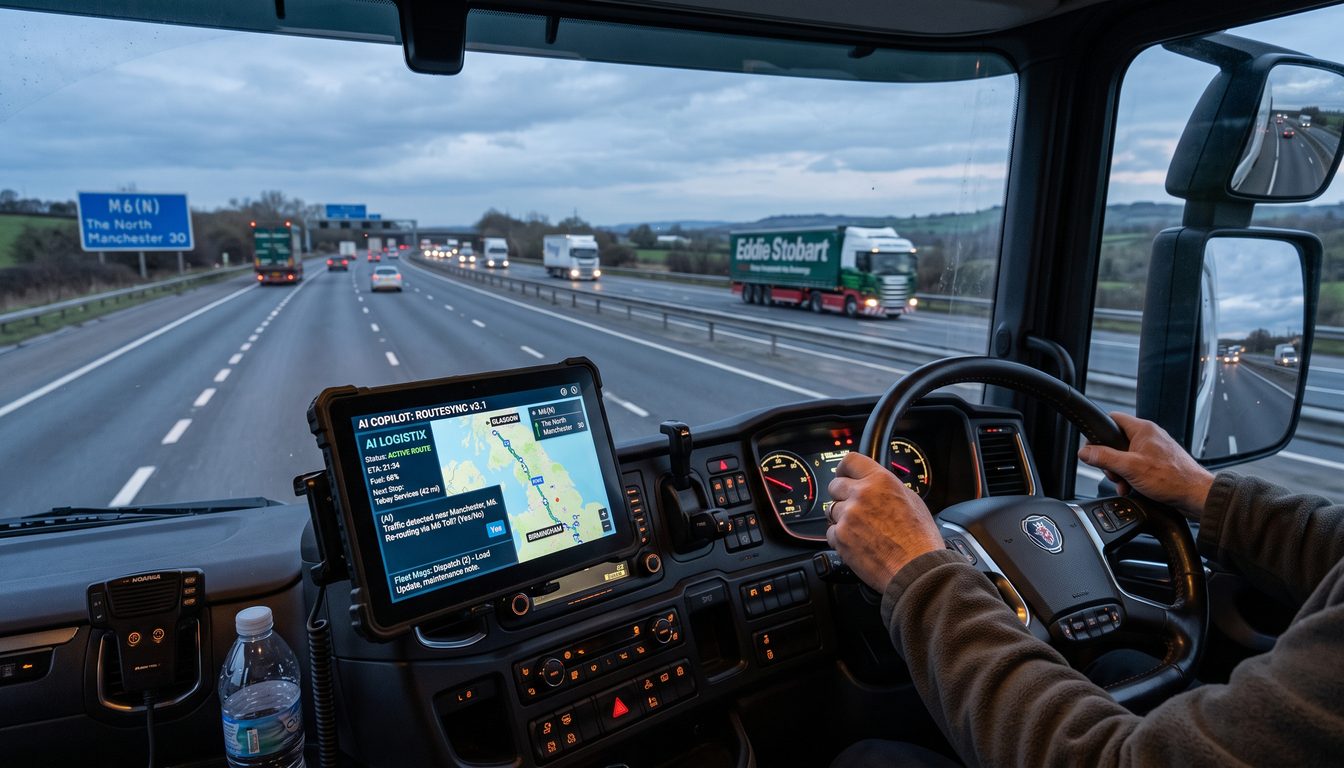
Direct answer: Hirschbach Motor Lines automated roughly 40 percent of its outbound driver communication using an AI agent named Augie, built by a partner called Augment, not an in-house team (FreightWaves). The carrier spent 18 months evaluating vendors before signing. Augie now reaches drivers on more than 85 percent of Hirschbach's Logistics Solutions loads and automates over 300 pickup and delivery check-ins a week.
CTO Ivan Ramirez's rule: "Hirschbach is a transportation company that uses AI to operate better. We're not trying to become an AI infrastructure company." That single sentence is the whole audit. Any $2M-plus service operation weighing AI should copy the discipline behind it, not just the tool.
The decision Hirschbach got right before it got any AI
Most owner-operators start the AI conversation backwards. They ask which tool to buy before they ask which problem is actually automatable. Hirschbach did the opposite.
The carrier isolated three interaction types: driver information requests, pickup arrivals, delivery arrivals. Those three represent about 40 percent of total track-and-trace volume, excluding power-only freight (edgeX). Everything outside that slice stayed manual.
That is scope discipline, not timidity. Augment's CEO Harish Abbott put it plainly: "If you sprinkle AI across the board like 'here's this cool stuff and it's going to make everybody's life better,' the operator's like, 'Okay, my life hasn't changed. I'm still doing the same thing'" (FreightWaves).
Narrow beats broad. Specific beats vague. Measured beats hoped-for.
The Navy taught me this before AI existed
On the submarine, we did not build our own sonar. The Navy built it. We trained our operators to run it at 100 percent, every watch, every casualty drill.
Nobody on that boat cared who wrote the sonar software. Everyone cared whether the operator could read the screen under pressure and call the right contact.
That is the buy-versus-build lesson most owners get backwards. You do not need to own the technology. You need to own the outcome.
Hirschbach's team could have built an in-house AI platform. They had the technical bench for it. They chose not to, because building AI infrastructure was not their business. Moving freight reliably was.
Competence beats credentials. A driver leader who can run the AI-assisted workflow at 100 percent beats a technology team that built an impressive demo nobody in the field actually uses.
Why 18 months of vetting was not slow, it was the audit
Ramirez evaluated vendors for roughly a year and a half before choosing Augment. Most of those vendors showed up with polished voice demos and little else built. "I knew none of these guys had anything built," Ramirez told FreightWaves. "They'd all just gone and raised a bunch of money and had this great idea" (FreightWaves).
He was not shopping for a feature. He was shopping for a team that combined logistics depth with technical depth, plus a willingness to let Hirschbach shape the roadmap rather than wait on a vendor's release calendar.
This is The 90-Day Bottleneck Audit in practice, stretched to 18 months because the stakes were an entire fleet's driver communication. The framework is simple. Name the single bottleneck costing the most hours or dollars. Measure it in real numbers, not gut feel.
Test one narrow fix against that bottleneck, and only that bottleneck. Verify the vendor has shipped something real, not a slide deck. Expand only after the narrow fix proves out in production, not in a demo room.
A $2M service operation cannot run an 18-month audit. It can run a 90-day version of the same logic: pick the one workflow bleeding the most hours, demand proof the vendor has shipped it elsewhere, pilot narrow, then scale.
Thirty days is enough to know if a pilot is working. Sixty days is enough to know if it scales. Ninety days is enough to decide, expand or walk away. That cadence beats an open-ended trial every time, because open-ended trials rarely end.
What Hirschbach got right, in order
First, narrow scope. Three interaction types, not a platform-wide rollout. Second, partner selection based on shipped product, not pitch decks.
Third, defined ownership of the work. Augie owns a specific, measurable slice of track-and-trace. Humans own everything else, plus every exception inside that slice.
Fourth, a roadmap clause. Hirschbach did not want "a traditional vendor relationship where we purchased a fixed product and waited for features," Ramirez said. "We wanted a partner willing to learn alongside us" (edgeX).
That clause matters more than most owners realize when they sign a SaaS contract. Influence over the roadmap is the difference between a partner and a vendor you are stuck with.
Fifth, they measured the automatable slice before buying anything. Roughly 70 to 80 percent of Hirschbach's shipments arrive through EDI already structured for automation. The rest arrives as tender emails, PDFs, or a bill of lading handed to a driver.
Hirschbach knew that ratio before it picked a partner. That is the kind of number a $2M operation should have on a whiteboard before any AI conversation starts.
The risk nobody at the press conference will say out loud
Here is the audit's other half. Forty percent is not the finish line. It is the ceiling of the automatable slice, and ceilings do not move on their own.
Vendor dependency is real. Hirschbach's roadmap now runs partly on Augment's calendar, not just its own. The company mitigated that with a shaping clause, but mitigation is not elimination. If Augment's priorities shift, or the company gets acquired, or funding dries up, Hirschbach owns the consequences of that dependency, not Augment.
The remaining 20 to 30 percent of shipment data, the messy tender emails and hand-delivered bills of lading, is the hard part by design. It resisted automation for a reason. It requires judgment, not pattern matching.
McKinsey's own research on enterprise AI agents makes the same point about build-partner-buy decisions generally: the deep layers, governance, exceptions, identity, are the most underestimated and the most expensive to get wrong (The Procurementor, citing McKinsey QuantumBlack). Automating the easy 40 percent buys time. It does not solve the operation.
And 95 percent, if Hirschbach ever gets there, will still leave a 5 percent that is disproportionately expensive to close. That last mile is where AI agents habitually stall, precisely because it is where judgment, relationships, and context live, not fields in a database.
The industry context Hirschbach is racing against
Hirschbach is not moving fast because AI is trendy. It is moving because the driver labor market has gotten more competitive, not less. A Spring 2026 survey found 58.1 percent of drivers were actively looking for a new trucking job, up from 46.8 percent a year earlier (Transport Topics). Tightening capacity and improving freight conditions are pushing carriers to compete harder on communication and driver experience, not just pay.
That backdrop explains why Hirschbach's next move is not a bigger AI rollout. It is a narrower one, aimed directly at driver retention. The economics are not abstract.
Losing one driver costs an estimated $13,000 once recruiting and onboarding are counted (Transport Topics), and large truckload carriers routinely see 90 percent or higher annual turnover (Stealth Agents). A 200-driver fleet running that turnover rate absorbs roughly $1.8 million a year in replacement costs alone.
Gartner projects that 40 percent of enterprise applications will carry task-specific AI agents by the end of 2026, up from under 5 percent in 2025 (Gartner). Hirschbach is not an outlier chasing a fad. It is an early mover inside a curve that is about to bend upward across every industry, including services with far smaller headcounts than a national fleet.
What a $2M-plus operation should copy tomorrow
Do not buy a platform. Buy a fix for one measured bottleneck. Write down the actual hours or dollars that bottleneck costs before you talk to a single vendor.
Ask every vendor for a customer reference who has the tool live in production today, not a demo environment. Negotiate roadmap influence into the contract, in writing, before you sign. Keep humans owning every exception the tool cannot handle, and staff for that ownership deliberately.
Hirschbach's next move validates this discipline. The company is not expanding Augie broadly. It is adding one more narrow use case: an AI assistant between drivers and driver leaders for routine questions, freeing leaders for the 30-minute conversations about pay, family, and miles that actually keep drivers around (FreightWaves).
That retention math is not abstract. The industry-wide cost of replacing one driver runs $8,000 to $20,000 once training and lost-revenue days are counted (O Trucking), and large-carrier turnover has run 72 to 94 percent annually (O Trucking). Freeing a driver leader's time from routine questions is a retention play with a real dollar multiple attached, not a nice-to-have.
Doctrine Connection: Competence beats credentials
Competence beats credentials. Hirschbach did not ask which vendor had the best pitch deck or the most funding announced. Ramirez asked which team had actually shipped something and could prove it under real operating conditions, not demo conditions.
Owner-operators evaluating AI tools should run the same test. Ask for a live customer, not a slide. Ask what breaks at scale, not what the sales rep promises. The vendor who has fixed the boring 20 percent of their own product knows more than the one still pitching the exciting 80 percent.
FAQ
Q: Should a $2M service business build its own AI tool or buy one? Buy, in almost every case. Hirschbach had a capable technology team and still chose to partner rather than build, because building AI infrastructure was not the core business. Unless AI development is your actual product, buying a proven partner gets you to value faster and at lower risk.
Q: How long should vendor evaluation take for a smaller operation? Hirschbach took 18 months, appropriate for a fleet-wide rollout. A $2M-plus operation can compress that to 90 days by narrowing the bottleneck first, then testing exactly one vendor against exactly one measured problem before expanding.
Q: What is the biggest mistake owners make when adopting AI agents? Rolling out broadly before proving narrow. Augment's own leadership flagged this: sprinkling AI across every workflow at once produces no visible change for anyone, because nobody's specific pain point actually got solved.
Q: Does automating 40 percent of a workflow mean the job is nearly done? No. The automated slice is usually the easiest slice by definition. The remaining volume resisted automation because it requires judgment, exception handling, or messy inputs. Budget for that remainder as a permanent cost of doing business, not a temporary gap.
Q: What should go in a vendor contract before signing? Roadmap influence, in writing. Hirschbach specifically avoided vendors who would sell a fixed product and make the buyer wait on a release calendar. A smaller operation has less negotiating weight than a national carrier, but the ask itself, some say in what gets built next, costs nothing to make.
*Disclosure: Jeff Barnes has no personal position in any company, tool, or platform named in this article. demg.ai has no current commercial relationship with any party mentioned. demg.ai provides marketing education and strategic guidance, not investment advice. All business decisions involve risk.*