
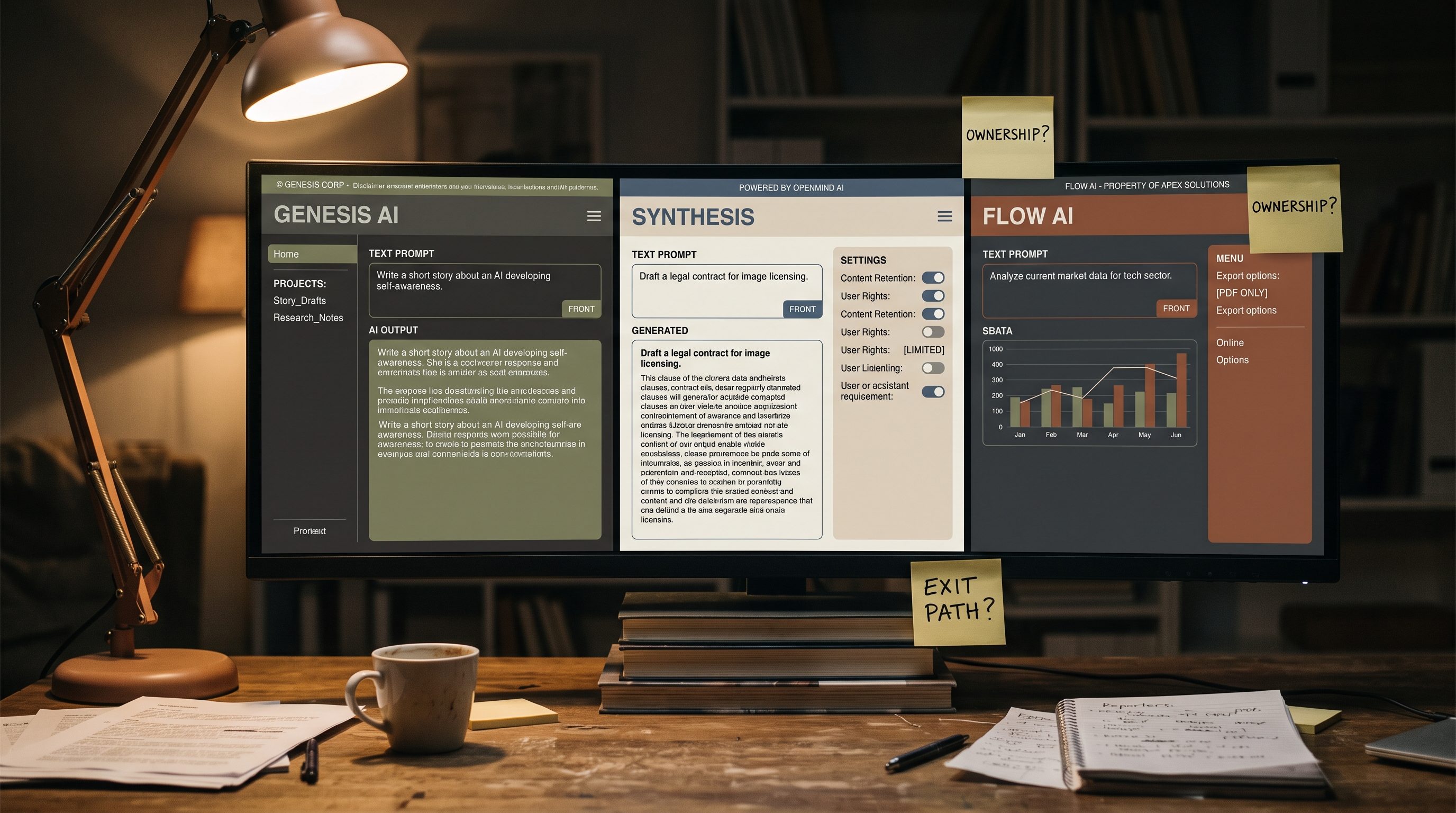
Three AI platforms launched this week promising to replace your entire marketing stack. The claim is bold. The question is whether they pass the sovereignty test: do you own the data, the process, and the exit path?
I want these to work. Operators need better tools, cheaper seats, fewer logins, and less Tuesday-afternoon Zapier debugging. But wanting a category to succeed and verifying that a specific product deserves your customer data are different departments. This week alone, Caples.ai, Wysera, and MarketBlazer.ai all launched or expanded within a five-day window, each with a version of the same pitch: stop paying for eight tools, pay us for one. Let's run each one through the audit.
The pitch, in plain terms
Caples.ai launched July 23 out of Miami, founded by Juan Alou, a fifteen-year Meta Ads veteran who built three paid social businesses before this one. It is not a generative AI model guessing at your ad account. It is a deterministic rule engine that reviews overnight campaign data and produces a daily written report: what to scale, what to pause, what creative to test next, each recommendation with its reasoning attached, per the official launch release. Nothing executes without a click from you. Pro, Max, and Agency tiers, per its Inc.com profile, though pricing itself is not yet public.
Wysera is the most ambitious of the three on paper. One AI copilot, Wyse, running two products: PostWyse for content, SEO, and social publishing, and OpsWyse for CRM, pipeline, and revenue ops. The company's own pitch compares a typical fourteen-tool stack, Semrush, Ahrefs, Hootsuite, Jasper, HubSpot, Zapier, Zendesk, Jira, running north of $1,872 a month, against a single Wysera bill, per the Wysera pricing page. Solo starts near $29 a month, a Starter bundle lands around $69, Growth around $149, and Pro and Enterprise are quote-only with a full API. A confirm-before-execute workflow sits on every action Wyse drafts, which is the right instinct.
MarketBlazer.ai is the odd one out: not a startup, but a 25-year-old Atlanta marketing shop repackaging itself as a platform of ten-plus AI "Machines," Chatbot, Voicebot, Sales Agent, Review, Ranking, Newsletter, Publication, Social Posting, Sales Funnel, and Sales Leads, rolled out through a string of July press releases, per the GlobeNewswire launch announcement. Each Machine is sold as its own module, a different shape of consolidation than Caples or Wysera. It is a menu, not a merger.
All three are legitimate attempts at a real problem. Owner-operators are drowning in seats. That part of the pitch is true everywhere you look.
What each one gets right
Start with the credit, because it is earned.
Caples.ai made a design choice most AI marketing tools skip entirely: it refuses to be a black box. A rule-based engine with fixed logic, built from a documented methodology, means you can actually audit why it told you to kill a campaign. That is rarer than it should be. Most "AI ad optimizer" products hide behind a model and a shrug. Caples shows its work. The human-approval gate before any action executes is the correct default, not an afterthought bolted on for compliance theater.
Wysera's approval-first architecture deserves the same praise, at scale. Three autonomy modes, drafts only, drafts plus auto-accept, full autopilot, with one-click rollback on anything Wyse sends, is a genuinely thoughtful control surface. Most all-in-one platforms make you choose between convenience and oversight. Wysera at least tries to let you dial the ratio yourself. The price point is real too. If you are actually running Semrush, Hootsuite, Jasper, and a CRM as four separate line items, $69 to $149 a month is not a rounding error. It's meaningful.
MarketBlazer's advantage is boring in the best way: it has existed for 25 years. That is not nothing. A vendor who has billed small businesses since before "AI agent" was a phrase has presumably survived a recession, a Google algorithm update or twelve, and a generation of clients who churned and told their friends why. Longevity is not proof of quality, but it is evidence against vaporware.
Where the sovereignty questions start
Here is where the 95 percent positive build gives way to the 5 percent that actually matters, because it is the 5 percent that determines whether you own your business or rent it back from a vendor.
Data portability. None of the three launch materials I reviewed, the press releases, the pricing pages, the product pages, mention an export path in plain language. Caples.ai connects directly to your Meta Ads account. The launch release describes what the system reads and recommends, but says nothing about what happens to the campaign history, creative library, or rule-engine outputs if you cancel. Wysera's pricing page notes that free-tier data "carries over" on upgrade, which is a good sign for upgrades and says nothing about downgrades or cancellations. MarketBlazer's Machines are sold as hosted, closed modules. There is no public documentation on exporting chatbot transcripts, voicebot call logs, or the CRM data flowing through its Sales Agent Machine.
API access. Wysera is the clearest here: full API access appears on the Pro tier, per MakerStack's independent 2026 review, which is the correct place to put it, though it also means the sovereignty feature is gated behind the top of the pricing ladder, not the entry point where most owner-operators actually live. Caples.ai's rule engine appears to be a closed system by design. That is defensible for a tool making financial recommendations on your ad spend, but it means the "why" behind each rule lives with Alou's methodology, not with you. MarketBlazer's ten-plus Machines, including its AI Sales Agent Machine release, show no public API documentation at all in the launch materials.
Exit path. This is the question none of the three answer voluntarily, and it is the only question that matters when you are three years into using a tool and the founder gets an acquisition offer, or shuts down, or triples the price. A rule-based engine you cannot see the rules of is not yours. A CRM you cannot export cleanly is not yours. A chatbot trained on your website content that lives entirely inside someone else's Machine is not yours either, no matter whose logo is on the invoice.
None of this makes any of the three bad products. It makes all three unverified on the one dimension that separates a tool from a trap.
The Sovereignty Stack test
The Sovereignty Stack is the standard I run every "replace your stack" pitch through: marketing infrastructure that makes a business operator-independent and exit-ready. Not infrastructure that makes the vendor indispensable. Infrastructure that makes you replaceable as the bottleneck, while the data, the process, and the relationship stay yours.
Three questions, every time:
- If I cancel tomorrow, do I walk away with my customer data in a usable format, or with a login error message?
- Can I see, and ideally modify, the logic making decisions on my behalf, or am I trusting a black box with my ad budget and my leads?
- Does the platform's pricing and structure assume I will stay because I want to, or because leaving is technically possible but practically brutal?
I've evaluated hundreds of platforms across AIN and DEMG, sitting through demos, reading the fine print vendors hope nobody reads, and watching operators get burned by tools that looked identical to the winners at first glance. I've seen 50 "replace your entire stack" promises. The three that worked had one thing in common: they let you leave. Not because leaving was easy. Because the vendor never needed you trapped to keep your business. Confidence in the product replaced dependency on the contract.
That is the tell. A vendor who has built something genuinely useful will tell you, unprompted, how to get your data out. A vendor who has built a moat will bury it in a support ticket queue.
Comparison table
| Platform | Data Ownership | API Access | Price/Seat | Exit Path | Operator Fit | |---|---|---|---|---|---| | Caples.ai | Unclear, no public export docs at launch | Closed rule engine, no public API | TBD, Pro/Max/Agency tiers | Unverified | Strong for solo Meta Ads spenders wanting transparent logic | | Wysera | Partial, upgrade-path data "carries over," downgrade or cancel path unclear | Full API on Pro tier only | $29 to $149/mo bundles, Pro/Enterprise custom | Best of the three, gated to top tier | Strong for solo-to-small teams consolidating marketing and CRM | | MarketBlazer.ai | Unclear, closed Machines, no export documentation | None documented | Custom, per-Machine | Weakest, menu of hosted modules | Fits owners wanting done-for-you execution over ownership |
Read that table as a starting scorecard, not a verdict. Every row is based on public launch materials as of this week. Call each vendor and ask the three sovereignty questions directly. Their answer, or their silence, is the real data point.
What to actually do this week
If you are evaluating any of the three, do not start with the demo. Start with the cancellation policy and the data export process. Ask support, in writing: "if I cancel in twelve months, what do I receive and in what format?" A vendor with nothing to hide answers in one email. A vendor building a moat sends you to a help center article that does not exist yet.
For Caples.ai specifically, ask whether the rule logic itself, not just the recommendations, is inspectable or exportable. A deterministic engine is only as trustworthy as your ability to verify the rules are still the ones you agreed to six months ago.
For Wysera, push past the Solo and Starter tiers before you commit budget. The API access and full CRM module set that make it genuinely stack-replacing live on Pro, and Pro is quote-only. Get the quote before you fall for the $69 headline.
For MarketBlazer, ask the direct question: if you stop paying for the Sales Agent Machine, do the call transcripts and lead records generated come with you, or stay behind?
None of these questions require legal training. They require the discipline to ask before you sign, not after you're six months deep and the export button turns out not to exist.
This audit sits alongside the broader look at all-in-one AI marketing platforms for owner-operators, where the same pattern shows up across a wider field: consolidation promises are common, sovereignty guarantees are rare. If your budget tops out under $100 a month, the white-label AI platform scorecard runs the same test against a cheaper tier of tools, with mostly the same gaps. And if the whole "replace your stack" framing feels backwards to you, it should. The doctrine piece on why consolidation platforms solve the wrong problem makes the case that the issue was never subscription count. It was never having a system in the first place.
Doctrine Connection
Freedom beats comfort. A single dashboard that saves you nine logins is comfortable. A single dashboard that owns your customer data, hides its logic, and prices your exit at "call sales" is a cage with good UX. Choose the tool that makes you freer in eighteen months, not just calmer this afternoon.
FAQ
Q: Are Caples.ai, Wysera, or MarketBlazer bad products? No, and that is not the audit's finding. All three solve a real, documented problem for owner-operators buried in disconnected tools. The finding is narrower: none of the three publicly document a clean data export or exit path at launch, which is a sovereignty gap, not a quality verdict.
Q: Which of the three is closest to passing the sovereignty test? Wysera, on paper, because it offers full API access and a stated data carry-over policy on upgrade. But that API sits on the Pro tier, which is quote-only, so the sovereignty features are not confirmed at the price point most owner-operators will actually buy.
Q: Should I wait before adopting any of these three? Not necessarily. Waiting is not a strategy either. Ask the exit-path question in writing before you migrate a single customer record, and start on the cheapest tier possible so a bad answer costs you a month, not a year.
Q: What is the Sovereignty Stack, and how is it different from a normal tech stack audit? A normal audit asks whether the tools work. The Sovereignty Stack asks whether the tools leave you free: do you own the data, can you inspect or modify the logic, and can you exit without a rebuild. A tool can pass a functionality review and fail sovereignty completely.
Q: How do I ask a vendor about exit path without sounding paranoid? Frame it as due diligence, because it is. "What does data export look like if we ever part ways?" is a question every serious vendor has answered before, for someone else. If they haven't, that itself is the answer.