
The Verdict First
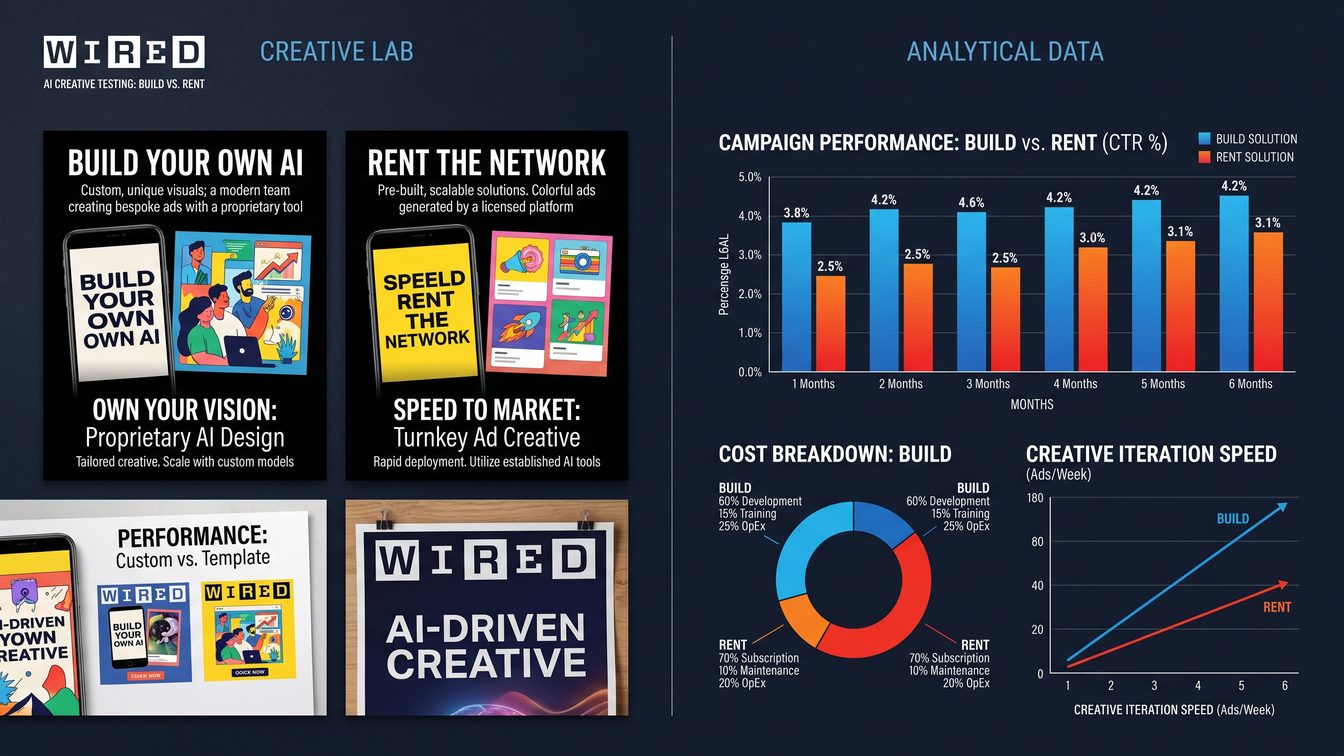
If you are spending less than $10K per month on ads, build a lightweight internal testing framework for $200 to $500 per month. If you are spending $10K to $50K, the answer depends on your testing cadence. If you test creative weekly, rent a mid-tier tool. If you test monthly, build.
The market for AI creative pre-testing, tools that predict ad performance before launch, is growing fast. Brunner, a 150-person Pittsburgh agency, acquired AdSkate on July 16, 2026. AdSkate built synthetic audience modeling on Carnegie Mellon research. The holding companies have been buying similar tools for years.
But the question for owner-operators under $5M revenue is different from the question for agencies or holding companies. You do not need the same infrastructure. You need the same decision quality at a fraction of the cost.
What Creative Pre-Testing Actually Does
Creative pre-testing tools predict how an ad creative will perform before you spend money running it. They score creative elements like imagery, copy, emotional tone, and format against historical performance data or synthetic audience models.
The promise: reduce wasted ad spend by killing weak creative before it goes live. The reality: the quality varies enormously by tool, by vertical, and by ad format.
Enterprise tools in this space include System1's Test Your Ad (emotional response prediction), Kantar LINK AI (brand lift prediction), and RealEyes (attention measurement). These work. They also cost $5,000 to $25,000 per month.
For a sub-$5M operator spending $5K to $50K per month on ads, that price range makes the math impossible.
The Enterprise Tools: What You Are Paying For
System1 Test Your Ad. Predicts emotional response and long-term brand impact. Uses facial coding and survey-based panels. System1 claims ads scoring in the top tier generate 2 to 3x the profit growth of low-scoring ads. Pricing: custom, typically $5K to $15K per month for agency volume.
Kantar LINK AI. Predicts brand lift, persuasion, and recall using a trained model on 200,000-plus ads. Claims to predict with 90 percent accuracy against human-panel benchmarks. Pricing: $8K to $25K per month depending on volume.
RealEyes. Attention measurement via webcam-based eye tracking. Predicts view-through rate and stopping power. Pricing: $3K to $10K per month.
These tools solve real problems for advertisers spending $500K-plus per month. At that scale, a 10 percent reduction in creative waste recovers $50K. The ROI is obvious.
At $10K per month in ad spend, a 10 percent reduction in waste recovers $1,000. Against a $5K monthly tool cost, you are underwater.
The DIY Path: What You Can Build for $200 to $500
You do not need synthetic audience panels to test creative. You need a structured scoring framework that applies historical performance data to new creative before launch.
Here is what a lightweight internal system looks like.
Step 1: Build your creative performance database. Pull the last 6 months of ad performance data from your Meta, Google, or TikTok account. For each creative, record: the image or video file, the primary text, the headline, the CTA, the hook (first 3 seconds for video), the audience, and the performance metrics (CTR, CPA, ROAS, thumb-stop rate).
You need 30 to 50 creatives minimum to establish patterns.
Step 2: Identify your winning patterns. Use Claude or GPT-4 to analyze your creative database. Prompt it to identify patterns in your top-performing creatives versus your bottom performers.
You will find specific signals. Background color. Text overlay placement. Emotional tone. Product positioning. Number of people in frame. These signals are specific to your audience and your product.
Step 3: Build a scoring prompt. Create a prompt that scores new creative against your winning patterns. Feed it the new creative (image description or actual image via multimodal) plus your pattern database. Ask it to score on a 1 to 10 scale across your identified dimensions.
Step 4: Validate against holdout data. Take 10 creatives you have already run but did not include in the training set. Score them with your prompt. Compare the AI scores to actual performance. If correlation is above 0.6, your system is useful. If below 0.4, you need more training data or better pattern identification.
Cost: Claude API at $10 to $20 per month for modest volume. A dashboard or spreadsheet to track results. Total: $200 to $500 including your time.
The 90-Day Bottleneck Audit
Before you decide build or rent, audit your actual testing bottleneck.
Week 1 to 2: Measure your throughput. How many new ad creatives do you produce per week? How many go live without any pre-testing? What is your current creative kill rate (percentage killed before launch versus killed after launch due to poor performance)?
Week 3 to 4: Measure your data maturity. Do you have 6 months of organized creative performance data? Do you tag creatives with visual and copy attributes? Can you pull this data from your ad platform in under 30 minutes?
Week 5 to 8: Pilot the DIY system. Build the scoring prompt. Test it on 10 known creatives. Measure correlation.
Week 9 to 12: Decision point. If the DIY system shows correlation above 0.6 and you test fewer than 10 creatives per week, keep it. If it shows low correlation or you test more than 10 per week, evaluate one mid-tier tool.
The Watchstanding Principle
On a submarine, you trust the instruments. Not your gut. The reactor plant has gauges, alarms, and automated safety systems precisely because human judgment drifts under stress and fatigue.
Ad creative decisions work the same way. Most operators pick creative based on what they personally like, not what the data predicts will perform. That is gut-based watchstanding. It works until it does not.
A creative pre-testing system, whether built or rented, is your instrument panel. It does not replace your judgment entirely. It calibrates it against evidence.
The operators who build this measurement layer first, even a simple version, make better creative decisions than the ones running on instinct.
What Meta Advantage-Plus Already Does
Meta's own Advantage-Plus creative optimization does some of this natively. It tests headline and image combinations automatically. It optimizes for the highest-performing variant.
But it only works within Meta's ecosystem. It does not test creative before launch. It tests during launch, spending your money to find the winner. And it only optimizes within the constraints you give it.
A pre-testing system works before the spend. That is the difference. You kill the losers before Meta burns $500 finding out they are losers.
The Decision Matrix
Monthly ad spend under $10K: Build. The ROI on rented tools does not work. A DIY scoring framework at $200 to $500 per month gives you 80 percent of the decision quality.
Monthly ad spend $10K to $50K and testing weekly: Rent a mid-tier tool. Look at platforms like Neurons, Dragonfly AI, or CreativeX. Price range: $1K to $5K per month. The testing volume justifies the subscription.
Monthly ad spend $10K to $50K and testing monthly: Build. You do not need the throughput of a rented tool. The DIY system is fast enough.
Monthly ad spend above $50K: Rent enterprise. System1 or Kantar. The 10 percent waste reduction on $50K-plus recovers the cost.
FAQ
Q: Does Meta Advantage-Plus make pre-testing unnecessary?
No. Advantage-Plus tests during spend, not before it. Pre-testing kills losers before you pay for the data. They complement each other. Use pre-testing to filter your creative pool, then let Advantage-Plus optimize within the filtered set.
Q: What if I only have 20 past creatives to train on?
You can still identify patterns, but your confidence will be lower. Supplement with industry benchmarks. Look at competitor creative through Meta Ad Library. The patterns get more reliable as your dataset grows past 50 creatives.
Q: Can I afford pre-testing if I spend $3K per month on ads?
Yes, but only the DIY path. At $200 to $500 per month, a single avoided bad creative ($300 in wasted spend) pays for the system. The math works. The scale is just small.
Q: What about the hidden costs of building?
Your time is the main cost. Expect 10 to 15 hours to set up the initial system, then 1 to 2 hours per week to maintain it. If your hourly value is $200, that is $2K to $3K in setup cost plus $200 to $400 per week in maintenance. Factor that into the build decision.