
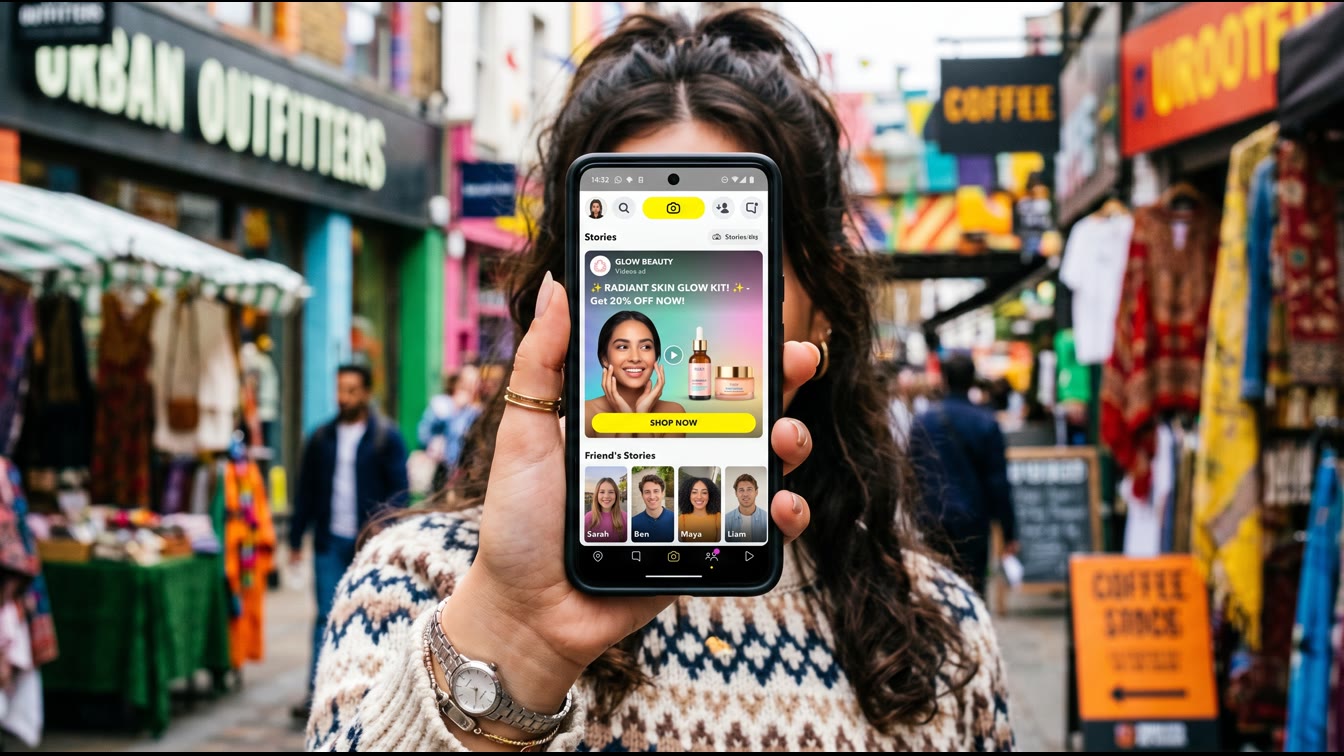
Snapchat AI Sponsored Snaps deliver 22% more conversions and roughly 20% lower cost-per-action than standard in-feed social inventory. Meta CPMs hit $10.88 in Q1 2025. TikTok CPMs climbed to $13.26. Snapchat awareness CPM sits at $5.84 — 35% cheaper than equivalent Meta placements. If you run an ecom brand doing $500K to $5M in annual revenue and you are not testing Snapchat right now, you are leaving a wide-open channel to whoever moves first.
What AI Sponsored Snaps Actually Are
Snapchat launched AI Sponsored Snaps in April 2026. They are not banner ads. They are not story interruptions. A brand deploys its own AI agent directly inside Snapchat's Chat tab — the same inbox where users message their friends. A Snapchatter sees the sponsored message, opens it, and can immediately ask the brand questions, get product recommendations, or move toward purchase without leaving the conversation.
The format builds on the original Sponsored Snaps product, which Snap rolled out globally throughout 2025. That base product already works. A Kantar study found 93% of users noticed Sponsored Snaps and 59% opened them without any prompt from the brand. Purchase intent for opened Sponsored Snaps runs 1.8x higher than competitor in-feed formats. The AI layer adds a two-way conversation on top of that.
Existing Sponsored Snaps drove 2.3x more lift in unaided brand awareness than other social platforms when fully opened. Add an AI agent that can answer product questions at 2 a.m. and close consideration in one session . and you have a full-funnel unit inside a single ad format.
The Numbers That Matter for Ecom Operators
AdLiftr analyzed 2,431 Snapchat campaigns across 412 advertisers, representing $11.4M in combined spend from February through May 2026. The DTC ecom vertical breakdown is worth memorizing.
Median CPA for DTC apparel and accessories: $19.80. Top-quartile advertisers hit sub-$12.40. Beauty and cosmetics: median $23.40, top quartile under $14.20. For context, Meta's average ecom CPA runs $38 to $65 depending on the category. Even a mid-table Snap campaign beats most Meta campaigns on acquisition cost in apparel, fashion, and beauty.
Median CTR across all Snap placements is 1.04% . 22% above Meta's equivalent. Spotlight placement hits 1.36% CTR. Catalog Sales CPM on Snap runs roughly 15% cheaper than equivalent Meta Dynamic Product Ad inventory.
Creative format is where most operators destroy their performance before the campaign starts. Short vertical video under 7 seconds hits a median CPA of $19.80. Video over 30 seconds: median CPA of $39.20. Repurposed landscape creative from Meta: median CPA of $43.80. Stop recycling Meta assets on Snap. That single decision explains most of the variance between operators who win here and those who write the platform off.
The Audience Your Meta Spend Cannot Buy
Snapchat reaches 75% of 13-to-34-year-olds in over 25 countries. Users aged 18-24 make up 37.1% of the platform. Daily active users hit 469 million in Q2 2025. Users open the app 30 times per day . not passive scroll behavior, but intentional engagement.
The spending power behind this audience is real. Millennials and Gen Z collectively hold over $1 trillion in purchasing power. A multi-market study of 28,500 users aged 13-34 found 88% use social media to discover new products and 49% are interested in purchasing from authentic creator and brand content. Snapchat ranked second in ad equity among global consumers in Kantar Media Reactions 2025 . up from sixth the year prior.
For ecom brands in fashion, accessories, beauty, and lifestyle, this demographic is your primary buyer. You cannot age-gate yourself into Meta's audience and expect the same result. Snap's audience is native to the format and increasingly conditioned to purchase through it.
A Case Study Worth Reading
Elumynt ran Snapchat catalog ads for a children's clothing boutique that had previously spent $8,000 at a 5.5x ROAS, almost entirely on retargeting. The agency restructured to 91% prospecting spend, rebuilt the product feed, and created manual product set segments rather than letting Snap auto-optimize across the full catalog. Result: 86% revenue growth in one month, with a sustained 12.7x ROAS over three months on roughly $40,000 in spend. A single retargeting test hit 36x ROAS on $235 spent.
This is not a funded brand with a $2M media budget. This is a boutique. The math works because the operator did the work before pressing launch . clean feed, native creative, and a prospecting-first structure instead of the default retargeting-only setup most brands run when nervous about a new platform.
Dan Kennedy Taught Me to Go Where the Competition Isn't
I spent years as a Dan Kennedy student. One principle never left me: go where the competition is not, run the math before you commit, and get there before the platform gets crowded. Snapchat for ecom operators under $5M is that channel right now. Meta's active advertiser count is enormous. TikTok is filling up fast. Snapchat grew its active advertiser base 28% year-over-year in 2025 . but the inventory-to-advertiser ratio still heavily favors new entrants. The arbitrage window is open. It will not stay open forever.
How This Fits the ATLAS Model: Test Phase
The ATLAS Model for Growth identifies five phases: Assess, Target, Launch, Accelerate, Sustain. Snapchat AI Sponsored Snaps belong squarely in the Test phase . structured, budget-bounded experimentation that generates real signal before you scale spend.
Here is the Test protocol for a Snap campaign: Start at $100 per day on Catalog Sales or Conversions objective. Build three creative variants . all short vertical video, all under 7 seconds, all shot natively for mobile. Run for 14 days. Top-quartile operators reach stable CPA in that window when spending $250-plus per day; at $100, plan for 21 days. If your CPA lands below $25 for apparel or below $30 for beauty, scale to $250. If not, audit creative before you audit targeting.
Creative is the variable that controls 60% of CPA variance on this platform, per AdLiftr's dataset. Do not launch with repurposed Meta creative. Do not launch landscape format. Do not launch video over 15 seconds. These three decisions kill Snap campaigns before the algorithm has enough data to optimize.
What the Setup Actually Requires
Snap Pixel installation is non-negotiable. Without it, the algorithm has no purchase signal to optimize against and your CPA will be high by default. If you run WooCommerce or Wix, Snap has native integrations . both launched in 2025 and take under an hour to configure.
For AI Sponsored Snaps specifically, the product launched in alpha in April 2026. You need to request access through Snap's advertising platform. The alpha launched with Experian as the first partner. DTC and ecom brands are next in line as Snap opens the format further. Get on the list now. By the time this format is widely available, CPMs will reflect the competition that does not exist yet.
Budget floor: $50 per day will technically run, but 92% of campaigns at that level never exit the learning phase within 14 days. The practical floor is $100 per day. A serious Test phase budget is $250 per day for 21 days . roughly $5,250 total. That is a legitimate test budget for a brand doing $1M or more annually.
Doctrine Connection: Due Diligence Is Non-Negotiable
The doctrine holds: due diligence is non-negotiable. Before you move budget to any new channel, you run the numbers. Snapchat passes the test. Awareness CPM at $5.84 beats Meta by 35%. Median DTC CPA at $19.80 for apparel competes with anything Meta is running in that category. The case data is real. The audience data is real. The Kantar research backing Sponsored Snap performance is multi-market and peer-reviewed.
Due diligence also means acknowledging the risk. Post-click conversion rates on Snap are lower than Meta for most verticals. You will not see Meta-level ROAS in week one. Attribution requires proper pixel setup and a willingness to look beyond last-click. Operators who run Snap without clean measurement infrastructure will misread the results and pull budget prematurely. Set the measurement stack before you set the campaign live.
Do the work before you spend the money. That is the doctrine. Snap rewards operators who enter prepared.
FAQ
Q: What is the minimum budget to test Snapchat ads for an ecom brand? The practical minimum is $100 per day. At that level, campaigns have a reasonable chance of exiting the learning phase within 21 days. For reliable CPA data within 14 days, $250 per day is the threshold. Total test budget: plan for $3,000 to $5,000 before drawing conclusions.
Q: How do AI Sponsored Snaps differ from regular Sponsored Snaps? Regular Sponsored Snaps deliver a brand message to the Chat inbox that users can open for a full-screen experience. AI Sponsored Snaps layer a conversational AI agent on top . the user can ask product questions, get recommendations, and move toward purchase within the same chat interface. The format launched in alpha in April 2026 and requires direct application through Snap's advertiser platform.
Q: Is Snapchat worth testing if my brand targets customers over 35? Probably not as a primary channel. Snapchat's core audience is 13-34, with the 18-24 cohort at 37.1% of total users. If your buyer demographic skews 35-plus, Meta and Google remain better first dollars. If your product has any crossover appeal with Gen Z or Millennials, Snap is worth a structured test.
Q: What creative actually works on Snapchat for ecom? Short vertical video under 7 seconds, shot natively for mobile, with a product in the first frame. Median CPA for sub-7-second vertical video is $19.80. Median CPA for video over 30 seconds is $39.20. Repurposed Meta landscape creative averages $43.80 CPA. Make Snap-native content or do not run the channel.
Q: What ecom categories perform best on Snapchat? Apparel, accessories, beauty, cosmetics, and beverages show the strongest DTC performance on Snap, per AdLiftr's 2026 benchmark data. These categories align with Snap's 18-34 demographic and the visual, fast-format nature of the platform. Verticals that require longer consideration cycles or target older buyers will find the post-click conversion rate challenging to work with.