
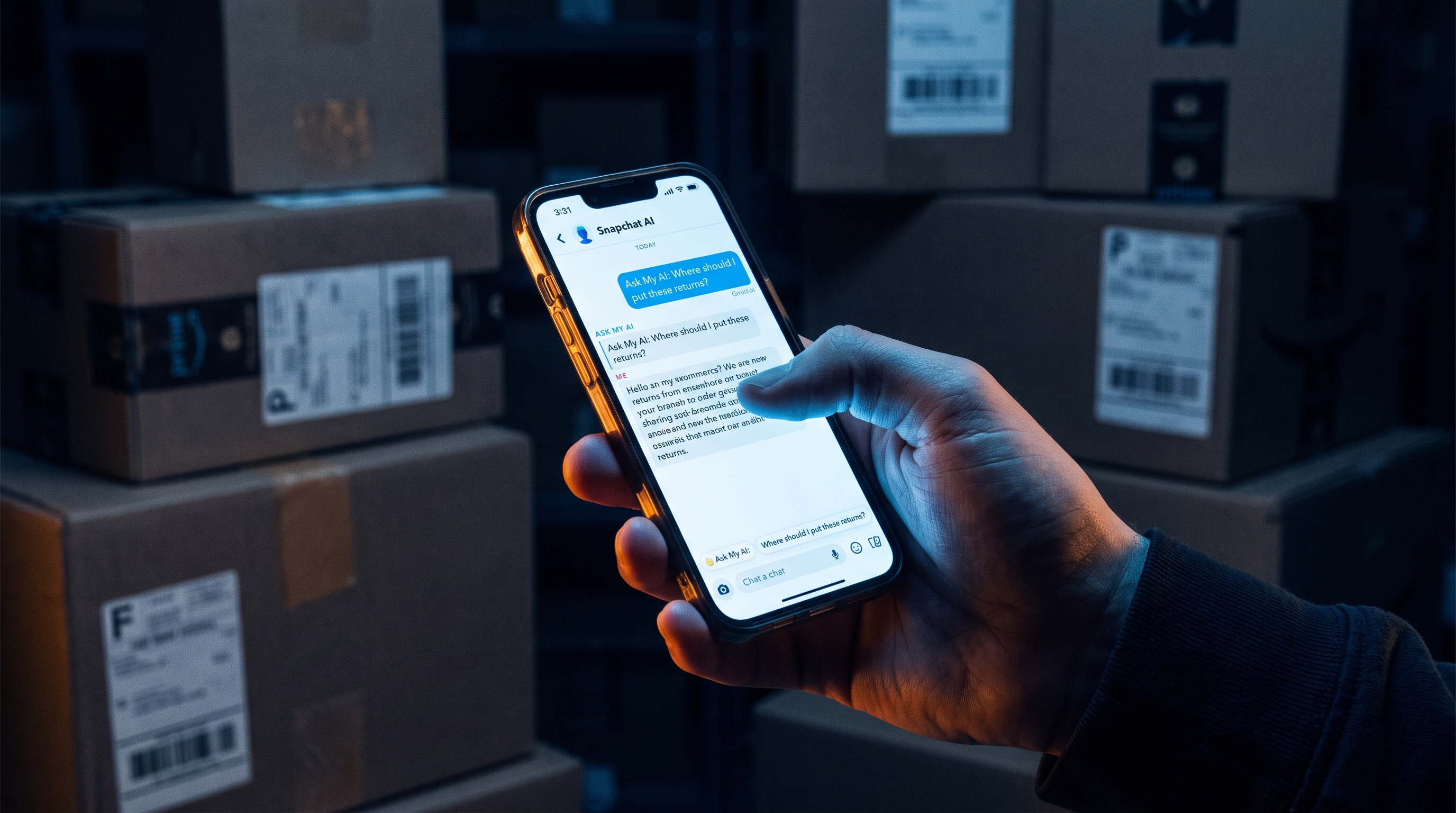
The Agentic Storefront: Chat as Your Ecommerce Engine
Snapchat's AI Sponsored Snaps do one thing: they make chat into a selling channel. A user sees a branded message in the Chat tab. They tap it. An AI agent, trained on your product catalog and tone, answers questions, recommends products, and closes sales without ever leaving the conversation. Early data from Experian's alpha shows 22% higher conversions and 20% lower cost-per-action versus standard Sponsored Snaps (which were already crushing it). For mid-market ecom brands, this is the moment to build operator-independent systems before the competition floods the zone.
Here's the tactical frame: You have maybe 60 days before Q3 pushes this feature to broader availability. Right now, fewer than ten brands are running live. The math rewards early movers who build the right playbook.
Why This Matters: The Snapchat Moment
Snapchatters sent 950 billion messages in Q1 2026 alone. That's not traffic. That's behavior. The platform has trained its audience to treat chat as the primary interface for everything: friends, discovery, and now, commerce. Over half a billion users have already messaged My AI, the in-app assistant. The cognitive friction is gone.
For ecom, this is different from Instagram or TikTok. On those platforms, ads interrupt the feed. On Snapchat's Chat tab, ads are native. They arrive as messages. Users expect to tap and interact. An AI agent sitting in that space feels less like an ad and more like a service.
The performance bar backs this up: Snap reports 2x more conversions per full-screen view compared to other inventory. Snapchatters are 34% more likely to buy from an ad on Snapchat than the same ad elsewhere. This is the least saturated major platform for ecom right now. CPMs are lower. ROAS is higher. The operator-independent toolkit keeps improving.
The Navy Lesson: System Over Luck
I spent time in the engine room of a submarine, and one thing stuck with me: when something breaks at sea, you can't call an engineer. You have the people and the procedure. The procedure beats panic every time. Most ecom founders I work with are still running ads like they're running a cottage business. Custom creatives, manual targeting, founder-operator tight loops. That works at $50K/month. It breaks at $500K/month and again at $5M.
AI Sponsored Snaps force you to systematize faster. You can't hand-tune an agent on the fly. You have to encode your playbook: product taxonomy, recommendation logic, CTA sequence. It's uncomfortable. It's also non-negotiable if you want to scale. This is where most brands break. They want the traffic without the doctrine.
The Tactical Stack: Owner's Exit Engine Framework
Use the Owner's Exit Engine to structure your AI Sponsored Snaps rollout. This framework maps three layers:
Layer 1: The Agent. This is your conversational AI deployed in Snapchat's Chat tab. It should own your full product catalog, trained on your best-selling categories and high-intent customer questions. The agent is not a chatbot; it's a system that operates independently of founder input. Document every decision rule: how it recommends products, which edge cases it handles, what escalates to human support. This is the inverse of "move fast." Move deliberately. Encode the math.
Layer 2: The Funnel. Map where users enter (Chat discovery), what the agent shows them (product recommendations via real-time intent signals), and where they exit (shop your Snap Store, your website, or your app). Use Snap Pixel and Snap Conversions API (CAPI) to track every step. For mid-market brands, we recommend starting with Website Conversions as your objective, using 7/0 optimization (prioritize clicks), and a minimum daily spend of $30 to exit the learning phase fast.
Layer 3: The Exit. This is the compound play. Each AI Sponsored Snap campaign that runs cleanly, converts predictably, and scales without founder dependency makes your business more acquirable. VCs and strategic buyers pay multiples for founder-independent revenue. Build the agent like you're selling it in 18 months.
The Owner-Operator Frame: What Brands Are Missing
Most ecom founders see AI and think "automation equals less work." Wrong. AI is a force multiplier tool. It shifts work from execution to design. Instead of running 47 ad variations, you design one powerful recommendation engine. Instead of writing customer service emails, you encode the response tree. Instead of testing creative, you focus on product categorization and catalog data quality.
Mid-market brands ($500K to $5M) usually have 3 to 8 people. If the founder is still the bottleneck for ad decisions, you'll max out around $3M in revenue. AI Sponsored Snaps expose this immediately. You can't hand-tune an agent in the Chat tab. You have to build doctrine first, then deploy the system. This is the founder dependency tax. It's why most brands stall before $10M.
The solution: Hire or retrain one person to own the agent infrastructure. This person is not a marketer. They're a systems operator. Their job is to encode your playbook, test assumptions, and continuously improve the recommendation logic. The founder steps back from daily execution into quarterly strategy. That's how you move from owner-operator to operator-independent. That's what acquires.
Competitive Advantage: The Timing Window
Snapchat's alpha is running with Experian (financial services). General availability is expected in Q3 2026. Right now, you can pitch your way into beta access. Here's the math: if you move now, you'll have 90 days of live data before broader competition arrives. That data compounds. Better recommendations, lower CAC, higher LTV signals. By Q3 expansion, you'll have proof that AI Sponsored Snaps work for your category.
That's a two-quarter head start on everyone else.
Secondary advantage: Dynamic Product Ads on Snapchat now use agentic recommendation models. These synthesize user behavior, product affinity, full-funnel signals, and real-time intent. For mid-market brands with SKU counts above 100, this is a conversion machine. Pair Dynamic Product Ads (for broad discovery) with AI Sponsored Snaps (for high-intent conversations), and you've built a full-funnel system.
The Setup Checklist: Pre-Q3 Action Items
Do this in order:
Week 1–2: Foundation. Install Snap Pixel on your website. Enable Snap Conversions API (CAPI). Set up your Product Catalog in Snapchat. This is mandatory. You cannot optimize without data. Most brands skip this and wonder why conversions are flat.
Week 3–4: Agent Design. Document your product taxonomy. Write the recommendation logic: Which products do you show first? What's the fallback if the user's intent is unclear? How do you surface seasonal campaigns? This is not technical work. It's strategy. Your agent is the embodiment of your marketing thesis.
Week 5–6: Pitch & Beta. Contact your Snap account rep or apply for beta access to AI Sponsored Snaps. Include your product category, average order value, and monthly ad spend. Snap prioritizes categories with clear conversion signals (retail, beauty, finance, home goods). No pitch, no access.
Week 7–8: Launch & Monitor. Start with a single Collection Ad, not an AI Sponsored Snap yet, to verify your pixel is firing and CAPI is sending clean data. Then, once beta access is live, deploy your agent with a daily budget of $30 to $50 and hold it steady for 14 days. The algorithm needs clean learning data before it optimizes.
Ongoing: Quarterly Review. Every 90 days, pull your data. Calculate CAC, LTV, payback period, and ROAS by product category. Which recommendations are converting? Which are dead weight? Feed that back into your agent logic. This is the compounding edge.
Real Citations & Performance Proof
Snap's official announcement (April 28, 2026) confirms AI Sponsored Snaps are live in alpha. The Experian case study shows the feature works for financial services—a high-consideration, conversational category. But ecom? We're looking at extrapolation from existing Sponsored Snaps data:
- Sponsored Snaps baseline: 22% more conversions, 20% lower cost-per-action, 2x conversions per full-screen view (per Snap's internal metrics and third-party reporting from PPC Land and Digiday). This is the floor. AI Sponsored Snaps are expected to exceed it.
- Chat saturation: 950 billion messages sent in Q1 2026 across nearly 1 billion monthly active users (per Snap newsroom). Chat is Snapchat's primary interface.
- User behavior: Over 500 million users have messaged My AI (Snap's assistant), signaling comfort with conversational commerce (per Snap newsroom).
- Catalog-powered AR lenses: Snapchatters who use shoppable AR lenses are 2.4x more likely to purchase (per Snap's Shopping Lens documentation). Agentic recommendations operate on similar conversion mechanics.
Sources:
- https://newsroom.snap.com/ai-sponsored-snaps
- https://forbusiness.snapchat.com/blog/human-first-ai-enabled-snaps-latest-ads-innovations
- https://ppc.land/ai-sponsored-snaps-let-brands-chat-directly-with-users/
- https://forbusiness.snapchat.com/advertising/industry/ecommerce
FAQ: The Questions Your Team Will Ask
Q: Is AI Sponsored Snaps worth it if we're doing $1.2M in annual revenue?
Yes, but time it right. Your CAC is probably between $15 and $35 (for mid-market ecom). An AI Sponsored Snap costs the same to deploy as a standard Sponsored Snap in terms of media spend. The payoff comes from conversion rate lift. If your baseline conversion rate from chat is 2%, and AI agents lift it to 2.8 to 3.2%, that delta pays for the infrastructure. Start with a 60-day pilot at $1.5K in media spend. Track CAC, LTV, and payback period weekly. If payback period is under 45 days, scale it. If it's over 90 days, pause and rethink your agent logic or product positioning.
Q: What if we don't have technical resources to build an AI agent?
Snap is building tooling to lower the bar. In beta, most brands are using their existing chatbot infrastructure (trained on their website data) and adapting it for Snap's Chat interface. You don't need a new agent. You need an adapter. If you're running customer service bots on your website or using a third-party platform like Intercom or Zendesk, those vendors will likely build Snapchat connectors. Budget for a systems integrator if you're going live pre-Q3 (expect 4 to 8 weeks of engineering).
Q: How much budget should we allocate to start?
Do the math: CAC times desired monthly purchases equals monthly media budget. For a $2M revenue brand with a $25 CAC, you're probably spending $8K to $15K per month on Facebook and Instagram. Start by moving 10% of that ($800 to $1.5K) to AI Sponsored Snaps. If conversion lift is real, scale by 10% per month until you hit saturation. Most mid-market brands should expect 8 to 12 weeks to reach reliable optimization. Don't expect revenue acceleration in month one.
Q: What's the risk of launching too early?
Data contamination is the real risk. If your pixel implementation is messy or CAPI is sending corrupted events, the algorithm will learn from noise. Spend two weeks verifying your pixel before you go live with AI Sponsored Snaps. Test standard ads first. Watch for duplicates, dropped events, and missing attribution. This is due diligence. It costs time, not money. Do it.
Doctrine Connection: Systems Beat Slogans
One of my core beliefs: systems beat slogans. Most brands want the story ("we force multiplier AI for conversational commerce"). What they actually need is the system—the documented playbook, the monitoring dashboard, the feedback loop. Snapchat is forcing that. You can't launch an AI agent and wing it. You have to encode your logic upfront.
This is what separates founders from operators. A founder sees AI Sponsored Snaps and thinks, "Let's try it." An operator builds a playbook, measures it, iterates it, and hands it to a system-operator teammate so the founder can step back. The second path scales. The first one doesn't.
Build your system. Document it. Make it founder-independent. That's not just better marketing. That's a business that compounds toward exit.
*Disclaimer: This article covers AI Sponsored Snaps in alpha as of August 2026. Snapchat's features, pricing, and availability may change. Always verify current product documentation at forbusiness.snapchat.com before deploying campaigns. This is tactical guidance for ecom brands between $500K and $5M in annual revenue and does not constitute financial, legal, or strategic advice specific to your business. Consult your own advisors before committing budget.*