
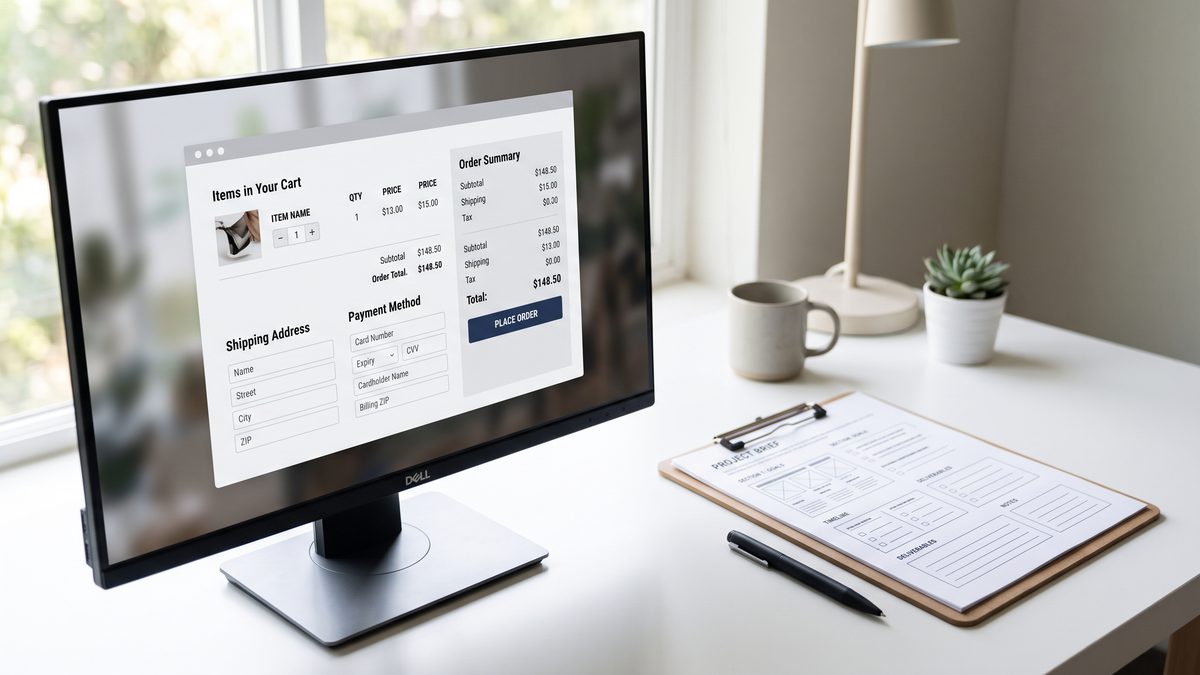
TL;DR
- Checkout Blocks and Checkout Extensibility have closed most of the gap between native Shopify checkout and paid third-party apps. Operators deploying three or more blocks report AOV gains of 11-18% and checkout conversion gains of 4-9% in controlled tests (D2C Times).
- Operators compounding those gains stopped treating checkout as a settings page. They run a written checkout brief: hypothesis, target segment, offer mechanics, success metric, minimum detectable effect (MDE), before the test ships.
- Ownership sits at the intersection of growth and ecommerce, usually reporting to a CMO or VP of Digital. No owner means no roadmap, and checkout reverts to the page nobody touches after launch.
- Shopify shipped native A/B testing (Rollouts, under Markets) on June 5, 2026, letting Grow-plan-and-above merchants run controlled checkout experiments without a third-party app.
- The app ecosystem built on the old gap, order bumps, upsells, checkout scripts, is under pressure. Shopify's legacy checkout.liquid migration deadline is October 1, 2026.
The watch nobody was standing
On a submarine, every space has an assigned watchstander. Nobody wanders into the engine room, glances at the gauges, and leaves. Someone owns that space for the entire watch and knows the second something drifts off nominal.
Most Shopify checkouts don't have a watchstander. An operator builds it once, installs a few apps, and never looks at it again until conversion drops and somebody panics. I've sat across the table from enough $8M and $12M founders to know this pattern by name: set-and-forget checkout, always-on ad spend. That's backwards. You're pouring paid traffic into the top of a funnel while ignoring the one screen where every visitor has already decided to buy. That's changing, because the tooling caught up to the opportunity.
What actually changed on the platform
For most of Shopify's history, checkout was a locked room. Merchants could swap a logo and button color, but the underlying flow was untouchable without a Plus plan and a developer hacking checkout.liquid. That era ended in phases through 2025 and 2026.
Checkout Extensibility replaced the old freeform Liquid template system with a supported framework: Checkout UI Extensions, Shopify Functions, app blocks, and branding settings (Shopify Help Center). Checkout Blocks, the merchant-facing layer on top, lets operators inject custom fields, trust signals, and upsell tiles directly into checkout without a code sprint.
The results reported across the DTC press this year are not marginal. Soft Services, a functional skincare brand, rebuilt checkout inside Checkout Blocks, adding trust signals, dynamic upsell tiles, and a one-field address validator, and saw checkout-to-purchase conversion climb 14% in Q1 2026 versus Q4 2025 (D2C Times). Caraway Home reported a 14% mobile checkout completion gain after migrating to the new Branding API, on a brand where mobile carries 71% of traffic (D2C Times). Varos, the DTC benchmarking platform, found average checkout completion in Shopify Plus beauty and personal care rose from 61.2% to 67.8% between Q4 2025 and Q2 2026 (D2C Times).
The insight most operators are missing: process, not tooling
D2C Times' most useful reporting this year wasn't about the feature set. It was about the operators using it well. A July 2026 piece on checkout revenue-per-session gains, showing RPS lifts of 11% to 28% by category, named the structural pattern behind it: "The brands moving fastest have done two things. First, they've assigned explicit ownership, usually sitting at the intersection of growth and e-commerce, reporting to a CMO or a VP of Digital. Second, they've developed what several operators are now calling a 'checkout brief,' a structured document that outlines the hypothesis, the target customer segment, the offer mechanics, the success metrics, and the minimum detectable effect before a test is called" (D2C Times).
Jeremy Horowitz, founder of Messenger Mastermind and a DTC growth advisor to sub-$50M brands, put it directly: "The mistake most brands make is they treat checkout like a set-it-and-forget-it thing. The brands I see compounding growth right now have a checkout roadmap the same way they have a creative roadmap. It's a living document" (D2C Times).
That gap is more pronounced at the growth stage than at the enterprise level, where dedicated CRO teams have run structured checkout experiments for years. The real shift is how much of that infrastructure is now accessible to brands doing $5M to $30M who previously couldn't afford to touch checkout at all.
The checkout brief: template
A checkout brief is not a Slack message that says "let's try a bundle upsell." It's a one-page document, filled out before the build starts, forcing the same discipline a fire-control solution demands before you commit a torpedo. You don't fire on a hunch.
1. Hypothesis. One sentence. "If we add a post-address, pre-payment upsell tile offering a bundle discount above $75 cart value, checkout conversion will increase because customers are in a buying mindset and haven't locked in a total yet."
2. Target segment. Who sees this test. First-time buyers, cart value above a threshold, mobile sessions, guest checkout. Shopify's expanded conditional logic (Wave 2 of the Checkout Blocks API, live since June 30, 2026) renders based on cart attributes, customer tags, and discount code presence, so segment targeting is no longer theoretical (Ecommerce Times).
3. Offer mechanics. The exact rule set: discount depth, trigger threshold, expiration, stacking rules with existing promotions. Specific enough that a developer or no-code builder can execute it without a follow-up meeting.
4. Success metric. Pick one: checkout conversion rate, average order value, revenue per session, or subscription attach rate. Don't optimize for three things at once.
5. Minimum detectable effect (MDE). The smallest lift worth caring about, stated before you look at results. If baseline conversion is 65% and traffic can only reliably detect a 3-point move in a two-week window, don't call the test early on a 1-point bump.
6. Test duration and sample size. Set before launch, not adjusted mid-flight.
7. Kill criteria. What result ends the test and reverts to control, written down before you're emotionally invested in the variant.
It's five minutes of writing. Almost nobody does it, because checkout still feels like a settings page instead of a growth surface, and settings pages don't get briefs.
Who owns it
The checkout brief only works if someone is accountable for the roadmap it lives in. In the brands D2C Times profiled, that person usually sits at the intersection of growth marketing and ecommerce operations: close enough to the P&L to know what a 2-point AOV lift is worth, close enough to the platform to ship a block change without a three-week wait on a dev ticket.
For a $5M-$30M operator, this is rarely a full-time hire. It's usually the growth lead or head of ecommerce carving out four hours a week, with a standing checkout review on the same cadence as the creative review. If checkout gets zero minutes in that sync, you're optimizing the front door and ignoring the register.
Testing cadence and running the numbers honestly
Shopify closed the biggest structural gap here on June 5, 2026, expanding Rollouts to support native A/B testing on checkout and customer-account configurations, not just storefront themes (Shopify Changelog). Rollouts lives under Markets in the admin. Scheduling works on the Basic plan; running an actual experiment requires Grow or higher. You publish a variant as a percentage-split experiment instead of pushing it to 100%, and Shopify tracks checkout conversion as the native comparison metric.
Before June 2026, testing a checkout variant with statistical rigor meant a third-party tool like Convert.com or Intelligems, both of which saw real growth in checkout-layer testing deployments through the first half of the year (D2C Times).
Native tooling doesn't replace discipline. Guidance on Rollouts is consistent: pick one hypothesis, hold a pre-decided sample size and run length, don't stop early because day three looks good (Capconvert). One change per test, adequate sample, no peeking. That's watchstanding discipline applied to a spreadsheet.
For a $5M-$30M brand doing roughly 40,000 monthly sessions, a realistic cadence is one active test at a time, running two to four weeks, with a new brief queued before the current test resolves. That's 12 to 18 tests a year, compounding into a materially different trajectory than one big redesign every 18 months.
The app ecosystem is getting squeezed
Shopify's native layer now handles an estimated 60-70% of what most mid-market brands need from checkout optimization, per D2C Times reporting on the May 2026 expansion (D2C Times). The remaining 30-40%, complex discount stacking, marketplace-native integrations, behavioral targeting, still lives in apps, and that ecosystem is under pressure.
Shopify's phased Checkout Blocks API rollout is now in its second of three waves as of July 2026, and roughly 1,400 apps in the Shopify App Store touch checkout in some capacity. Analysts at Logical Position estimate 15-20% of those apps derive more than half their revenue from functionality Checkout Blocks now replicates natively (Ecommerce Times). Developers on legacy Script Editor hooks face a hard cutoff of October 1, 2026, before delisting risk kicks in.
Before renewing any checkout-adjacent app subscription, check whether it's now native in Checkout Blocks. If it is, redeploy that fee into paid media or into the labor cost of running your testing cadence properly. Apps still earn their keep for dedicated experimentation platforms and for marketplace-native checkout tools where the data bridge back to your own CRM is the harder problem (D2C Times).
What's coming next
Native A/B testing for checkout arrived June 5, 2026, ahead of the Q4 timeline many operators were bracing for. Wave 3 of the Checkout Blocks API, expected late August 2026, is rumored to add native A/B testing within individual blocks, not just full configuration swaps (Ecommerce Times). Shopify has also signaled a predictive abandonment layer in private beta, triggering retention offers for high-exit-intent sessions, targeted for general availability before year end (D2C Times).
The barrier to running a rigorous testing program just dropped for every merchant on the Grow plan, not just Plus enterprises with dedicated CRO budgets. That's good news for the $5M-$30M range. It's also a warning: when the tooling becomes table stakes, the operators who already built the ownership, the brief discipline, the testing cadence, bank the compounding advantage first.
Building this at demg.ai
I didn't come up in marketing. I came up standing watch in engine rooms on a submarine, where a casualty drill only works if everyone already knows their station before the alarm sounds. When I started building AI-driven marketing systems for owner-operators at demg.ai, the first thing I checked in every client's Shopify account wasn't the ad account. It was the checkout. Nine times out of ten, it had been built once, at launch, and never touched again.
We built a version of the checkout brief process for a $9M home goods brand last year, running variants through a third-party testing app because Rollouts didn't exist yet. The discipline mattered more than the tool: assign an owner, write the hypothesis down, pick one metric, don't call the test early. Over five sequential tests across two quarters, we moved checkout conversion from 58% to 64%, not from one clever idea, but from a repeatable process. That's the doctrine. Process beats ego. The operator who wants to be right about one big redesign loses to the operator running a disciplined test every three weeks.
If your checkout hasn't been touched since launch, you're not behind on tooling. You're behind on process. Fix that first.
For more on building systems that compound, read The 90-Day Bottleneck Audit: Find Every Place You're the Single Point of Failure and The AI Tool Audit: 7 Questions That Separate Systems From Subscriptions.
FAQ
What exactly is a Shopify checkout brief?
A one-page document written before you build a checkout test: a stated hypothesis, the target segment, the offer mechanics, the single success metric, and the minimum detectable effect that would make the result meaningful. It stops teams from calling tests early based on a good-looking trend line.
Do I need Shopify Plus to use Checkout Blocks?
Basic customizations, Thank You and Order Status page blocks, order value limits, are available on standard plans. Full customization, custom fields, conditional logic, reordering payment and delivery methods, requires Shopify Plus (Shopify Help Center). Native A/B testing through Rollouts requires the Grow plan or higher.
What's the difference between Checkout Blocks and Checkout Extensibility?
Checkout Extensibility is the underlying framework, Checkout UI Extensions, Shopify Functions, app blocks, that replaced checkout.liquid and Script Editor. Checkout Blocks is the merchant-facing app built on that framework, letting you place and configure blocks without touching code.
How long should a checkout A/B test run?
Set the duration before launch based on traffic volume and the minimum detectable effect in your brief, not on how early numbers look. Most guidance points to a minimum of two full business cycles, commonly two weeks, to account for day-of-week variation.
Are third-party checkout apps still worth paying for?
For an estimated 60-70% of what a mid-market brand needs, no. Native Checkout Blocks now covers that ground. Apps still earn their keep for dedicated statistical testing platforms, complex discount stacking, and bridging marketplace-native checkout (TikTok Shop, Buy with Prime) back into your owned CRM.
Related reading on demg.ai: see our breakdown of GHL automation tactics for owner-operators, and our piece on building AI-driven retention flows for ecommerce brands under $10M.
*Jeff Barnes, MBA has no personal position in any company, fund, or platform named in this article. Digital Evolution Marketing Group has no current commercial relationship with any party mentioned. DEMG provides marketing systems and education for owner-operators, not investment advice. Past performance does not guarantee future results. All business decisions involve risk.*