
Shopify Autopilot vs Canva Grow vs DIY: Ecom Ad Automation Compared
Three tools want to run your ecom ads. One keeps you in the engine room. Two hand the controls to someone else's platform. The difference matters most when you're ready to sell.
Shopify launched Campaign Autopilot on June 23, 2026. Canva pushed Grow 2.0 three days later. Both promise to simplify ad management for ecom operators. I spent time pulling both apart alongside the DIY stack I've been building with clients at DEMG for the last three years. Here's the honest comparison.
What Each Tool Actually Does
Shopify Campaign Autopilot is AI-powered campaign management baked into Shopify's dashboard. You set a ROAS target, a budget, and pick your channels — Meta, Shop Campaigns, email, with ChatGPT Ads, Microsoft, and Snapchat listed as coming soon. Sidekick, Shopify's AI assistant, handles the optimization logic. You don't touch bid strategy. You don't touch audience splits. The machine decides.
Canva Grow 2.0 takes a design-first approach. You build ad creative inside Canva, publish directly to Meta, TikTok, and LinkedIn, and get campaign reporting with auto-tagging on performance elements. The pitch is speed: produce 10 ad variants in the time it used to take to make 2, and see which creative elements are winning without building a separate analytics layer.
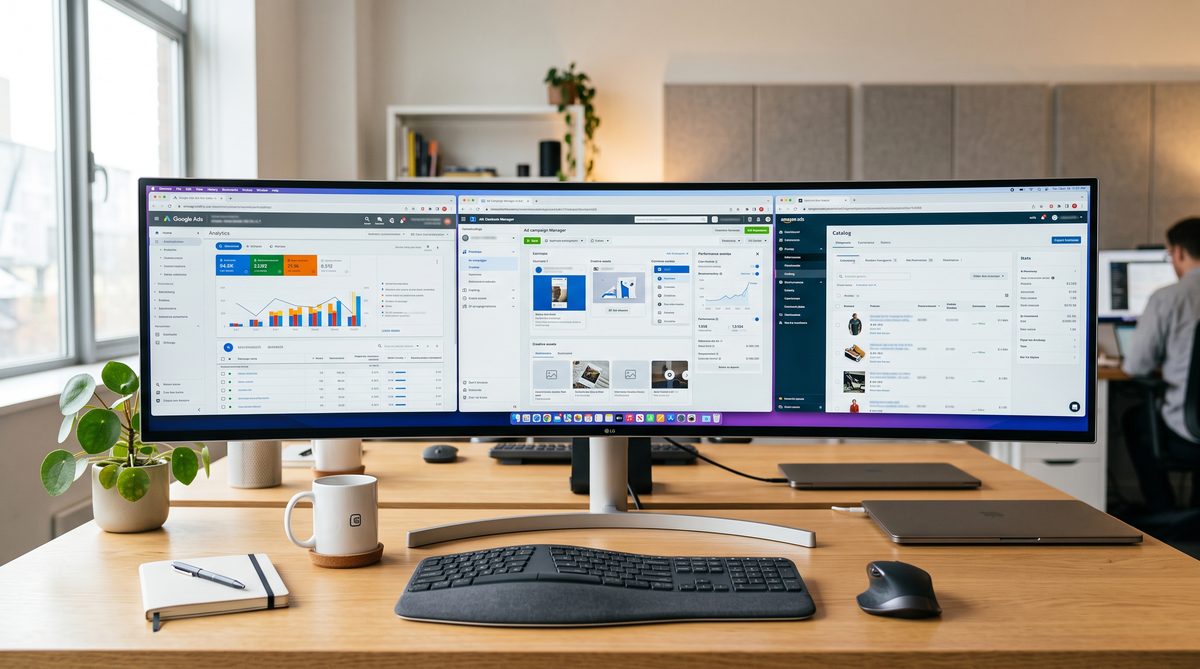
The DIY Stack is Meta Ads Manager for buying, Canva for creative production, Google Analytics for attribution, and your own CRM — GoHighLevel or HubSpot , for customer data and retargeting logic. More moving parts. More control. Your system, not a vendor's.
The Comparison Table
| Feature | Shopify Autopilot | Canva Grow 2.0 | DIY Stack | |---|---|---|---| | Setup time | Under 30 minutes | Under 1 hour | 2–5 days | | Channels supported | Meta, Shop, Email (more coming) | Meta, TikTok, LinkedIn | Any platform | | Creative production | Pulls existing product assets | Full design suite, 10+ variants fast | Canva or any tool you choose | | Budget control | AI-managed, ROAS-target input | Manual with AI suggestions | Full manual control | | Attribution model | Shopify-native | Canva reporting layer | GA4 + CRM, your model | | Data ownership | Shopify holds your Meta data + logic | Canva holds campaign performance data | You own everything | | CRM integration | Shopify customer data only | Limited | Full CRM of your choice | | Exit / sale value | Low , logic lives in Shopify's UI | Low , creative process, not a system | High , documented, transferable asset | | Best for | Shopify stores wanting hands-off spend | Lean teams needing fast creative output | Owner-operators building to sell | | Monthly cost estimate | Included with Shopify plan tiers | Canva Teams pricing (~$30/mo/user) | $150–$400/mo in tools |
The Sovereignty Question Nobody Asks
Here's where I get direct with you.
Shopify Autopilot gives Shopify two things: your Meta pixel data and your budget allocation logic. That's not one dependency. That's two. Your audience data flows through Shopify's pipes. Your ROAS decisions run on Shopify's AI. If Shopify changes its pricing, deprioritizes your niche, or gets acquired, your "marketing system" is a toggle inside someone else's dashboard.
Canva Grow has a smaller surface area, but the same structural problem. Your campaign performance data lives in Canva. Your creative library lives in Canva. When you walk into an acquisition conversation, the buyer doesn't see a marketing system. They see a Canva subscription.
The DIY stack costs more upfront. A properly configured GoHighLevel account runs $97–$297 per month. GA4 is free but takes 40 hours to set up correctly. Meta Ads Manager is free but requires a human who knows what they're doing. The payback period on that investment is 6–18 months, depending on your revenue. After that, it compounds. Every campaign you run trains your own attribution model. Every customer segment you build lives in your CRM, not a vendor's database.
I've seen this play out at exit. A client we worked with at DEMG , $4.2M in annual revenue, two-person team , sold for a 4.1x multiple. The acquirer's first question during due diligence was not "what's your ROAS?" It was "who owns the customer data?" The answer was: they did. GHL instance, documented ad playbooks, segmented lists. That answer added six figures to the deal. Another operator I know ran everything through a platform's native ad tool. Cfocusterface. Easy reporting. Sold for 2.8x on similar revenue. The acquirer had to rebuild the marketing stack from scratch. That risk got priced in.
Ownership beats wages. The same doctrine applies to marketing infrastructure.
When Shopify Autopilot Actually Wins
I'm not anti-Autopilot. There's a specific operator profile where it makes sense.
You're already on Shopify. You're doing $20,000–$200,000 per month in revenue. You have one person wearing five hats and no bandwidth to become a media buyer. You want to put $3,000/month into ads and see what comes back without learning bid strategy.
In that window, Autopilot is a reasonable choice. It beats doing nothing. It beats manually managing campaigns with no system at all. The ROAS targeting removes the most dangerous mistake new ad buyers make: letting a campaign run hot with no ceiling.
The risk is that you stay in that window too long. Autopilot optimizes for Shopify's definition of a good outcome. That might not match your margin profile. It definitely doesn't match your exit strategy.
When Canva Grow Wins
Canva Grow 2.0 beats both options on one dimension: creative throughput.
If you're a lean team producing content for multiple brands or product lines, the ability to generate 10 ad variants, push them live across Meta and TikTok, and get auto-tagged performance data in one interface is real. That's 3–4 hours of work compressed into 45 minutes.
The auto-tagging feature matters. Knowing that "lifestyle photography outperforms product-white-background by 34% on TikTok" is actionable creative intelligence. Most operators don't track this. Canva Grow makes it automatic.
Use it for creative production and testing. Don't use it as your attribution system. Don't let it become the owner of your campaign performance history.
Building the DIY Stack: The Watchstanding Order
If you're building to sell, or building for margin control, here's the order of operations.
Start with your CRM. GoHighLevel costs $97/month. HubSpot's starter tier is $20/month. Either one. The point is that customer records, purchase history, and segment logic live in infrastructure you control. This is your damage control system , when a platform algorithm changes, you still have the data.
Layer in GA4. Set up custom events for add-to-cart, checkout initiation, and purchase. Connect your Shopify store. This gives you attribution data that doesn't depend on Meta's self-reported numbers, which overcount conversions by 15–40% depending on your category.
Run Meta Ads Manager directly. Yes, it's harder than Autopilot. The learning curve is 20–30 hours for a competent operator. After that, you control your audience exclusions, your bid caps, your campaign structure. You're not renting someone else's optimization logic.
Use Canva for creative production. Strip it of any campaign management function. Canva is excellent at making ads. Keep it in that lane.
This stack costs $150–$400 per month in tools. It requires one person with 5–10 hours per week of attention. The ROI shows up in two places: lower CPA because you control attribution, and higher exit multiple because you own the system.
The Three Scenarios
Scenario 1: You're at $15K/month, one person, no ad experience. Start with Shopify Autopilot. Set a conservative ROAS target , 3x minimum. Cap your monthly spend at 10% of revenue. Use it to learn what works. Plan to migrate off in 12–18 months.
Scenario 2: You're at $50K/month, need faster creative output. Add Canva Grow for creative production. Keep your attribution in GA4. Don't let Canva become your reporting layer. Use the auto-tagging data to inform your creative brief, then make the next round of ads in Canva and push through Meta Ads Manager directly.
Scenario 3: You're at $100K+/month or you're building to sell. DIY stack, full stop. The cost of dependence on a platform's native tools is not a $300/month subscription fee. It's a 0.5x–1.5x reduction in your exit multiple. On a $5M business, that's $2.5M–$7.5M. The DIY stack is not a cost center. It's a capital asset.
Frequently Asked Questions
Does Shopify Autopilot work if I'm not heavily invested in the Shopify ecosystem? No. Autopilot's optimization logic pulls from Shopify's customer data, product catalog, and order history. If your store runs on WooCommerce, BigCommerce, or a headless setup, you don't have access and the integration doesn't apply.
Can I use Canva Grow alongside a DIY stack? Yes, and I'd recommend it for teams that need creative volume. Use Canva Grow for ad production and variant testing. Export your performance data. Keep your campaign management and attribution outside of Canva's ecosystem.
What's the minimum monthly ad spend where a DIY stack makes financial sense? I put it at $5,000/month. Below that, the time cost of maintaining the stack outweighs the control benefit. Above $5,000/month, the attribution accuracy gains from GA4 plus your own CRM start to measurably lower your CPA.
How does Shopify Autopilot handle data privacy and Meta's ad API? Shopify acts as a first-party data partner, meaning your customer purchase data is used to build Meta audiences through Shopify's pixel and Conversions API integration. You're authorizing Shopify to use that data for ad targeting. Read the data sharing terms before you enable it.
If I'm planning to sell my store in 3 years, which tool gives me the best exit position? DIY stack. The acquirer wants to see a documented, transferable marketing system. A campaign running inside Shopify's AI dashboard is not transferable. Your GHL account, your GA4 property, your Meta Business Manager , those transfer. That's the difference between a 2.8x and a 4.1x multiple on identical revenue.
The Bottom Line
Shopify Autopilot is fast and easy. Canva Grow is fast and creative. The DIY stack is slow to build and yours to keep.
You're not choosing between three ad tools. You're choosing between renting a marketing system and owning one. I built DEMG around the premise that operators who own their infrastructure keep more margin and sell for more money. Every client we've moved off platform-native ad tools and onto a documented stack has seen the same result: lower CPA within 90 days, better exit positioning within 18 months.
That's not a coincidence. That's compounding.
Sources:
- Shopify Campaign Autopilot launch details , ecommercetrix.com: https://www.ecommercetrix.com/ecommerce-news/shopify-launches-campaign-autopilot-ai-marketing-tool/
- Canva Grow 2.0 feature breakdown , entelechyasia.com: https://entelechyasia.com/2026/06/26/canva-packs-grow-with-ad-automation/
- Meta Ads Manager attribution accuracy and over-reporting rates , Meta Business Help Center: https://www.facebook.com/business/help/metric-discrepancies