
Most Operators Pick the Wrong Tool. Here's How to Pick the Right One.
Forty-five percent of Shopify stores now run some form of AI personalization. According to Shopify's 2026 commerce report, most sub-$5M operators are using a tool built for a volume they haven't reached yet, paying for features they're not using, and wondering why their data looks thin. The right tool is not the most popular one. It's the one that fits your current order volume, your AOV, and your stage in the ATLAS Model. Traffic. Lift. Abandon. Each stage needs a different system. Pick the wrong system for your stage and you've bought a warship to patrol a river.
At AIN, every new tool recommendation went through a single filter before it reached the network: would I bet my own money on this? Not would I demo it, not would I write it up — would I personally put capital behind this recommendation. Most tools failed that test. The ones that passed are the ones in this article.
The ATLAS Framework Applied to Personalization
The ATLAS Model for Growth maps your growth levers to Traffic, Lift, Abandon, and Scale. Personalization apps operate across all three active stages, but their use point differs. Traffic-stage tools improve the quality of the first impression, matching incoming visitors to relevant products faster. Lift-stage tools increase AOV through upsells, cross-sells, and cart recommendations. Abandon-stage tools recover purchase intent through quiz-based segmentation, targeted re-engagement, and post-purchase flows.
A store doing 400 orders per month has a different bottleneck than one doing 3,000. The right personalization tool for each stage is the one that addresses your actual constraint, not the one with the longest feature list. What follows is an operator's verdict — not a vendor pitch.
Rank 1: Shopify Sidekick. Best $0 Starting Point (All Volume Levels)
Cost: Free. Available on every Shopify plan.
Sidekick is your starting position, not your destination. It's built into the Shopify admin, trained on your store data, and has been significantly expanded in the Winter 2026 Editions. You can ask it to segment customers by purchase behavior, build customer groups for targeted campaigns, and generate automations in plain language. Weekly active shops using Sidekick grew 385 percent year over year through Q1 2026.
Sidekick is not a recommendation engine. It will not inject upsell widgets on your cart page or run A/B tests on your product detail page. Think of it as your operations staff, not your revenue engine. If you're under 200 orders per month, Sidekick plus your base Shopify analytics is sufficient infrastructure. Use it to understand your customer patterns before you pay for a tool that optimizes them.
The ATLAS use point here is primarily Traffic: better segmentation at the awareness and campaign stage before a paid tool becomes cost-justified.
Rank 2: LimeSpot. Best for Stores Under 1,000 Orders/Month
Cost: Turbo starts at $9.99/month. Max starts at $50/month, scaling to $150/month at $50K monthly revenue. 15-day free trial.
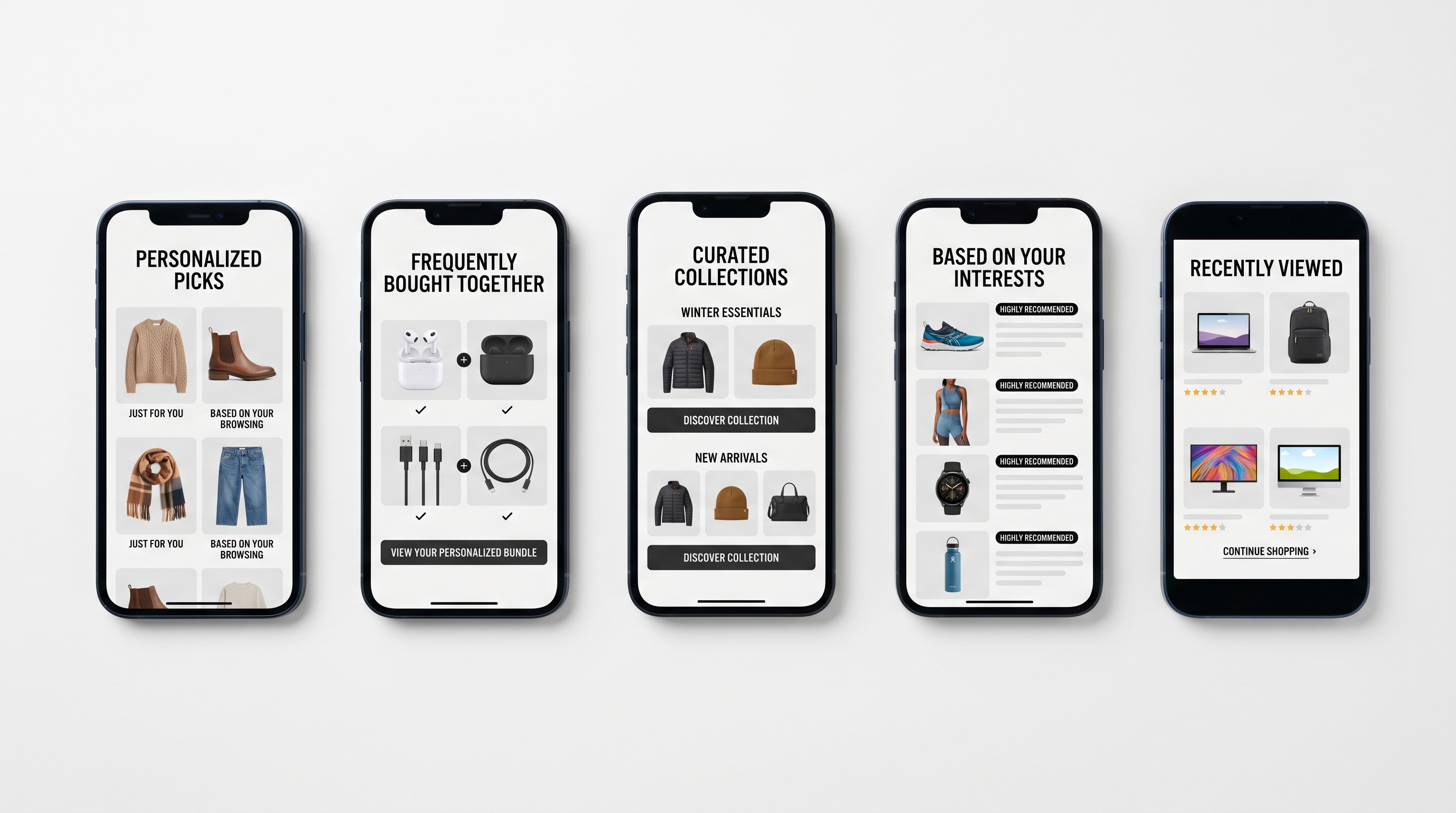
LimeSpot runs 12-plus recommendation types across two products. Turbo is the core engine: Frequently Bought Together, Recently Viewed, You May Also Like, and similar placements. Max adds audience segmentation, A/B testing, and email personalization. For a store doing 300 to 900 orders per month, LimeSpot Max at $50 to $150 per month is the most efficient Lift-stage investment available.
The setup is fast. You're placing recommendation widgets within a session, not a sprint. The AI learns from behavioral data and improves over time, though at lower volumes the learning curve is slower than at Rebuy scale. The verdict: LimeSpot earns its cost at volumes where Rebuy's minimum spend is not yet justified. It is a defensible asset on your P&L at the sub-1,000-order tier.
ATLAS use: Lift stage, primarily AOV through on-site recommendation placement.
Rank 3: Octane AI. Best for Zero-Party Data and Quiz-Driven Discovery
Cost: $50/month (Octane), $200/month (Octane Plus), $500/month (Enterprise). 14-day free trial.
Octane AI earns a separate ranking because it solves a different problem. Where LimeSpot and Rebuy optimize based on behavioral data (what customers did), Octane AI builds on declared data (what customers told you). A skincare brand asking shoppers about their skin type, concerns, and budget is building a first-party asset that feeds every downstream channel. email flows, ad audiences, CRM segmentation.
Octane's CORE-1 engine maps quiz answers to SKUs with improving accuracy over time. Their Klaviyo integration is clean: quiz responses flow as Smart Properties directly into Klaviyo profiles, enabling segmented flows immediately. Brands like Jones Road Beauty and ILIA have built significant revenue systems on this quiz-first architecture.
For stores in the $500K to $3M range with products that require discovery (supplements, beauty, wellness, apparel with fit complexity), this is the most underused Lift-and-Traffic tool available. One well-built quiz becomes a permanent data asset, not a sunk cost.
A word on the Abandon stage: Octane's zero-party data feeds your re-engagement campaigns with declared preferences, not just behavioral inference. Someone who told you they need a solution for sensitive skin gets a different abandon sequence than someone who browsed three moisturizers with no quiz completion. The segmentation depth is significant.
ATLAS use: Traffic (ad audience building), Lift (quiz-to-product conversion), Abandon (declared-preference retargeting).
Rank 4: Rebuy. Best for Stores Doing 1,000-Plus Orders/Month
Cost: Starter $99/month (1,000 orders), Scale $249/month (2,500 orders), Pro $499/month (5,000 orders), Grow $749/month (7,500 orders). 21-day free trial.
Rebuy is the market leader in Shopify upsell and cross-sell infrastructure. Its Smart Cart, AI-powered search, A/B testing, and post-purchase upsell tools are best-in-class when you have the data volume to train them. Rebuy accounts for more than half of all personalization app installs among stores that use personalization. That adoption rate is not an accident.
The critical boundary: Rebuy's value proposition compounds with order volume. Below 1,000 orders per month, the AI models don't have enough data to outperform manual merchandising rules. You're paying Starter tier pricing ($99/month) for a system that isn't fully loaded. That's a waste of capital.
Above 1,000 orders per month, the equation flips. The Smart Cart pays for itself through AOV lift. Rebuy's ROI guarantee and 60-day refund policy signal confidence in that math. Stores past $1M annual revenue where cart performance is a bottleneck should run Rebuy. Stores below that threshold should not.
Cost warning: Rebuy's modular pricing stacks fast. Recommendations, checkout upsells, and search are separate packages. A mid-size store adding premium support hits $600 to $800 per month before long. Model the total cost against your AOV improvement estimate before committing.
ATLAS use: Lift (cart AOV), Abandon (post-purchase offers), and partial Scale through A/B testing infrastructure.
Rank 5: Nosto. Enterprise Context Only
Cost: Custom pricing. Revenue share model typical at this tier.
Nosto earns a mention specifically to close the decision matrix. If your store is approaching or past $5M in annual revenue, Nosto's deep segmentation, multi-channel orchestration, and enterprise integrations become commercially viable. Below that, Nosto's cost structure and onboarding complexity are not justified by the return. This is a scale-stage tool. It does not belong in this article's primary target segment, but operators need to know the next rung on the ladder so they don't buy it prematurely.
Decision Matrix by Volume and AOV
| Order Volume | Recommended Stack | |---|---| | Under 200/month | Shopify Sidekick only | | 200-999/month | Sidekick + LimeSpot Max | | Quiz-driven product discovery (any volume) | Add Octane AI | | 1,000-5,000/month | Sidekick + Rebuy Starter/Scale | | 5,000+/month | Rebuy Pro/Grow + evaluate Nosto |
High AOV with complex product selection (over $80 AOV, 3-plus purchase decision factors): add Octane AI at any volume tier. The quiz data compounds. It is a balance sheet asset, not a monthly expense.
What This Is Not
This is not a sponsored ranking. No affiliate relationship exists with any of these tools. The ranking reflects one operator's verdict after applying the would-I-bet-my-own-money filter. Tools labeled "AI" that run static recommendation rules in month six the same as month one failed that filter. The five above have genuine machine learning that improves with data, documented pricing that won't surprise you, and track records with stores in this revenue range.
Adoption scales sharply with traffic. Only 1.4 percent of stores under 50,000 monthly visitors use personalization versus 57 percent of stores at 5 million-plus visits. The gap is not awareness, it's the mismatch between tool complexity and operator readiness. This ranking is the correction for that mismatch.
Doctrine Connection
Due diligence is non-negotiable. Picking a personalization tool by app store rating or competitor recommendation is optimism, not analysis. Map your order volume, identify your ATLAS stage bottleneck, and pick the tool built for that specific constraint. Every dollar spent on the wrong tool is a dollar not compounding in the right one.
Frequently Asked Questions
Q: Do I need a personalization app if I'm under 200 orders per month? A: Not immediately. Start with Shopify Sidekick, which is free, to understand your customer segments and behavioral patterns. Add a paid personalization tool when your monthly order volume gives the AI enough data to outperform manual merchandising. typically around 200 to 300 orders per month for LimeSpot, 1,000 for Rebuy.
Q: What is zero-party data and why does Octane AI's approach matter? A: Zero-party data is information customers give you voluntarily and consciously. quiz answers, preference surveys, self-reported attributes. Unlike behavioral data (what they clicked), zero-party data doesn't erode with cookie deprecation or attribution changes. It lives in your CRM as a permanent first-party asset.
Q: Is Rebuy worth it at 800 orders per month? A: Not yet. Below 1,000 orders, Rebuy's AI models don't have sufficient training data to outperform manual rules. LimeSpot Max at $50 to $150 per month is a better capital allocation at that volume. Revisit Rebuy at 1,000-plus.
Q: Can I run Octane AI and Rebuy together? A: Yes. They address different stages. Octane AI collects declared preferences at the Traffic and Lift stages. Rebuy optimizes cart and post-purchase at the Lift and Abandon stages. The two don't conflict; they compound. Many stores in the $1M to $3M range run both.
Q: What does "engage-through" personalization mean vs. behavioral AI recommendations? A: Behavioral AI (Rebuy, LimeSpot) uses what customers did. what they viewed, added to cart, or purchased. to surface recommendations. Engage-through personalization uses explicit signals from interactions (quiz completions, survey responses, social engagement) to personalize. Both are valid; the right weight depends on your product category and customer acquisition cost.
*Jeff Barnes is founder of DEMG.ai (Digital Evolution Marketing Group). He has no financial position in any company, tool, or platform named in this article. DEMG.ai provides marketing education and consulting services, not investment advice. Results described are illustrative and may not be typical.*