
Sabi Launches an AI Chief of Staff That Runs by Text — What It Gets Right
Sabi launched an AI chief of staff for small business founders with a constraint that most founders immediately recognize: they do not want another app. Co-founded by Stephen Diaz and Bruce Van Zyl, the San Diego company targets non-technical Gen X business owners who already run their business from their phone.
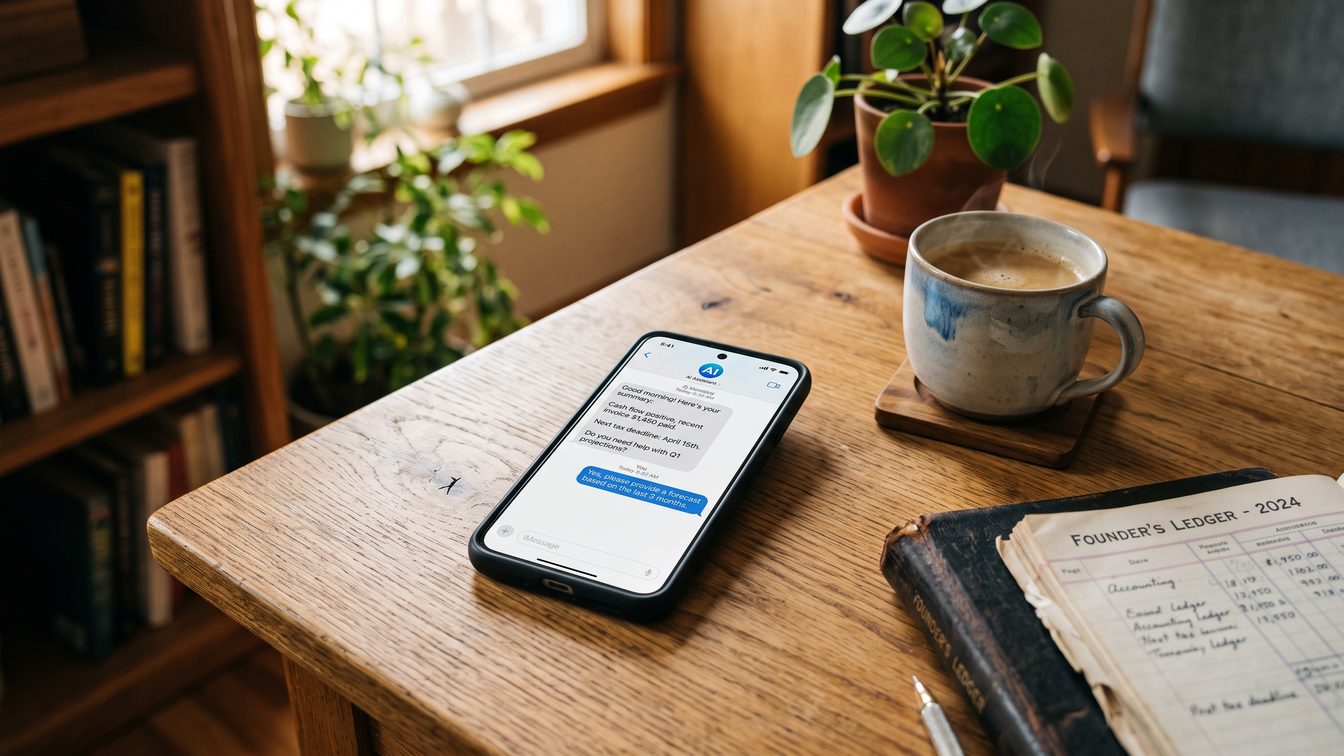
The interface is text message. iMessage. SMS. Not a dashboard. Not a mobile app that demands login and scroll. Just ask the AI chief what you need and get an answer back as text.
That is the first thing Sabi gets right.
The Interface Problem
Most AI applications assume the user has attention to spare. Open the app. Scroll. Refine the prompt. Wait for the response. But a founder running a service business—contractors, consultants, agencies, local retail: does not have that attention. They are in the field, on a call, or in a meeting.
They check text messages.
Sabi's SMS interface meets the founder where their phone already is. No onboarding friction. No new credential. Just text a question and get an answer back as a text. "What did I spend on payroll last month?" Response: PDF of the P&L texted back. "Schedule my 3pm call and send me a prep brief." Done. "What does my cash forecast look like?" Graph texted in under 30 seconds.
The cognitive load is zero. The founder does not need to remember where the AI lives or what interface to use. Text message is the default interface for every smartphone user on Earth.
The Features That Compound
Beyond the interface, Sabi built features that compound into real operating value. Inbox triage claims 80 percent reduction in inbox time. The AI reads incoming messages, categorizes by priority, and either answers (with approval) or surfaces context for the founder to handle.
Calendar scheduling includes prep briefs for each meeting. The AI reads the attendees, the topic, and your SOP notes, then surfaces what you need to know before you walk in.
But the real asset is persistent memory. Sabi learns your SOPs, your client notes, your decision patterns. Every interaction teaches the system more about how you operate. Night Shift re-reads your SOPs each evening and prepares a morning brief: the AI compounds context every day.
That is the inverse of every AI product that treats each conversation as stateless. Sabi builds a persistent operating system inside the founder's business.
Security and Architecture
A small business owner who texts financial data, calendar details, and client notes to an AI expects real security. Sabi uses Row Level Security per customer, OAuth to avoid storing passwords, and a deterministic approval gate: the AI never sends a message without explicit founder approval first.
The infrastructure runs on Supabase, Stripe, and DigitalOcean. SOC 2 compliance means security is not theater; it is hardened into the system.
For a founder running a $500K to $3M revenue service business, that security posture is table stakes. No cutting corners on client data or financial records.
The Economics
Sabi claims 1,100 hours per year saved per founder. At $150 per hour (rounded cost of founder time), that is $165K of value annually. The free internship plan lets founders try the system without friction. Paid plans presumably capture a fraction of that value creation.
The unit economics work. If a founder pays $50 to $200 per month for Sabi and captures 20 percent of the $165K annual value, that is $33K of net benefit. The math is clear.
But the real value is not the time saved. It is what the founder does with that time. Instead of tactical email triage and calendar management, they can focus on sales, client delivery, or team building. The margin uplift compounds from reinvestment.
What Owners Are Looking For
Service business owners think in operational terms. Do I have bandwidth? Is my team bottlenecked? Can I take on the next client? Can I scale without hiring?
Sabi answers those questions by compressing tactical work. The founder gets ten hours per month back. That is capacity for two more client projects per quarter. That is the expansion thesis owners care about.
Most AI products market themselves to the individual user: save time on your emails, write faster. Sabi markets to the owner: recapture business capacity, build a tighter operating system.
The Persistent Asset
Here is what most AI companies miss: the persistent data is the asset. Every founder SOP that Sabi learns. Every decision the AI sees and remembers. Every client note that trains the system.
If the founder ever sells the business, the AI operating system transfers with it. The new owner does not restart from zero; they inherit the decision log, the SOP documentation, the client context. That is unique value that does not exist in stateless AI assistants.
Ownership beats wages. An owner-operator who compounds their business into a system: documented, repeatable, transferable: has a business that multiplies in value at exit. Sabi is not just saving time. it is building the asset that transfers.
The Expansion Play
Sabi can expand vertically by adding more domains. Accountant chiefs of staff. Property manager chiefs of staff. Contractor chiefs of staff. Each vertical has different SOPs and different data sources, but the interface stays the same: SMS. The architecture stays the same: Row Level Security, persistent memory, approval gates.
The moat is not the technology. It is the interface adoption and the incumbent switching cost once the founder's operating system lives inside Sabi.
For a founder who has ingrained Sabi into their daily workflow: morning brief, inbox triage, evening recap: switching costs are real. Sabi becomes the operating system the business runs on, not an app the founder uses.
Getting Started
If you run a service business under $5M revenue and your bottleneck is tactical email, calendar, and financial data handling, Sabi's free internship plan is worth trying. Text the questions you actually need answered. See if the AI understands your operation.
Give it two weeks. During week three, the persistent memory starts paying dividends. By week four, you are seeing the morning brief and noticing patterns in your own decision-making that the AI surfaced. That is the inflection point where Sabi becomes a system, not a tool.
Q: Can I use Sabi if I already have a Slack workspace or other communication tool?
Yes. SMS is the default, but Sabi can integrate with Slack, email, and other channels. The persistent memory works across all interfaces. That said, the founder benefit is greatest when Sabi is the single interface. Adding more places to check dilutes the attention recovery. Stick with text.
Q: How long does it take for Sabi to understand my business?
Basic understanding happens in days: the AI can answer templated questions about your Stripe revenue or QuickBooks balance sheet immediately. But persistent memory: learning your SOPs, your decision patterns, your client names: takes two to three weeks of daily interaction. By week four, the morning brief becomes genuinely useful.
Q: What if my business is too complex for an AI chief of staff?
Complexity usually means more SOPs and more exceptions. That is exactly what Sabi learns. If your operation has 20 client types, 10 service offerings, and constant edge cases, the AI will take longer to be useful but will deliver more value once trained. The persistent memory compounds with complexity, not despite it.
Q: Will Sabi replace my actual staff?
No. Sabi removes tactical work: email reading, calendar scheduling, financial reporting: but not domain work. You still need a contractor for installations, a designer for client work, a bookkeeper for tax compliance. Sabi frees you to focus on those people and clients, not on administrative thrashing.
Q: Is there a risk that the AI learns my business secrets?
Sabi uses Row Level Security, which means your data never mixes with other customers' data, and OAuth prevents password exposure. The deterministic approval gate means sensitive messages require your explicit approval before the AI sends them. Security is baked into the architecture, not retrofitted.
Jeff Barnes has no personal position in any company named in this article. DEMG provides marketing systems, not investment advice.
The Interface Matters More Than Features
Most AI tools for small business fail on the same point. They require the founder to open another app. Learn another interface. Remember another login.
A 2024 survey by Capterra found that small business owners use an average of 5.4 software tools daily. Each tool adds cognitive load. Each login adds friction. The founder who runs their business from their phone between job sites, client meetings, and school pickups does not want tool number six.
Sabi solves this by meeting the founder where they already are. SMS. Not a dashboard. Not a web app. A text thread that looks identical to every other conversation on the phone.
The Night Shift feature is particularly worth watching. While the founder sleeps, Sabi re-reads SOPs, indexes new email, and prepares a morning brief. By 6 AM, the founder gets a text summarizing what happened overnight, what needs attention, and what is already handled. That is not a notification. That is a briefing, the same function a chief of staff performs in any scaled organization.
The Persistent Memory Advantage
The feature that separates Sabi from a generic AI chatbot is persistent memory. Every conversation, every decision, every correction compounds into a knowledge base specific to that business.
After six months of daily interaction, Sabi knows which clients are flagged, which vendor payments are sensitive, how the founder prefers to handle escalations, and which team members need more oversight. That is institutional knowledge.
At exit, that knowledge base becomes a transferable asset. A new owner inherits not just the business but the operating context that makes the business work. The persistent memory does not replace the founder. It captures what the founder knows so the replacement cycle is shorter and less costly.
The security architecture deserves mention. Per-customer Row Level Security, OAuth connections with no password storage, and a hard-coded approval gate that prevents any outbound action without explicit permission. These are not marketing features. They are the minimum standard for giving any AI access to a business inbox and financial data.