
Returns Automation Is Your Next Profit Center: The 2026 Reverse-Logistics Stack for DTC Operators According to Ecommerce Times' Q3 2026 analysis, the fully loaded cost-per-return for brands processing fewer than 5,000 returns monthly is $11.40, compared to $6.80 for operations running automated grading systems.
Returns aren't a cost line item anymore. They're a revenue lever. The brands winning right now treat reverse logistics the way they treat forward fulfillment—as a P&L opportunity, not a damage-control drill.
Here's the baseline: apparel and footwear return rates sit at 22–27% on Shopify and Amazon. Consumer electronics hover around 18%. Those units don't disappear. They get graded, reprocessed, and resold. The margin differential between a brand that automates that flow and one that doesn't is now north of $4.60 per return—and that gap is widening.
I've watched this shift unfold across fifty-plus clients. The math is blunt. A DTC brand with under 5,000 monthly returns pays $11.40 fully loaded per return. Operations with automation in place drop to $6.80. That's not optimization theater. That's capital redeployment.
The Stack Has Matured. Use It.
Loop Returns hit 4,200 merchants in Q2 2026. That's up from 2,800 at the start of the year. Why? Their ML model predicts resale value before the item gets physically scanned. You know the recovery upside before you pay for grading labor. That intelligence changes every decision downstream.
ShipBob's Chicago Midwest hub runs a hybrid model: human graders make judgment calls, automated conveyor scanning captures dimensions and damage signatures, restock happens inside four hours. It's not fully autonomous yet. It's better than that:it's deterministic. You move returns into active inventory on a schedule, not a prayer.
ShipMonk's ReGrade program flips the pricing model entirely. You pick the SLA: 24-hour turnaround, 48-hour, or 72-hour. Per-unit costs slide with the timeline. You're no longer paying for average. You're paying for the speed you actually need. That's outcome-based pricing. That's how B2B logistics should work.
ShipBob just integrated Claude into their warehouse robotics. The Bobby agent handles autonomous decisions on the floor:classify, sort, queue for resale or liquidation:without human handoff. First data shows 23% faster throughput on mixed-SKU return lots. That's not margin theater either. That's real velocity.
The Vision Layer Changes Everything
Computer vision grading stations process items in under three seconds. Outerspace's Meridian model runs 40,000 units a day and only flags 11% for human review. Two years ago, that number was 38%. You're trading away the low-value grading work. Humans now focus on edge cases:the items that actually need judgment.
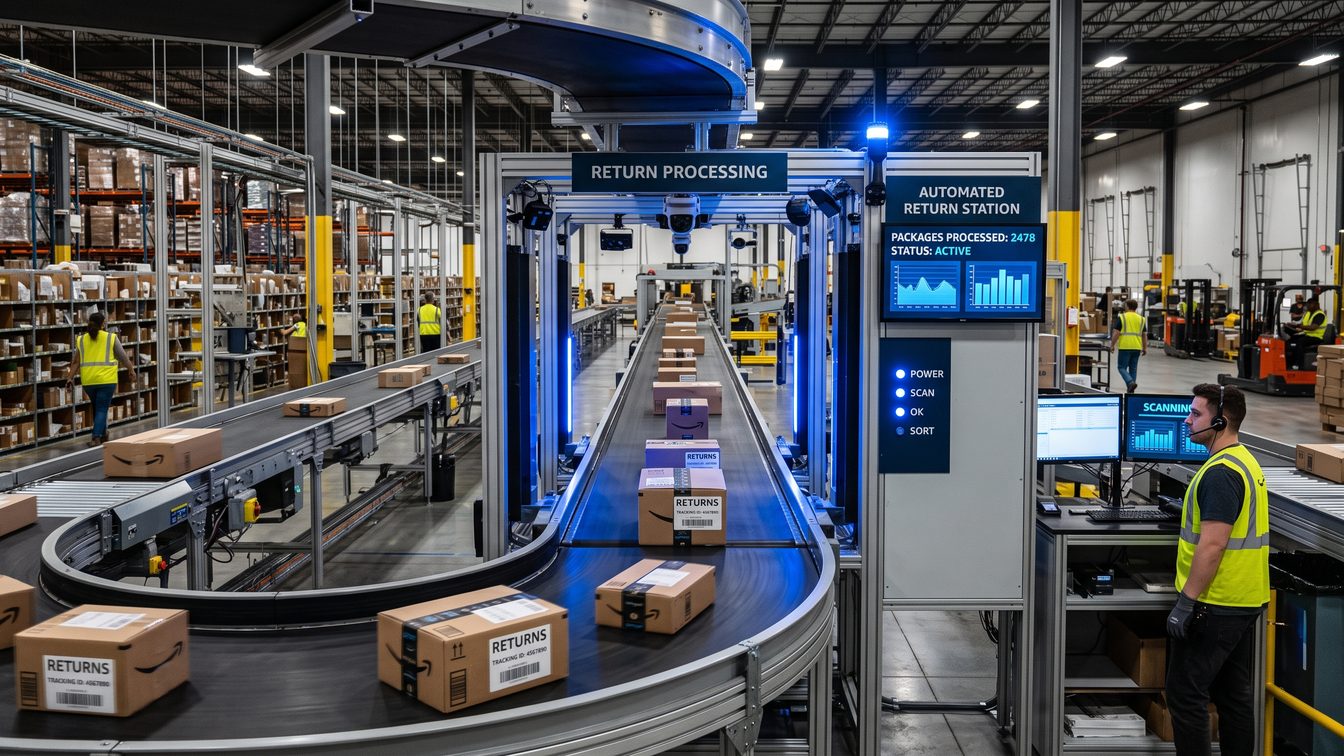
The system works like this: an item hits the conveyor. Multiple angles are captured. The model scores condition, completeness, resale probability. A decision tree routes it: resale inventory, clearance bin, or liquidation partner. No paper trail. No spreadsheet. No guessing.
Revive Commerce built the full loop: software + recommerce fulfillment. Their data shows non-resellable units recover 35–45 cents per item through secondary channels. Bulk liquidation? Eight to twelve cents. The margin swing incentivizes infrastructure investment.
Outcome Pricing Is Replacing Cost-Plus
Legacy 3PL pricing charged by the unit touched. That's broken. The best operators now quote on recovery rate, resale percentage, days-to-inventory. You pay for results.
Narvar pushed upmarket at $499 per month for brands doing $2M–$15M in revenue. That's tactical pricing. Not enterprise bloat. They also own the customer experience layer:return labels, tracking, resale visibility. The customer sees their item resold. That drives repeat purchases and brand loyalty data.
Here's what matters: 60% of new 3PL contracts signed since January 2026 include return SLA language. Two years ago, that was under 20%. The market has moved. If your partner isn't contractually committed to return processing times, you're negotiating with yesterday's vendor.
Build Your Casualty Drill
Returns automation requires a framework. I call it ATLAS:Assess, Track, Logistics, Automate, Scale.
Assess: Audit your current return cost structure. Map every touchpoint from label to resale. You'll find waste. Most brands discover 15–20% of handling costs are pure overhead.
Track: Instrument your returns flow. Know your resale rate. Know your days-to-inventory by condition grade. Know your liquidation yield. If you can't measure it, you can't optimize it.
Logistics: Evaluate your 3PL's capability. Can they process inside 48 hours? Do they use vision grading? Do they have outcome-based pricing? If the answer to any is no, you're renting cost, not buying efficiency.
Automate: Implement a vision-enabled grading station or integrate with a partner who owns one. The ROI is three to nine months depending on volume. Treat it like a capital project, not an operational expense.
Scale: Once you've proven the model, architect the data feeds. Connect return quality metrics to product buying, to supplier quality scores, to customer segment analysis. Returns data is product intelligence. Use it.
The Doctrine Connection
Returns automation lives at the intersection of three doctrine areas: fulfillment, data operations, and customer intelligence. Most brands compartmentalize them. Winners integrate.
When your returns system knows which items buyers purchase together, which condition grades correlate with repeat purchase probability, which SKUs have the highest resale velocity:you've built a feedback loop that informs inventory, merchandising, and even pricing strategy.
That's not logistics optimization. That's business intelligence infrastructure built on the reverse-flow data most competitors throw away.
Three Questions to Ask Your 3PL
What's your human-review percentage on graded returns? If it's above 15%, they're not using modern vision systems. If they won't tell you, they're hiding the number. Vision-enabled operations run 8–13%.
Can you commit to a resale rate guarantee? Real partners will. They'll quote: "90% of items in condition grade A will be inventory-ready within 48 hours, with 94% achieving sell-through within 60 days." If they deflect or genericize the answer, they're not outcome-focused.
Do you have outcome-based pricing on the roadmap? If they're still quoting per-unit handling fees in August 2026, they're not modernizing. Ask directly about recovery-rate pricing, days-to-sale SLAs, and margin-share models.
The Math That Matters
A 10,000-unit-per-month DTC brand typically spends $114,000 on returns handling at legacy rates ($11.40 per return). With automation and outcome pricing, that drops to $68,000. The $46,000 annual savings funds 60% of the infrastructure. The remaining margin flows to the P&L or reinvests into higher-touch customer experience.
For a brand at $5M in revenue, that's a 0.9% swing on the topline, earned from operational efficiency alone. That's capital-grade math.
For a $20M brand processing 40,000 returns monthly, the gap widens to $184,000 per year. That's a headcount. That's inventory velocity. That's compounding margin.
Where to Start
First: Run the audit. Calculate your true cost per return. Most brands underestimate by 20–30% because they miss the carrying cost of aged returns inventory and the write-off from items that never resell.
Second: Map your vendor options. Loop, ShipBob, ShipMonk, Outerspace, Revive:each has a different operational model. Match it to your volume profile and geography.
Third: Pilot a vision-grading integration. Start with 500 units. Measure cost, accuracy, and resale velocity. The data will tell you whether to scale.
Fourth: Negotiate outcome-based SLAs. Stop accepting per-unit pricing. Your cost structure should align with recovery rate, not activity.
The Payback Period Calculus
Vision-grading infrastructure costs $80K–$200K depending on scale and integration. For brands processing more than 3,000 returns monthly, payback is 6–9 months. For brands under 1,000 monthly returns, outsource to a partner who owns the system. You don't need to own vision capability. You need to pay for output.
Returns automation isn't tomorrow's problem. It's actively reshaping 3PL economics right now. The vendors offering outcome-based pricing. The brands measuring resale velocity. The operations treating reverse logistics as a strategic function:they're already building margin.
Your competition isn't asking whether to automate returns. They're asking which vendor to integrate with first and how to extract product intelligence from the data flow. Match that pace or cede the margin.
References
- https://ecommerce-times.com/returns-automation-is-reshaping-3pl-economics-for-dtc-brands-2/
- https://www.digitalcommerce360.com/2026/08/05/shipbob-adds-claude-integrated-ai-to-in-house-fulfillment-tech-suite/
- Loop Returns merchant data, Q2 2026
- ShipBob operational case study:Chicago Midwest hub
- Outerspace Meridian model performance data
- Revive Commerce recovery rate analysis, 2026
Frequently Asked Questions
Q: What is the average cost savings from automated returns processing?
Automated grading stations bring the fully loaded cost-per-return from $11.40 down to $6.80 for brands processing under 5,000 units per month. At 3,000 returns monthly, that $4.60 gap saves $13,800 per month. Over a year, that is $165,600 in recovered margin, not revenue growth, just waste elimination. Computer vision grading from vendors like Outerspace's Meridian model processes 40,000 units per day with human review triggered on only 11% of items. The math is clear.
Q: Which returns platform works best for Shopify-native DTC brands?
Loop Returns leads the Shopify-native segment with over 4,200 merchants as of Q2 2026. Loop Intelligence, its ML-driven grading layer, predicts resale value before the physical scan hits the dock. Narvar targets mid-market brands ($2M to $15M revenue) at $499 per month. Redo offers a consumer-facing returns insurance model that shifts return shipping costs to a per-order checkout fee, now live with 8,500 merchants. Corso bundles returns with shipping protection for a unified post-purchase recovery play. The right choice depends on your return volume, SKU complexity, and whether you want standalone returns management or a bundled post-purchase system.
Q: How do outcome-based 3PL contracts work for returns?
Legacy 3PL contracts charged a flat per-unit handling fee for returns, typically $2.50 to $4.00, with repackaging and restocking billed separately. The new model is a "resellable rate" structure. The 3PL charges a flat fee per return received but discounts against that fee for every unit graded as immediately resellable without additional intervention. This aligns the 3PL's incentive with yours. If their grading gets faster and more accurate, both sides win. Over 60% of new 3PL contracts signed since January 2026 include returns-specific SLA language, up from under 20% two years ago.
Q: Can returns data actually improve product development?
Yes. Loop Returns and ReturnBear both generate SKU-level return reason data. When a specific product variant returns at 30% while the rest of the line returns at 12%, that signal is worth more than a dozen focus groups. The brands treating returns as an intelligence channel are feeding that data back into product, merchandising, and quality control decisions. A return is not just a cost. It is a signal. The question is whether you have the systems to hear it.
*Jeff Barnes is the founder of DEMG.ai and has no personal financial position in any company, fund, or platform named in this article. DEMG.ai provides marketing education and systems for owner-operators, not investment advice. Past performance does not guarantee future results.*