
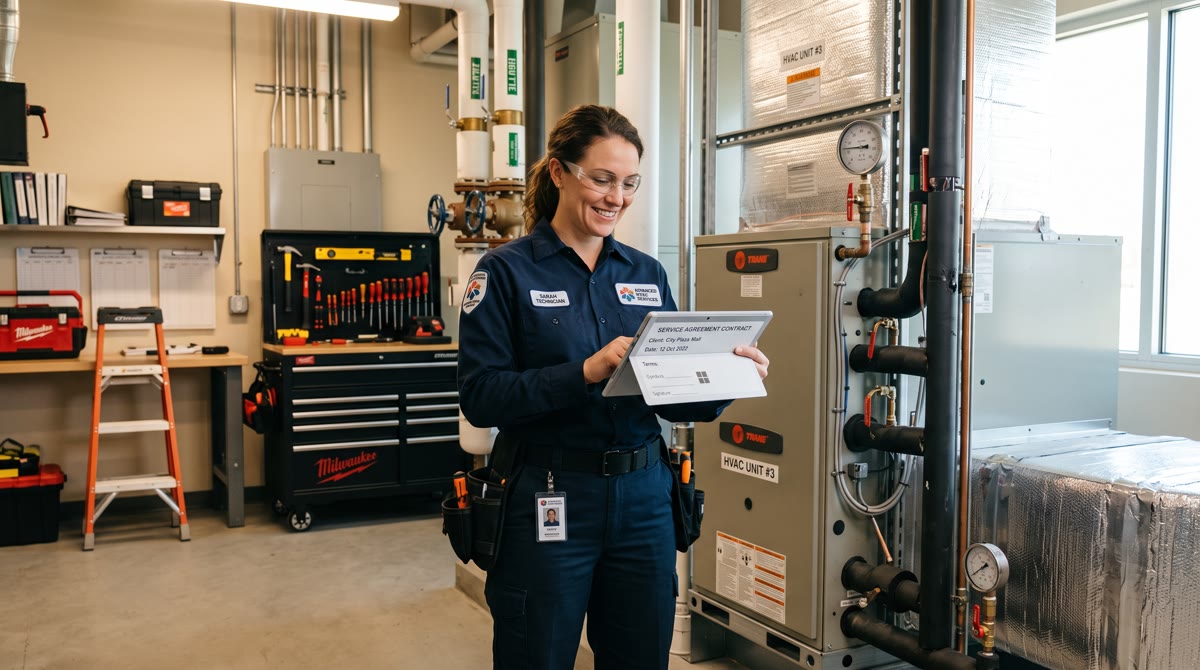
Recurring service agreements are the single biggest lever you control before a sale. According to CT Acquisitions' 2026 HVAC valuation analysis, Push multi-year maintenance contracts past 30% of total revenue and buyers pay 1-2 full turns more EBITDA for the same business. That is the difference between a 3x SDE sole-operator exit and an 8x EBITDA platform acquisition. This article breaks down the exact valuation tiers, the mechanics behind the premium, and the 90-day plan to build agreement density before you ever talk to a buyer.
Why Owners Sell the Wrong Asset
Most home services owners think they are selling equipment, trucks, and a customer list. Wrong. Buyers are pricing one thing: predictable future cash flow they don't have to fight for every year.
When I was scouting innovations at Hartford Steam Boiler, I learned one thing: the service contract IS the asset. The equipment is the delivery vehicle. HSB didn't insure boilers because boilers were interesting. HSB insured boilers because a signed contract meant a predictable, recurring revenue stream with known risk. Buyers of your HVAC, plumbing, or pest control business are running the same math. They are not paying for your condensers. They are paying for the contracts that guarantee someone services those condensers next year, and the year after, without a marketing dollar spent to win the job again.
This is the core doctrine: ownership beats wages. A technician earns a wage for one job. An owner who builds a recurring agreement book earns equity value for every future job that contract guarantees, whether they personally show up or not. That's the shift from operator income to sellable enterprise value.
The Owner's Exit Engine: How Multiples Actually Move
I call this framework The Owner's Exit Engine because it treats your valuation multiple as a machine with inputs you can pull, not a number handed down by the market. Three inputs matter most, and recurring agreement density is the biggest one you can move in a single year.
Input 1: Revenue Size. Scale alone moves your multiple. According to CT Acquisitions' 2026 HVAC valuation data, sole-operators under $1M in revenue trade at 3.0x-4.5x SDE. Established businesses between $1M-$3M command 4.0x-5.5x SDE, or 4.5x-6.5x EBITDA once you cross into EBITDA-based pricing. Mid-size operators between $3M-$10M see 5.5x-8.0x EBITDA. PE-platform-ready businesses above $10M command 8.0x-12.0x EBITDA. Calder Capital's Q1 2026 market update puts general services SDE multiples in a similar 3.0x-5.5x band for smaller operators, confirming the pattern across categories.
Input 2: Recurring Agreement Density. This is the lever with the fastest payback. CT Acquisitions' analysis found that service-agreement density adds a straight +0.5x-1.5x EBITDA premium. Cross 30% of total revenue from multi-year maintenance contracts and that premium becomes the single largest lever in your valuation, worth 1-2 full turns of EBITDA on its own. No other operational change moves the multiple that fast.
Input 3: Platform Readiness. Buyers pay up for businesses that plug into a platform with zero integration risk. CT Acquisitions' research shows technician retention below 15% annual turnover, multi-license coverage across trades or states, and geographic clustering, meaning multiple locations inside one MSA, each add value. Clustering alone adds 0.5x-1.0x EBITDA because it lets a PE platform absorb your business without opening a new market.
Here's what those three inputs look like stacked by tier.
| Revenue Tier | Base Multiple | With 30%+ Agreement Density | With Clustering + Low Turnover | |---|---|---|---| | Sole-operator (<$1M) | 3.0x-4.5x SDE | 3.5x-5.5x SDE | Rarely reaches this tier | | Established ($1M-$3M) | 4.0x-5.5x SDE / 4.5x-6.5x EBITDA | 5.5x-7.5x EBITDA | 6.0x-8.0x EBITDA | | Mid-size ($3M-$10M) | 5.5x-8.0x EBITDA | 6.5x-9.0x EBITDA | 7.0x-9.5x EBITDA | | PE-platform-ready ($10M+) | 8.0x-12.0x EBITDA | 9.0x-13.0x EBITDA | 9.5x-13.5x EBITDA |
Read that table by tier, not by row in isolation. A $2M revenue HVAC business with weak agreement density sits at the bottom of its band, maybe 4.5x EBITDA. The same $2M business with 30%+ of revenue locked into multi-year maintenance contracts jumps toward 6x-7x EBITDA. On $400K of EBITDA, that's the difference between a $1.8M exit and a $2.6M exit. Same trucks. Same technicians. Same customer list. Different contract structure.
What Actually Counts as a Service Agreement
Buyers scrutinize this line item harder than any other in due diligence. Not every recurring charge counts equally.
A month-to-month pest control plan with no term commitment is weak recurring revenue. It churns like any other transaction, just billed differently. A multi-year HVAC maintenance agreement with auto-renewal, a defined service scope, and a price escalator is strong recurring revenue. It survives an ownership change because the customer signed a contract with the business, not a handshake with your lead technician.
Three questions determine whether your agreement book actually moves your multiple.
First, is there a written term longer than 12 months? Annual auto-renewal counts. Month-to-month does not.
Second, is the agreement tied to the business entity, not a specific technician? If customers leave when their favorite tech leaves, you don't have a contract asset. You have a personality-dependent revenue stream that a buyer will discount hard.
Third, does the agreement generate its own follow-on revenue? Maintenance visits that surface repair and replacement opportunities compound the value of every contract you sign. A buyer models that follow-on revenue into the price.
There's a fourth question buyers ask that owners rarely anticipate: how concentrated is the agreement book across customers? A $3M HVAC business where the top ten commercial accounts hold 60% of agreement revenue looks recurring on paper but carries real customer concentration risk. Lose two accounts and the "recurring" number collapses. Buyers price that risk into the multiple just as hard as they price the upside of strong density. Spread your agreement revenue across hundreds of residential accounts instead of a handful of commercial ones, and the recurring label actually holds up under stress testing.
Why Agreement Contracts Beat Even Strong Repeat-Customer Rates
Owners sometimes push back here. "My repeat customer rate is already 70%. Isn't that the same thing as a service agreement?" No, and the distinction matters more than most owners think.
A repeat customer is a behavior. A service agreement is a contract. Behavior can change without warning; a loyal customer of eight years can get a postcard from a competitor and switch next season with zero friction. A signed multi-year agreement creates switching cost. The customer has already paid, or committed to pay, for services they haven't received yet. Breaking that commitment requires an active decision, not a passive one. Buyers underwrite contracts because contracts are binding. They underwrite repeat-customer rates as a soft signal at best, because a rate is just history repeating itself until the day it doesn't.
This is why two businesses with identical revenue and identical repeat-customer percentages can land in different valuation tiers. The one with agreements in writing gets the premium. The one with loyalty and a handshake gets a footnote in the diligence report.
The 90-Day Plan to Build Agreement Density
You don't need two years to move this number. You need a focused campaign and the discipline to price agreements correctly.
Days 1-30: Audit and price your existing agreement book. Pull every customer with a service history and segment by contract status. Most owner-operators find 10%-15% of revenue is technically recurring but priced too low to be profitable, let alone attractive to a buyer. Reprice new agreements to reflect actual visit cost plus margin, not a legacy number from five years ago.
Days 31-60: Convert your best repeat customers first. Target customers who've called twice in 18 months without a contract. They've already proven demand. Offer the agreement at point of service, not as a separate follow-up campaign. Conversion rates drop by more than half once the truck leaves the driveway.
Days 61-90: Build the agreement into every new install. Every new system sale should include a maintenance agreement as a default line item, not an upsell. HVAC installs, water heater replacements, and major plumbing repairs are your highest-use moments to lock in five to ten years of recurring visits from a single sales conversation.
Track one number weekly during this window: agreement revenue as a percentage of trailing 12-month total revenue. That single number is your Exit Engine dashboard. Everything else is noise.
Why 25+ PE Platforms Are Chasing This Number Specifically
This isn't theoretical. More than 25 PE-backed platforms, including Apex, Wrench, Sila, and ARS, are actively acquiring home services businesses across HVAC, plumbing, and adjacent trades. Every one of them runs the same underwriting model. They pay for predictable cash flow they can bolt onto an existing platform without rebuilding demand generation from zero.
A business with 35% agreement density hands a platform buyer a built-in retention engine on day one. A business with 5% agreement density hands them a book of one-time transactions they have to re-win every year with paid marketing. Ownership beats wages because the owner who built the contract book gets paid once, at a premium multiple, for years of future work the buyer now owns. The technician who did the work gets paid once, for the hour they were on-site.
These platforms aren't buying one business at a time and stopping. They're rolling up fragmented trades market by market, and every acquisition needs to justify itself against the platform's existing base rate of return. A high-density agreement book clears that bar faster than almost any other asset an owner-operator controls, which is exactly why the premium exists and why it's holding steady even as smaller, transaction-only businesses see softer demand.
The Bottom Line
Your multiple is not fixed by your trade, your market, or your size alone. It moves with agreement density faster than any other input you control. Cross 30% of revenue from multi-year maintenance contracts and you're not negotiating from the bottom of your tier anymore. You're negotiating from the top of the next one up.
FAQ
How long before agreement density shows up in a valuation? Buyers typically want 12-24 months of trailing agreement revenue to trust the number. Start the 90-day plan now and you'll have a credible trailing history by the time you're ready to go to market in 18-24 months.
Does agreement density matter if I'm not planning to sell? Yes. Recurring agreements smooth cash flow, reduce your dependence on lead generation spend, and increase per-technician productivity. The valuation premium is a side effect of running a healthier business.
What's the minimum agreement penetration worth pursuing? Below 15%, buyers largely ignore it. Between 15%-30%, you get partial credit. Above 30%, you open the full 1-2 turn EBITDA premium CT Acquisitions documented across HVAC transactions.
Do all home services verticals see the same premium? HVAC and pest control see the clearest data because maintenance visits are built into the product. Plumbing and electrical can build agreement density too, typically through annual inspection and priority-service plans, though penetration tends to run lower across the category.
Should I discount agreements to hit 30% faster? No. A buyer's diligence team will unwind underpriced agreements and discount your EBITDA accordingly. Price for margin first. Volume follows a correctly priced offer faster than most owners expect.
*Disclosure: This article was researched and drafted with AI assistance as part of demg.ai's editorial process. Valuation figures are sourced from CT Acquisitions (https://ctacquisitions.com/hvac-business-valuation-multiples-explained/) and Calder Capital's Q1 2026 Market Update (https://www.caldergr.com/q1-2026-market-update/). This is general market commentary, not individualized valuation, financial, tax, or legal advice for your specific business. Consult a qualified M&A advisor and CPA before making decisions about a sale or recapitalization.*
*Jeff Barnes, MBA holds no personal position in any company or fund named in this article. demg.ai provides marketing education and systems for owner-operators, not investment advice.*