
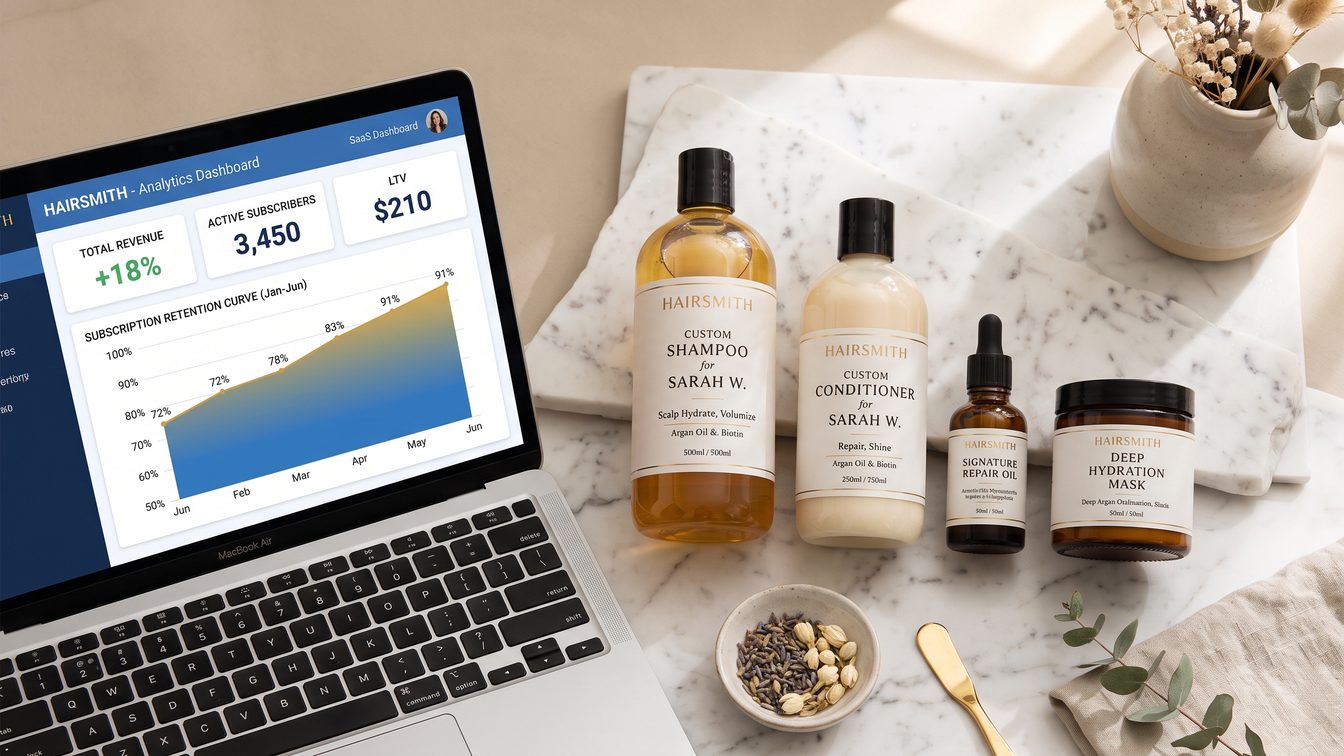
Prose Proves 65% Twelve-Month Retention — AI Personalization Is the Only DTC Moat Left
Prose hits 65% subscription retention at twelve months. Most DTC beauty brands run 40-55%. That 20-point gap is not a marketing win—it is a math problem solved.
The moat is not the brand. It is not the bottle. It is the data model that learns what your hair needs before you do. Prose's 25-question consultation harvests climate, stress history, treatment data, and behavioral signals. Over 2M customer records feed the ML layer. That corpus predicts formulas for new customers with precision that first-order CAC cannot match.
This is how retention becomes an asset. When 22% of subscribers upgrade within six months, you are not selling hair care. You are compounding formula precision. Each customer interaction funds the next customer's acquisition cost.
The economics are visible. LTV/CAC sits above 4:1 on pre-2023 cohorts. Subscribe & Save runs 15% discount. Custom Lab costs $20 monthly for adjustments. Gross margins hold 52-58% despite manufacturing intensity. Those are the numbers of a brand with pricing power.
The Data Moat Gets Wider
Prose runs a product flywheel that most DTC operators miss entirely. CMO Megan Streeter, recruited from Glossier, shifted customer acquisition from Meta (now $85-110 first-order CAC post-ATT) to TikTok transformation content. Cheaper channel. Proof-of-work that the product works. That content machines the consultation funnel.
But the real engine is what happens after the first order. The consultation data flows into the ML layer. The layer learns. The next customer gets a better formula prediction. The next retention cohort compounds.
L Catterton and Sequoia Scout backed it. Not for brand story. For the data asset and the path to scaled manufacturing. Prose plans European production 2027-2028. That is capital-formation thinking: build repeatable operations at volume, then exit or acquire downstream.
Your DTC Brand Does Not Need Prose-Scale Manufacturing
You cannot out-Prose Prose. That is not the play. The play is what Prose proves: data beats advertising spend.
For DTC operators under $5M topline, the moat is a consultation system that gathers behavioral data and uses it to make the second order easier than the first. You do not need a hair lab. You need to know what your customer returns for. That is the retention machine.
Most DTC brands see 40-55% twelve-month retention because they treat the first order and the second order as separate problems. Prose treats them as one system. The consultation is not lead capture. It is the foundation of the customer value model.
What does that look like in practice?
Start with a lightweight consultation. Not 25 questions. Maybe 5-7 that capture the core driver of repurchase. If you sell skincare, ask about water quality and sun exposure and seasonal changes. If you sell coffee, ask about brewing method, water temperature, flavor preferences, and caffeine sensitivity. If you sell supplements, ask about dietary gaps, goals, and biomarkers you actually measure.
Then instrument the repeat. When customers reorder, ask why. Did the formula not deliver? Did taste preferences shift? Did they run out? Did they forget? Each reorder is a chance to predict the next ask.
Then test variants against the cohort. If your data says customers with hard water + sensitive skin + seasonal flare-ups prefer formula X, test whether formula X actually raises LTV. If it does, you now have a compounding system. Each cohort teaches the next.
That is the retention asset. Not the brand. Not the bottle. The system.
The CAC Trap and Why Retention Beats It
Prose's CAC climbed post-ATT like every D2C brand. Meta first-order now runs $85-110. TikTok helps, but the unit economics only work because retention compounds the value.
Most DTC operators chase CAC reduction like it is the driver. It is not. Retention is the driver. If you retain at 65% year-one and compete on formula precision, a $110 CAC is a discount relative to what you compound.
The math is simple. If CAC is $110 and LTV is $500+, the customer pays for acquisition by month three. Everything after month three is margin. At 65% retention, your customer lives 18+ months. That is a 2-3x spread between CAC and total contribution.
Brands running 45% retention with the same CAC are dead in the water. They need to cut CAC or raise LTV. Both are hard. Prose chose to raise LTV through retention because the data model enables it.
Doctrine Connection: Systems Beat Slogans
Prose is a system business posing as a brand business. The brand is the Trojan horse for the system. Customers think they are buying personalized hair care. They are buying into a feedback loop. Every order updates their profile. Every profile teaches the formula model. Every model improves the next customer experience.
That is not marketing. That is operations. It is doctrine.
Your brand story is not a moat. Your ability to learn and predict faster than your customer's next purchase is a moat. Prose proved it. Now the question is whether you build your own system or get price-competed by someone who does.
FAQ
Q: Do I need 2M data records to compete with Prose? No. You need a system that learns from 50 records and makes each customer experience better than the last. Start small. Build the feedback loop. Scale the data as you scale the brand.
Q: How do I convince customers to answer 5-7 consultation questions instead of just buying? Make the consultation do work they want done. If you sell skincare, the consultation tells them which product solves their problem. If you sell coffee, it recommends a grind and brew method. The consultation is not friction. It is proof that you understand their problem better than they do.
Q: What if my product is not customizable like Prose's formula? Retention still compounds. The question is what you learn from each repeat purchase. If you sell shoes, you learn fit preferences and style evolution. If you sell food, you learn taste drift and dietary changes. Use that data to recommend adjacent products or predict churn. The moat is the prediction engine, not the customization.
Q: How long before this retention system pays off? Cohort-level payoff takes 6-12 months. Month one is acquisition and the first order. Months two through twelve show whether the system actually improves retention. If it does, you have a compounding asset. If it does not, you have a very expensive CRM.
Jeff Barnes has no personal position in any company named in this article. DEMG provides marketing systems, not investment advice.
The Subscription Economics
The math behind Prose clarifies why AI personalization changes DTC unit economics. A standard DTC beauty brand loses 55-60% of first-time buyers within twelve months. Prose loses 35%. That gap, applied across a customer base, compounds into fundamentally different revenue trajectories.
Consider a cohort of 1,000 buyers acquired at $95 CAC each (the midpoint of Prose reported Meta CAC range). At industry-average 45% retention: 450 remain at month 12, roughly 200 at month 24. At Prose 65% retention: 650 remain at month 12, approximately 420 at month 24. The second cohort generates more than double the lifetime revenue on the same acquisition spend.
According to Recharge subscription commerce data, the median DTC subscription brand sees 42% twelve-month retention. Prose sits 23 percentage points above that median. The delta is not marketing. It is product architecture.
The Custom Lab membership at $20 per month adds a second revenue stream on top of product purchases. Twenty-two percent of subscribers upgrading within six months means roughly 1 in 5 buyers becomes a dual-revenue customer. That changes the LTV curve from linear to compounding.
What This Means for DTC Brands Under $5M
You do not need a Brooklyn factory and a 25-question consultation to apply this model. You need three things.
First, a data capture mechanism that learns something real about each customer at point of first purchase. Not a preference quiz that maps to four segments. A data point that genuinely changes what the customer receives next.
Second, a recommendation engine that uses purchase history and captured data to improve the next offer. McKinsey research on personalization found that companies growing faster drive 40% more revenue from personalization than their slower-growing counterparts.
Third, a subscription structure that rewards staying. Not just a discount. A genuine improvement in the product or service the longer the customer remains. Prose calls this "formula adjustments." Your version might be priority access, custom configurations, or accumulated purchase credits that expire on cancellation.