
Direct Answer
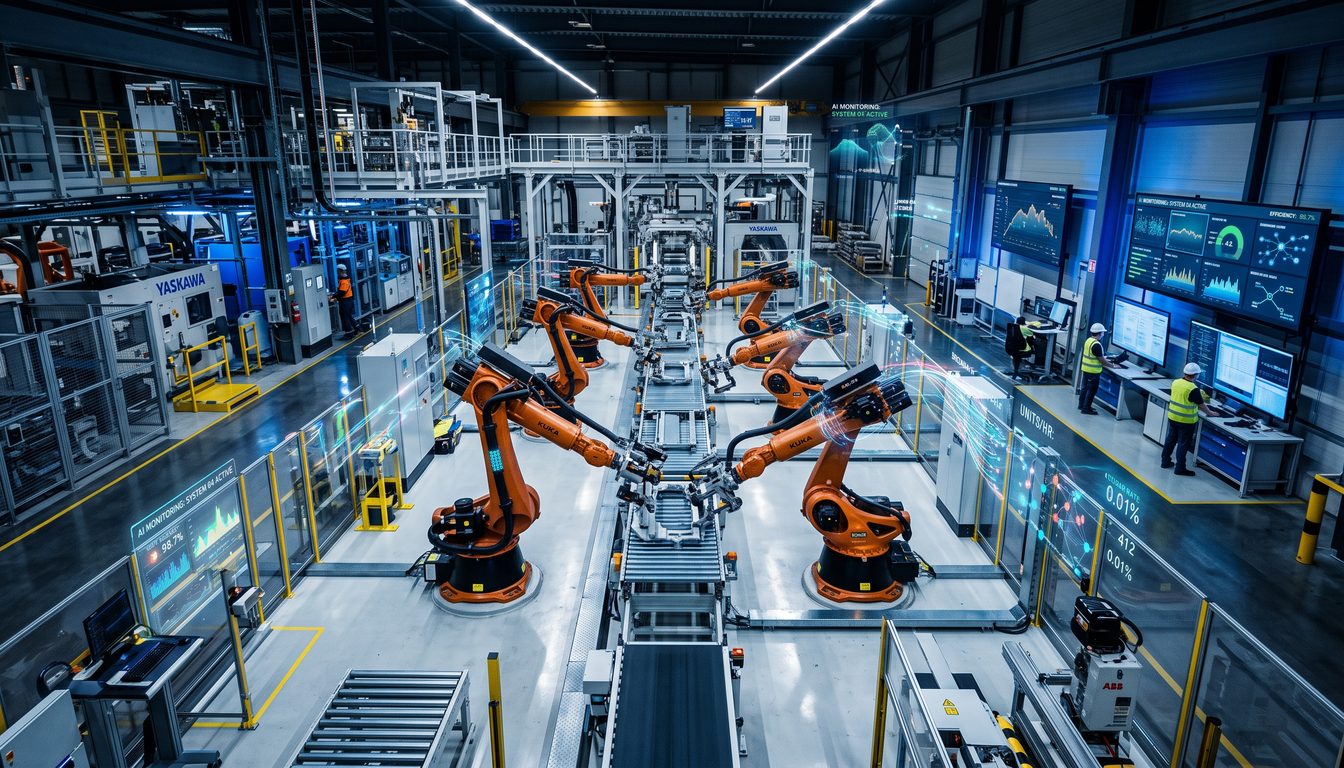
Private equity firms are treating AI automation as a core value-creation lever, not a bolt-on cost cut. MiddleGround Capital, an industrial-focused PE firm, has built an internal AI application that compiles operational data from portfolio companies to speed up decisions and flag anomalies before month-end reports arrive. This is the standard buyers now expect. B2B SaaS founders preparing for exit need the Owner's Exit Engine, a framework for building AI infrastructure that survives due diligence and commands a premium multiple. According to PE Professional, automation deployed during a PE hold period tends to persist because cost savings outweigh maintenance costs.
A documented automation roadmap signals systematic value creation. An undocumented one signals a business that only works because the founder is in the room.
Why PE Firms Changed the Rulebook
For most of private equity's history, automation was a tactical afterthought. Replace old equipment, trim costs, move to the next deal [1]. That approach is now out of step with how firms underwrite and manage industrial and software portfolios.
MiddleGround Capital's John Stewart put it directly: automation is becoming a core lever of value creation, one that shapes performance long after the initial investment closes [1]. The firm's automation division, launched in 2022, now runs 11 specialists who evaluate opportunities before an acquisition even closes [2][3].
That is the shift founders need to internalize. PE firms are no longer asking whether a target has automation. They are asking whether the automation is systematic, documented, and durable enough to survive a change of ownership [4].
This is not a manufacturing-only trend dressed up in software language. It is a change in how every sponsor underwrites every deal, across every sector where operations can be measured, monitored, and improved with data.
The Data Point That Should Worry Unprepared Founders
MiddleGround completed the first phase of an automated forging-press installation at a Race Winning Brands facility in Ohio. The firm expects the project to generate roughly $9 million in equity value creation [1][4].
A separate wristpin-machining automation project cost about $100,000 in capital expenditure and produced an estimated $1.27 million in enterprise value creation, a return north of twelve times the outlay [3].
Those are manufacturing examples, but the underlying logic transfers directly to B2B SaaS. Buyers price a business on what survives the sale, not on what the founder can personally sustain.
A $100,000 investment that returns twelve times its cost, documented and repeatable, is the exact story a SaaS founder needs to tell about their own automation stack. The number matters less than the paper trail behind it.
AI as the New Operating Layer
Stewart describes MiddleGround's internal AI system as one designed to pull operational data from portfolio company systems and turn it into usable insight [1][4]. The goal is not to replace hands-on management. It is to make oversight faster and more precise.
Traditional reporting cycles are too slow. A monthly financial pack can arrive well after a labor efficiency problem or an inventory imbalance has already cost real money [1]. AI-enabled monitoring closes that gap by flagging anomalies close to real time.
Industry advisers are converging on the same view from different angles. HatchWorks AI argues that embedding AI within portfolio companies can modernize operations and create defensible intellectual property [4]. Digital Alpha has argued AI-driven transformation can expose hidden EBITDA and accelerate returns [4].
Brownloop focuses on unifying portfolio data so leadership teams spot trends earlier [4]. Three firms, three angles, one conclusion. AI is moving from a nice-to-have narrative to infrastructure that buyers price directly.
Jeff's Anecdote: The Manual That Made the Deal
When I built systems at Angel Investors Network, every process had a manual. Every manual had a checklist. It felt like overkill at the time. It was not.
When a PE firm eventually looked at the operation, they did not ask me to walk them through how things worked. They read the manuals. They watched the checklists execute themselves, without me in the room, without me on the call, without me anywhere near the building.
That is what makes a business acquirable. Not the founder's expertise. The proof that the expertise has been extracted from the founder's head and written into a system that runs without him.
A business a buyer can operate without you is a business a buyer will pay for. A business that collapses without you is a job with a fancy title, not a company. That distinction decided how that deal got priced.
The Owner's Exit Engine
The Owner's Exit Engine is a four-part framework for building the AI and automation infrastructure that survives diligence and moves the multiple.
Engine One: Underwrite Automation From Day One. Stewart argues automation should be built into the investment thesis from the start, not bolted on after the deal closes [1][4]. A SaaS founder should do the same with their own roadmap. Automation gains belong in the same forecast as pricing actions and expansion revenue, not a separate slide nobody diligences.
Engine Two: Build the Data Layer Before the Deal Team Asks. Buyers want a single source of truth: labor efficiency, utilization, churn signals, support load. MiddleGround's own AI system exists to compile exactly this kind of data automatically instead of waiting for a monthly report [1][4]. A SaaS founder who can hand a buyer live dashboards instead of static spreadsheets wins the diligence argument before it starts.
Engine Three: Document the Roadmap, Not Just the Result. A business with a documented automation roadmap, a clearer data environment, and a credible pipeline of future initiatives looks more scalable to buyers [1][4]. It signals value creation is systematic, not opportunistic, with room for the next owner to keep scaling.
Engine Four: Prove It Runs Without You. This is the manual-and-checklist discipline. Every AI workflow, every automation, every escalation path needs to be documented well enough that a new operator could pick it up without a handoff call. Buyers do not pay for founder-dependent systems. They discount them.
Run all four engines in parallel, not in sequence. A founder who waits to document the roadmap until the data layer is finished will find the data layer keeps changing, and the documentation never catches up. Build the paper trail as you build the system, not after.
The Market Forces Making This Urgent
Labor costs across many sectors remain elevated, and skilled labor shortages continue to constrain throughput and capacity expansion [1][4]. At the same time, automation technologies have matured and become more accessible for middle-market businesses [4].
For SaaS specifically, the valuation math has its own version of this pressure. Private SaaS revenue multiples sat near 3.1x as of March 2026, with AI-native businesses commanding a meaningful premium over traditional peers [5][6].
The mechanism matters more than the headline multiple. Net revenue retention is one of the primary mechanical drivers of SaaS valuation, alongside growth rate and market appetite [7].
AI that measurably improves NRR, not AI that merely appears in a pitch deck, is what moves the multiple applied to every dollar of ARR [7]. A company at 95% NRR trades at a lower multiple than a company at 115% NRR, holding growth constant [7].
If a founder's AI investment is what drove that swing, through better onboarding, smarter health scoring, or automated expansion triggers, that is a valuation story with a calculable dollar outcome, not just a product story [7].
What Buyers Actually Diligence
Most sponsors are still in the early stages of treating automation as a true operational discipline [4]. Firms that invest now in centralized automation expertise and repeatable implementation playbooks gain an advantage as these capabilities become baseline expectations across private equity [4].
For a SaaS founder, the diligence room asks a narrower version of the same question. Can you show AI feature adoption, retention impact, and delivery cost in the same view?
If adoption is high but inference cost rises faster than expansion revenue, buyers treat the AI story as a margin risk, not a value driver. If adoption improves retention while cost stays controlled, the AI story supports a stronger multiple conversation.
The diligence test is simple to state and hard to fake: show the metrics, not the marketing. A slide deck claiming AI-native status means nothing next to a cohort table showing NRR climbing eighteen points after an automation rollout.
Doctrine Connection: Due Diligence Is Non-Negotiable
On a submarine, you do not get a second casualty drill before the real one. You run the drill until the crew can execute blind, because the ocean does not grant do-overs. Due diligence works the same way for a founder preparing to sell.
A buyer's diligence team will find every gap between the story on your pitch deck and the reality in your systems. MiddleGround's own playbook proves the standard: automation embedded in the thesis from day one, data compiled automatically, and a roadmap documented well enough to survive a change of ownership [1][4].
Meet that standard before the data room opens, not during it. There is no partial credit in a casualty drill, and there is no partial credit in diligence.
FAQ
The Data Behind Exit-Ready Infrastructure
According to PE Professional, automation deployed during a PE hold period tends to persist because cost savings outweigh maintenance. That durability changes the operating profile of the investment at exit.
MiddleGround Capital built an AI application to compile operational data from portfolio companies. The system produces data on business trends and pockets of opportunity. Leadership teams spend less time assembling reports and more time on strategy.
According to McKinsey, AI-enabled operational monitoring has evolved from theoretical to practical. Firms managing industrial portfolios that invest in centralized automation expertise now are positioned for advantage as these capabilities become baseline expectations.
Bain & Company research shows that operational value creation now drives more PE returns than financial engineering. The firms that systematize automation across portfolios compound that advantage.
A Deloitte survey found that 79% of enterprise leaders say AI is already embedded in at least three business functions. For SaaS founders, embedding AI into core operations before exit is no longer optional. It is expected.
Q: Does this apply to software companies, or only industrial portfolio companies like MiddleGround's? The MiddleGround examples are industrial, but the underlying discipline transfers directly. Buyers in every sector now expect a documented automation roadmap and a data layer that proves the business runs without the founder in the room.
Q: What is the single highest-impact AI investment before a sale process? AI that measurably improves net revenue retention. NRR is a direct mechanical input into the SaaS valuation multiple, more so than any feature that only looks good in a demo.
Q: How far ahead of an exit should founders start building this infrastructure? Start now, regardless of timeline. MiddleGround underwrites automation into the investment thesis from day one, not after the deal closes. The same discipline should govern a founder's roadmap from the earliest stage.
Q: What is the biggest red flag for a PE buyer during diligence? A business that depends on the founder's personal knowledge to function. If the operation cannot run without the owner in the building, the buyer will discount the price to cover that risk.
Q: Can automation actually hurt valuation if done wrong? Yes. AI that raises delivery or inference cost faster than it raises expansion revenue reads as a margin risk in diligence, not a value driver. Measure the retention and cost impact before you pitch the feature.
Sources
[1] SRM Today, "Private equity embraces automation and AI as core strategies for lasting industrial value," July 31, 2026. https://www.srmtoday.com/private-equity-embraces-automation-and-ai-as-core-strategies-for-lasting-industrial-value/
[2] MiddleGround Capital, "Manufacturing Tomorrow: Automation Solutions in Mid-Size Manufacturing," December 20, 2023. https://middleground.com/manufacturing-tomorrow-automation-solutions-in-mid-size-manufacturing/
[3] MiddleGround Capital, "Buyouts: Unlocking Value Through Automation," May 6, 2024. https://middleground.com/buyouts-unlocking-value-through-automation/
[4] PE Professional, "The Automation Imperative: How Private Equity Must Lead the AI Transformation of Portfolio Companies," July 31, 2026. https://peprofessional.com/2026/07/the-automation-imperative-how-private-equity-must-lead-the-ai-transformation-of-portfolio-companies/
[5] Iconic, "What Drives SaaS Multiples in 2026, and How Buyers Pay for Them," August 2, 2026. https://iconic.co/blog/saas-multiples/
[6] Acquiry, "SaaS Valuation Multiples in 2026: What the Data Actually Shows," February 20, 2026. https://www.acquiry.com/saas-valuation-multiples-2026/
[7] Livmo, "AI SaaS Valuation Premium: 1-3x More in 2026," February 23, 2026. https://livmo.com/blog/ai-impact-saas-valuations-2026/
*Disclosure: Jeff Barnes has no personal position in any company, tool, or platform named in this article. demg.ai has no current commercial relationship with any party mentioned. demg.ai provides marketing education and strategic guidance, not investment advice. All business decisions involve risk.*