
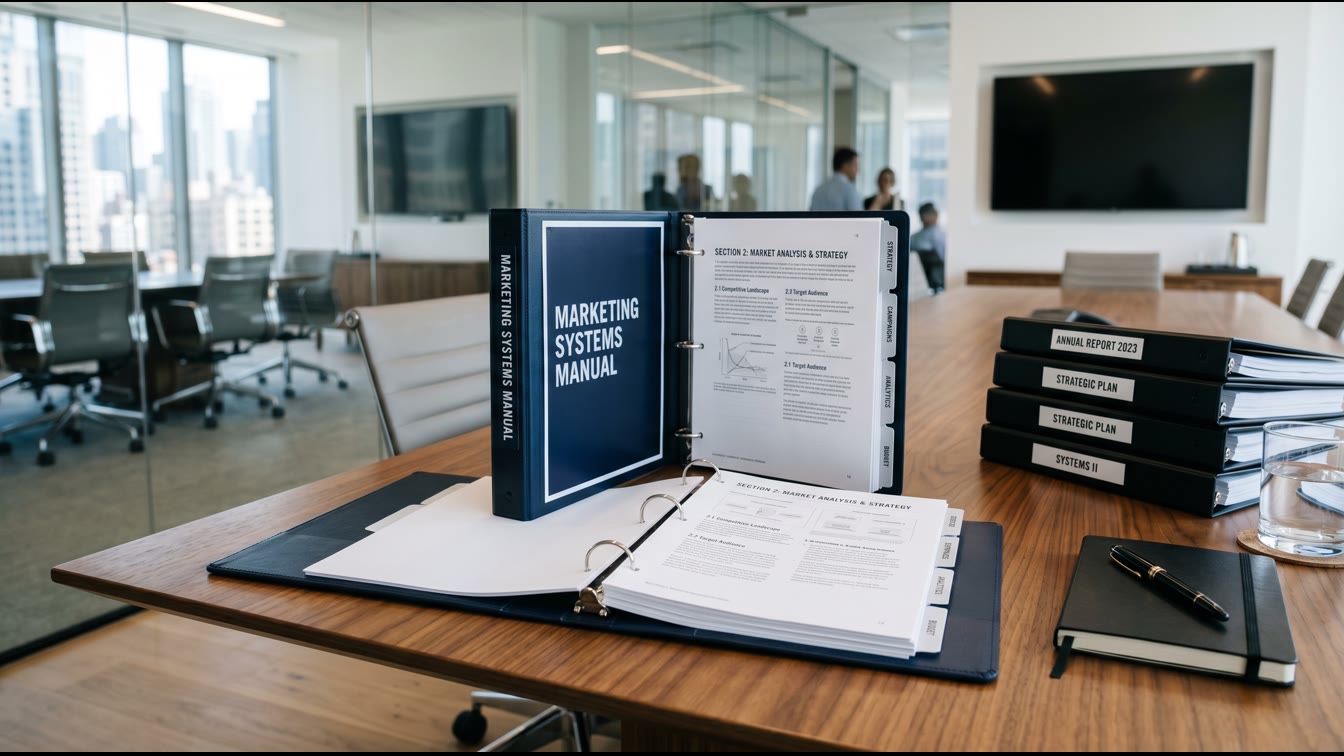
Your Business Is Worth What a Buyer Can Run Without You
Documented marketing systems are not a nice-to-have. They are the mechanical difference between a 2x SDE multiple and a 4x SDE multiple. The Exit Planning Institute reports that businesses with documented systems and delegated management command multiples 25–35% higher than owner-centric operations. BizBuySell's 2024 Insight Report sets the average small business sale at 2.57x SDE. Undocumented, owner-dependent operations rarely crack 2.0x. Documented, operator-independent systems routinely reach 3.5x to 4.5x. That gap is the Exit Engine.
The Multiple Is a Trust Score
Acquirers are not buying your revenue. They are buying their confidence in the revenue continuing after you leave.
Every line item in due diligence is a trust question. Can the new operator run the lead generation process? Can someone other than the founder maintain the conversion funnel? Is there a written procedure for how marketing campaigns get launched, measured, and optimized?
If the answer is "the owner handles that," the buyer applies a discount. Always. The discount is not negotiable.
This is how two businesses with identical cash flow land at entirely different multiples. One has the owner's brain in the machine. The other has the manual.
What Buyers Actually Check During Due Diligence
Quiet Light, which handles deals in the $250K to $25M range, is explicit about this. Their pre-sale process includes documenting operational processes as a prerequisite to building the Confidential Information Memorandum. FE International, with over 6,000 completed due diligence reviews, flags undocumented marketing systems as a risk factor that directly compresses valuation.
Marketing systems that buyers scrutinize include:
- Lead generation documentation. Is there a repeatable written process for how leads enter the pipeline? Is it channel-specific?
- Conversion process mapping. Is there a written sequence for how leads become customers? Who owns each step?
- Customer acquisition cost tracking. Is there a documented method for calculating CAC by channel?
- Retention and reactivation procedures. Is there a written playbook for keeping customers and reactivating dormant ones?
- Campaign management SOPs. Is there a procedure for launching, monitoring, and killing a campaign?
Absent documentation, a buyer sees a founder-operated black box. They reprice accordingly.
FE International notes that a premium acquisition target will have "well-documented, annotated and tested" systems. That language applies equally to marketing operations as it does to source code. FE International's SaaS due diligence framework makes clear: documentation is a must-have above $500K, not a differentiator.
The Engine Room Analogy
In the Navy, the engine room runs on the Watch, Quarter, and Station Bill. Every sailor knows their station. Every evolution has a written procedure. A casualty drill is not improvised — it is executed from a checklist drilled into muscle memory.
A ship does not run differently when the captain changes. The engine room does not depend on one person's institutional knowledge. The procedures live in the manual, and the manual lives with the ship.
Your marketing operation needs to run the same way. The owner is the captain, not the engine. When you sell, the captain changes. If the engine room has no manual, the ship stops.
This is not a metaphor. It is a mechanical description of why most founder-built businesses sell at the floor multiple.
The Numbers Behind the Engine
BizBuySell's 2024 Insight Report recorded 9,546 closed transactions worth $7.59 billion in enterprise value. The median small business sold for $350,000 at 2.57x SDE. That is the average. That is what you get when you have a business that works with you in it.
The businesses that sell at 3.5x to 4.5x share a profile. Recurring revenue. Clean financials. Low customer concentration. And documented operating systems — including marketing.
According to the International Business Brokers Association, 20–30% of businesses listed for sale never close. Owner dependency is cited as the primary driver in half of those failed transactions. The business does not fail to sell because the market is bad. It fails to sell because there is no machine for a buyer to buy. There is only a person.
The math on documentation is blunt. If your business generates $500,000 in SDE, the difference between a 2.5x and a 4.0x multiple is $750,000 in exit proceeds. That is not a rounding error. That is the price of having written the manual.
How the Owner's Exit Engine Gets Built
The Exit Engine is not built in the six months before you sell. It is built over three to five years. Exit planning research consistently shows that businesses prepared with 3+ years of runway close at two to three times higher rates and achieve multiples 0.5x to 1.5x higher than reactive listings. A well-executed exit plan increases sale price by 20–40% compared to an unplanned exit.
The marketing documentation layer of the Exit Engine has four components.
1. The Channel Register. A written inventory of every marketing channel the business operates, with current CAC, conversion rate, and monthly spend per channel. Updated quarterly.
2. The Campaign Playbook. Step-by-step written procedures for launching and managing campaigns on each active channel. Not a strategy deck. A procedure manual. Specific enough that a new hire could execute it.
3. The Funnel Map. A documented flow from first contact to closed customer, with defined owner for each stage, and written escalation paths for stalls and anomalies.
4. The Reporting Protocol. A written schedule and process for weekly and monthly marketing performance reporting. Who pulls the data. What the report contains. How it gets reviewed.
These four documents do not need to be long. They need to be accurate, current, and operator-independent. A buyer's due diligence team should be able to pick them up and run the marketing operation without calling you.
A System That Runs Without Me
I built Angel Investors Network in 1997. Over the next two decades, it grew to enable more than $1 billion in capital raised by clients. I am proud of that number. I am more proud of a different number: the percentage of deals that closed when I was not in the room.
Angel Investors Network ran on doctrine, not on my presence. The deal qualification process was written. The investor matching procedure was documented. The pitch preparation system was a procedure, not a conversation with me. The organization could run a watchstanding rotation without me at the wheel.
That is what made it a system. That is what makes any business acquirable. The value is in the procedure, not the person.
Owners who build personal fiefdoms build jobs. Owners who build documented systems build assets. The acquisition market prices the difference precisely.
Owner Dependency Is the Single Largest Value Discount
Two businesses with identical cash flow, identical growth rates, and identical markets will trade at materially different multiples if one has a management team and documented processes while the other runs through the founder.
The Exit Planning Institute's research is consistent: owner dependency is the most common value destroyer in lower middle market businesses, and also the most fixable given enough lead time. Buyers price ownership risk directly into the offer. If 40% of revenue depends on the founder's personal relationships, 40% of the revenue is at risk on day one of new ownership. That risk becomes a discount.
For marketing systems specifically, the risk is compounded. Marketing is the revenue engine. If the engine only runs when the founder operates it, the buyer is not acquiring an engine. They are acquiring the founder's obligation to keep showing up.
Doctrine Connection: Systems beat slogans
Every founder has a story about their marketing instincts. Most of those stories are true. None of them are transferable.
A story about your marketing intuition is a slogan. It sounds good in a pitch deck and means nothing in due diligence. A documented process for how you execute that intuition . step by step, owned by roles not by people, reviewed quarterly, updated annually . that is a system. That is what a buyer is paying for.
Slogans live in your head. Systems live in the manual. The manual stays with the business. You do not.
The owner's job in the exit phase is to get out of the engine room and write the procedure for the next engineer. Every week you spend building systems you do not have to operate is a week of compounding on your exit multiple.
The doctrine is simple: if you have not written it down, you have not built it. You have only performed it.
FAQ
Q: How much can documented marketing systems realistically increase my acquisition multiple? Data from the Exit Planning Institute and business broker reports consistently shows documented systems and delegated management add 25–35% to multiples for comparable businesses. In practical terms for small businesses, this is often the difference between selling at the BizBuySell average of 2.57x SDE and reaching 3.5x to 4.5x . a gap that can represent hundreds of thousands or millions of dollars in exit proceeds depending on your SDE.
Q: When should I start documenting my marketing systems if I plan to sell in five years? Start now. Exit planning research shows businesses prepared with three or more years of documented systems and planning close at higher rates and achieve significantly higher multiples than reactive listings. The documentation itself compounds . a system documented today becomes a system trained to staff tomorrow, which becomes an operator-independent asset at exit.
Q: What is the difference between SDE and EBITDA, and which one matters for my exit? SDE (Seller's Discretionary Earnings) adds back the working owner's salary to EBITDA. It is the standard metric for businesses under $3M in revenue. EBITDA becomes the benchmark when a professional management team is in place. Either way, the multiple applied to that number is directly affected by how documented and operator-independent your systems are. A business with documented systems moves up the multiple range regardless of which metric a buyer uses.
Q: Will a buyer actually read my marketing SOPs during due diligence? Yes . but the primary value is not that they read them. It is that the documentation exists. Quiet Light, FE International, and comparable brokers list operational documentation as a prerequisite for a defensible Confidential Information Memorandum. The absence of marketing documentation signals owner dependency. Its presence signals a transferable asset. Buyers price both signals.
Q: What if my marketing strategy is complex and hard to document? Complex strategies are the ones that most need documentation. The procedure does not need to capture every judgment call . it needs to capture the decision tree, the tools, the reporting cycle, and the escalation path. A new operator does not need to replicate your brilliance. They need to run the system at a competent level until they develop their own. If the system only runs at your level of brilliance, it is not a system. It is a performance.
*Sources: BizBuySell Insight Report | BizBuySell SDE vs EBITDA Guide | FE International Due Diligence Services | FE International SaaS Due Diligence | Quiet Light Due Diligence | Exit Planning Institute State of Owner Readiness | Jamestown Capital Exit Planning from the PE Buyer Perspective*