
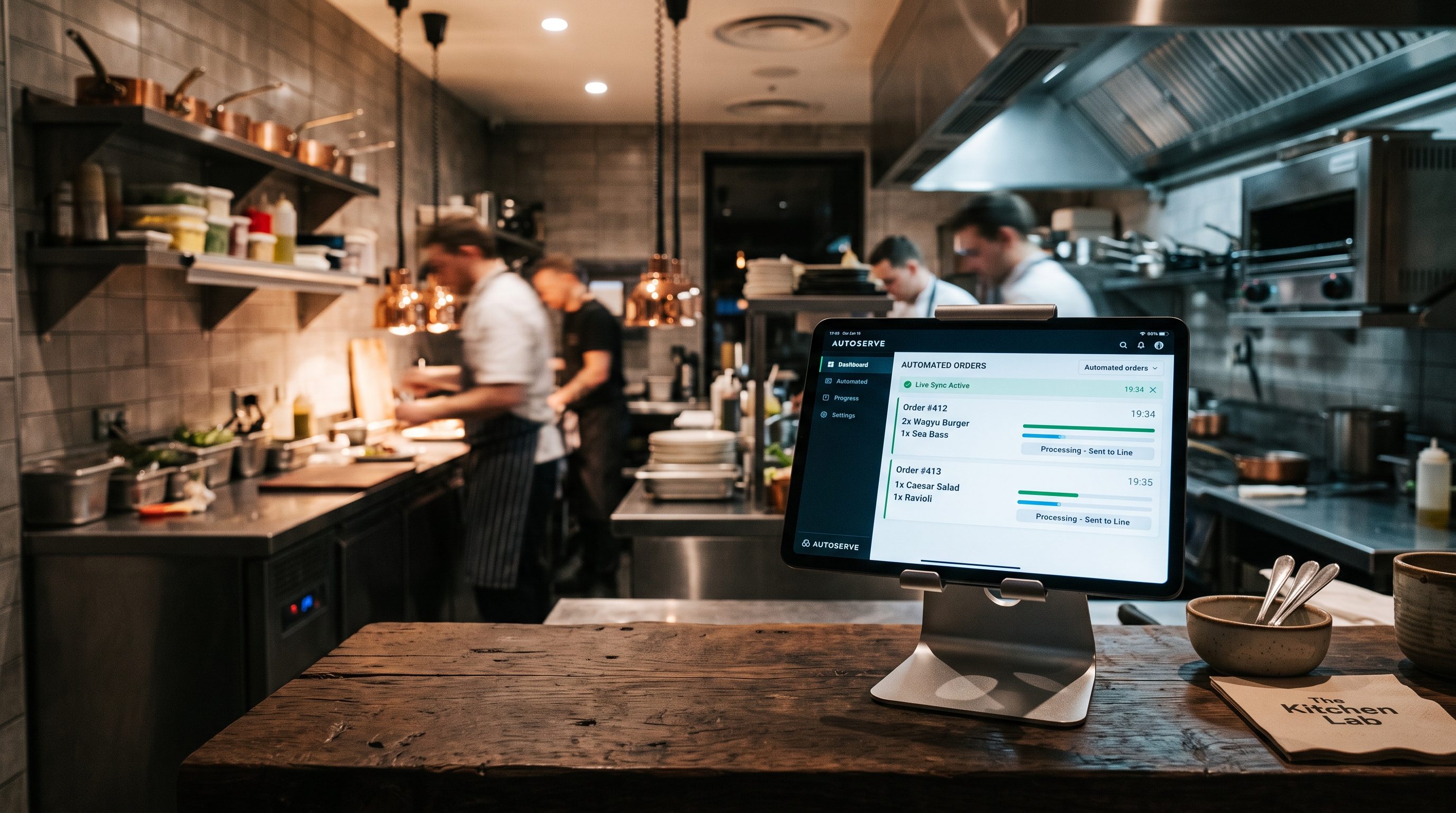
TL;DR: Owner.com, the restaurant SaaS platform founded by Adam Guild, crossed roughly $100M in annual recurring revenue in 2026, up from $34M at the end of 2024 (SaaStr; Sacra). Guild's own words explain why: "every time a customer logs in, Owner has failed." He built a company that runs the business for the restaurant owner instead of handing them another screen to manage. That is the Anti-Dashboard Doctrine, and it applies to your business whether you sell tacos or transmissions.
The Number That Should Scare Every SaaS Founder You Know
Owner sells websites, online ordering, and marketing automation to independent restaurants. Thousands of pizzerias and taquerias. Not exactly a glamorous market. Yet Sacra pegs the company at $81M ARR at the end of November 2025, a 137% jump from $34M twelve months earlier (Sacra).
By mid-2026, Owner was crossing $100M and accelerating, not slowing down after the milestone like most companies do (SaaStr). In May 2025, the company raised a $120M Series C led by Meritech Capital and Headline, at a $1B valuation (TechCrunch; Restaurant Business Online). Total capital raised to date: $189M (Inc.).
That's a 19x revenue multiple on a company selling $499-a-month software to mom-and-pop restaurants. Do the math yourself. It checks out.
Here's the part that matters more than the multiple, the part every founder chasing a growth round should sit with longer than the valuation headline. Adam Guild didn't build a better dashboard. He built a system that makes the dashboard optional. His stated design principle, repeated on stage at SaaStr AI, is blunt: every login is a failure (SaaStr).
Most software companies measure success by engagement, by daily active users, by session length, by every metric that assumes the customer's time in the product is time well spent instead of time stolen from whatever they actually opened the business to do. Owner measures it by the absence of engagement. That inversion is the doctrine.
The Anti-Dashboard Doctrine, Defined
On the submarine, the best watchstander was invisible. I stood watch in the engine room of a nuclear-powered fast attack, USS Jefferson City, monitoring a plant that could kill everyone aboard if a single procedure got skipped or a single gauge got misread under pressure. Nobody congratulated the reactor operator for a quiet shift.
A quiet shift meant the system ran the way it was designed to run: no alarms, no casualty drills, no drama. The compliment was silence. That's the standard I still hold every marketing system to, decades later.
Most SaaS companies build the opposite. They chase dashboards that demand attention: weekly logins, feature adoption scores, "time in app" as a north star metric. That metric rewards friction. It confuses activity with value.
Owner flipped it. 83% of new customers now start their entire relationship with the company inside a free AI tool, not a login screen, up from 0% two years earlier (SaaStr).
The tool is called Gradr. A restaurant owner types in their name. Within five minutes, an agent crawls their Google Business Profile, studies every nearby competitor, reads every review, shoots and upscales new menu photography, and rebuilds the entire website around what customers actually love about the place (SaaStr).
No onboarding call. No setup wizard. No dashboard tour.
The system does the work while the owner is closing the restaurant, prepping tomorrow's specials, or asleep. The owner just approves it.
Compartmentalize that idea for a second. The product isn't the login. The product is the outcome, delivered before the login ever happens.
Why Owner-Operators Should Care More Than VCs Do
I train owner-operators doing $500K to $5M in revenue, the exact segment that gets sold every shiny new SaaS tool with a promise that it will run itself and then quietly demands two hours of their Tuesday forever. None of them signed up to become software administrators. They signed up to run a restaurant, a plumbing company, a dental practice.
Every hour spent logging into a marketing dashboard, tagging a lead, or debugging a broken automation is an hour stolen from the business that actually pays the bills. This is the founder dependency tax, and most owners pay it without noticing.
They install a tool. The tool needs feeding: content, configuration, weekly check-ins. Six months later the owner is running the software instead of the software running the business.
That's not a system. That's a second job disguised as a subscription, and nobody negotiated a salary for it.
I made this mistake myself early in my agency years, before I understood it as doctrine. I bought a marketing automation platform that promised to run itself, and it required two hours of my week, every single week, just to keep the workflows from quietly breaking underneath me. That wasn't an asset. That was a bottleneck wearing a subscription invoice.
Owner's bet is that the market will pay a premium to skip that tax entirely, and the data backs it. Their CRO, Kyle Norton, told SaaStr that reps close $2M+ in ARR per year on average, roughly 4x what competitors' reps close (SaaStr).
The product sells itself on a single premise: you'll spend less time in your tech, not more. Owner even wrote this into its Series C investor memo as an opinionated stance, not a hedge. Restaurant owners who want deep customization should use somebody else's tool (Owner.com Series C Memo).
Compare that to Toast, the category's dominant POS incumbent. Toast crossed $2.2B in ARR with 171,000 locations by early 2026, built on hardware, payments, and a much wider surface area of features an owner has to manage (Restaurantology).
Toast is a bigger business today. It earned that scale honestly by processing an estimated 16% of the roughly $962 billion U.S. restaurant payments market, building hardware, software, and a payments network that most competitors still can't touch after more than a decade of trying. But Owner is growing faster on a model that requires less of the owner's attention. Attention is the one resource an owner-operator can never buy back.
Owner also charges a flat $499 a month plus 5% per order, positioned deliberately against the 30% commissions DoorDash and Uber Eats extract from the same restaurants (Sacra). That's not just a pricing decision. It's a doctrine decision: charge less, ask less of the owner's time, and let the math close the sale instead of a rep's pitch deck, a discovery call, or a demo that walks the owner through forty screens they'll never open again.
The Asset, Not the Interface
Here's the reframe every founder-operator needs to internalize: software is either an asset or a liability on your time. A dashboard that requires daily babysitting is a liability wearing an asset's clothing. It shows up as a line item on the P&L and a second, invisible line item on your calendar.
Real assets compound without you standing watch over them every hour. That's the whole logic behind The Owner's Exit Engine, the framework I built for AI marketing systems that run without founder involvement and compound business value toward acquirability.
A system that requires you to log in every day isn't an asset. It's a bottleneck with a subscription fee. A buyer doing due diligence on your business will ask the same question Adam Guild asks about his own product: does this work without the owner present?
If the answer is no, your valuation takes the hit, not the software vendor's, because the vendor cashes out today and you're the one left explaining the gap to a private equity associate three years from now. This is basic payback period math. A buyer isn't just pricing your revenue. They're pricing how much of that revenue survives your exit.
I've watched this pattern from both sides. At Angel Investors Network, we helped raise over $1 billion in capital across hundreds of deals. The pattern that killed valuations more than any other single factor was founder dependency.
Buyers don't pay full multiple for a business that stops running the day the founder stops logging in. They pay full multiple, sometimes a premium, for a business that runs on procedure: a manual, a system, receipts that prove it worked without the founder in the room.
Owner's whole company is a bet on this principle applied to its own customers, scaled across ten thousand restaurants that would rather be running their kitchens than optimizing a conversion funnel they never asked to learn. The restaurant owner who never logs in is the restaurant owner who's actually running a business, not managing software. Sovereignty over your time, not mastery of somebody else's interface, is the real product.
Doctrine Over Dashboard: What This Means for Your Business
The lesson isn't "go build restaurant software." The lesson is structural, and it applies whether you sell HVAC repairs or high-ticket coaching. Ask three questions about every system in your business, every piece of software, every process that touches a customer between the first click and the closed sale.
First: does this system require your daily attention to function, or does it run on its own procedure? A marketing system that needs you to write the emails every week isn't a system. It's a chore with a dashboard attached.
Second: if you took a two-week vacation with no laptop, would the system keep producing? Third: could you hand this system's output, not its interface, to a buyer as proof of value? Receipts, not screenshots. That's the whole standard.
The market is already voting on this. Owner didn't win by adding more dashboard tabs. It won by removing the need for the tab entirely, letting AI agents handle pre-call research, photography, and website generation without a human clicking through a single menu, a single settings page, or a single onboarding checklist that exists mostly to make the product feel more substantial than it needs to be.
Researchers are now documenting the same shift across enterprise SaaS broadly: products moving from "log in and click" toward "the system acts, you approve" (Startupik). The winners in that shift won't be the prettiest dashboard. They'll be the quietest one.
On the boat we ran casualty drills constantly, not because we expected failure, but because the drill proved the procedure worked without any single sailor being irreplaceable. Every watchstander had to be operator-independent, capable of being swapped out mid-crisis without the reactor caring who was standing there.
That's the test for your business systems too. If your marketing only works when you personally show up to run it, you don't have a system. You have a job you built for yourself and called a business.
Doctrine Connection
Systems beat slogans. Owner.com didn't market its way to $100M ARR with a clever tagline about restaurants, a viral ad campaign, or a rebrand that repositioned the same tired dashboard behind a friendlier font. It engineered a product where the absence of a login is the pitch, backed by receipts: 137% year-over-year growth, a $1B valuation, and a sales team closing four times what competitors close (Sacra; Restaurant Business Online; SaaStr).
A slogan is what you say when you don't have the system to back it up. Owner has the system. So does every acquirable, sellable business I've ever helped build, and every one of them was forged under pressure long before it was worth anything on paper.
FAQ
Q: What exactly is the Anti-Dashboard Doctrine? A: It's the principle that the best software runs the business for the customer instead of requiring the customer to run the software. Success is measured by outcomes delivered, not logins, clicks, or time spent in the app.
Q: Did Owner.com actually hit $100M ARR, or is that a rounding claim? A: Independent analyst Sacra estimated Owner at $81M ARR at the end of November 2025. Owner's own leadership stated at SaaStr AI in mid-2026 that the company was crossing and accelerating past $100M. Verify both figures yourself before repeating them as fact. Growth-stage ARR numbers move fast and get rounded generously.
Q: Does this doctrine apply outside of SaaS? A: Yes. Any owner-operator business, a dental practice, an HVAC company, a law firm, can apply the same test: does this system require the owner's daily attention, or does it run on procedure? The less it needs you, the more it's worth to a buyer.
Q: Isn't reducing customer engagement bad for retention? A: Not if the outcome improves. Owner's retention comes from restaurants saving money versus 30% delivery-app commissions and spending less time on marketing, not from forcing daily logins. Engagement with a product is not the same as value delivered by a product. Confusing the two is a classic SaaS mistake.
Q: How does this connect to selling my business someday? A: Buyers discount businesses that depend on the founder's daily involvement. A system that runs without you, and can prove it with receipts, is what The Owner's Exit Engine framework is built around: AI marketing systems that compound value toward acquirability instead of compounding your workload.
*Jeff Barnes is the founder of demg.ai and Digital Evolution Marketing Group. This article represents his analysis and does not constitute professional advice. Verify all claims independently.*