
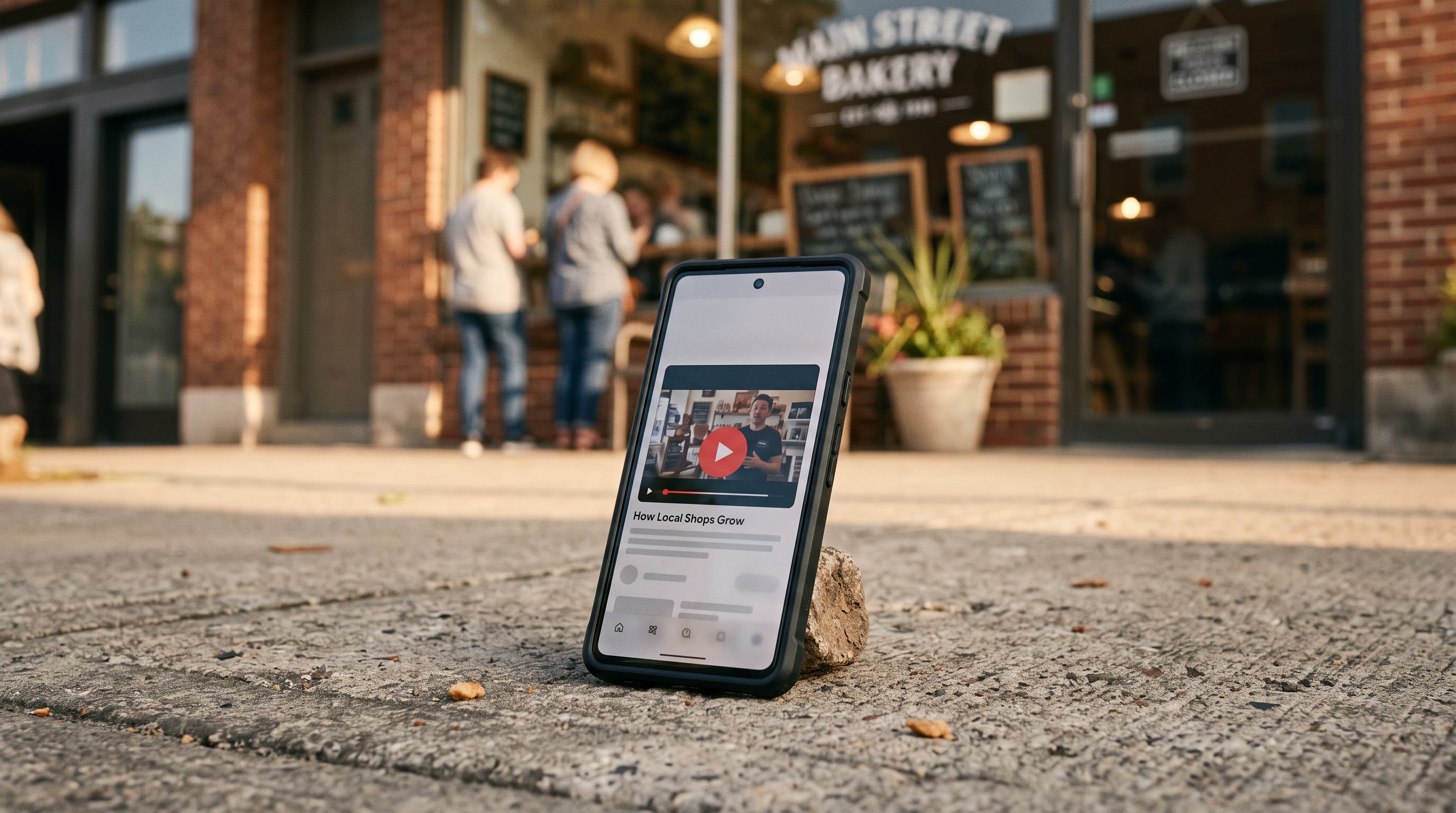
TL;DR: YouTube Shorts is a conditional yes, not a blanket yes. The platform now serves over 200 billion daily views globally as of mid-2025, per YouTube CEO Neal Mohan's Cannes Lions announcement, with 74% of those views going to viewers who don't subscribe to the channel they're watching. That's free reach. But reach isn't revenue. For a local plumber, dentist, or agency owner, Shorts produces near-zero direct attribution to booked jobs unless it's wired into a retargeting pixel and email capture system on the back end. Without that infrastructure, you're feeding Google's engagement metrics, not your pipeline. My verdict: post Shorts if you already have a lead capture system to catch the traffic. Skip it if you don't.
I've published over 1,500 videos on my capital raising channel, @capitalraisingsecrets, and I've run a separate Shorts-only experiment on @jeffbarnes-renegade to test exactly this question: does short-form video move the revenue needle for an operator, or just the vanity metrics? The answer isn't what the "post more Shorts" crowd wants to hear, and it isn't a flat no either. It's a verdict with conditions attached, and most local business owners are skipping the conditions.
The numbers everyone quotes, and why they don't mean what you think
Every marketing guru slide deck in 2026 opens with the same statistic. YouTube Shorts crossed 200 billion daily views in June 2025, up from 70 billion in March 2024, a roughly 186% jump in fifteen months (axis-intelligence.com, 2026). The platform has over 2 billion monthly active users, more than TikTok's 1.59 billion, and a 5.91% engagement rate that beats both TikTok and Instagram Reels (Hootsuite, 2026). Channels that post Shorts consistently grow about 50% faster year over year than channels that don't (autofaceless.ai, 2026).
Those numbers are real. They are also almost entirely irrelevant to whether your HVAC company gets a phone call this week.
Here's the caveat nobody puts on the slide. As of March 31, 2025, YouTube changed how it counts a Shorts view. A view now registers the instant a Short starts to play or replay, with zero minimum watch time required (axis-intelligence.com, 2026). Before that date, a view required a few seconds of actual watching. The 200 billion figure and the 70 billion figure are not measuring the same thing, you are comparing a loose definition against a strict one and calling it growth. Some of it is real growth. A meaningful chunk of it is a definition change dressed up as a milestone.
This matters because it tells you something important: the platform's own reported numbers are built to make Shorts look bigger, not to help you measure whether Shorts made you money. If YouTube's headline metric shifts to flatter itself, you cannot outsource ROI measurement to YouTube Analytics. You need your own tracking, which is the entire point of this article.
What Shorts actually does for a local business
Shorts is a discovery engine, not a sales page. There are no clickable links inside the video itself, and the description exists but almost nobody taps through before swiping to the next clip. The platform is built for passive, entertainment-mode browsing, structurally different from someone typing "emergency plumber near me" into Google Search with their wallet already in hand (sellontube.com, 2026).
One case study makes the point bluntly. A SaaS founder posted 90 Shorts over three months and racked up 340,000 views. Zero demo requests. His competitor, over the same window, posted 12 long-form videos targeting buyer-intent keywords and grew pipeline by $180,000 (sellontube.com, 2026). Same platform, wildly different outcome, because one strategy chased reach and the other chased search intent with a conversion path attached.
Contrast that with Cider, the fashion retailer, which ran video action campaigns on Shorts inventory, combined in-market and custom-intent targeting, and set add-to-cart as the conversion goal. Result: new customers at a 33% lower cost per acquisition than other channels (Google Business, 2026). The difference isn't the platform, it's the infrastructure. Cider built a conversion goal and remarketing list into the campaign from day one. The SaaS founder posted content and hoped.
For local service businesses, the contractor data backs this up with harder numbers. YouTube ad benchmarks for home service businesses in 2026 show direct-response cost per booked job running $280 to $450 on click-through alone, worse than Local Service Ads at roughly $190 (PipelineOn, 2026). But when the same contractor layers in view-through conversion tracking, branded search lift measurement, and offline conversion upload from a CRM, the picture changes. One roofing contractor in that same analysis spent $3,800 a month combining custom-intent prospecting with a 30-day retargeting layer, and blended cost per booked job dropped to $284, landing between his Local Service Ads and cold Search campaign costs. Without the retargeting and the CRM-to-Google conversion loop, that same spend would have looked like a total loss on a click-through report.
That's the whole argument in one data point. The platform doesn't fail local businesses. The measurement and follow-up infrastructure fail them.
The Sovereignty Stack question: owned infrastructure or rented reach
I evaluate every marketing channel through what I call the Sovereignty Stack, meaning I ask whether I'm building on infrastructure I own or renting reach from a platform that can change the rules whenever it wants. Your email list is owned. Your CRM is owned. Your retargeting pixel data, while it lives inside Google's ad platform, produces an asset, a warm audience, that compounds the longer you run it. Your YouTube subscriber count, view totals, and Shorts feed placement are all rented. YouTube can change the algorithm, change the view-counting methodology (it already did, in March 2025), change monetization thresholds, or decide Shorts placements favor a different content style next quarter. You have zero vote in any of those decisions.
This is why "just post Shorts" is incomplete advice bordering on bad advice. Posting Shorts with no backend rents reach and calls it a strategy. You hand YouTube free content that keeps users on the platform longer, good for YouTube's ad revenue, over $40 billion in 2025 per Hootsuite's 2026 report, and you get brand impressions in exchange. Brand impressions do not pay your crew on Friday.
The conditional yes requires converting rented reach into owned infrastructure at every single opportunity. That means:
- A YouTube channel linked to Google Ads so every viewer, subscriber, and channel visitor becomes a retargeting audience you can build ads against later (Postoria, 2026)
- A landing page, not a homepage, that every Short points to through a pinned comment, since pinned comments reliably outperform description links for click-through (StayAbundant, 2026)
- An email or SMS capture on that landing page, since email subscribers convert at higher rates than social followers and, unlike a subscriber count, survive a platform ban or algorithm change
- Offline conversion upload from your CRM back into Google Ads, so a lead that becomes a booked job three weeks later gets credited to the campaign that produced it (PipelineOn, 2026)
Skip any one of those four and you've built a content operation for YouTube's benefit. Build all four and Shorts becomes a cheap top-of-funnel acquisition layer feeding a system you control.
My own test: two channels, two outcomes
I've been putting out content on @capitalraisingsecrets for years now, past 1,500 videos, almost entirely long-form and built around specific searchable questions capital raisers actually type into Google and YouTube. That channel produces leads I can trace. Someone watches a 12-minute breakdown of a fundraising structure, clicks the link in the description to a resource page, and either books a call or lands on my email list. I know exactly which video produced which lead because the infrastructure was built before the content was.
@jeffbarnes-renegade was the opposite experiment, on purpose. I ran it Shorts-only for a defined stretch to see what happens when you strip away everything except the format everyone tells you to chase. The view counts looked fine, some clips did numbers that would make an agency's monthly report look great. The direct-attributed leads, meaning someone who filled out a form or booked a call and could be traced back to a Renegade Short specifically, were close to zero for most of the run. Not because the content was bad, but because a Short has no clickable in-video link, a low tap-through rate to the description, and I hadn't built a dedicated retargeting audience or landing page the way I had for capitalraisingsecrets.
The lesson wasn't "Shorts don't work." The lesson was that Shorts without a capture mechanism produce exactly what the SaaS founder above got: views with no revenue attached. Once I started pinning comments with a single clear link and building a Google Ads remarketing audience off Renegade viewers, the picture shifted, slowly, the way retargeting always does. It's a 60-to-90-day lift, not a next-Tuesday lift (Sagum, 2026).
The math a local operator needs to run before posting a single Short
YouTube Shorts placement itself is cheap. Standard YouTube ad inventory runs $9 to $15 CPM, and organic posting costs nothing but your time (PipelineOn, 2026). Brisbane-based local service businesses report views costing $0.04 to $0.12 apiece when boosted with small daily budgets of $10 to $20 (Local Marketing Group, 2026). That's the "free reach" argument, and it's true as far as it goes.
But cheap reach with no conversion path is still a cost, because it's your time or your team's time producing content and posting on a schedule. If none of that traffic gets captured anywhere, you've spent real hours generating brand impressions with no mechanism to turn a single one into a customer six weeks from now when they actually need a plumber. Platform-reported return on ad spend understates YouTube's real impact by 60% to 80% when businesses skip view-through tracking and offline conversion upload, according to two independent measurement studies of small business YouTube campaigns (SmartSMSSolutions, 2026, and PipelineOn, 2026). That statistic cuts both ways: YouTube is probably doing more for you than the dashboard shows, and you won't know it unless you built the tracking that reveals it.
Run this checklist before you film your first vertical video: a landing page separate from your homepage that a pinned comment can point to, a Google Ads account linked to your YouTube channel so viewer behavior becomes a retargeting audience, a capture field on that page for an email or phone number rather than a "call us" button buried in navigation, a CRM that can push a closed-deal event back to Google as an offline conversion, and 90 days of patience with a small ad budget, $500 to $1,500 a month, for a retargeting layer on top of organic posts.
If you're missing two or more of those, don't post yet. Build the backend first.
FAQ
Does YouTube Shorts drive direct sales for a local business? Rarely, on its own. Shorts has no clickable in-video links and a passive, entertainment-mode audience, weaker buyer intent than someone actively searching Google (SellOnTube, 2026). Treat it as a top-of-funnel awareness layer, not a closer.
How many Shorts should a local business post per week? Case studies of niche service agencies show a range from three per week for beginners scaling to daily once the workflow is established (Seven Figure Agency, 2026). For a business with a small addressable audience, frequency to a defined local audience matters more than total volume.
Is YouTube Shorts better than Google Search ads for local leads? No, and it isn't trying to be. Local Service Ads and Google Search capture people actively looking for a service right now, at a lower cost per booked job in most contractor data (PipelineOn, 2026). Shorts works as a third or fourth channel layered on a working Search and Local Service Ads program, not a replacement for either.
What's the single biggest mistake local businesses make with Shorts? Measuring success by view count instead of branded search lift, email list growth, or offline conversions. A campaign can look dead on platform-reported metrics while producing real lift in branded search volume and CRM bookings weeks later, if the tracking exists to see it (SmartSMSSolutions, 2026).
Can a solo operator with no video budget still make Shorts work? Yes, arguably better than a big-budget competitor. Overproduced, commercial-feeling Shorts underperform authentic phone-shot content of the owner explaining something real (Local Marketing Group, 2026, and BlitzMetrics, 2025). The budget that matters isn't production, it's the landing page, the CRM integration, and the retargeting layer that catches the traffic.
Doctrine Connection: Ownership beats wages
The through-line here is the same one that shows up in every channel I evaluate. Ownership beats wages. A Shorts view is a wage: you did the work, YouTube paid you in an impression, and the transaction ends the moment the viewer swipes away. An email list, a retargeting audience built from your own pixel data, and a CRM full of tracked leads are ownership, assets that compound whether or not you post again tomorrow, and that no algorithm update can take from you overnight.
Post the Shorts. The reach is real and nearly free. Just don't mistake the reach for the business. Build the capture system first, point every Short at it, and only then does 200 billion daily views become more than a number on somebody else's earnings call.
*Disclosure: Jeff Barnes is the founder of demg.ai and Digital Evolution Marketing Group. demg.ai has no commercial relationship with any company, platform, or tool named in this article unless explicitly stated. This content is educational and does not constitute business, legal, or financial advice. Results vary based on implementation, market conditions, and individual business circumstances.*