
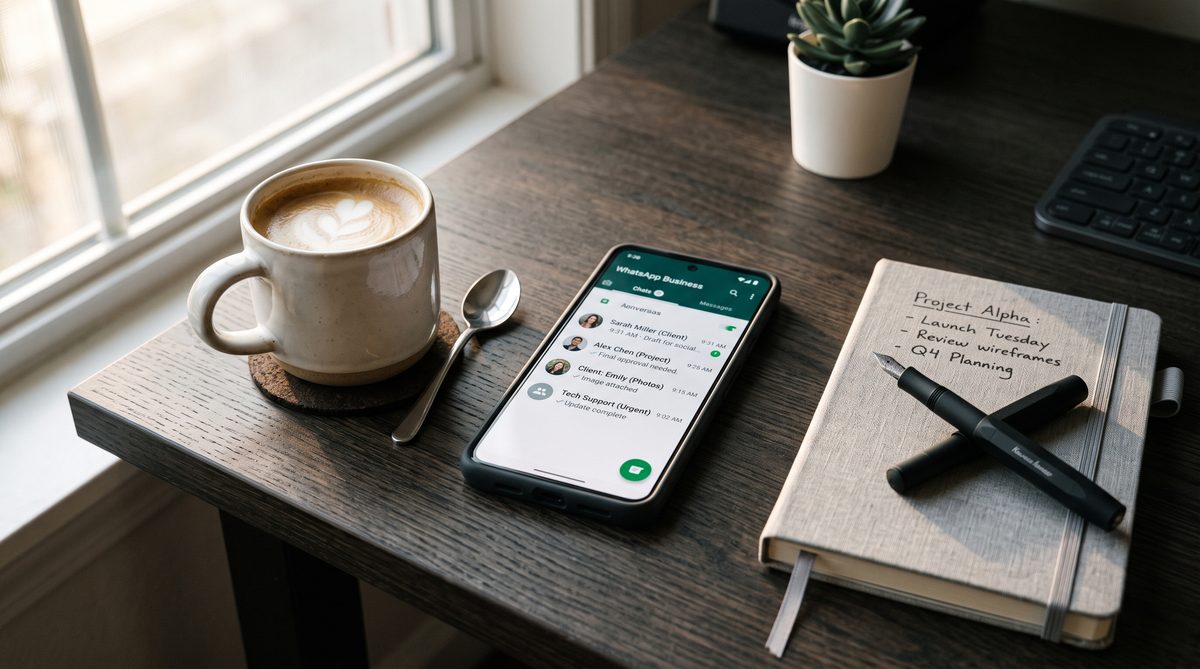
TL;DR: Meta launched autonomous AI agents for WhatsApp Business Platform and Instagram Direct that handle multi-turn conversations, qualify leads, check inventory via API, and guide checkout—all without a human typing a single response. Over 1 million businesses already tested the agents before the June 2026 announcement. Read Search Engine Land's full breakdown.
The Move Is Real
Meta just announced Meta Business Agent at Conversations 2026 in London on June 3. Not a chatbot. Not a template system. An autonomous AI agent that can answer questions, recommend products, check inventory in real-time, book appointments, qualify leads, and close sales—all inside a WhatsApp or Instagram Direct conversation without a human ever typing a reply.
This is the moment messaging stops being support overflow and starts being where deals actually close.
One million businesses already tested it in pilot markets: India, Mexico, Brazil. Now it's rolling out globally. The free test window runs through July 31. Billing starts August 1 at $2.00 per million tokens, roughly 4 to 5 cents per message. That month is your only free testing period before the meter starts.
What the Agent Actually Does
The agent answers customer questions about your products and services. It looks at your product catalog and makes specific recommendations based on what the customer is asking about. It books appointments directly into your calendar system. It qualifies leads by asking the right questions in a defined sequence.
For straightforward sales, a customer asks for a product, the agent shows inventory, the customer buys, the agent completes the transaction without escalation. It handles payment integration through Shopify, Zendesk, and other backend systems. This is not a suggestion engine. It is a sales system.
When the conversation requires human judgment, objections that don't fit the scripted flows, unusual requests, high-value decisions, you define the escalation rule. The conversation moves to a team member. The agent doesn't fight it. You maintain control.
Your team also gets a daily briefing generated by the agent. What conversations happened while you slept? Which prospects moved forward? Which ones stalled? The agent summarizes threads, surfaces patterns, and flags conversations that need attention. This is the operational benefit most operators miss: the agent doubles as a business intelligence tool.
The platform integrates with your existing systems. It pulls live data from your inventory. It reads your pricing in real-time. It connects to Shopify, Zendesk, Shopee, and the platforms you already use. The agent isn't working from static FAQs or outdated product lists. It's reading your actual business data.
It speaks any customer language. It maintains your brand voice. You train it on your past conversations, your website content, your catalog, your customer service FAQs. You set every rule, tone, active hours, when to escalate, what it's permitted to say, what questions trigger a human takeover.
Why This Matters for Operators
Dan Kennedy taught me something 15 years ago: control the conversation, control the sale. Meta just automated that principle for WhatsApp.
For direct-response businesses, this is a control point. Every inbound customer question is now a qualified conversation happening at scale. You're not waiting for leads to reach your website. Customers are starting conversations inside the apps where they already live. The friction is zero.
WhatsApp's discovery feature will let customers find you by searching your business name directly inside the app. Picture the effect: high-intent traffic flowing directly into a conversation that can close, without a landing page, without email follow-ups, without tag-and-nurture sequences. A customer with an immediate need finds you and talks to your agent, who either closes the sale or hands them to you pre-qualified.
For $50 to $250 per month in agent costs, depending on your conversation volume, you can handle 5,000 customer interactions that would otherwise require a junior team member's salary and overhead. That isn't cost cutting. That is operational multiplication.
For operators selling mid-ticket items ($5K to $25K), the math shifts again. An agent can qualify 200 inbound conversations per week. A human can qualify 30. Ninety percent of your raw inbound traffic fails the qualification filter before a human ever speaks to them. The agent does that filtering automatically. You only talk to the 10 percent who actually fit. This is sales strategy, not automation theater.
The Capital Calculation
This is where operators need to think like capital allocators, not just marketeers.
Through July 31, the agent is free. Starting August 1, you pay $2.00 per million tokens. That translates to 4 to 5 cents per typical message. A full conversation, product questions, inventory checks, appointment booking, maybe payment processing, consumes 20,000 to 25,000 tokens. A single conversation costs 80 cents to $1.25.
A business processing 5,000 agent conversations in a month pays roughly $200 to $250. A business processing 50,000 conversations pays $2,000 to $2,500. That is not free. It is cheap compared to payroll, but it is not free.
But October 1 changes the equation.
Starting October 1, every service message sent inside an open conversation window carries a per-message charge, whether the agent sends it, you send it manually, or it's a pre-built template. Meta is moving WhatsApp from free messaging to consumption-based pricing across the entire operation. Not just the agent. Everything.
For a business handling 200 agent conversations per week, October means new cost tiers. If 40 percent escalate to humans and each human conversation requires 10 back-and-forth messages inside the service window, you add a second cost layer on top of token charges. Budget this carefully.
What This Does Not Cover
The agent must be task-specific. It cannot be open-ended. Meta requires you to define what it does: returns handling, appointment booking, product recommendations, lead qualification for a specific job category, checkout guidance. A conversational AI without a defined job gets your access terminated. This is not a negotiable rule. This is Meta's compliance line.
For high-ticket consulting ($50K and above), this is not the right tool yet. An agent cannot conduct real discovery calls. It cannot read emotional undertones. It cannot handle unusual client situations that don't fit your standard qualification framework. It is designed for volume and pattern-matching, not nuance and improvisation.
For B2B service businesses selling to decision-making committees, skip it. Too many stakeholders, too many competing interests, too much negotiation. The agent handles 1-on-1 high-intent interactions. It does not orchestrate committee sales calls.
The agent learns from your existing data. If your training data is weak or incomplete, the agent's outputs are weak. This is not automation magic overcoming bad process. This is artificial intelligence exposing bad data. If you haven't been systematically tracking customer conversations, recording product specs, or documenting policy exceptions, you are starting from zero.
Systems Beat Slogans
This is the operator's law. The agent is only as good as the system feeding it.
The conversation flow is a system. The data quality is a system. The escalation rules are a system. The product catalog is a system. The inventory integration is a system. One broken piece and the agent sends wrong information or routes conversations to the wrong team or misses the handoff trigger entirely.
Before you flip the agent on, build the infrastructure underneath. Catalog your products completely. Document your policies without ambiguity. Audit your inventory data for accuracy. Write down the questions the agent should ask, in order, to qualify a prospect correctly. Define the escalation triggers with precision. This is not a feature you enable. This is a business operating system you construct.
Operators who deploy the agent first and build the system second will regret it in 60 days. Operators who spend 30 days building the system first will have a multiplier that runs for years.
The Operator's Verdict
Worth serious testing if you sell direct into high-intent traffic and your product offering or service booking can be systematized into defined steps. E-commerce with catalog products, appointment-based services with clear booking flows, lead qualification for sales teams, customer support for defined problem categories.
Not ready for deep consulting, complex B2B sales, or businesses without documented products, pricing, and policies.
Start now. The free test window closes July 31. Spend this month understanding your own conversation patterns. What percentage of your inbound conversations are simple questions? How many escalate to humans? What is the conversion rate for the agent's qualification questions? Which conversations does it actually close?
Do not optimize for conversations the agent closes. Optimize for conversations the agent qualifies accurately. Qualification at scale is the real win. If the agent moves your team from handling 100 raw inquiries to handling 10 qualified prospects, that is a 10x efficiency gain on human time.
Meta's discovery will take time to build volume. It will not drive thousands of conversations on day one. But this is a new channel opening. In a decade, being discoverable on WhatsApp search will matter as much as being discoverable on Google search today. First movers will have an advantage.
FAQ
Q: Can I use Meta Business Agent if I already work with a BSP (Business Solution Provider)?
A: Yes, and you should think of them as complementary, not competitive. Your BSP handles templates, broadcast campaigns, team shared inboxes, and CRM workflows. The native Meta Business Agent handles first-line customer conversations. They operate alongside each other on the same WhatsApp number. Your team sees all conversations, AI-handled and human-handled, in the same inbox. The practical move is deciding which types of conversations the agent owns (simple questions, booking, lead qualification) and which stay in your human workflows. No migration required. No switching.
Q: How do I know if my products are "systematized enough" for the agent?
A: If you can describe your sale in 3-5 questions and those answers determine next steps, you are ready. What is the customer's main problem? What is their budget? When do they need the solution? Do they match your ideal customer profile? If those answers tell you "move forward" or "not qualified," the agent can ask them and qualify correctly. If your sales process requires storytelling, relationship-building, or personal negotiation, you are not ready.
Q: Will October 1 pricing changes kill the ROI on this?
A: Possibly. If 50 percent of your conversations escalate to human agents and each escalated conversation generates 10 back-and-forth messages, October doubles your cost per qualified lead. Run the numbers now, not in September. Test with the agent bearing the full token cost starting August 1. If the unit economics work at full pricing, October is survivable. If not, you will know by September and can adjust before charges actually hit.
Q: Can my team override the agent or edit what it's saying to customers?
A: Yes. The control interface lets you monitor live conversations, take over from the agent anytime, and provide feedback that the agent learns from. You are not handing the entire operation to AI and walking away. You keep one hand on the wheel. If the agent says something wrong or a conversation goes sideways, you step in. That feedback improves the agent's future responses.
Q: Does using Meta Business Agent lock me into WhatsApp?
A: Partially. Your conversations live on WhatsApp's infrastructure. Your data is accessible through Meta's Business API, but you cannot simply export and move to another platform if Meta changes their terms. Treat it the way you treat any owned channel: as a valuable asset that you should diversify around, not bet everything on. Build on WhatsApp. Also build your email list. Also build your SMS list. Do not let a single channel become 80 percent of your customer acquisition.
The Real Opportunity
Most operators will skip this entirely. They will assume it is a tool for e-commerce or large enterprises. They will miss that this is a capital-efficient way to turn every customer inquiry into a qualified conversation.
The ones who systematize their business, test during the free window, and deploy thoughtfully will have a multiplier running for the next five years. That is the operator's verdict.
[DISCLOSURE: This article is opinion based on Meta's public statements about Meta Business Agent, reports from attendees at Conversations 2026, and coverage by Search Engine Land and other industry publications. I have no financial relationship with Meta. I tested early versions of Meta's messaging tools 10 years ago as part of a Messenger bot project. The article reflects my analysis of features and pricing as announced.]
Jeff Barnes is the founder of Digital Evolution Marketing Group (demg.ai) and CEO of Angel Investors Network. He has been involved in over $1B in capital transactions across 27+ years. demg.ai provides marketing education and operational frameworks for owner-operators. This article is for informational purposes only and does not constitute business, legal, or financial advice. Results vary by business, market, and execution. demg.ai may have commercial relationships with tools or platforms mentioned.