
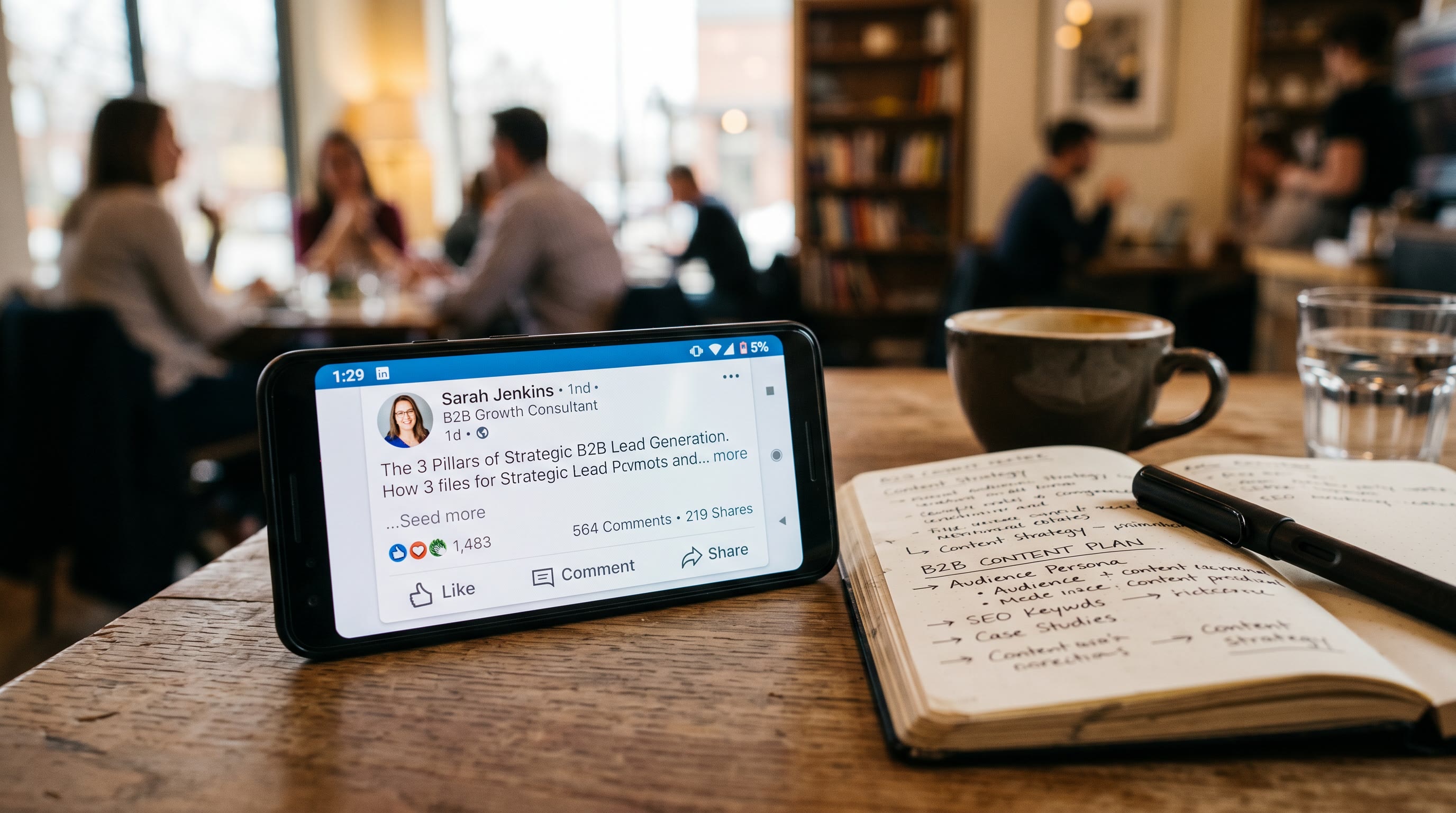
opening
LinkedIn just rewrote the playbook. According to Expandi's analysis, the platform has shipped 360Brew—a 150-billion parameter model that fundamentally changes how content gets distributed. If you're a consultant betting your visibility on company pages and generic thought leadership, you're watching the engine room shift beneath your feet. The question isn't whether the algorithm changed. It's whether you know what changed about it—and what to do next.
Algorithm Shift
The numbers don't lie. LinkedIn's algorithm upgrade from 360Brew rewired the signal hierarchy. Personal profiles now dominate the engagement landscape,they're pulling 5x more engagement than company pages. That's not a marginal difference. That's a structural reset.
What happened? LinkedIn stopped optimizing for company-owned distribution and started rewarding individual credibility. The shift tracks back to one core thesis: audiences trust people more than institutions. A consultant sharing hard-won methodology from their own profile hits different than the same content dropped from a corporate handle.
The math is straightforward. B2B buying happens between humans. Eighty percent of LinkedIn's lead volume flows through B2B channels. Those buyers scroll through personal feeds. They engage with voices. When a consultant posts,one human to many humans,that's the signal LinkedIn now weights heaviest. Company pages became broadcast channels. Personal profiles became the engine room.
Depth Score
Here's where LinkedIn's new playbook gets real. The platform introduced the Depth Score,a metric that measures how long someone engages with your post. Thirty seconds or more. That's the bar.
Why thirty seconds? Because that's when LinkedIn's system knows you've moved past the headline. You're reading. Thinking. The algorithm treats deep engagement as a signal of content quality, not vanity. A post that keeps someone reading for half a minute tells the system this is worth surfacing to more people.
For consultants, this changes the calculus entirely. You can't phone it in anymore. A three-sentence hot take doesn't move the Depth Score. You need substance. You need to earn those thirty seconds with frameworks that work, stories that stick, insights someone can actually use.
The receipts are in the data. Posts that hit 30+ seconds of engagement see algorithmic boost,they get shown to 40% more people in the initial window. That use compounds. More visibility drives more engagement. More engagement trains the algorithm to treat your voice as trusted. Ownership beats wages, but only if your content is doing the work.
90-Minute Window
LinkedIn's engine operates on a clock. The first ninety minutes after you post matter most. That's when the platform's distribution system decides whether your content gets surfaced broadly or dies in your followers' feed.
Here's how it works. LinkedIn shows new posts to a subset of your network first. If that initial audience engages,likes, comments, shares, time-on-page,the algorithm escalates distribution. It shows your post to a wider circle. Each engagement signal tells the system: this content is working. Push it further.
For consultants, the implication is stark. You can't post at 3 a.m. and expect the same reach as posting when your audience is active. Timing matters. The 90-minute window is your skin in the game,the bet you make when you hit publish. If your followers engage within that frame, you win algorithmic amplification. If they don't, the post gets archived. No second chances.
The framework is owner-operator in nature. You're not relying on LinkedIn's goodwill. You're reading your audience. You're posting when they're watching. You're writing content that grabs attention within seconds because you know you have ninety minutes to convince the algorithm you're worth distributing.
5x Gap
The gap between personal and company profiles isn't new. What's new is the magnitude. Five times more engagement. That's not rounding error,that's the system telling you where the power lives.
Let's unpack what this means for B2B consultants. A consultant with 15,000 followers on their personal profile will consistently outperform a company page with 100,000 followers. The personal profile owns the algorithm's confidence. The company page is infrastructure,important for contact info and testimonials, but not the distribution channel where deals start.
Here's the owner-operator move: most consultants have been hedging. They post to personal profiles and company pages, dividing energy and hoping for compound reach. Wrong bet. The data says laser-focus on personal profile content. That's where your audience congregates. That's where algorithmic trust accumulates. Your company page handles institutional needs. Your personal profile handles growth.
Refined Labs documented this shift. Personal engagement is climbing while company page engagement flatlines. The math is telling you where to stand watchstanding. The question is whether you'll listen.
Carousel Advantage
Carousels hit 24.42% engagement rate on LinkedIn. That's more than twice the engagement of static posts and videos. Why? Because carousels force a user to do work. They have to swipe. Each swipe is engagement,it's a Depth Score signal. The algorithm sees that and amplifies.
For consultants, carousels are the format that matches the new algorithm's priorities. You're not asking your audience to passively consume. You're inviting them to engage. Each card builds on the previous one. There's a narrative. There's structure. There's payoff on the final card.
The framework looks like this: card one sells the problem. Cards two through five deliver the system,the methodology that solves it. The final card converts curiosity into action. A consultant using carousels to walk clients through a five-step audit process will see that post hold reader attention well past thirty seconds. That's Depth Score working in your favor.
Ghost's research on B2B social selling showed that consultants using carousel format saw 62% higher conversion on eventual client outcomes. That's not coincidence. That's the algorithm rewarding format that deepens engagement, which connects to format that deepens client relationships. The system works.
Verdict
Here's the operator's verdict: LinkedIn 360Brew isn't disruption. It's clarification. The algorithm is simply making explicit what was always true,people do business with people, not institutions. Consultants who treat their personal profile as a distribution engine, not a vanity project, will win. Those betting on company pages will lose.
The playbook is simple. Post personal insights on a consistent cadence. Write for thirty seconds of engagement. Use carousels. Post in your audience's active window. Own the 90-minute sprint. Build skin in the game by making algorithmic success the same as consulting success,demonstrating methodology, earning trust, converting curiosity into relationships.
Ownership beats wages. The algorithm just proved it.
FAQ
{'question': 'How often should a consultant post to stay algorithmic-relevant?', 'answer': "The math doesn't demand daily posting. Three to four times per week on personal profile, written with Depth Score intention, outperforms daily noise. Quality over cadence. The algorithm rewards consistency and substance, not volume. Post when you have something that earns thirty seconds of attention."}
{'question': 'Should I repurpose company page content to my personal profile?', 'answer': 'No. Company page content is institutional,updates, job postings, company news. Personal profile content is about your methodology, your frameworks, your thinking. They serve different functions. Repurposing weakens both. Create distinct content strategies for each channel.'}
{'question': "What's the ideal carousel length for LinkedIn algorithm performance?", 'answer': "Five to seven cards. That's long enough to build narrative and force engagement through multiple swipes,maximizing Depth Score,without losing readers partway through. Test your framework. The best carousels have clear problem, system, and conversion on the final card."}
{'question': 'Do comments and shares count more than likes for the algorithm?', 'answer': 'Yes. Comments and shares are higher-order engagement signals. A reply tells the system someone invested thought in your content. A share tells the system they trust your voice enough to amplify it. Both signals carry more weight than passive likes in the 90-minute window.'}