
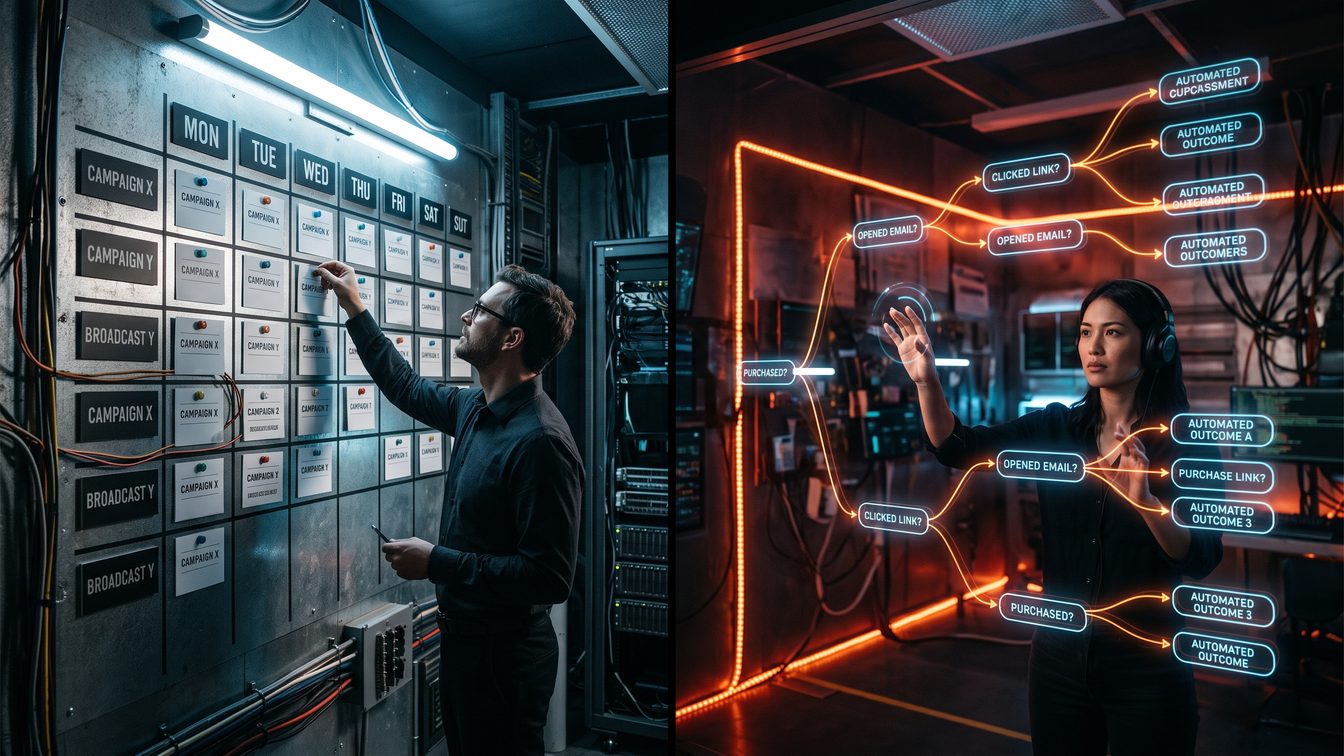
Behavior-triggered emails generate 18 times more revenue per recipient than calendar-based broadcast campaigns. That is not a marginal improvement. That is an order-of-magnitude gap that separates operators who build systems from operators who schedule blasts. Klaviyo's 2026 benchmarks show that automated flows account for 41 percent of total email revenue from just 5.3 percent of sends. The math is lopsided because behavior-triggered messages are inherently relevant. They respond to what the customer actually did, not what the marketing calendar says.
The Architecture of the Gap
Calendar-based drip campaigns work on a timer. Customer signs up on Monday. Day 1 email goes Tuesday. Day 3 email goes Thursday. Day 7 email goes the following Monday. The sequence fires regardless of whether the customer took any action, showed any interest, or went completely silent.
Behavior-driven flows work on signals. Customer viewed a product page but did not add to cart. Browse abandonment email fires. Customer added to cart but did not check out. Cart abandonment flow fires. Customer purchased. Post-purchase upsell flow fires. Customer has not bought in 60 days. Win-back flow fires.
The difference is not cosmetic. It is structural. Calendar drips treat every subscriber identically based on when they entered the funnel. Behavior flows treat every subscriber differently based on what they did. The behavioral approach produces 5.58 percent click-through rates versus 1.69 percent for campaigns, according to Klaviyo. That 3.3x engagement gap compounds into the 18x revenue gap because engaged clicks convert at dramatically higher rates than passive opens.
The Numbers That Should End the Debate
The CustomersAI 2026 Klaviyo Benchmark Report broke email programs into flow-dominant and campaign-dominant accounts. The findings are stark.
Flow-dominant accounts send 3.7 times fewer emails than campaign-dominant accounts. Despite sending fewer messages, they earn 3.75 times more revenue per email. And total revenue is 16 percent higher.
Read that again. Fewer emails. More revenue per email. More total revenue. The behavior-driven model wins on every metric that matters.
Yet 76 percent of email accounts derive less than 17 percent of their revenue from flows. Three out of four businesses are leaving the highest-ROI channel in their marketing stack mostly untouched. That is not a technology gap. The tools exist and are widely available. It is a doctrine gap. Most operators have not made the decision to build behavior systems because they are still comfortable scheduling blasts.
Why Calendar Drips Persist
Calendar drips are easier to set up. You write seven emails, set the timing, and forget about them. The operational burden is low. The creative work happens once. And they produce some revenue, which makes them feel like they are working.
The problem is opportunity cost. Every subscriber receiving a generic Day 3 email is a subscriber not receiving a behavior-triggered message precisely calibrated to their last action. The generic email gets opened at 1.69 percent CTR. The behavior-triggered email would have gotten 5.58 percent. That delta, multiplied across thousands of subscribers and months of sending, is the revenue you never captured.
At WGOAA, we stopped sending calendar drips to our firearms training members. Instead, we built behavior triggers. Complete the Safe Start course and you get the Pistol Masterclass offer. Skip two classes and you get the re-engagement sequence. Revenue per email tripled. Unsubscribes dropped 40 percent. Members told us the emails felt like they were written for them specifically, because they were.
The Five Behavior Flows Every Operator Needs
These five flows cover 80 percent of the revenue opportunity. Build them in order.
Flow 1: Welcome Sequence (triggered by signup). Not a drip. A behavior-aware sequence that branches based on the subscriber's first actions. Opened the first email? Send the product recommendation. Clicked to a specific category? Send category-specific content. Did nothing? Send a stronger value proposition.
Flow 2: Browse Abandonment (triggered by product view without add-to-cart). This catches high-intent visitors who got close but did not commit. Fire within one to four hours. Include the specific product they viewed. Keep the ask simple.
Flow 3: Cart Abandonment (triggered by add-to-cart without checkout). The highest-converting flow in most programs. 70 percent of carts are abandoned across all industries. A three-email recovery sequence captures 5 to 15 percent of those abandoned carts. At scale, this single flow can generate more revenue than your entire broadcast calendar.
Flow 4: Post-Purchase (triggered by completed purchase). Cross-sell related products. Request a review. Deliver usage instructions. Build loyalty before the customer forgets you exist. The window is 24 to 72 hours after purchase.
Flow 5: Win-Back (triggered by inactivity). Customer has not purchased or engaged in 60 to 90 days. Send a re-engagement sequence with a reminder of what they bought, what is new, and optionally a time-limited offer. This flow saves customers you would otherwise lose to attrition.
The Tools: Where to Build
Klaviyo: The gold standard for ecommerce behavior flows. 350-plus behavioral attributes for segmentation. Native Shopify integration. Revenue attribution built in. The benchmark data cited above comes from Klaviyo's own customer base because they have the deepest dataset on flow performance.
ActiveCampaign: Strong CRM depth with behavior-driven automation. Better for service businesses and B2B where the customer journey is longer and involves more touchpoints before purchase. Site tracking, lead scoring, and multi-step conditional flows.
Drip: Purpose-built for ecommerce operators who want behavior automation without the complexity of enterprise platforms. Ccommit toterface. Strong Shopify and WooCommerce integrations.
GoHighLevel: All-in-one for service businesses that want behavior flows inside their CRM, pipeline, and booking system. The automation builder supports trigger-based workflows tied to pipeline stage changes, appointment bookings, and form submissions.
For ecommerce operators, Klaviyo is the default choice. For service businesses, ActiveCampaign or GoHighLevel depending on whether you need standalone email automation or a full CRM suite.
The StudioGrowth Signal
StudioGrowth launched "Synced Sequences" on August 18, 2026, and the feature points to where behavior-driven automation is heading. Their sequences auto-start when a member meets behavioral criteria and auto-stop the moment they no longer qualify. A member receiving a membership pitch who signs up on Tuesday morning does not get the next pitch email on Tuesday afternoon. The system knows.
This is the evolution from behavior-triggered (fire once when the action happens) to behavior-orchestrated (continuously adjust based on the customer's changing state). The difference matters for service businesses with longer customer lifecycles where a customer's status changes over months, not minutes.
DesignRush's 2026 email statistics report that 43 percent of marketers now attribute more than half of their total email revenue to automated flows, and 71 percent report at least a 20-percent engagement lift from dynamic personalized content. The trend line is unambiguous. The operators who build behavior engines now compound the advantage over every competitor still scheduling blasts.
The Verdict
Calendar drips are not broken. They produce some revenue. But they leave the majority of email's potential on the table. Behavior-driven flows are structurally superior on every metric: open rate, click rate, revenue per email, total revenue, and subscriber satisfaction.
The implementation cost is front-loaded. Building five behavior flows takes more initial work than scheduling seven drip emails. But the maintenance cost is lower, the revenue is higher, and the system gets smarter with every customer interaction it observes.
Build the five flows. Kill the calendar drips. Let the signals run the marketing.
Doctrine Connection: Systems that respond to signals beat systems that run on timers. A behavior-driven email engine is a watchstanding rotation for your marketing: it responds to what actually happened, not what you hoped would happen.
FAQ
Q: Can I run behavior flows and calendar campaigns simultaneously? Yes, and most mature email programs do. Use behavior flows for the high-intent lifecycle moments (browse, cart, purchase, win-back) and use campaigns for broad announcements, seasonal promotions, and content distribution. The key is ensuring behavior flows take priority: if a subscriber is in an active behavior flow, suppress the calendar campaign so they are not receiving competing messages.
Q: How long does it take to build the five core flows? Plan two to three weeks for a first implementation if you are building from scratch. Week one: map the triggers and write the emails for flows one and two. Week two: build flows three and four. Week three: build flow five and QA the full system. You can compress this with templates from your email platform, but do not rush the trigger logic.
Q: What is the minimum list size where behavior flows make sense? There is no minimum. A 500-person list with behavior flows will outperform a 5,000-person list with only calendar drips on a per-subscriber basis. The revenue-per-recipient advantage applies at any scale. Start with the flows, then grow the list.
Q: Do behavior flows work for service businesses, not just ecommerce? Absolutely. The triggers change but the principle is identical. For a service business: booked an appointment but did not show triggers a re-engagement sequence. Completed a service triggers a review request and upsell. Inquired but did not book triggers a follow-up. The behavior is the booking and service lifecycle, not the shopping cart.
Q: How do I measure whether behavior flows are working? Track revenue per recipient for flows versus campaigns. Track the percentage of total email revenue coming from flows. Target moving flows from under 17 percent (the current median) to above 40 percent of total email revenue within 6 months. Also track unsubscribe rates: behavior flows typically reduce unsubscribes because subscribers receive fewer, more relevant messages.