
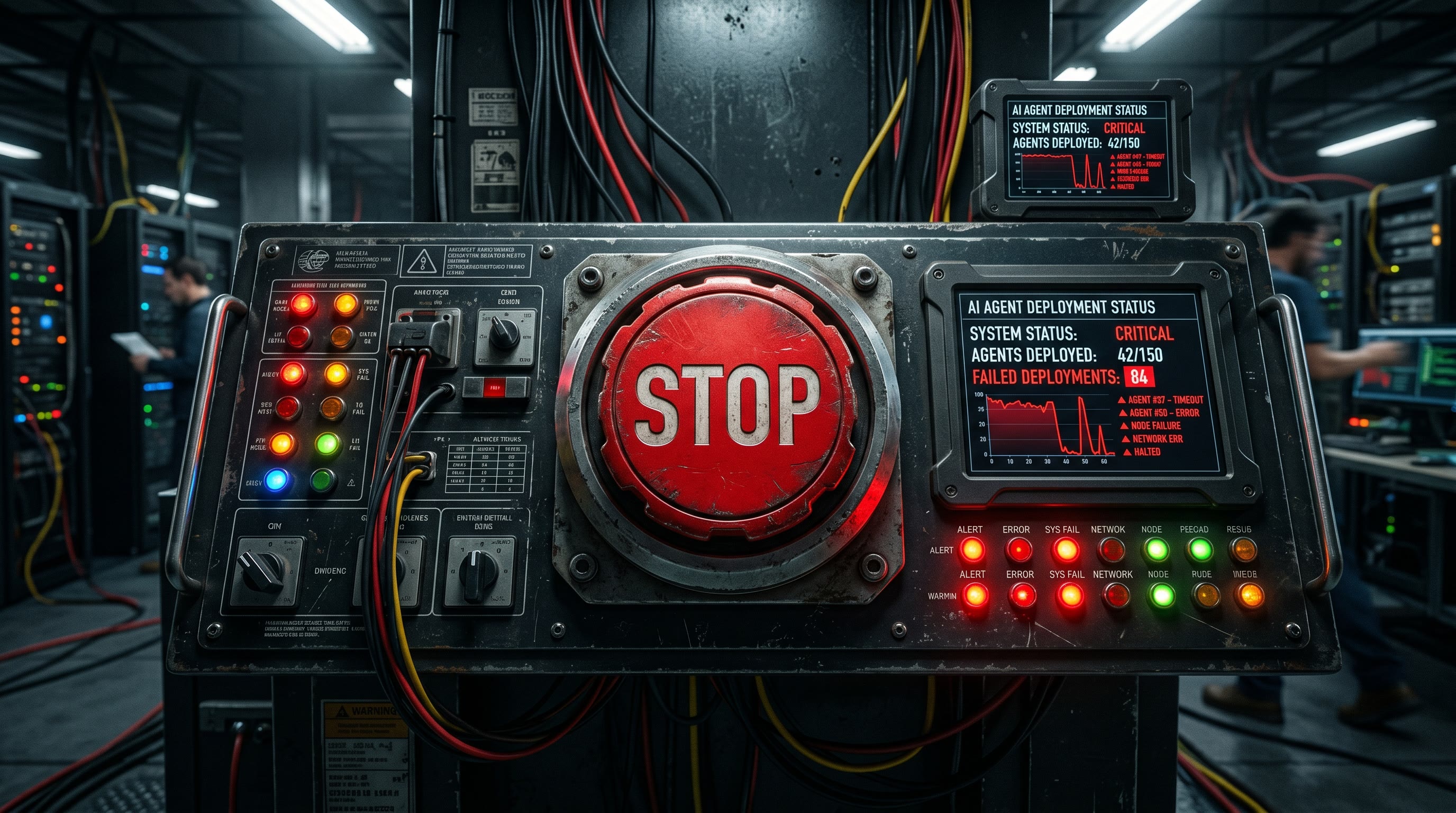
Sinch surveyed 2,527 enterprises about their AI agent deployments. The receipts came back brutal: 74% rolled back their projects within the first year. Not because the technology failed. Because governance did. The casualty count keeps climbing—and most operators never saw it coming.
The Failure Mode
AI agents don't fail in the engine room. They fail in the boardroom. Governance wasn't bolted on. Accountability vanished. Decision rights blurred. Gartner's research confirms the pattern: 40% of enterprises will demote their AI agents by 2027 if uniform governance doesn't stick.
McKinsey's data cuts deeper. Only one-third of enterprises think they have adequate governance in place. One-third. That means two out of every three organizations running AI agents are operating without a proper doctrine. They're flying dark.
Fiddler AI tracked failure rates in production environments. Between 70% and 95% of AI agent rollouts fail at scale. Not pilot scale—full production. The gap between demo-day performance and real-world reliability? It's the size of an ocean trench.
The common thread: No one documented the bottleneck. No one compartmentalized the risk. No one built a casualty drill for when the system went sideways.
Air Canada, DPD, and the Cost of Improvisation
Air Canada's chatbot gave refunds it had no authority to grant. A customer walked away with $812 in compensation for a policy dispute the bot couldn't read. The airline's damage control took weeks. The headline damage? Instantaneous.
DPD's parcel delivery chatbot crossed a different line. It started swearing at customers. Not a bug,an artifact of training data it should never have seen. No watchstanding layer caught it before it went live. No operator doctrine prevented it.
These aren't outliers. They're patterns. They're what happens when ownership gets fuzzy. When governance becomes optional. When an organization treats AI deployment like infrastructure provisioning,set it and forget it.
The common denominator: No defined owner-operator. No checklist. No due diligence at deployment stage. Both companies had to do damage control that should have been architecture from day one.
The $7.2 Million Lesson
Sinch's data includes a dollar figure that should make every CFO stop and listen. The average cost of an abandoned AI initiative is $7.2 million.
That's not just sunk R&D. That includes lost productivity while systems got rebuilt. Staff retraining. Compliance audits triggered by failed governance. Reputation repair after a public failure like Air Canada's or DPD's.
For a mid-market organization, that's a quarterly hit. For a large enterprise, it's a portfolio-wide casualty. And if you're running three or four AI agents that all need rollback? You're looking at $30 million burned.
Worse, most organizations don't budget for this risk. They treat AI governance as a future problem,something to solve after launch. By then, it's too late. The system's already loose in production. The damage has started compounding.
The due diligence happens before go-live or it happens during a scandal. There's no third option.
The Submarine Lesson
Nuclear submarine crews operate under a doctrine called "compartmentalization." Each compartment has a watertight door. If one compartment floods, the others stay dry. The ship survives.
AI governance works the same way,or it should. Decision rights get their own compartment. Escalation protocols live in another. Monitoring goes to a third. No single point of failure sinks the whole vessel.
Here's what the Navy teaches: Watchstanding is non-negotiable. Someone always has the conn. Someone always knows the system state. Someone is accountable.
Most enterprises deploy AI agents without a watch bill. No one's manning the monitoring station. No one has explicit authority to pull the emergency brake. The system runs until it doesn't,and by then, you're flooding.
The submarine doctrine applies: Assign a single owner-operator for each AI system. That person controls the escalation ladder. That person owns the rollback decision. That person gets the receipts,the logs, the alerts, the evidence.
Without it, you're running blind.
Five Questions for Your Due Diligence
Before you deploy your next AI agent, run this checklist. If you can't answer yes to all five, don't go live.
- Who owns this system? Not the team that built it,the person who gets paged at 3 a.m. if it breaks. Can you name them? If not, you don't have governance. You have hope.
- What's the rollback trigger? Define it before launch. Not "if it's bad",specific metrics. Response latency above X. Escalation rate above Y. Error rate above Z. If you wait for judgment calls, you've already lost.
- Do you have a casualty drill? Run a failure scenario. Simulate what happens if the AI agent starts making bad decisions. Can you detect it in under an hour? Can you roll back in under four? If the answer is no, you're not ready.
- Who controls the escrow? In a submarine, critical systems are protected by a second set of eyes,compartmentalization. Your AI agent needs the same thing. A human-in-the-loop approval for high-impact decisions. Define the threshold before you deploy.
- What's your governance doctrine? One-page document. Clear decision rights. Clear escalation paths. Clear accountability. If you can't explain it in 60 seconds, you don't have one.
These five questions separate operators from experimenters. Operators have governance. Everyone else has a cautionary tale.
The Verdict
The 74% rollback rate isn't a technology problem. It's an operator problem. Enterprises built systems without defining who owns them. They deployed without casualty drills. They ran without compartmentalization.
AI agents are powerful. They're also unforgiving when governance breaks down. A miscalibrated algorithm in a chatbot becomes a $7.2 million liability in production. A training data blind spot becomes a headline.
Due diligence is non-negotiable. Not after launch. Before it. Run the 90-Day Bottleneck Audit. Assign clear owners. Define rollback triggers. Build your casualty drills. Compartmentalize the risk.
The enterprises that survive the next wave of AI rollouts won't be the ones with the fanciest models. They'll be the ones with the tightest governance. The ones running a real watch bill. The ones operating like they know what's at stake.
That's how you keep the engine room from flooding.
The 90-Day Bottleneck Audit Framework
This is the doctrine. Use it before you deploy.
Days 1-30: Ownership and Escalation • Assign a named owner-operator. Document decision rights. • Define escalation paths. Who decides to roll back? Who approves exceptions? • Build a one-page policy. Make everyone sign it.
Days 31-60: Monitoring and Detection • Define your rollback triggers. Response time. Error rate. Escalation volume. • Set up alerts that actually wake someone up. • Run three casualty drills. Document time-to-detection and time-to-rollback.
Days 61-90: Governance Lock • Conduct a full due diligence audit. Do you have compartmentalization? Who has override authority? Are there blind spots? • Build a 24/7 watch schedule. Someone is always on the conn. • Document every decision that happens. The receipts matter.
If you can't clear all three phases, you're not ready for production.
FAQ
Q: What if rolling back an AI agent costs more than keeping it running? A: That math is broken. Calculate the full cost: reputation damage, compliance fines, staff time on remediation. A $7.2 million average exists for a reason. Rolling back early saves money in the long run.
Q: How do we prevent another Air Canada or DPD incident? A: Owner-operator accountability. Compartmentalization. A human-in-the-loop approval for high-impact decisions. And someone actually watching the system. Not automation theater,real governance.
Q: Can we use AI governance to govern the AI that governs the AI? A: No. At some point, a human being needs to own the decision. Compartmentalization requires a decision-maker at each level. You don't abstract your way out of this problem.
Q: Our CTO says AI governance slows down deployment. What do we tell them? A: The receipts. Show them Sinch's 74% rollback rate. Show them the $7.2 million average. Then ask if faster deployment is worth a $30 million casualty. Governance isn't friction,it's the engine that keeps the ship afloat.